
Jigme Lingpa
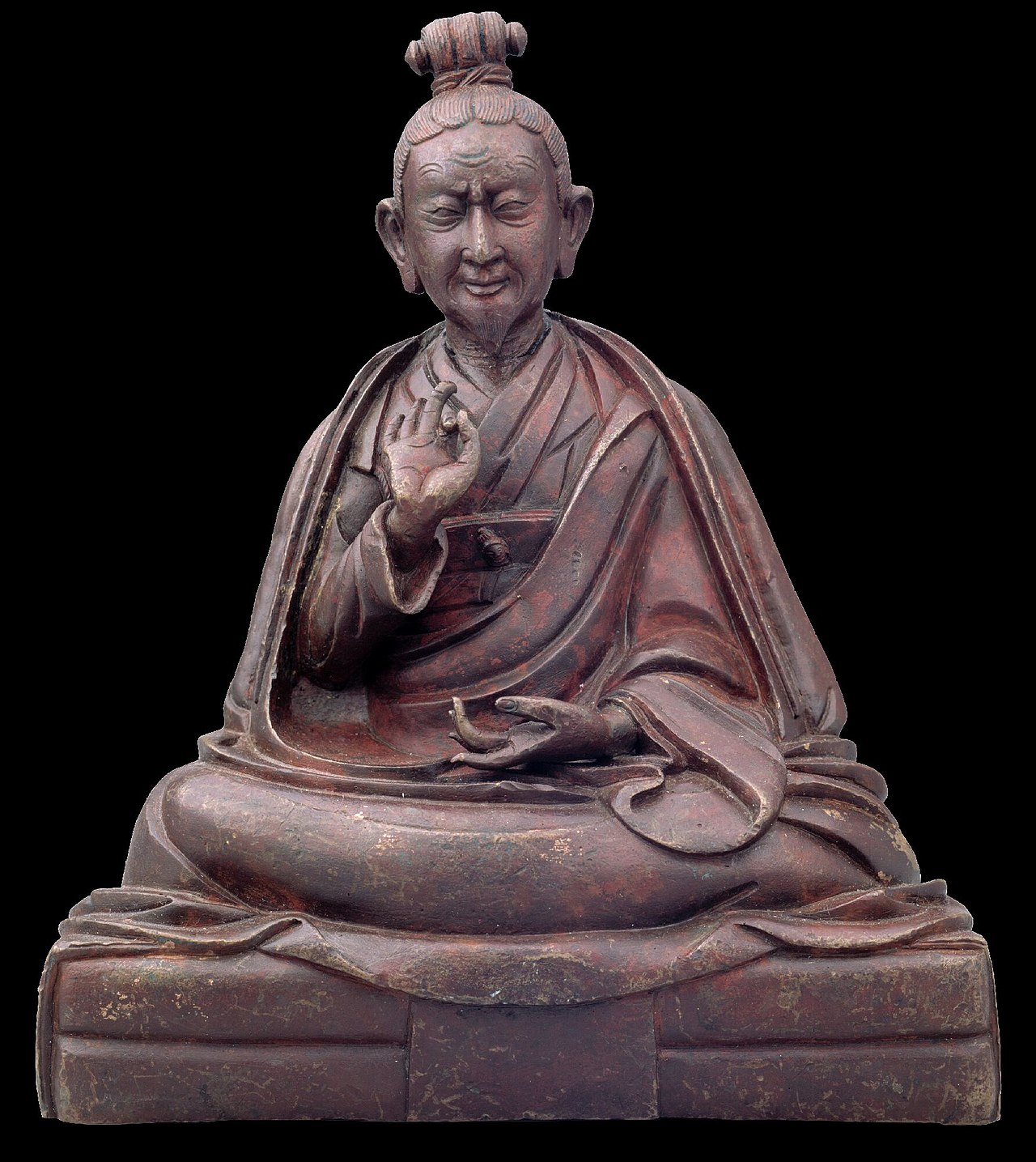
Illustration — Jigme Lingpa • Illustration — Jigme Lingpa Jigme Lingpa (1730–1798) was a Tibetan tertön of the Nyingma lineage of Tibetan Buddhism. He was the promulgator of the Longchen Nyingthig, the Heart Essence teachings of Longchenpa, from whom, according to tradition, he received a vision in which the teachings were revealed. The Longchen Nyingthik eventually became the most famous and widely practiced cycle of Dzogchen teachings.
Jigme Lingpa
Public domain
- Died
- 1798
- Occupation
- writer · tertön
- Teachers
- Drimé Lingpa · Rigdzin Tuk Chok Dorjé · Tsogyal Tulku · Tashi Chode Won Tulku 03
- Languages
- Tibetan
VALÉORINE Encyclopedia
VALÉORINE documentary reading
Documentary summary
Illustration — Jigme Lingpa • Illustration — Jigme Lingpa Jigme Lingpa (1730–1798) was a Tibetan tertön of the Nyingma lineage of Tibetan Buddhism. He was the promulgator of the Longchen Nyingthig, the Heart Essence teachings of Longchenpa, from whom, according to tradition, he received a vision in which the teachings were revealed. The Longchen Nyingthik eventually became the most famous and widely practiced cycle of Dzogchen teachings.
Admitted source layer · organised and presented by VALÉORINE
Note VALÉORINE
The Wikipedia record describes Jigme Lingpa as tertön and writer. Jigme Lingpa was born in 1729. Death followed in 1798. The language is Tibetan.
Composed from admitted, traceable facts · 26 September 2026
VALÉORINE
Reference Check
Propose documentary evidence for Jigme Lingpa. A contribution is never written directly as fact: identity, source, rights and evidence gates still decide.
Sign in to contribute
Documentary evidence
Documentary basis
Authority files
wikidata · Q462875 · wikipedia · Jigme Lingpa
In this article
Career
Career
Jigme Lingpa's childhood monastery was the Nyingma school's Palri monastery, or Pelri Tekchen Ling, in Chonggye, established by Sherab Ozer. Prefiguring Jamgon Kongtrul's creation of the Five Collections, Jigme Lingpa gathered Nyingma texts that had become rare, starting with Nyingma tantras held in the manuscript collection of the Mindrolling Monastery. This collection of the Nyingma tantras led to the amassing of the Nyingma Gyübum ("Collection of Nyingma Tantras") for which Getse Mahapandita wrote the catalogue, proofread and arranged for its printing by soliciting the expensive and labour-intensive project of carving the woodblocks for the woodblock printing. The wood block carving was forded through the patronage of the royal family of Derge of Kham, who favoured and honoured Jigme Lingpa. Getse Mahapandita also arranged for the printing of texts by Jigme Lingpa and Longchenpa. Getse Mahapandita proofread the works of Jigme Lingpa, Longchenpa and the Nyingma Gyübum. Jigme also wrote a nine-volume history of the Nyingma school of Tibetan Buddhism and other works. His non-sectarian presentation of the Madhyamaka (Middle Way view) follows Je Tsongkhapa's system. A major precursor of the Rimé movement, Jigme Lingpa had many distinguished disciples in all four lineages. The first Dodrupchen Rinpoche, Dodrupchen Jigme Trinle Ozer, became his main lineage-holder. Among those held by tradition to be Jigme Lingpa's reincarnations are Ye shes rdo rje, the Mdo mkhyen brtse ye shes rdo rje (1800–66, his mind-emanation), Patrul Rinpoche (speech-emanation) and Jamyang Khyentse Wangpo (body-emanation). In Bhutan his tradition is held by successive incarnation of the Padtselling tulku and Jikmé Kündröl Namgyel. Both Druptop Namgyel Lhündrup, 1st Padtselling Tulku (1718–1786) and Jigmé Tenpé Gyeltshen, 2nd Padtselling Tulku (1788–1850) were students of Jigme Lingpa. Jigme Lingpa, translated by Sam van Schaik, states how his learnings commenced: Janet Gyatso states that:
Terma
Terma
When explaining the transmission and reception of the 'treasures' (Tibetan: terma) of 'The Words of the Omniscient One' and 'The White Lotus' Jigme Lingpa makes reference to an admixture of 'mindstream', '[[Absolute (philosophy)|Absolute [Truth]]]' and 'adhishthana' and van Schaik (2004: p. 45) has rendered the Tibetan in English as follows: "the blessing of the truth-continuum", "the blessing of the continuum", and "the transmission-blessing of symbols and words".
Longchen Nyingthig
Longchen Nyingthig
Jigme Lingpa is held by tradition to be the reincarnation of two important masters, Vimalamitra and King Trisong Deutsen. As the embodiment of these two figures, Tibet's two primary Dzogchen lineages were combined in him—the Vima Nyingtik and Khandro Nyingtik, both of which are contained in the Nyingtik Yapshi. Hence, the Longchen Nyingthig terma cycle is considered a condensation of these profound teachings. The texts that were revealed by Jigme Lingpa, in their present-day form, comprise three volumes known as the Nyingtik Tsapö. The numerous treatises, sadhanas and prayers it contains deal primarily with tantric practice, in particular the generation stage and Dzogchen. Jigme Lingpa discovered the Longchen Nyingtik teachings as mind terma at the age of twenty-eight. Tulku Thondup writes: In this vision, the wisdom dakinis gave Jikmé Lingpa a casket containing five yellow scrolls and seven crystal beads. One of the scrolls contained the prophetic guide of Longchen Nyingtik, called Nechang Thukkyi Drombu. At the instruction of a dakini, he ate the yellow scrolls and crystal beads, and all the words and meaning of the Longchen Nyingtik terma were awakened in his mind. Jigme Lingpa kept this terma secret for years, and he did not even transcribe the terma until he entered another retreat in which he had a series of visions of Longchen Rabjam. Tulku Thondup explains: • In the earth-hare year (1759) he started another three-year retreat at Chimpu. During that retreat, because he was inspired by three successive pure visions of Longchen Rabjam, and he was urged by repeated requests of dakinis, he transcribed his terma as the cycle of Longchen Nyingtik. On the tenth day of the sixth month (monkey month) of the monkey year (1764) he made his terma public for the first time by conferring the transmission of empowerment and the instructions upon fifteen disciples.
Chöd
Chöd
The Loud Laugh of the Dakini is a Chöd sādhanā from the Longchen Nyingtik.
Animal welfare
Animal welfare
Jigme Lingpa was concerned about animal welfare and criticized meat as a sinful food incompatible with a compassionate mindset but did not personally adopt a vegetarian diet due to practical difficulties, nor did he mandate a vegetarian diet among his students. Instead, Jigme Lingpa prescribed prayers to purify the consumer who had eaten meat as he believed that prayers could create a positive karma connection between the animal and the consumer, helping the animal achieve a better rebirth. Historian Geoffrey Barstow has described Jigme Lingpa as offering his "students a chance to continue cultivating compassion without having to completely abandon meat".
Autobiography
Autobiography
Jigme Lingpa is also known for his autobiographical works, primarily his outer autobiographies found in his nine-volume "Collected Works" alongside his "Heart Sphere" cycle and other historical works. Most notably, his autobiographical works showed the dynamics of relationships between Tibetan Buddhist visionaries and lay political figures.
Works in translation
Works in translation
* * * * * * * *

a sketch of jigme lingpa
Notes from the source article
Cited by Wikipedia
Notes from the source article
These works are cited by the source article, in its own numbering. They are recorded as its citations, not as sources VALÉORINE has verified.
Bibliography printed in the source article · 17
- Barstow, Geoffrey. Buddhism Between Abstinence and Indulgence: Vegetarianism in the Life and Works of Jigme Lingpa. Journal of Buddhist Ethics. 20. 74–104. 2013.
- Deroche, Marc Henri. Sherab Ozer. The Treasury of Lives. December 2011. 2332-077X.
- Gardner, Alexander. Do Khyentse Yeshe Dorje. The Treasury of Lives. December 2009. 2332-077X.
- Gyatso, Janet. Religions of Tibet in Practice. Princeton University Press. 1997.
- Lingpa, Jigme. Apparitions of the Self, the Secret Autobiographies of a Tibetan Visionary. Motilal Banarsidass. 2001. 978-81-208-1796-8.
- Penjore, Dorje. Jigme Kundrol Namgyel. The Treasury of Lives. n.d. 2332-077X.
- Penjore, Dorje. The First Petseling, Drubtob Namgyel Lhundrub. The Treasury of Lives. February 2011a. 2332-077X.
- Penjore, Dorje. The Second Petseling, Jigme Tenpai Gyeltsen. The Treasury of Lives. February 2011b. 2332-077X.
- Thondup, Tulku. Hidden Teachings of Tibet: An Explanation of the Terma Tradition of Tibetan Buddhism. Wisdom Publications. 1994. 086171122X.
- Thondup, Tulku. Masters of Meditation and Miracles: Lives of the Great Buddhist Masters of India and Tibet. Shambhala. 1996. 1-57062-113-6.
- Tsadra Foundation. sde dge. Dharma Dictionary. December 28, 2005.
- Tsadra Foundation. Loud Laugh of the Dakini. Dharma Dictionary. August 17, 2006.
- van Schaik, Sam. Sun and Moon Earrings: Teachings Received by Jigmé Lingpa. Tibet Journal. 25. 4. 3–32. 2000.
- van Schaik, Sam. Approaching the Great Perfection: Simultaneous and Gradual Methods of Dzogchen Practice in the Longchen Nyingtig. Wisdom Publications. 2004. 0-86171-370-2.
- Dargyay, Eva M. The Rise of Esoteric Buddhism in Tibet. Motilal Banarsidass. 32. 1998. 81-208-1579-3.
- Dharma Fellowship. Biographies: Kunkhyen Jigme Lingpa. Dharmafellowship.org. 2005.
- Dudjom Rinpoche. The Nyingma School of Tibetan Buddhism: its Fundamentals and History (2 volumes). Wisdom Publications. 1991. 0-86171-087-8.
References
Citations
References
Each reference names the institution holding it, so a reader may go to the document itself.
reference work
Secondary witnessreference work
Secondary witness
The Encyclopedia exists whether or not anything is for sale. Corrections are recorded rather than overwritten, and every version of this record is kept. Published 16 August 2026.
Elsewhere in Books
39,529 published records in this field, each with its sources named.
- Jibanananda DasAuthor
- Jibra'il DallalAuthor
- Jidi MajiaAuthor
- Jigar MoradabadiAuthor
- Jihan Ghazawi AwniAuthor
- Jila MossaedAuthor
- Jilani KamranAuthor
- Jili Abd al-RahmanAuthor
Best supported in this field
For owners
Own a work by Jigme Lingpa?
A specialist will read what you send and tell you what the house can establish, what it cannot, and whether the object is suited to sale. There is no charge and no obligation. The object stays with you throughout; nothing is shipped to us unless it is arranged in writing beforehand.