
Jean-François Marmontel
Illustration — Portrait by Alexander Roslin (1767) Jean-François Marmontel (11 July 1723 – 31 December 1799) was a French historian, writer and a member of the Encyclopédistes movement.
Also recorded as Jean François Marmontel
Jean-François Marmontel
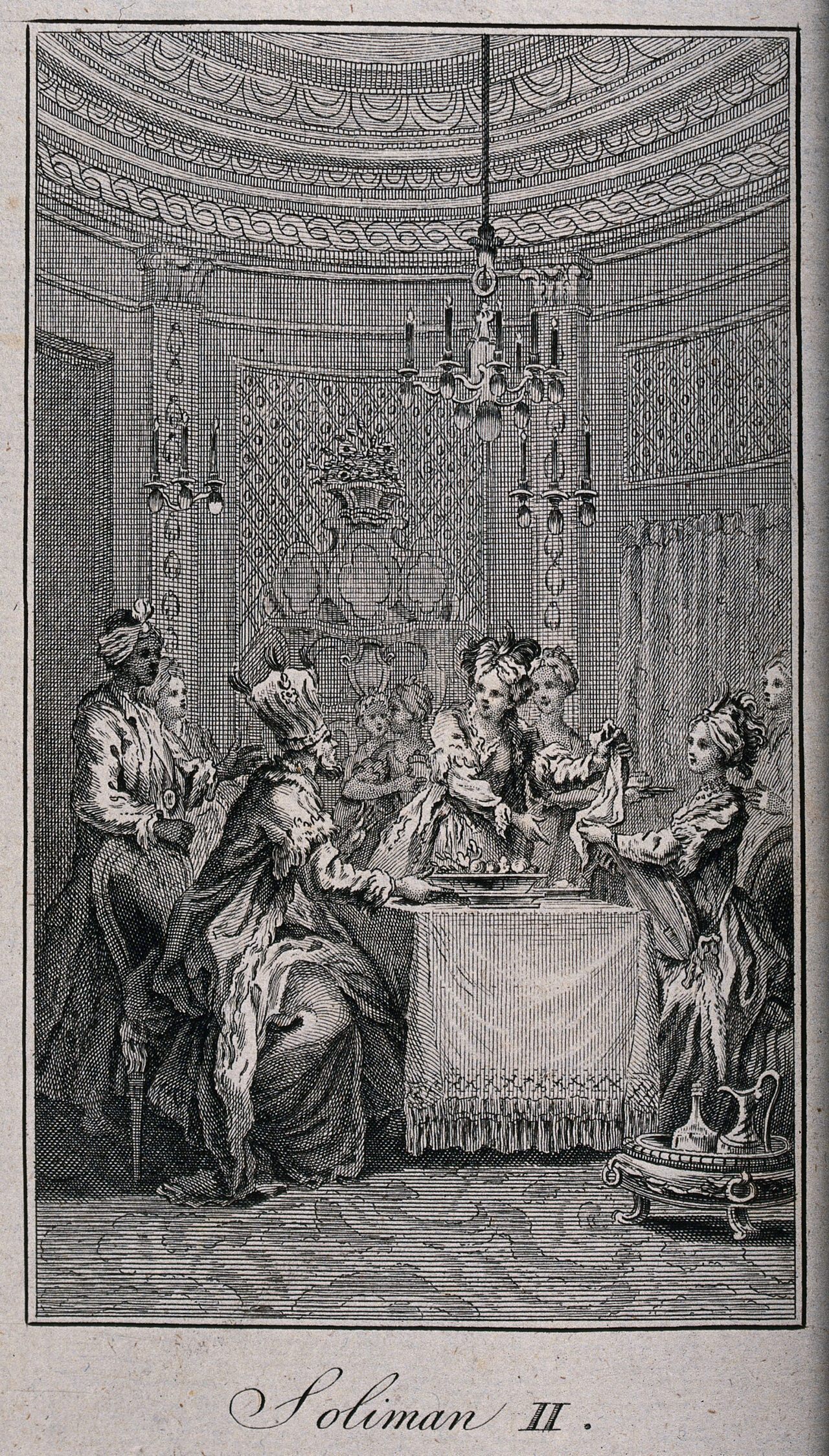
Jean-François Marmontel · Wellcome Collection, London · Wellcome Collection · Public Domain Mark
- Born
- 1723 · Bort-les-Orgues.
- Died
- 1799 · Saint-Aubin-sur-Gaillon.
- Nationality
- France
- Occupation
- philosopher · politician · journalist · poet · historian · playwright · librettist · writer
- Fields
- literature · music
- Languages
- French
VALÉORINE Encyclopedia
VALÉORINE documentary reading
Documentary summary
Illustration — Portrait by Alexander Roslin (1767) Jean-François Marmontel (11 July 1723 – 31 December 1799) was a French historian, writer and a member of the Encyclopédistes movement.
Admitted source layer · organised and presented by VALÉORINE
Note VALÉORINE
No house-authored Note is published until its assertions and sources pass the VALÉORINE evidence contract. The documentary article remains available in full while that enrichment is being consolidated.
Documentary enrichment in progress · no unsupported statement published
Reference Check
Propose documentary evidence for Jean-François Marmontel. A contribution is never written directly as fact: identity, source, rights and evidence gates still decide.
Sign in to contribute
World of VALÉORINE
Documentary connections
Only confirmed graph relationships appear here. Images are shown only when their identity and reuse rights both pass the documentary gate.
Documentary evidence
Evidence Panel
not yet certified
- Identity
- resolved
- Independent source families
- 0
- Admitted assertions
- 0
- Open conflicts
- 0
Authority files
gnd · 1396760393 · wikidata · Q379923 · wikipedia · Jean-François Marmontel
In this article
Biography
Biography
The recorded working language is French. The field of work recorded is literature and music. Places of work recorded in the authority are Paris. Employment is recorded with Bâtiments du Roi. Positions recorded include member of the Council of Elders and historiographer of France.
He was born of poor parents at Bort, Limousin (today in Corrèze). After studying with the Jesuits at Mauriac, Cantal, he taught in their colleges at Clermont-Ferrand and Toulouse; and in 1745, acting on the advice of Voltaire, he set out for Paris to try for literary success. From 1748 to 1753 he wrote a succession of tragedies: Denys le Tyran (1748); Aristomene (1749); Cleopâtre (1750); Heraclides (1752); Egyptus (1753). These literary works, though only moderately successful on the stage, secured Marmontel's introduction into literary and fashionable circles. He wrote a series of articles for the Encyclopédie evincing considerable critical power and insight, which in their collected form, under the title Eléments de Littérature, still rank among the French classics. He also wrote several comic operas, the two best of which probably are Sylvain (1770) and Zémire et Azore (1771). In the Gluck–Piccinni controversy he was an eager partisan of Piccinni with whom he collaborated in Roland (Piccinni) (1778) and Atys (1779), both using Jean Baptiste Lully's libretto by Quinault as basis, Didon (1783) and Penelope (1785). In 1758 he gained the patronage of Madame de Pompadour, who obtained for him a place as a civil servant, and the management of the official journal Le Mercure, in which he had already begun the famous series of Contes moraux. The merit of these tales lies partly in the delicate finish of the style, but mainly in the graphic and charming pictures of French society under King Louis XV. The author was elected to the Académie Française in 1763. In 1767 he published Bélisaire, now remarkable in part because of a chapter on religious toleration which incurred the censure of the Sorbonne and the archbishop of Paris. Marmontel retorted in Les Incas, ou la destruction de l'empire du Perou (1777) by tracing the cruelties in Spanish America to the religious fanaticism of the invaders. He was appointed historiographer of France (1771), secretary to the academy (1783), and professor of history in the Lycée (1786). As a historiographer, Marmontel wrote a history of the regency (1788). Reduced to poverty by the French Revolution, Marmontel retired during the Reign of Terror to Evreux, and soon afterwards to a cottage at Abloville (near Saint-Aubin-sur-Gaillon) in the département of Eure. There he wrote Memoires d'un père (4 vols., 1804), including a picturesque review of his life, a literary history of two important reigns, a great gallery of portraits extending from the venerable Jean Baptiste Massillon, whom more than half a century previously he had seen at Clermont, to Honoré Mirabeau. The book was nominally written for the instruction of his children. It contains an exquisite picture of his own childhood in the Limousin; its value for the literary historian is great. Marmontel lived for some time under the roof of Madame Geoffrin, and was present at her famous dinners given to artists; he was welcomed into most of the houses where the encyclopaedists met, and was a contributor to the Encyclopédie ou Dictionnaire raisonné des sciences, des arts et des métiers. He thus had at his command the best material for his portraits, and made good use of his opportunities. After a short stay in Paris when elected in 1797 to the Conseil des Anciens, he died at Abloville. He was a member of the Masonic lodge Les Neuf Sœurs. John Ruskin named him as one of the three people in history who were the most influential for him. In his autobiography, John Stuart Mill credits Mémoires d'un père with curing him of depression.
Theatre
Theatre
Marmontel published many opera librettos, mostly for operas comiques. • 1748: Denys le tyran, tragedy, 5 February • 1749: Aristomène, tragedy, 30 April • 1750: Cléopâtre, tragédie, 20 May • 1751: La Guirlande, acte de ballet, music by Jean-Philippe Rameau • 1751: Acante et Céphise, pastorale héroïque in three acts, music by Jean-Philippe Rameau • 1752: Les Héraclides, tragedy, 24 May • 1753: Égyptus, tragedy • 1753: Lisis et Délie, pastorale héroïque in 1 act, music by Jean-Philippe Rameau • 1753: Les sibarites, acte de ballet, music by Jean-Philippe Rameau • 1761: Hercule mourant, tragédie lyrique, music by Antoine Dauvergne • 1762: Annette et Lubin • 1766: La Bergère des Alpes • 1768: Le Huron, opera comique, music by André Grétry • 1769: Lucile, opéra comique, music by André Grétry • 1770: Sylvain, opéra comique, music by André Grétry • 1771: L'amie de la maison, opéra comique, music by André Grétry • 1771: Zémire et Azor, opéra comique, music by André Grétry • 1773: Céphale et Procris, ballet héroïque, music by André Grétry • 1775: La Fausse magie, opéra comique, music by André Grétry • 1783: Didon, opera, music by Niccolò Piccinni • 1785: Pénélope, opéra comique, music by Niccolò Piccinni • 1788: Démophoon, music by Luigi Cherubini.
Poetry
Poetry
• Polymnie, satire en 11 chants • 1751: L’établissement de l’École militaire, • 1752: Vers sur la convalescence du Dauphin, • 1753: La naissance du duc d’Aquitaine, • 1760: Épître aux poètes, • 1820: La Neuvaine de Cythère, (licencious poem)
Novels
Novels
• 1755–1759: Contes moraux, • 1767: Bélisaire, Reprinted in 1787 by the Bibliothèque amusante. (see the two paintings by Jacques Louis David Bélisaire demandant l'aumône) • 1777: Les Incas, ou la destruction de l'empire du Perou • 1792: Nouveaux contes moraux
Essays
Essays
• 1763: Poétique française, 3 parts: a work in which Racine and Boileau are strongly attacked. • 1777: Essai sur les révolutions de la musique en France, • 1785: De l’Autorité de l’usage sur la langue, • 1787: Éléments de littérature. Modern edition at Desjonquères, presented, established and annotated by Sophie Le Ménahèze, 2005. • 1788: Mémoire sur la régence du duc d’Orléans • 1792: Apologie de l’Académie française.
Varia
Varia
• 1746: L'Observateur littéraire: literary journal established with Jean-Grégoire Bauvin (or Beauvin); « Cette feuille, écrira-t-il, n'étant ni la critique infidèle et injuste des bons ouvrages, ni la satire amère et mordante des bons auteurs, elle eut peu de débit.». The title was revived by abbé de La Porte in 1758. • 1712–1714: The Rape of the Lock by Alexander Pope, translated into verse La boucle de cheveux enlevée, 1746. Edition bilingue moderne chez Rivages poche, 2010, 142 pages • 1759: édition remaniée de Venceslas by Rotrou, • 1766: La Pharsale de Lucain, translated into prose, • 1775: édition des Chefs d’œuvres dramatiques de Mairet, Du Ryer et Rotrou, with a Commentaire, • 1800: Mémoires d’un père pour servir à l’instruction de ses enfants, • 1806: Leçons d’un père à ses enfants sur la langue française.
Career and activity
Career and activity
Jean-François Marmontel worked in literature and music. He was employed by Bâtiments du Roi. Recorded positions include member of the Council of Elders, historiographer of France, perpetual secretary of the French Academy and member of the Académie française. He belonged to Académie Française and Académie des sciences, belles-lettres et arts de Rouen. He worked at Paris.
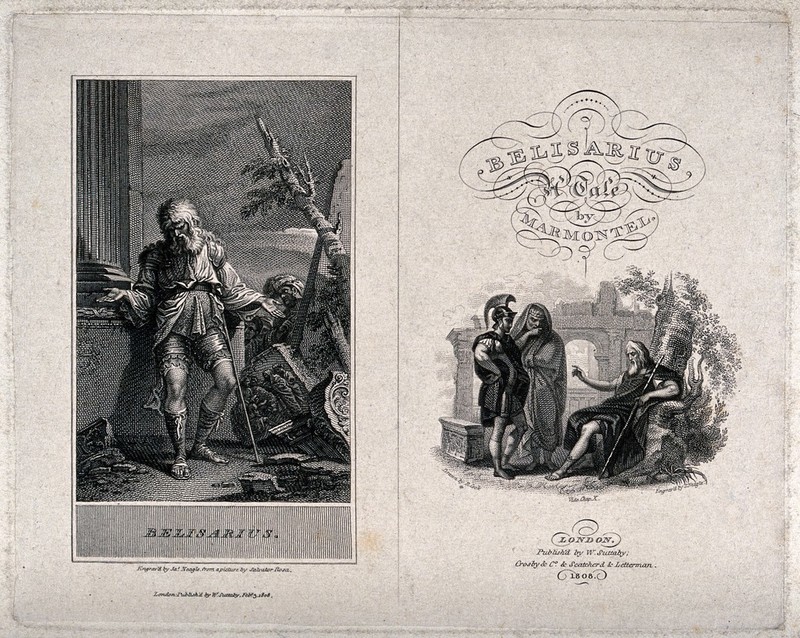
Belisarius begging for alms. Engraving by J. Neagle, 1808, after Salvator Rosa and after R. Cook., Feby.3. 1808, by Jean-François Marmontel
Jean-François Marmontel · Wellcome Collection, London · Wellcome Collection
Life and career
Dated record
Life and career
The full dated record · 2 entries
1723
Jean-François Marmontel born at Bort-les-Orgues.
1799
Jean-François Marmontel died at Saint-Aubin-sur-Gaillon.
Places
Named by the record
Places
Only places the record itself states, plotted where the house gazetteer settles their coordinates. Nothing is inferred from a name or a nationality.
Bort-les-Orgues.
Birth place
Saint-Aubin-sur-Gaillon.
Death place
Primary material
Documents and archives
scholarly publication
- La Poétique Française de Jean-François Marmontel, Mémorable Marmontel 1799-1999, 1999
Scholarly · Crossref registry · 1999
Institutional database
- Wikidata, structured authority record Q379923: Jean-François Marmontel
Scholarly · Wikimedia Foundation
reference work
- “Jean-François Marmontel”, English Wikipedia, consulted as further reading
Reputable secondary · Wikipedia
References
Citations
References
Each reference names the institution holding it, so a reader may go to the document itself.
scholarly publication
La Poétique Française de Jean-François Marmontel, Mémorable Marmontel 1799-1999, 1999Crossref registry
VerifiedInstitutional database
Wikidata, structured authority record Q379923: Jean-François MarmontelWikimedia Foundation
Verifiedreference work
Partially resolvedauthority file
Gemeinsame Normdatei 1396760393, Jean-François Marmontel (1723-1799). Bilan et nouvelles perspectives critiques : Colloque international du tricentenaire de la naissance de l’écrivain (2023 : Bordeaux).Deutsche Nationalbibliothek
Partially resolved
Further particulars
Held on the record
Further particulars
Open the remaining particulars
The authorities additionally record the heading Jean François Marmontel. His recorded language was French. He was the child of Martin Marmontel and Marianne Gourdes. Recorded as philosopher, politician, journalist, poet and historian.
Identity and origins
The Encyclopedia exists whether or not anything is for sale. Corrections are recorded rather than overwritten, and every version of this record is kept. Published 15 August 2026.
Elsewhere in Books
39,427 published records in this field, each with its sources named.
- Jean-François DucisAuthor
- Jean-François KahnAuthor
- Jean-François Leriget de La FayeAuthor
- Jean-François LyotardAuthor
- Jean-François ParotAuthor
- Jean-François RegnardAuthor
- Jean-Guy PilonAuthor
- Jean-Henri AzémaAuthor
Best supported in this field
For owners
Own a work by Jean-François Marmontel?
A specialist will read what you send and tell you what the house can establish, what it cannot, and whether the object is suited to sale. There is no charge and no obligation. The object stays with you throughout; nothing is shipped to us unless it is arranged in writing beforehand.