
Jean Baptiste Merlen
Jean Baptiste Merlen (1769–1850) was a French engraver and medallist.
Jean Baptiste Merlen
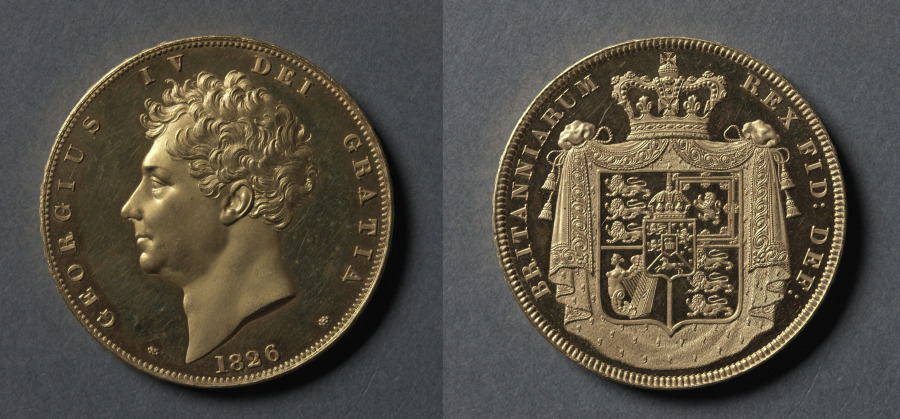
Jean Baptiste Merlen · The Cleveland Museum of Art · The Norweb Collection · CC0
- Born
- 1769
- Died
- 1850
- Occupation
- sculptor · medalist
VALÉORINE Encyclopedia
VALÉORINE documentary reading
Documentary summary
Jean Baptiste Merlen (1769–1850) was a French engraver and medallist.
Admitted source layer · organised and presented by VALÉORINE
Reference Check
Propose documentary evidence for Jean Baptiste Merlen. A contribution is never written directly as fact: identity, source, rights and evidence gates still decide.
Sign in to contribute
Documentary evidence
Documentary basis
Authority files
wikidata · Q39955813 · wikipedia · Jean Baptiste Merlen
In this article
Key facts
Key facts
• Country — United Kingdom • Denomination — Thirty pence • Unit — pound sterling • Mass — 14.1 • Diameter — (Silver) 32 • Edge — Milled • Composition — (1816–1919) 92.5% Ag • Years Of Minting — 1820 • Obverse Design — Benedetto Pistrucci • Reverse Design — Jean Baptiste Merlen • Reverse Design Date — 1820 Jean Baptiste Merlen (1769–1850) was a French engraver and medallist.
Biography
Biography
Merlen began work at the Paris Mint, where he was responsible for designing the medal which celebrated Napoleon's coronation as Emperor in 1804. In 1815, after Napoleon's defeat at the Battle of Waterloo, Merlen’s post at the Paris Mint was uncertain. As a result, he left and moved to London where he searched for work eventually being offered a post at the Royal Mint from February 1820. It is believed Benedetto Pistrucci, an established engraver at the Royal Mint in London, may well have met him in France and offered the post to Merlen in London. As Merlen was not eligible for a full-time post at the Royal Mint, he was hired on a temporary basis, with a salary of four guineas (84 shillings)-a-week. His most famous work was the obverse portrait of George IV from 1823 of the gold double sovereign, after an original work by Sir Francis Chantrey. The King had disliked the 'overweight' effigy Pistrucci had designed, preferring the Chantrey portrait. Merlen was given the task of engraving the Chantrey image after Pistrucci refused to redesign the effigy following the work of another artist. Merlen's effigy is also notable for being the first to show a male monarch bareheaded, i.e. neither crowned or laureate (in the style of Roman emperors) since the reign of Edward VI. Merlen was also responsible for the obverse design of the 1823 George IV gold double sovereign, the first currency double sovereign or two pounds coin. Pistrucci had designed an 1820 gold double sovereign three years earlier although this was never issued for general circulation and, as such, is deemed to be a pattern coin and of the highest rarity. Merlen also designed several reverses, the most widely used being a crowned shield surrounded by a wreath, variants of which were used in issues of William IV and later Queen Victoria. Merlen's initials, the letters 'J' 'B' and 'M' can be found on the first issue George IV halfcrowns dated 1820 and 1821 between the reverse border denticles at approximately 3 o'clock to the right of the shield design (see reverse photograph). The same individual letters used for his initials are also within the reverse beads, to the left of the reverse design, on the corresponding shillings and sixpences of the same period. Merlen continued to work alongside engraver William Wyon during the early part of Queen Victoria's long reign. Merlen retired from work at the Royal Mint in July 1844 with Wyon continuing until his own death seven years later in 1851. Merlen produced the reverse designs for all the early silver and gold for Victoria coinage. The engraving work was carried out by Wyon's son, Leonard Charles Wyon, who entered service at the Mint upon Merlen's retirement. The reverse designs by Merlen on the Queen Victoria 'young head' silver half-crowns were identical to those of the gold sovereigns of the same period with the sovereigns attaining the nickname 'shield backs', a description which continues in use today by numismatists. His designs for the reverses of maundy money remained in use until 1887.
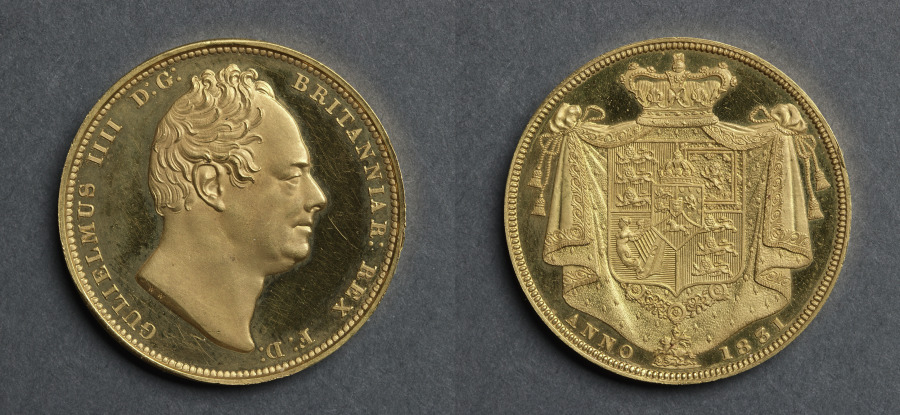
Two Pound Piece: George IV (obverse); Shield of Arms (reverse), 1831, by Jean Baptiste Merlen
Jean Baptiste Merlen · The Cleveland Museum of Art · The Norweb Collection
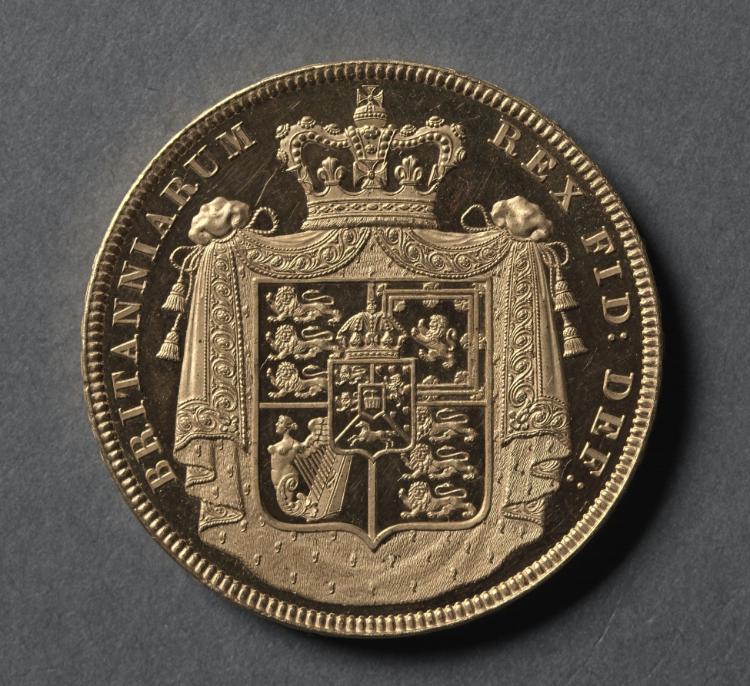
Five Pound Piece: Crowned and Heavily Mantled Shield of Arms (reverse), 1826, by Jean Baptiste Merlen
Jean Baptiste Merlen · The Cleveland Museum of Art · The Norweb Collection
Primary material
Documents and archives
reference work
- “Jean Baptiste Merlen”, English Wikipedia, consulted as further reading
Reputable secondary · Wikipedia
authority record
- Wikidata, structured authority record Q39955813: Jean Baptiste Merlen
General reference · Wikidata
Citations
References
Each reference names the institution holding it, so a reader may go to the document itself.
reference work
Secondary witnessauthority record
General reference
The Encyclopedia exists whether or not anything is for sale. Corrections are recorded rather than overwritten, and every version of this record is kept. Published 17 August 2026.
Elsewhere in Sculpture
6,174 published records in this field, each with its sources named.
- Jean Baptiste BerréArtist
- Jean Baptiste DieussartArtist
- Jean Baptiste Joseph DebayArtist
- Jean Baptiste MasreliezArtist
- Jean BenoîtArtist
- Jean Bernard DuseigneurArtist
- Jean BoucherArtist
- Jean BullantArtist
Best supported in this field
For owners
Own a work by Jean Baptiste Merlen?
A specialist will read what you send and tell you what the house can establish, what it cannot, and whether the object is suited to sale. There is no charge and no obligation. The object stays with you throughout; nothing is shipped to us unless it is arranged in writing beforehand.