
Janet Malcolm
Janet Clara Malcolm (born Jana Klara Wienerová; July 8, 1934 – June 16, 2021) was an American writer, staff journalist at The New Yorker magazine, and collagist who fled antisemitic persecution in Nazi-occupied Prague. She was the author of Psychoanalysis: The Impossible Profession (1981), In the Freud Archives (1984), and The Journalist and the Murderer (1990). Malcolm wrote frequently about psychoanalysis and explored the relationship between journalist and subject.
Also recorded as Jana Wienerová · Janet Clara Malcolm
Janet Malcolm
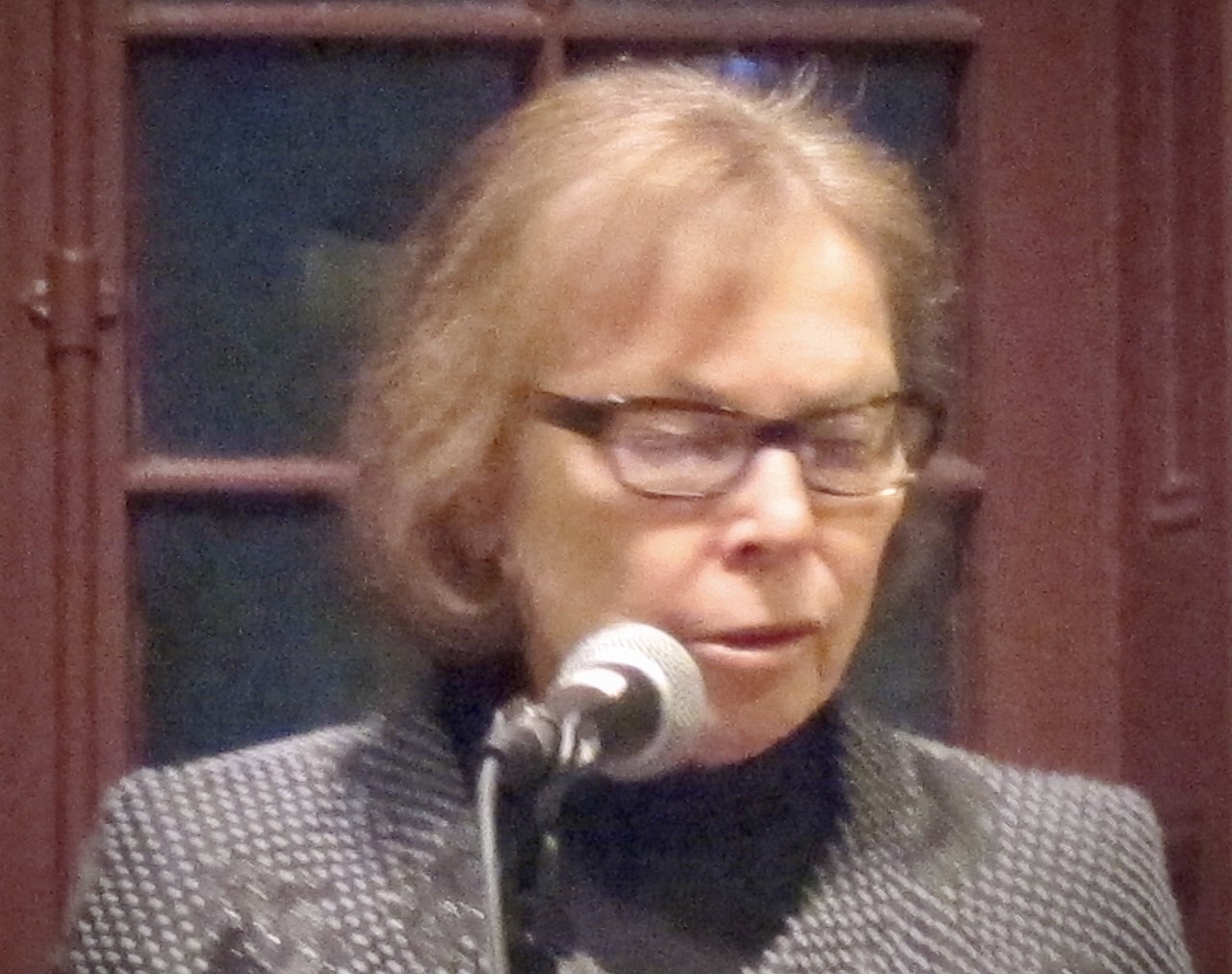
File:Janet Malcolm 3.18.13.jpg: kellywritershouse derivative work: Innisfree987 · This file was derived from: Janet Malcolm 3.18.13.jpg · CC BY 2.0
- Name
- Janet Malcolm
- Birth Name
- Jana Klara Wienerová
- Born
- 8 July 1934
- Birthplace
- Prague, Czechoslovakia
- Died
- 16 June 2021
- Place of death
- New York City, U.S.
- Occupation
- * Writer
- Education
- University of Michigan
- Awards
- American Academy of Arts and Letters, 2001
- Full name
- Jana Wienerová.
- Nationality
- United States
- Fields
- journalism · non-fiction literature · psychoanalysis
VALÉORINE Encyclopedia
VALÉORINE documentary reading
Documentary summary
Janet Clara Malcolm (born Jana Klara Wienerová; July 8, 1934 – June 16, 2021) was an American writer, staff journalist at The New Yorker magazine, and collagist who fled antisemitic persecution in Nazi-occupied Prague. She was the author of Psychoanalysis: The Impossible Profession (1981), In the Freud Archives (1984), and The Journalist and the Murderer (1990). Malcolm wrote frequently about psychoanalysis and explored the relationship between journalist and subject.
Admitted source layer · organised and presented by VALÉORINE
Reference Check
Propose documentary evidence for Janet Malcolm. A contribution is never written directly as fact: identity, source, rights and evidence gates still decide.
Sign in to contribute
World of VALÉORINE
Documentary connections
Only confirmed graph relationships appear here. Images are shown only when their identity and reuse rights both pass the documentary gate.
Documentary evidence
Documentary basis
Authority files
wikidata · Q6153486 · wikipedia · Janet Malcolm
In this article
Biography
Biography
She was known for her prose style and for polarizing criticism of her profession, especially in her most contentious work, The Journalist and the Murderer, which has become a staple of journalism-school curricula.
Janet Malcolm studied at University of Michigan. The recorded working language is English. The field of work recorded is journalism, non-fiction literature and psychoanalysis. Employment is recorded with The New Yorker. Distinctions recorded are PEN/Jacqueline Bograd Weld Award for Biography and Judy Grahn Award.
Key facts
Key facts
• Name — Janet Malcolm • Birth Name — Jana Klara Wienerová • Born — 8 July 1934 • Birthplace — Prague, Czechoslovakia • Relatives — Marie Winn (sister) • Died — 16 June 2021 • Place of death — New York City, U.S. • Occupation — * Writer • journalist • collagist • Education — University of Michigan • Notable Work — The Journalist and the Murderer (1990) • Children — 1 • Awards — American Academy of Arts and Letters, 2001
Early life
Early life
Malcolm was born in Prague in 1934, one of two daughters (the other is the author Marie Winn), of Hanna (Taussig) and Josef Wiener (aka Joseph A. Winn), a psychiatrist. She resided in New York City after her Jewish family emigrated from Czechoslovakia in 1939, fleeing Nazi persecution of Jews. Malcolm was educated at the High School of Music and Art, and then at the University of Michigan, where she wrote for the campus newspaper, The Michigan Daily, and the humor magazine, The Gargoyle, later editing The Gargoyle.
Career
Career
Malcolm was a literary nonfiction writer known for her prose style and her examination of the relationship between journalist and subject. She began working at The New Yorker in 1963 with women's interest assignments, writing about holiday shopping and children's books, as well as a column on home decor. She next wrote about photography for the magazine. She moved to reporting in 1978, which Malcolm attributed to her smoking cessation in a 2011 profile by Katie Roiphe: "She began to do the dense, idiosyncratic writing she is now known for when she quit smoking in 1978: she couldn't write without cigarettes, so she began reporting a long New Yorker fact piece, on family therapy, called 'The One-Way Mirror.'" Her preference for writing in the first person was influenced by New Yorker colleague Joseph Mitchell, and she developed an interest in the construction of the auctorial subject as much as the objects it described, quickly realizing "this 'I' was a character, just like the other characters. It's a construct. And it's not the person who you are. There's a bit of you in it. But it's a creation. Somewhere I wrote, 'the distinction between the I of the writing and the I of your life is like Superman and Clark Kent.'" She turned this interest in the construction of narrative to a variety of subjects, including two books about couples (Gertrude Stein and Alice B. Toklas, and poets Sylvia Plath and Ted Hughes), one on Anton Chekhov, and another on the true crime genre. In a number of works, she returned repeatedly to the subject of psychoanalysis. Malcolm was elected to the American Academy of Arts and Letters in 2001. Her papers are held at the Beinecke Rare Book & Manuscript Library at Yale University, which acquired her archive in 2013.
Psychoanalysis: The Impossible Profession
Psychoanalysis: The Impossible Profession
In 1981, Malcolm published a book on the modern psychoanalytic profession, following a psychoanalyst she gave the pseudonym “Aaron Green”. Freud scholar Peter Gay wrote that Malcolm's "witty and wicked Psychoanalysis: The Impossible Profession has been praised by psychoanalysts (with justice) as a dependable introduction to analytic theory and technique. It has the rare advantage over more solemn texts of being funny as well as informative". In his 1981 New York Times review, Joseph Edelson wrote that Psychoanalysis: The Impossible Profession "is an artful book", praising Malcolm’s "keen eye for the surfaces — clothing, speech and furniture — that express character and social role" (noting she was then the photography critic for The New Yorker). It succeeds because she has instructed herself so carefully in the technical literature. Above all, it succeeds because she has been able to engage Aaron Green in a simulacrum of the psychoanalytic encounter — he confessing to her, she (I suspect) to him, the two of them joined in an intricate minuet of revelation." The book was a 1982 National Book Award for Nonfiction finalist.
The Journalist and the Murderer
The Journalist and the Murderer
Malcolm's 1990 book The Journalist and the Murderer begins with the thesis: "Every journalist who is not too stupid or too full of himself to notice what is going on knows that what he does is morally indefensible." Her example was the popular nonfiction writer Joe McGinniss. While researching his true crime book Fatal Vision, McGinniss lived with the defense team of doctor Jeffrey MacDonald while MacDonald was on trial for the murders of his two daughters and pregnant wife. In Malcolm’s reporting, McGinniss quickly arrived at the conclusion that MacDonald was guilty, but feigned belief in his innocence to gain MacDonald’s trust and access to the story—ultimately being sued by MacDonald over the deception. Malcolm's book created a sensation when in March 1989 it appeared in two parts in The New Yorker magazine. Roundly criticized upon first publication, the book is still controversial, although it has come to be regarded as a classic, routinely assigned to journalism students. It ranks ninety-seventh in The Modern Library's list of the twentieth century's "100 Best Works of Nonfiction". Douglas McCollum wrote in the Columbia Journalism Review, "In the decade after Malcolm's essay appeared, her once controversial theory became received wisdom."
Personal life
Personal life
Malcolm met her first husband, Donald Malcolm, at the University of Michigan. In 1953 the pair married while still enrolled as students. After graduation, they moved to Washington, D.C., where Malcolm occasionally reviewed books for The New Republic before returning to New York. Donald reviewed books for The New Yorker in the 1950s and 1960s and served as a theater critic. They had a daughter, Anne, in 1963. The pair separated and Donald Malcolm died in 1975. Malcolm's second husband was long-time New Yorker editor Gardner Botsford, a member of the family that had originally funded The New Yorker. They married in 1975. The author of A Life of Privilege, Mostly: A Memoir, Botsford died at the age of 87 in September 2004.
Death
Death
On June 16, 2021, Janet Malcolm died of lung cancer at the age of 86 at a Manhattan hospital.
Long-form non-fiction
Long-form non-fiction
* • Reissued in 2002 with an afterword by Janet Malcolm by New York Review Books. * * * * * * *
As editor
As editor
• Chekhov, Anton (2018). The Lady with the Little Dog and Other Stories. Translated by Constance Garnett; selected, with a preface by Janet Malcolm. riverrun. • — (2020). The Duel and other stories. Translated by Constance Garnett; selected, with a preface by Janet Malcolm. riverrun. • — (2020). Ward No. 6 and other stories. Translated by Constance Garnett; selected, with a preface by Janet Malcolm. riverrun.
Identity and origins
Identity and origins
Janet Malcolm was recorded at birth as Jana Wienerová. The authorities additionally record the headings Jana Wienerová and Janet Clara Malcolm. Her recorded language was English.
Career and activity
Career and activity
Janet Malcolm worked in journalism, non-fiction literature and psychoanalysis. She was employed by The New Yorker. She belonged to American Academy of Arts and Letters.
Life and career
Dated record
Life and career
The full dated record · 2 entries
1934
Janet Malcolm born at Prague.
2021
Janet Malcolm died at Manhattan.
Places
Named by the record
Places
Only places the record itself states, plotted where the house gazetteer settles their coordinates. Nothing is inferred from a name or a nationality.
Prague.
Birth place
Manhattan.
Death place
Further books
In the posthumously published Still Pictures: On Photography and Memory, Malcolm writes autobiographical sketches, starting the chapters from family photographs.
Photography
*
Reception
Malcolm's penchant for controversial subjects and tendency to insert her views into the narrative brought her both admirers and critics. "Leaning heavily on the techniques of psychoanalysis, she probes not only actions and reactions but motivations and intent; she pursues literary analysis like a crime drama and courtroom battles like novels," wrote Cara Parks in The New Republic in April 2013. Parks praised Malcolm's "intensely intellectual style" as well as her "sharpness and creativity." In Esquire magazine, Tom Junod characterized Malcolm as "a self-hater whose work has managed to speak for the self-hatred (not to mention the class issues) of a profession that has designs on being 'one of the professions' but never will be." Junod found her to be devoid of "journalistic sympathy" and observed: "Very few journalists are more animated by malice than Janet Malcolm.” Junod himself, however, has been criticized for a number of journalistic duplicities, including a smirking piece in Esquire which outed the actor Kevin Spacey, as well as a similarly homophobic faux profile of the singer Michael Stipe. Katie Roiphe summarized the tension between these polarized views, writing in 2011: "Malcolm's work, then, occupies that strange glittering territory between controversy and the establishment: she is both a grande dame of journalism, and still, somehow, its enfant terrible." Charles Finch wrote in 2023 "it seems safe to say that the two most important long-form journalists this country produced in the second half of the last century were Joan Didion and Janet Malcolm."
In the Freud Archives and the Masson case
In the Freud Archives and the Masson case
Articles Malcolm published in The New Yorker and in her subsequent book In The Freud Archives (1984) offered, according to the book's dust jacket, "the narrative of an unlikely, tragic/comic encounter among three men." They were psychoanalyst Kurt R. Eissler, psychoanalyst Jeffrey Moussaieff Masson, and independent Freud scholar Peter J. Swales. The book triggered a legal challenge by Masson, the former project director for the Sigmund Freud Archives. In his 1984 lawsuit, Masson claimed that Malcolm had libeled him by fabricating quotations she attributed to him. In August 1989, United States Court of Appeals for the Ninth Circuit in San Francisco agreed with a lower court in dismissing without full trial a libel lawsuit that Masson had filed against Malcolm, The New Yorker and Alfred A. Knopf. Malcolm claimed that Masson had called himself an "intellectual gigolo". She also claimed that he said he wanted to turn the Freud estate into a haven of "sex, women, and fun" and claimed that he was, "after Freud, the greatest analyst that ever lived." Malcolm was unable to produce all the disputed material on tape. Masson then appealed to the Supreme Court, which did not decide the case in his favour, but held that the case could go forward for trial by jury to decide whether what Malcolm had written was true and, if not, whether any untruths had been malicious. After a decade of proceedings, a jury finally decided in Malcolm's favor on November 2, 1994. In August 1995, Malcolm said that she had discovered a misplaced notebook containing three of the disputed quotes, swearing "an affidavit under penalty of perjury that the notes were genuine."
Essay collections
Essay collections
* • * * * *
Awards and honors
• 1982 - National Book Award for Nonfiction finalist for Psychoanalysis: The Impossible Profession • 2001 - election to the American Academy of Arts and Letters • 2008 - PEN/Jacqueline Bograd Weld Award for Biography for Two Lives: Gertrude and Alice • 2008 - Stonewall Honor Book in Non-Fiction for Two Lives: Gertrude and Alice • 2013 - National Book Critics Circle Award (Criticism) shortlist for Forty-One False Starts • 2017 - American Academy of Arts and Letters Gold Medal for Belles Lettres and Criticism
Literature
Scholarly footprint
A count of publications is evidence of attention, not of standing, and is given here only as a measure.
Notes from the source article
Cited by Wikipedia
Notes from the source article
These works are cited by the source article, in its own numbering. They are recorded as its citations, not as sources VALÉORINE has verified.
- 1.Italie, Hillel. Janet Malcolm, provocative author-journalist, dies at 86. Associated Press. June 17, 2021.
- 2.Lori Bookstein Fine Art. Janet Malcolm.
- 3.Malcolm, Janet. Six Glimpses of the Past. The New Yorker. October 29, 2018.
- 4.Center for Jewish History. Winn Family Collection; Identifier: AR 25493.
- 5.Roiphe, Katie. The Art of Nonfiction No. 4. The Paris Review. Interviews. Spring 2011. 196. 2011. 0031-2037.
- 6.Brockes, Emma. A life in writing: Janet Malcolm. the Guardian. June 5, 2011.
- 7.Roiphe, Katie. Portrait of a Marriage. The New York Times. September 23, 2007. 0362-4331.
- 8.James, Caryn. The Importance of Being Biased. The New York Times. March 27, 1994. 0362-4331.
- 9.Hammond, Simon. Reading Chekhov: A Critical Journey by Janet Malcolm – review. the Guardian. July 20, 2013.
- 10.Friendly, Fred W. Was Trust Betrayed?. The New York Times. February 25, 1990. 0362-4331.
- 11.Academy Members. American Academy of Arts and Letters.
- 12.Cummings, Mike. Undergraduate mines Yale archives for insight into journalist Janet Malcolm. YaleNews. 2019-05-15.
- 13.Peter Gay, Freud: A Life for Our Times (London, 1988) p. 763.
- 14.Adelson, Joseph. Not Much Has Changed Since Freud. The New York Times. September 27, 1981. 0362-4331.
- 15.Janet Malcolm. National Book Foundation.
- 16.Quindlen, Anna. Public & Private; Quote Unquote. The New York Times. May 19, 1993. 0362-4331.
- 17.Randolph, Eleanor. New Yorker Libel Suit Dismissed. Washington Post. 5 August 1989.
- 18.Margolick, David. Psychoanalyst Loses Libel Suit Against a New Yorker Reporter. New York Times. November 3, 1994.
- 19.Masson v. New Yorker Magazine, Inc., 501 U.S. 496 (1991). cornell.edu.
- 20.Boynton, Robert. Till Press Do Us Part: The Trial of Janet Malcolm and Jeffrey Masson. The Village Voice. November 28, 1994.
- 21.Stout, David. Malcolm's Lost Notes And a Child at Play. The New York Times. August 30, 1995. 0362-4331.
- 22.Stout, David, The New York Times, "Malcolm's Notes and a Child at Play", August 30, 1995. The New York Times. August 30, 1995.
- 23.Malcolm, Janet, The Journalist and the Murderer, New York: Knopf, 1990.
- 24.Scardino, Albert, The New York Times. "Ethic, Reporters and The New Yorker", March 21. 1989. "Janet Malcolm, a staff writer for The New Yorker, returned her magazine to the center of the long-running debate over ethics in journalism this month ... Her declarations provoked outrage among authors, reporters and editors, who rushed last week to distinguish themselves from the journalists Miss Malcolm was describing."
- 25.See Friendly, Fred W., The New York Times Book Review, "Was Trust Betrayed?", February 25, 1990, and Lehmann-Haupt, Christopher, The New York Times, "Deception and Journalism: How Far to Go for the Story", February 22, 1990.
- 26.McCollum, Douglas, Columbia Journalism Review, "You Have The Right to Remain Silent", January, February 2003.
- 27.Modern Library: 100 Best Nonfiction
- 28.Finch, Charles. Janet Malcolm Remembers. The New York Times. January 11, 2023.
- 29.Parks, Cara. In Praise of Janet Malcolm's Prickly Career. The New Republic. April 30, 2013.
- 30.Junod, Tom. Rupert Murdoch, Meet Janet Malcolm — Pro Scandalist. Esquire. July 11, 2011.
- 31.A Public Bashing. Buffalo News. September 25, 1997.
- 32.Writer Comes Clean On Fake Stipe Profile. Billboard. May 25, 2001.
- 33.Seligman, Craig. Janet Malcolm. Salon. February 29, 2000.
- 34.Jack, Ian. Janet Malcolm obituary. The Guardian. 2021-07-01. 0261-3077.
- 35.Donald Malcolm. The New Yorker.
- 36.St. Martin's Press, 2003.
- 37.Smith, Dinitia. Gardner Botsford, 87, Dies; Editor at The New Yorker. The New York Times. September 29, 2004. 0362-4331.
- 38.Seelye, Katharine Q. Janet Malcolm, Provocative Journalist With a Piercing Eye, Dies at 86. The New York Times. June 17, 2021. 0362-4331.
- 39.Still Pictures | Janet Malcolm | Macmillan.
- 40.Begley, Adam. Our Critic's Tip Sheet on Current Reading: Kingsley Amis Drinks; Bill Bryson Admonishes; and PEN Bestows Prizes. The New York Observer. May 19, 2008.
- 41.Stonewall Book Awards List. American Library Association: Rainbow Round Table.
- 42.Kirsten Reach. NBCC finalists announced. Melville House Publishing. January 14, 2014.
- 43.National Book Critics Circle. Announcing the National Book Critics Awards Finalists for Publishing Year 2013. January 14, 2014.
- 44.Janet Malcolm. Literary Hub.
References
Citations
References
Each reference names the institution holding it, so a reader may go to the document itself.
reference work
Wikidata, structured authority record Q6153486: Janet MalcolmWikimedia Foundation
Secondary witnessreference work
Secondary witness
The Encyclopedia exists whether or not anything is for sale. Corrections are recorded rather than overwritten, and every version of this record is kept. Published 16 August 2026.
Elsewhere in Photography
11,392 published records in this field, each with its sources named.
- Jane ShackletonPhotographer
- Jane ThomsonPhotographer
- Jane WigleyPhotographer
- Janet DelaneyPhotographer
- Janet OssebaardPhotographer
- Janet ParkerPhotographer
- Janet SternburgPhotographer
- Janet StonePhotographer
Best supported in this field
For owners
Own a work by Janet Malcolm?
A specialist will read what you send and tell you what the house can establish, what it cannot, and whether the object is suited to sale. There is no charge and no obligation. The object stays with you throughout; nothing is shipped to us unless it is arranged in writing beforehand.