
James Ward
James Ward (23 October 1769 – 17 November 1859) was an English painter, particularly of animals, and an engraver.
Also recorded as James, I Ward · R. A. James Ward · James Wara · James I Ward
James Ward
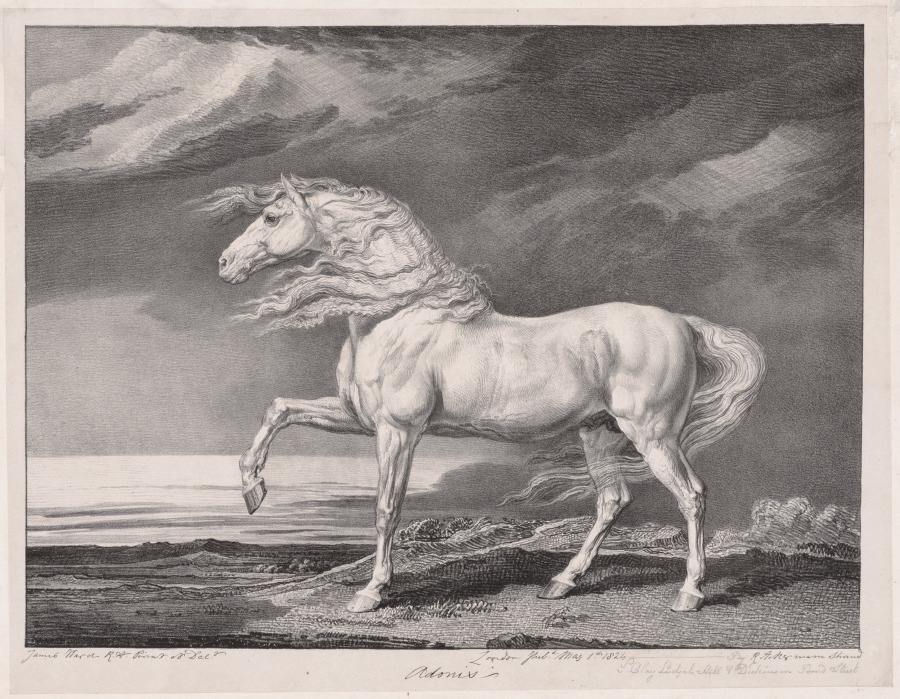
James Ward · The Cleveland Museum of Art · Dudley P. Allen Fund · CC0
- Name
- James Ward
- Born
- 23 October 1769
- Birthplace
- London, England
- Died
- 17 November 1859
- Place of death
- Cheshunt, Hertfordshire, England
- Field
- Painting, engraving
- Movement
- Landscapes, Romanticism
- Awards
- Royal Academician (R.A.)
- Nationality
- United Kingdom of Great Britain and Ireland, United Kingdom and England.
VALÉORINE Encyclopedia
VALÉORINE documentary reading
Documentary summary
James Ward (23 October 1769 – 17 November 1859) was an English painter, particularly of animals, and an engraver.
Admitted source layer · organised and presented by VALÉORINE
Reference Check
Propose documentary evidence for James Ward. A contribution is never written directly as fact: identity, source, rights and evidence gates still decide.
Sign in to contribute
Documentary evidence
Documentary basis
Authority files
wikidata · Q1681281
In this article
Key facts
Key facts
• Name — James Ward • Born — 23 October 1769 • Birthplace — London, England • Died — 17 November 1859 • Place of death — Cheshunt, Hertfordshire, England • Field — Painting, engraving • Movement — Landscapes, Romanticism • Relatives — Henrietta Ward (granddaughter) Leslie Ward (great-grandson) • Awards — Royal Academician (R.A.)
Biography
Biography
• Illustration — Venus Rising from her Couch, 1828 Born in London to James Ward and Rachael Goldsmith, and younger brother of William Ward the engraver, James Ward was influenced by many people, but his career is conventionally divided into two periods: until 1803, his single greatest influence was his brother in law George Morland; from that time, it was Rubens. From 1810 or so onward, Ward specialised in painting horses within landscapes; slightly later, he turned to very large-scale landscapes, of which Gordale Scar (Tate, London), completed in 1814 or 1815 and depicting Gordale Scar (Yorkshire) as an example of the sublime, is considered his masterpiece and a masterpiece of English Romantic painting. Ward devoted much of the period 1815–21 to the painting of a gigantic work titled Allegory of Waterloo (now lost); this neither was much praised nor brought in the revenue Ward had hoped for. The experience may have embittered him, and the deaths of his first wife and a daughter were among other tragedies. Like many artists of the time, Ward sought commissions from wealthy gentry of their favorite horses, their favorite hunting dogs or their children. One such family that Ward painted and drew repeatedly, and whom he counted among his friends, were the Levett family of Wynchnor Park, Staffordshire. One of Ward's best-known portraits was his Theophilus Levett hunting at Wychnor, Staffordshire of 1817. Another was Ward's 1811 painting entitled The Reverend Thomas Levett and his favourite dogs, cock-shooting. Ward also painted a group portrait of three Levett children — John, Theophilus and Frances Levett. (For the Levetts, see link to the Ward exhibit at the Yale Center for British Art.)
Family
Family
James Ward was first married to Mary Ann Ward (no known relation) in 1794, and after her death to Charlotte Fritche in 1827 (supposedly a relative of his first wife). James and Mary Ann Ward had several children including: • Matilda Louisa Ward, who married the artist John Jackson. • George Raphael Ward, b. 1798, d. 1879 James Ward was the paternal grandfather of the painter Henrietta Ward and the great-grandfather of Leslie Ward, the Vanity Fair caricaturist. In 1830, Ward moved to Cheshunt (Hertfordshire) with his second wife, but he continued to work, particularly on religious themes. A stroke in 1855 ended his work, and he died in poverty. He is buried at Kensal Green Cemetery. His monument was sculpted by John Henry Foley in 1866.
Style
Style
James Ward was one of the outstanding artists of the day, his singular style and great skill set him above most of his contemporaries, markedly influencing the growth of British art. Regarded as one of the great animal painters of his time, James produced history paintings, portraits, landscapes and genre. He started off as an engraver, trained by William, who later engraved much of his work. The partnership of William and James Ward produced the best that English art had to offer, their great technical skill and artistry having led to images that reflect the grace and charm of the era. He was admitted for membership into the Royal Academy in 1811. One of Ward's best-known paintings, The Deer Stealer, was commissioned in 1823 for the sum of 500 guineas by Ward's patron Theophilus Levett. When the work was finished, Levett pronounced himself delighted with the results, and consequently raised the remuneration to 600 guineas. Subsequently, Ward was said to have been offered 1,000 guineas for the painting by 'a nobleman,' which he declined. The painting now hangs at Tate in London.
Gallery
Gallery
• Illustration — Ewe and Lambs, 1810 • Illustration — The Levett Children, 1811 • Illustration — Gordale Scar, 1815 • Illustration — View in Tabley Park, c.1818 • Illustration — A Spaniel Frightening Ducks, 1821 • Illustration — The Deer Stealer, 1823 • Illustration — Marengo 1824 • Illustration — The Day's Sport, 1826 • Illustration — Diana at the Bath, 1830 • Illustration — Kenwilworth Castle, 1840 • Illustration — An Overshot Mill in Aberdulais, Wales, 1847
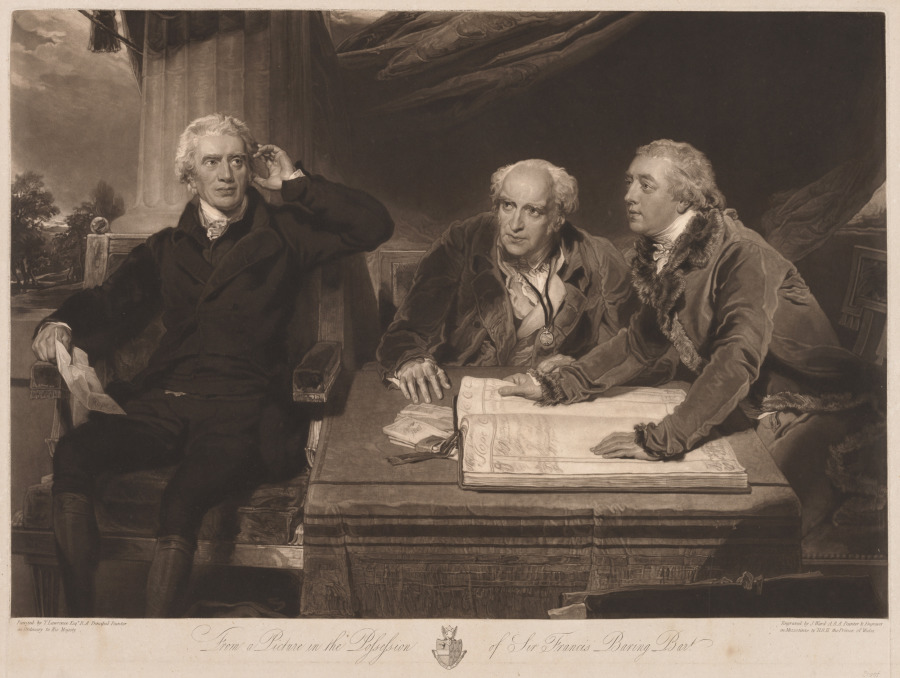
Sir Francis and John Baring and Charles Wall, by James Ward
James Ward · The Cleveland Museum of Art · Gift of Edward B. Greene
Life and career
Dated record
Life and career
Explore 1769–1859
The full dated record · 3 entries
1769
James Ward was born in 1769.
1829
Sketch for 'The Intruder' is dated 1829.
1859
James Ward died at Cheshunt.
Primary material
Documents and archives
scholarly publication
- Ward, James Charles, Benezit Dictionary of Artists, 2011
Scholarly · Crossref registry · 2011
- Ward, James, Benezit Dictionary of Artists, 2011
Scholarly · Crossref registry · 2011
reference work
- Wikidata, structured authority record Q1681281: James Ward
Reputable secondary · Wikimedia Foundation
Notes from the source article
Cited by Wikipedia
Notes from the source article
These works are cited by the source article, in its own numbering. They are recorded as its citations, not as sources VALÉORINE has verified.
- 1.28. 320.
- 2.The Sporting Magazine, or Monthly Calendar of the Transactions of The Turf and The Chase and Every Other Diversion Interesting to the Man of Pleasure Enterprise & Spirit, Vol. 19, New Series, Printed for J. Pittman, London, 1827. 1827.
- 3.The New York Times, Grace Glueck, July 30, 2004. New York Times. 2004-07-30.
- 4.Christies.com. Group Portrait of John, Theophilus and Frances Levett, James Ward, November 1811, Christie's.
- 5.Babbage, F. Animal Painters of England from the Year 1650, Walter Gilbey, 1900. Vinton & Company. 232. 1900.
- 6.Familytreemaker.genealogy.com. Patrick T Nisbett. 1996-08-15.
- 7.Friends of Kensal Green Cemetery. Paths of Glory. 103. 1997.
- 8.Dictionary of British Sculptors 1660-1851 by Rupert Gunnis p.154
- 9.Art Review: Dashing World of Animals as Regal as Their Owners, Grace Glueck, The New York Times, July 30, 2004. The New York Times. 2004-07-30.
- 10.A Great British Collection, sothebys.com
Bibliography printed in the source article · 8
- Beckett, Oliver. The Life and Work of James Ward, RA. Book Guild, 1995.
- Farr, Dennis. James Ward 1769–1859. London: Arts Council, 1960.
- Frankau, Julia. Eighteenth century artists and engravers: William Ward A.R.A., James Ward R.A.: Their Lives and Works. London: Macmillan, 1904.
- Fussell, G. E. James Ward R.A., Animal Painter 1769–1859 and His England. London: Michael Joseph, 1974.
- Grundy, Reginald. James Ward, R.A.: His Life and Works with a Catalogue of his Engravings and Pictures. London, 1909. (An extra number of The Connoisseur.)
- Nygren, Edward J. James Ward's "Gordale Scar": An Essay in the Sublime. London: Tate, 1982.
- Murray, P. & L. (1996). Dictionary of art and artists London: Penguin Books. . p. 557.
- Opening address, The Art of James Ward, Yale Center for British Art, New Haven, Conn., May 20, 2004, curator Angus Trumble
References
Citations
References
Each reference names the institution holding it, so a reader may go to the document itself.
scholarly publication
Ward, James Charles, Benezit Dictionary of Artists, 2011Crossref registry
Institutional witnessscholarly publication
Ward, James, Benezit Dictionary of Artists, 2011Crossref registry
Institutional witnessreference work
Wikidata, structured authority record Q1681281: James WardWikimedia Foundation
Secondary witness
The Encyclopedia exists whether or not anything is for sale. Corrections are recorded rather than overwritten, and every version of this record is kept. Published 14 August 2026.
Elsewhere in Prints
4,138 published records in this field, each with its sources named.
- James TorlaksonEngraver
- James TrenchardEngraver
- James TurnerEngraver
- James WalkerEngraver
- Jan Baptist BarbéEngraver
- Jan Baptist BonnecroyEngraver
- Jan Baptist de WaelEngraver
- Jan Baptist van der HulstEngraver
Best supported in this field
For owners
Own a work by James Ward?
A specialist will read what you send and tell you what the house can establish, what it cannot, and whether the object is suited to sale. There is no charge and no obligation. The object stays with you throughout; nothing is shipped to us unless it is arranged in writing beforehand.