
James Elroy Flecker
Illustration — Flecker, in his rooms at Cambridge (circa 1905) James Elroy Flecker (5 November 1884 – 3 January 1915) was a British novelist, playwright, and poet, whose poetry was most influenced by the Parnassian poets.
James Elroy Flecker
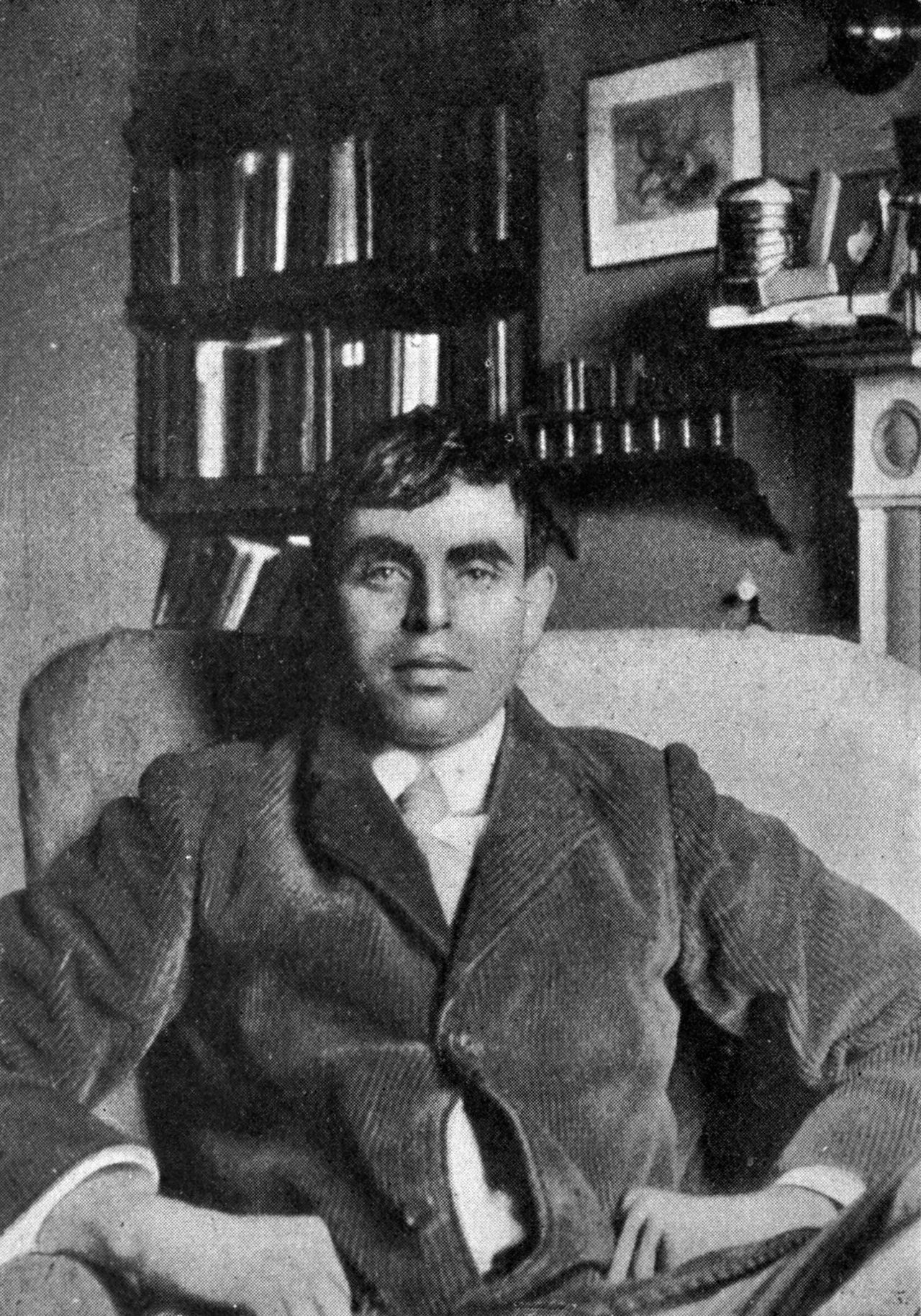
Unknown author. · Image from Goldring, Douglas: James Elroy Flecker · Public domain
- Born
- 1884 · London.
- Died
- 1915 · Davos.
- Nationality
- United Kingdom of Great Britain and Ireland
- Occupation
- poet · diplomat · novelist · playwright · writer · translator
- Education
- Uppingham School · Dean Close School
- Languages
- English
VALÉORINE Encyclopedia
VALÉORINE documentary reading
Documentary summary
Illustration — Flecker, in his rooms at Cambridge (circa 1905) James Elroy Flecker (5 November 1884 – 3 January 1915) was a British novelist, playwright, and poet, whose poetry was most influenced by the Parnassian poets.
Admitted source layer · organised and presented by VALÉORINE
Reference Check
Propose documentary evidence for James Elroy Flecker. A contribution is never written directly as fact: identity, source, rights and evidence gates still decide.
Sign in to contribute
Documentary evidence
Documentary basis
Authority files
wikidata · Q1680343 · wikipedia · James Elroy Flecker
In this article
Biography
Biography
• Illustration — His birthplace, 9 Gilmore Road, Lee, London, is marked with a blue plaque • Illustration — Flecker (sitting) and J. D. Beazley in 1908 Herman Elroy Flecker was born on 5 November 1884 in Lewisham, London, to William Herman Flecker, headmaster of Dean Close School in Cheltenham, and his wife Sarah. His much younger brother was the educationalist Henry Lael Oswald Flecker, who became headmaster of Christ's Hospital. Flecker later chose to use the first name "James", either because he disliked the name "Herman" or to avoid confusion with his father. "Roy", as his family called him, was educated at Dean Close School, and then at Uppingham. He subsequently studied at Trinity College, Oxford, and at Gonville and Caius College, Cambridge. While at Oxford, he was greatly influenced by the last flowering of the Aesthetic movement there under John Addington Symonds, and became a close friend of the classicist and art historian John Beazley. From 1908, Flecker worked in the consular service in the Eastern Mediterranean. On a ship to Athens, he met Hellé Skiadaressi, and they were married in 1911. Flecker died on 3 January 1915, of tuberculosis, in Davos, Switzerland, and was buried in Bouncer's Lane Cemetery, Cheltenham. His death at the age of thirty was described at the time as "unquestionably the greatest premature loss that English literature has suffered since the death of Keats". Hellé Flecker settled in England. She edited Flecker's Letters: Some Letters from Abroad of James Elroy Flecker, published by Heinemann in 1930 "with a few reminiscences by Hellé Flecker". In 1935, she was awarded a Civil List pension of £90 a year "in recognition of the services rendered by her husband to poetry". Hellé Flecker survived her husband for more than 45 years, dying in Sunbury-on-Thames in October 1961.
Hassan
Hassan
Flecker's poem The Golden Journey to Samarkand was published in 1913, but only found its larger context when his play, Hassan, was published. Hassan (The Story of Hassan of Bagdad and How He Came to Make the Golden Journey to Samarkand) is a five-act drama in prose with verse passages. It tells the story of Hassan, a love-sick middle-aged confectioner of Baghdad who saves the Caliph Haroun ar Raschid from the King of the Beggars and is showered with riches in gratitude. However, horrified by witnessing the Caliph's capricious cruelty to a pair of lovers, he rejects the life of luxury and joins the caravan to Samarkand dressed as a pilgrim. Hassan was not staged in Flecker’s lifetime, and was published posthumously in 1922. The play premiered in a sumptuous production directed by Basil Dean at His Majesty's Theatre, London on 20 September 1923. Henry Ainley played Hassan, with Leon Quartermaine, Malcolm Keen, Esme Percy, Cathleen Nesbitt, Basil Gill and Laura Cowie in the cast. The incidental music was by Frederick Delius and conducted by Eugène Goossens. The ballets were devised by Michel Fokine, and George W. Harris designed the sets and costumes. Delius was in the audience. Percy Fletcher conducted the music after the second performance, and recorded a selection of numbers from the production with the orchestra and chorus of His Majesty's Theatre in November 1923. The production included incidental music, songs, dances, and choral episodes. It caught the fancy of English audiences at the time, perhaps because of the escape implied in its exotic setting and a post-war vogue for oriental imagery, and its wistful ending of death, by execution, and a hoped-for reunion and love in the afterlife, a theme that would have resonated for the survivors of the Great War, remembering those who died in the war. Delius's atmospheric music also contributed to the success of the production. • Illustration — A scene from the 1923 production of Hassan
Poetry
Poetry
• The Bridge of Fire (Elkin Matthews, 1907) • Thirty-Six Poems (Adelphi Press, 1910) • Forty-Two Poems (J. M. Dent & Sons, 1911) - a reissue of Thirty-Six Poems, with six new poems added. (Also as e-book and audio book) - 1924 edition bound with The Grecians (1910) • The Golden Journey to Samarkand (1913) • The Old Ships (The Poetry Bookshop, 1915) (as audio book) • Collected Poems (Martin Secker; Doubleday, Page & Co., 1916)
Novels
Novels
• The Last Generation: A Story of the Future (New Age Press, 1908) • The King of Alsander (George Allen & Unwin, 1914)
Drama
Drama
• Hassan (William Heinemann, 1922) Full title: Hassan: The Story of Hassan of Baghdad and How he Came to Make the Golden Journey to Samarkand. (Incidental music to the play was written by Frederick Delius in 1920, before the play's publication, and first performed in September 1923.) • Don Juan (William Heinemann, 1925)
Other
Other
• The Grecians: A Dialogue on Education (J. M. Dent & Sons; E. P. Dutton, 1910) • The Scholars' Italian Book (1911) • Collected Prose (G. Bell and Sons, 1920) - contains 'Tales and Sketches'; The Grecians; 'Critical Studies'. • The Letters of J.E. Flecker to Frank Savery (The Beaumont Press, 1926) • Some Letters from Abroad of James Elroy Flecker (William Heinemann, 1930)

Collected poems of Flecker - Frontispiece
Author James Elroy Flecker Editor John Squire
Places
Named by the record
Places
Only places the record itself states, plotted where the house gazetteer settles their coordinates. Nothing is inferred from a name or a nationality.
London.
Birth place
Davos.
Death place
Works and influence
Flecker's life and works were the subject of Life of James Elroy Flecker, a biography by Geraldine Hodgson published in 1925, relying on letters and other material provided by Flecker's mother. She summarised his contribution as "singular in our literature". However, this comment and her book received a damning review in The Calendar, which called it "sentimental and prudish... conceited and irrelevant". A character in the second volume of Anthony Powell's novel sequence, A Dance to the Music of Time, is said to be "fond of intoning" the lines "For lust of knowing what we should not know / We take the Golden Road to Samarkand", without an attribution to Flecker. (This is in fact a misquotation, the original reads "...what should not be known"). Saki's short story "A Defensive Diamond" (in Beasts and Super-Beasts, 1914) references "The Golden Journey to Samarkand". Agatha Christie quotes Flecker several times, especially in her final novel, Postern of Fate (1973). "Pass not beneath, O Caravan, or pass not singing. Have you heard That silence where the birds are dead yet something pipeth like a bird?" Jorge Luis Borges quotes a quatrain from Flecker's poem "To a Poet a Thousand Years Hence" in his essay "Note on Walt Whitman" (available in the collection Other Inquisitions, 1937–1952): O friend unseen, unborn, unknown, Student of our sweet English tongue, Read out my words at night, alone: I was a poet, I was young. Nevil Shute quotes from Hassan in Marazan (1926), his first published novel, and in the headings of many of the chapters in his 1951 novel Round the Bend. The Pilgrims' Song from Hassan and its setting by Delius play a pivotal role at the beginning of Elizabeth Goudge's novel The Castle on the Hill (1942). Tracy Bond quotes an amended stanza from Hassan in the 1969 film On Her Majesty's Secret Service as she looks out of the window of Piz Gloria at the sun rising over the Swiss alps: Thy dawn, O Master of the World, thy dawn; For thee the sunlight creeps across the lawn, For thee the ships are drawn down to the waves, For thee the markets throng with myriad slaves, For thee the hammer on the anvil rings, For thee the poet of beguilement sings. The original in Flecker's play is more romantic, and makes clear that the Caliph is being addressed, not the Almighty: In Flashman at the Charge (1973), author George MacDonald Fraser concludes a final scene with a decasyllable quatrain pastiche in Flecker’s style. Following many misadventures suffered by the book’s picaresque hero Harry Flashman, brother-in-arms rebel leader Yakub Beg waxes poetic and evokes the mystique of middle Asia with its concomitant voyage of self-discovery and friendships hard-won by reciting: To learn the age-old lesson day by day: It is not in the bright arrival planned, But in the dreams men dream along the way, They find the Golden Road to Samarkand. Flecker's poem "The Bridge of Fire" features in Neil Gaiman's Sandman series, in the volume The Wake, and The Golden Journey to Samarkand is quoted in the volume World's End. In Vikram Seth's A Suitable Boy, the young English Literature lecturer Dr Pran Kapoor attempts to reduce colonial influence in the syllabus and suggests removing Flecker (to make room for James Joyce). Professor Mishra disagrees and quotes from "The Gates of Damascus" Pass not beneath, O Caravan, or pass not singing. Have you heard That silence where the birds are dead yet something pipeth like a bird. The excerpt from Flecker's verse drama Hassan... the Golden Journey to Samarkand) inscribed on the clock tower of the barracks of the British Army's 22 Special Air Service Regiment in Herefordshire, provides an enduring testimony to Flecker's work: We are the Pilgrims, master; we shall go Always a little further; it may be Beyond that last blue mountain barred with snow Across that angry or that glimmering sea. The same extract appears on the New Zealand Special Air Service monument at Rennie Lines in the Papakura Military Camp in New Zealand, and at the Indian Army's Special Forces Training School in Nahan, Himachal Pradesh, India. The extract also appears inside the sporting pavilion at Dean Close School, where Flecker was educated.
Citations
References
Each reference names the institution holding it, so a reader may go to the document itself.
reference work
Secondary witnessreference work
Secondary witness
The Encyclopedia exists whether or not anything is for sale. Corrections are recorded rather than overwritten, and every version of this record is kept. Published 15 August 2026.
Elsewhere in Books
39,427 published records in this field, each with its sources named.
- James E. TalmageAuthor
- James Edwin CampbellAuthor
- James Eli WatsonAuthor
- James EllroyAuthor
- James EmanuelAuthor
- James Emman Kwegyir AggreyAuthor
- James FallowsAuthor
- James FarrarAuthor
Best supported in this field
For owners
Own a work by James Elroy Flecker?
A specialist will read what you send and tell you what the house can establish, what it cannot, and whether the object is suited to sale. There is no charge and no obligation. The object stays with you throughout; nothing is shipped to us unless it is arranged in writing beforehand.