
Jacob de Gheyn II
Jacob de Gheyn II (also Jacques de Gheyn II) (c. 1565 – 29 March 1629) was a Dutch painter and engraver, whose work shows the transition from Northern Mannerism to Dutch realism over the course of his career. • Illustration — Portrait of "Jacobus de Geyn, Antwerp", by Hendrik Hondius I, from his "Pictorum", 1610 • Illustration — Print: Ruben, Son of Jacob. Made after the example of Karel van Mander.
Also recorded as Jacques de Gheyn II · Jacob II De Gheyn · Jacques de, the elder Gheyn · Jacques Gheyn
Jacob de Gheyn II

Jacob de Gheyn II · The Cleveland Museum of Art · Norman O. Stone and Ella A. Stone Memorial Fund · CC0
- Died
- 1629
- Nationality
- Southern Netherlands
- Occupation
- painter · graphic artist · visual artist · engraver · map drawer
- Known for
- Flowers in a Glass Flask · Venus and Cupid · Spanish Warhorse
Reference Check
Propose documentary evidence for Jacob de Gheyn II. A contribution is never written directly as fact: identity, source, rights and evidence gates still decide.
Sign in to contribute
World of VALÉORINE
Documentary connections
Only confirmed graph relationships appear here. Images are shown only when their identity and reuse rights both pass the documentary gate.
Documentary evidence
Documentary basis
Authority files
wikidata · Q1347434 · wikipedia · Jacob de Gheyn II
In this article
Biography
• Illustration — Portrait of "Venus and Cupid", c.1605-1610 De Gheyn was born in Antwerp and received his first training from his father, Jacob de Gheyn I, a glass painter, engraver, and draftsman. In 1585, he moved to Haarlem, where he studied under Hendrik Goltzius for the next five years. He moved again, to Leiden, in the middle of the 1590s. His work attracted the attention of wealthy sponsors, and his first commission was from Maurice of Nassau, Prince of Orange for an engraving of the Siege of Geertruidenberg. This event, from 27 March to 24 June 1593, had been more of a demonstration of power by Prince Maurits, than an actual war, and had even attracted tourists. As a publicity stunt, the siege and its subsequent engraving were successful in propagating an image of Prince Maurits as an able general. Around 1600, de Gheyn abandoned engraving, and focused on painting and etching. Moving to The Hague in 1605, he was employed often by Dutch royalty, designing a garden in the Buitenhof for Prince Maurice of Orange which featured the two first grottoes in the Netherlands. After Prince Maurice's death in 1625, de Gheyn worked for his brother, Prince Frederick Henry. De Gheyn painted some of the earliest female nudes, vanitas, and floral still lifes in Dutch art. He is credited with creating over 1,500 drawings, including landscapes and natural history illustrations. He produced 117 engravings for the military manual The Exercise of Armes while living in Amsterdam. De Gheyn married Eva Stalpaert van der Wiele of Mechelen in 1595. His son, Jacob de Gheyn III, was born in 1596, and grew to become an engraver in his own right, as well as the subject of a portrait by Rembrandt. De Gheyn died in The Hague. • Illustration — Karel van Mander on his Deathbed • Illustration — Vanitas Still Life - 1603 • Illustration — Vanitas Still Life Yale University Art Gallery • Illustration — 'Vase of Flowers with a Curtain', 1615. • Illustration — Engraving of musketeer from his Wapenhandelinge • Illustration — Spanish battle stallion 1603. • Illustration — Drawing in waterpaint by Jacques de Gheyn, Four times a mouse
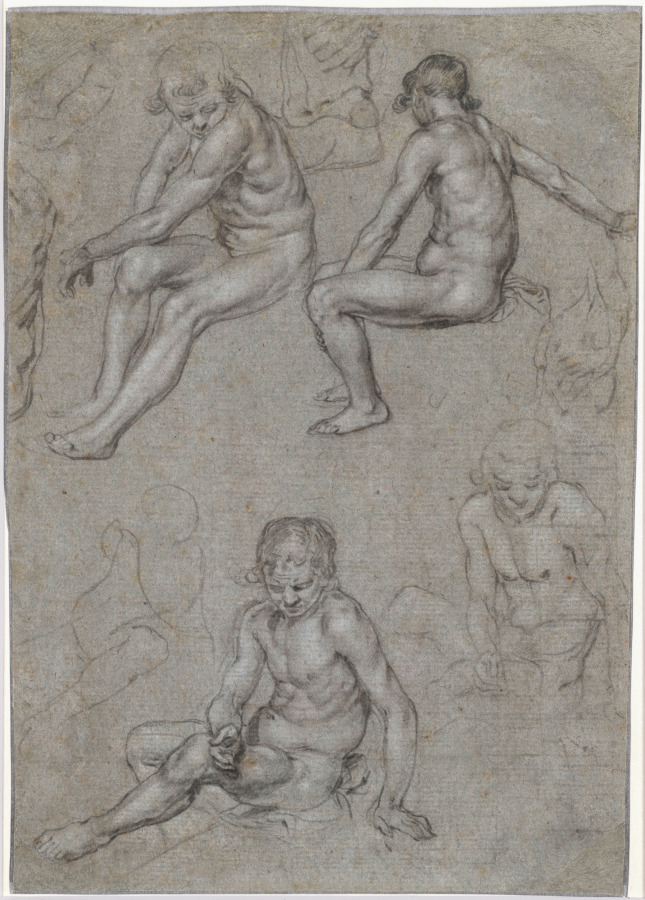
Studies of a Naked Seated Boy, c. 1603, by Jacob de Gheyn II
Jacob de Gheyn II · The Cleveland Museum of Art · John L. Severance Fund

The Twelve Sons of Jacob, c. 1589, by Jacob de Gheyn II
Jacob de Gheyn II · The Cleveland Museum of Art · Carole W. and Charles B. Rosenblatt Endowment Fund
Primary material
Documents and archives
authority record
- Wikidata, structured authority record Q1347434: Jacob de Gheyn II
General reference · Wikidata
reference work
- “Jacob de Gheyn II”, English Wikipedia, consulted as further reading
Reputable secondary · Wikipedia
Text attribution
Licensing
Text attribution
Part of the biographical narrative on this page reuses licensed material. Its origin, revision and licence are recorded here.
The biographical narrative on this page is based on the Wikipedia article Jacob de Gheyn II, revision 1359002711 (EN edition), by its contributors. VALÉORINE has edited that text and built its own documentary record around it. The reused material is available under CC BY-SA 4.0, and this page's reuse of it is offered under the same licence. Everything else on this page — the chronology, the holdings, the evidence, the plates and the connections — is VALÉORINE's own record. Sources and licences.
References
Citations
References
Each reference names the institution holding it, so a reader may go to the document itself.
authority record
Secondary witnessreference work
Secondary witness
People, houses and institutions
Knowledge graph
People, houses and institutions
Teachers, collaborators, publishers and institutions recorded against this person, each on a stated basis.
Citizenship
1- Southern NetherlandsPlace
Established from a fact already recorded on a verified source.
The Encyclopedia exists whether or not anything is for sale. Corrections are recorded rather than overwritten, and every version of this record is kept. Published 14 August 2026.
Elsewhere in Prints
4,138 published records in this field, each with its sources named.
- Jackson Mac LowEngraver
- Jacob ben Abraham ZaddiqEngraver
- Jacob Christoph Le BlonEngraver
- Jacob de BieEngraver
- Jacob FolkemaEngraver
- Jacob Franquart the youngerEngraver
- Jacob JordaensEngraver
- Jacob KoninckEngraver
Best supported in this field
For owners
Own a work by Jacob de Gheyn II?
A specialist will read what you send and tell you what the house can establish, what it cannot, and whether the object is suited to sale. There is no charge and no obligation. The object stays with you throughout; nothing is shipped to us unless it is arranged in writing beforehand.