
J. Paul Getty Museum
Paul Getty Museum, commonly referred to as the Getty, is an American art museum in Los Angeles, California, housed on two campuses: the Getty Center and Getty Villa. It is operated by the J. Paul Getty Trust, the world's wealthiest art institution. The Getty Center is located in the Brentwood neighborhood of Los Angeles on a cliff overlooking the Sepulveda Pass.
Also recorded as The J. Paul Getty Museum · Paul Getty Museum · Getty Museum · the Getty
J. Paul Getty Museum
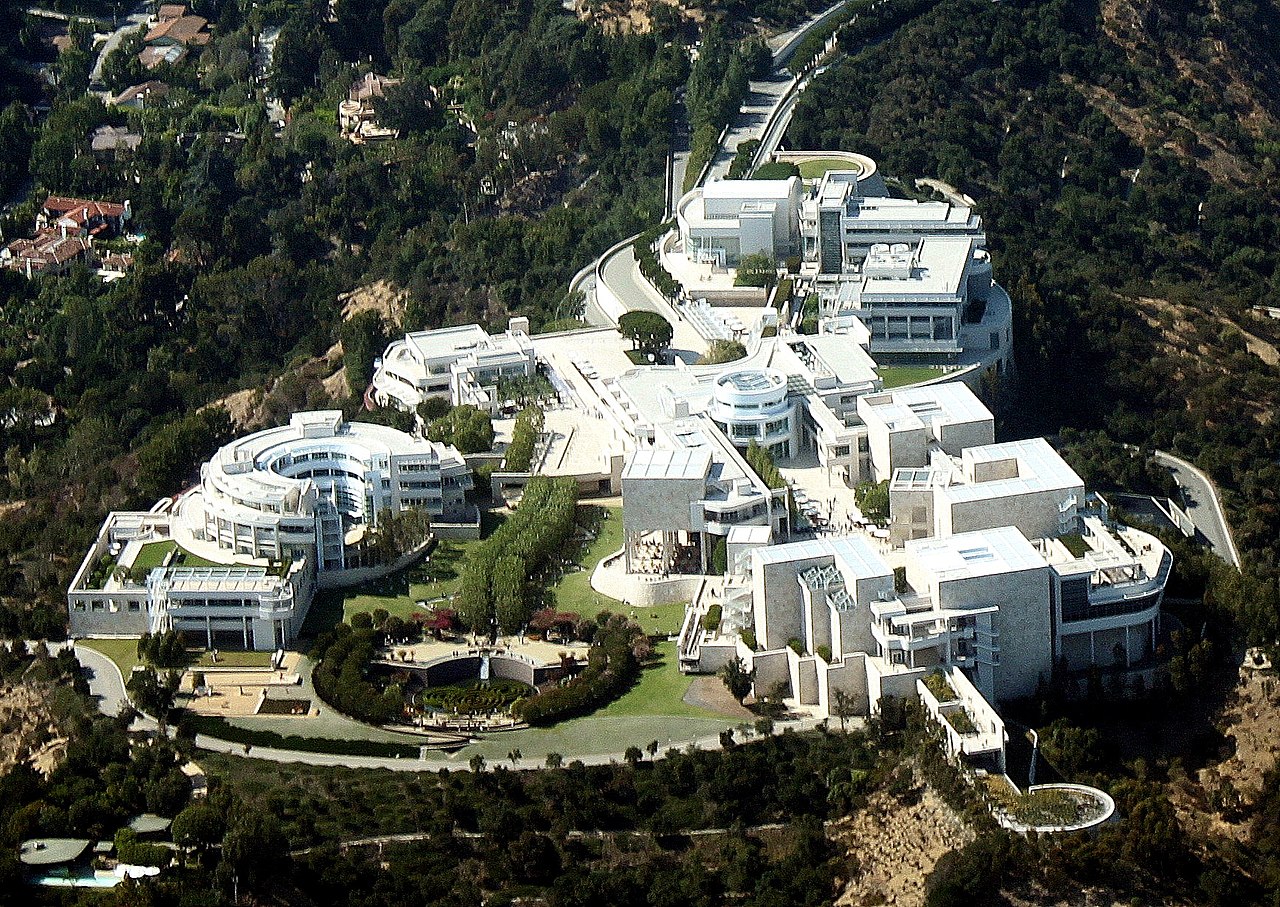
Jelson25 · Public domain
- Name
- J.
- Founded
- 1974
- Headquarters
- Los Angeles
VALÉORINE Encyclopedia
VALÉORINE documentary reading
Documentary summary
Paul Getty Museum, commonly referred to as the Getty, is an American art museum in Los Angeles, California, housed on two campuses: the Getty Center and Getty Villa. It is operated by the J. Paul Getty Trust, the world's wealthiest art institution. The Getty Center is located in the Brentwood neighborhood of Los Angeles on a cliff overlooking the Sepulveda Pass.
Admitted source layer · organised and presented by VALÉORINE
Note VALÉORINE
No house-authored Note is published until its assertions and sources pass the VALÉORINE evidence contract. The documentary article remains available in full while that enrichment is being consolidated.
Documentary enrichment in progress · no unsupported statement published
Reference Check
Propose documentary evidence for J. Paul Getty Museum. A contribution is never written directly as fact: identity, source, rights and evidence gates still decide.
Sign in to contribute
World of VALÉORINE
Documentary connections
Only confirmed graph relationships appear here. Images are shown only when their identity and reuse rights both pass the documentary gate.
Documentary evidence
Evidence Panel
not yet certified
- Identity
- resolved
- Independent source families
- 0
- Admitted assertions
- 0
- Open conflicts
- 0
Authority files
gnd · 19128-0 · wikidata · Q731126 · wikipedia · J. Paul Getty Museum
In this article
Overview
Overview
It features pre-20th-century European paintings, drawings, illuminated manuscripts, sculpture, decorative arts, and photographs from the inception of photography through present day from all over the world. The original Getty museum, the Getty Villa, is located on a cliff overlooking the Pacific Ocean in the Pacific Palisades neighborhood. It displays art from Ancient Greece, Rome, and Etruria.
Key facts
Key facts
• Name — J. Paul Getty Museum • Mapframe Caption — Interactive fullscreen map • Mapframe Zoom — 10 • Mapframe Marker — museum • Mapframe Wikidata — yes • Established — 1974 • Location — 1200 Getty Center Drive, Los Angeles, California; and 17985 Pacific Coast Highway, Pacific Palisades, Los Angeles, California • Type — Art museum • Visitors — 2,023,467 (2016) • Director — Timothy Potts
History
History
In 1974, Jean Paul Getty opened a museum in a re-creation of the Villa of the Papyri at Herculaneum on his property in Malibu, California. In 1982, the museum became the richest in the world when it inherited US$1.2 billion. In 1983, after an economic downturn in West Germany, the Getty Museum acquired 144 illuminated medieval manuscripts from the financially struggling Ludwig Collection in Aachen. In 1996, John Russell, writing in The New York Times, said of the collection, "One of the finest holdings of its kind ever assembled, it is quite certainly the most important that was in private hands." In 1997, the museum moved to its current location in the Brentwood neighborhood of Los Angeles. The Malibu museum, renamed the "Getty Villa", was renovated and reopened in 2006. Many museums turned to their existing social media presences to engage their audience online during the COVID-19 pandemic. Inspired by the Rijksmuseum in Amsterdam and Instagram accounts such as the Dutch Tussen Kunst & Quarantaine ("between art and quarantine") and Covid Classics, the Getty sponsored the Getty Museum Challenge, inviting people to use everyday objects to recreate works of art and share their creations on social media, prompting thousands of submissions. The museum was among those singled out for particular praise by industry analysts for their successful social media content strategy during the shutdown, both for the challenge and for incorporating its works into the popular video game Animal Crossing. Following the 2025 Southern California wildfires, in April 2025, the Getty sold $500 million in bonds to raise money to protect its collection from fire.
Controversies with Italy and Greece
Controversies with Italy and Greece
• Illustration — The Getty attracts approximately 1.8 million visitors a year. • Illustration — Architect Richard Meier chose beige-colored Italian travertine panels to cover the retaining walls and to serve as paving stones for the arrival plaza and museum courtyard. In the 1970s and 1980s, the curator, Jiří Frel, designed a tax manipulation scheme which expanded the museum collection of antiquities, essentially buying artifacts of dubious provenance, as well as a number of artifacts generally considered fakes, such as the Getty kouros. In 1984, Frel was demoted, and in 1986, he resigned. The Getty is involved in a controversy regarding proper title to some of the artwork in its collection. The museum's previous curator of antiquities, Marion True, hired by Frel, was indicted in Italy in 2005, along with famed dealer Robert E. Hecht, on criminal charges relating to trafficking in stolen antiquities. Similar charges have been addressed by the Greek authorities. The primary evidence in the case came from the 1995 raid of a Geneva, Switzerland, warehouse which had contained a fortune in stolen artifacts. Italian art dealer Giacomo Medici was arrested in 1997. His operation was thought to be "one of the largest and most sophisticated antiquities networks in the world, responsible for illegally digging up and spiriting away thousands of top-drawer pieces and passing them on to the most elite end of the international art market". In 2005 True was forced to tender her resignation by the Board of Trustees, which announced her early retirement. Italy allowed the statute of limitations of the charges filed against her to expire in October 2010. In a letter to the J. Paul Getty Trust in December 2006, True stated that she was being made to "carry the burden" for practices which were known, approved, and condoned by the Getty's board of directors. True is currently under investigation by Greek authorities over the acquisition of a 2,500-year-old funerary wreath, that was illegally excavated and smuggled out of Greece. The wreath, along with a 6th-century BC statue of a kore, have been returned to Greece and are currently exhibited at the Archaeological Museum of Thessaloniki. A 2,400-year-old, black limestone stele and a marble votive relief dating from about 490 BC were also returned. • Illustration — The succulent garden at the Getty Center In November 2006, the director of the museum, Michael Brand, announced that 26 disputed pieces were to be returned to Italy, but not the Victorious Youth, which is still claimed by the Italian authorities. In 2007, the Los Angeles J. Paul Getty Museum was forced to return 40 artifacts, including a 5th-century BC statue of the goddess Aphrodite, which was looted from Morgantina, an ancient Greek settlement in Sicily. The Getty Museum resisted the requests of the Italian government for nearly two decades, only to admit later that "there might be 'problems'" attached to the acquisition." In 2006, Italian senior cultural official Giuseppe Proietti said: "The negotiations haven't made a single step forward." Only after he suggested that the Italian government should "take cultural sanctions against the Getty, suspending all cultural cooperation," did the J. Paul Getty Museum return the antiquities. In another unrelated case in 1999, the Getty Museum had to hand over three antiquities to Italy after determining they were stolen. The objects included a Greek red-figure kylix from the 5th-century BC, signed by the painter Onesimos and the potter Euphronios as potter, looted from the Etruscan site of Cerveteri; a torso of the god Mithra from the 2nd-century AD, and the head of a youth by the Greek sculptor Polykleitos. In 2016, the terracotta head of the Greek god Hades was returned to Sicily (Italy). The archaeological artifact was looted from Morgantina in the 1970s. The Getty museum purchased the terracotta head of Hades in 1985 from the New York collector Maurice Tempelsman, who had purchased it from the London dealer Robin Symes. Getty records show the museum paid $530,000 for it. In December 2016, the head of Hades was added to the collection of the archaeological museum of Aidone, where it joined the statue of Demeter, the mother of his consort Persephone. Sicilian archaeologists found a blue curl that was missing from Hades' beard, and so it proved the origin of the terracotta head.
Selected objects at the Getty Center
Selected objects at the Getty Center
• Illustration — Lieven van Lathem, a page from Roman de Gillion de Trazegnies, 1471 • Illustration — Michelangelo, Study of a Mourning Woman, 1500–05 • Illustration — Giambologna, Female Figure (Giambologna), 1571–73 • Illustration — Gian Lorenzo Bernini, Bust of Pope Paul V, 1621 • Illustration — Ernst Rietschel, Bust of Felix Mendelssohn, 1848 • Illustration — André-Charles Boulle, c. 1670. • Illustration — André-Charles Boulle, c. 1675.
Institutional history
Dated record
Institutional history
Explore 1974–2005
The full dated record · 4 entries
1974
J. Paul Getty Museum established.
1974
J. Paul Getty Museum is recorded from 1974.
1997
A is for artist: a Getty Museum alphabet (1997) is digitised and catalogued by Internet Archive.
2005
Guide to the Getty Villa (2005) is digitised and catalogued by Internet Archive.
Places
Named by the record
Places
Only places the record itself states, plotted where the house gazetteer settles their coordinates. Nothing is inferred from a name or a nationality.
- United States
Selected paintings at the Getty Center
Selected paintings at the Getty Center
• Illustration — Fra Angelico Saint Francis and a Bishop Saint, 1420 • Illustration — Circle of Rogier van der Weyden Portrait of Isabella of Portugal, 1450 • Illustration — Dieric Bouts Annunciation, 1450-1455 • Illustration — Vittore Carpaccio Hunting on the Lagoon, 1455-1465 • Illustration — Andrea Mantegna Adoration of the Magi, 1495 • Illustration — Circle of Raphael Portrait of a Young Man in Red, 1505 • Illustration — Fra Bartolomeo The Rest on the Flight into Egypt with Saint John the Baptist, 1509 • Illustration — Quentin Matsys Madonna of the Cherries, 1520 • Illustration — Lucas Cranach the Elder A Faun and His Family with a Slain Lion, 1522 • Illustration — Pontormo, Portrait of a Halberdier, 1528 • Illustration — Parmigianino, Virgin with Child, St. John the Baptist, and Mary Magdalene, about 1530 • Illustration — Sebastiano del Piombo Pope Clement VII, 1531 • Illustration — Jan Gossaert Portrait of Francisco de los Cobos y Molina, 1532 • Illustration — Hans Holbein the Younger An Allegory of Passion, 1532 • Illustration — Titian, Portrait of Alfonso d'Avalos, Marchese del Vasto, 1533 • Illustration — Bronzino, Virgin and Child with Saint Elizabeth and Saint John the Baptist, 1540-1545 • Illustration — Jacopo Bassano Portrait of a Bearded Man, 1550 • Illustration — Paolo Veronese The Baptism of Christ, 1588 • Illustration — El Greco Christ on the Cross, 1610 • Illustration — Peter Paul Rubens, The Entombment, 1612 • Illustration — Orazio Gentileschi, Danaë, 1621 • Illustration — Anthony van Dyck Portrait of Agostino Pallavicini, 1621 • Illustration — Gerard van Honthorst Musical Group on a Balcony, 1622 • Illustration — Rembrandt, Rembrandt Laughing, 1628 • Illustration — Nicolas Poussin, Landscape in Calm Weather, 1651 • Illustration — Bartolomé Esteban Murillo The Vision of Saint Francis of Paola, 1670 • Illustration — Canaletto, The Grand Canal in Venice from Palazzo Flangini to Campo San Marcuola, about 1738 • Illustration — Giovanni Battista Tiepolo Alexander the Great and Campaspe in the Studio of Apelles, 1740 • Illustration — Jean-Honoré Fragonard The Fountain of Love, 1785 • Illustration — Jacques-Louis David, The Sisters Zénaïde and Charlotte Bonaparte, 1821 • Illustration — Francisco de Goya, Bullfight, 1824 • Illustration — J. M. W. Turner, Modern Rome - Campo Vaccino, 1839 • Illustration — Eugène Delacroix Moroccan Horseman Crossing a Ford, 1850 • Illustration — Pierre-Auguste Renoir, La Promenade, 1870 • Illustration — Camille Pissarro Landscape at Louveciennes (Autumn), 1870 • Illustration — Gustave Caillebotte Young Man at His Window, 1876 • Illustration — Édouard Manet, Spring, 1881 • Illustration — Vincent van Gogh, Irises, 1889 • Illustration — Paul Gauguin, Arii Matamoe (The Royal End), 1892 • Illustration — Edgar Degas After the Bath, 1895 • Illustration — Claude Monet The Portal of Rouen Cathedral in Morning Light, 1894 • Illustration — Paul Cézanne, Young Italian Woman at a Table, 1895
Selected photographs at the Getty Center
Selected photographs at the Getty Center
• Illustration — alt=The Crystal Palace at Hyde Park, London (John Jabez Edwin Mayall) John Jabez Edwin Mayall, The Crystal Palace at Hyde Park, London, 1851 • Illustration — alt=Portrait of J.F.W. Herschel (Julia Margaret Cameron) Julia Margaret Cameron, J.F.W. Herschel, April 1867 • Illustration — alt=Desert Sand Hills near Sink of Carson, Nevada (Timothy H. O'Sullivan) Timothy H. O'Sullivan, [Desert Sand Hills near Sink of Carson, Nevada], 1867 • Illustration — alt=Studio portrait of a seated woman (Kusakabe Kimbei) Kusakabe Kimbei, [Seated Woman], c. 1870–c. 1890 • Illustration — alt=Camp Looking SW (Carleton Watkins) Carleton Watkins, Camp Looking SW, 1881 • Illustration — alt=The Hand of Man (Alfred Stieglitz) Alfred Stieglitz, The Hand of Man, 1902 • Illustration — alt=The Steerage (Alfred Stieglitz) Alfred Stieglitz, The Steerage, 1907 • Illustration — alt=Staircase, Montmartre (Eugène Atget) Eugène Atget, Staircase, Montmartre, 1921 • Illustration — alt=A Chronicle of Drifting (Kansuke Yamamoto) Kansuke Yamamoto, A Chronicle of Drifting, 1949
Primary material
Documents and archives
Institutional database
- Wikidata, structured authority record Q731126: J. Paul Getty Museum
Scholarly · Wikimedia Foundation
authority file
- Gemeinsame Normdatei 19128-0, J. Paul Getty Museum.
Unverified · Deutsche Nationalbibliothek
reference work
- “J. Paul Getty Museum”, English Wikipedia, consulted as further reading
Reputable secondary · Wikipedia
Citations
References
Each reference names the institution holding it, so a reader may go to the document itself.
Institutional database
Wikidata, structured authority record Q731126: J. Paul Getty MuseumWikimedia Foundation
Verifiedauthority file
Gemeinsame Normdatei 19128-0, J. Paul Getty Museum.Deutsche Nationalbibliothek
Partially resolvedreference work
Partially resolved
The Encyclopedia exists whether or not anything is for sale. Corrections are recorded rather than overwritten, and every version of this record is kept. Published 14 August 2026.
Elsewhere in Institutions
3,152 published records in this field, each with its sources named.
- Iwasaki Art MuseumOrganisation
- Iwate Museum of ArtOrganisation
- İzmir Archaeological MuseumOrganisation
- İzmir Painting and Sculpture MuseumOrganisation
- J. Wayne Stark GalleriesOrganisation
- Jacques Marchais Museum of Tibetan ArtOrganisation
- Jagdschloss GrunewaldOrganisation
- Jakopič PavilionOrganisation
Best supported in this field
For owners
Own an object connected with J. Paul Getty Museum?
A specialist will read what you send and tell you what the house can establish, what it cannot, and whether the object is suited to sale. There is no charge and no obligation. The object stays with you throughout; nothing is shipped to us unless it is arranged in writing beforehand.