
IRIS-T
The IRIS-T (infrared imaging system tail/thrust vector-controlled) is a short range infrared homing air-to-air missile. It is also called AIM-2000. The missile also has other variants, including the surface-to-air-launched IRIS-T SLS and IRIS-T SLM and their derivatives.
IRIS-T
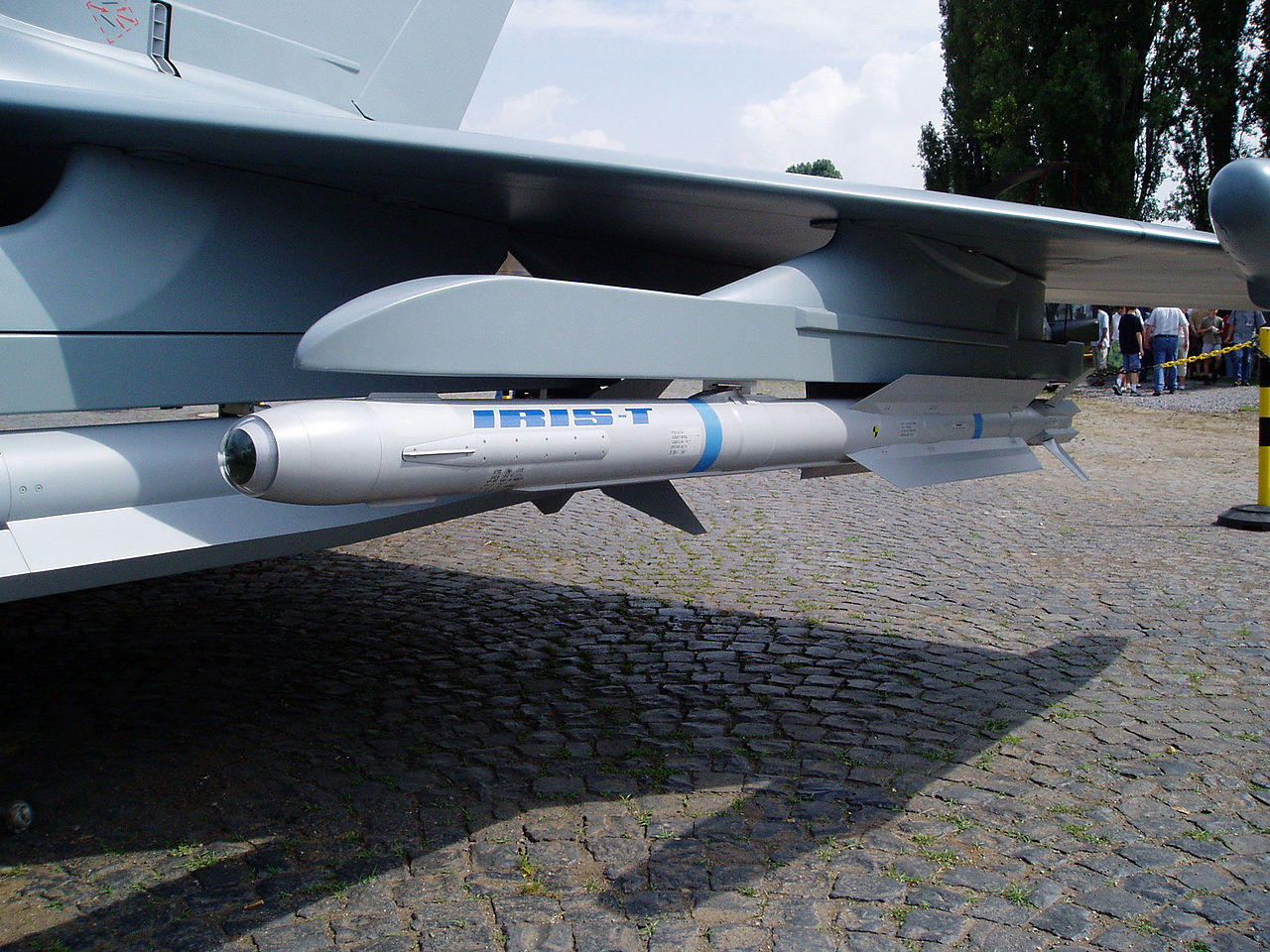
Photo taken 2005-07-16 in Koblenz by Owly K · CC BY-SA 3.0
- Name
- IRIS-T
- Field
- air-to-air missile
- Region
- Germany · Italy
VALÉORINE Encyclopedia
VALÉORINE documentary reading
Documentary summary
The IRIS-T (infrared imaging system tail/thrust vector-controlled) is a short range infrared homing air-to-air missile. It is also called AIM-2000. The missile also has other variants, including the surface-to-air-launched IRIS-T SLS and IRIS-T SLM and their derivatives.
Admitted source layer · organised and presented by VALÉORINE
Reference Check
Propose documentary evidence for IRIS-T. A contribution is never written directly as fact: identity, source, rights and evidence gates still decide.
Sign in to contribute
World of VALÉORINE
Documentary connections
Only confirmed graph relationships appear here. Images are shown only when their identity and reuse rights both pass the documentary gate.

Documentary evidence
Documentary basis
Authority files
gnd · 4630884-2 · wikidata · Q432650 · wikipedia · IRIS-T
In this article
Overview
Overview
The missile was developed in the late 1990s–early 2000s by a German-led program to produce a short to medium range infrared homing air-to-air missile to replace the AIM-9 Sidewinder in use by some NATO member countries at the time. A goal of the program was to ensure that any aircraft capable of firing the Sidewinder could also launch the IRIS-T. The air-to-air variant was fielded in 2005.
Key facts
Key facts
• Is Missile — yes • Name — IRIS-T • Origin — Germany, Italy, Sweden, Greece, Norway, Spain • Type — *IRIS-T: Short-range air-to-air missile • IRIS-T SL family: Surface-to-air missile • IDAS: Submarine-launched multipurpose surface-to-air missile • Used By — See operators • Manufacturer — Diehl Defence, Avio S.p.A., Litton Italia, Leonardo S.p.A., Saab AB, GPCC, Nammo • Developed Into — Surface-to-air missile: • IRIS-T SLS • IRIS-T SLM • IRIS-T SLX • IRIS-T HYDEF Submarine-to-air missile: • IDAS • Unit Cost — €400,000 (~US$) for an AAM • Propellant — HTPB • Number — > 5,000 missiles (as of December 2023) • Service — December 2005 • Engine — Solid-fuel rocket with thrust vectoring control • Weight — 87.4 kg • Length — 2.94 m • Diameter — 127 mm • Wingspan — 447 mm • Speed — Mach 3 • Vehicle Range — * 25 km • Altitude — Sea level to 20000 m • Filling — Dual-layer HE/fragmentation • Filling Weight — 11.4 kg • Guidance — Imaging infrared homing • Steering — 4 exhaust vanes and 4 tail wings • Detonation — Impact and active radar proximity fuse • Launch Platform — Manned aircraft: • European aircraft: Eurofighter Typhoon, JAS 39 Gripen, M-346 Master, Panavia Tornado • American aircraft: F-4 Phantom II AUP, F-5M Super Tigris, F-16 Fighting Falcon, F/A-18 Hornet, F-15SA Strike Eagle • Asian aircraft: KAI T-50 Golden Eagle, KAI KF-21 Boramae Unmanned aircraft: • Polaris Raumflugzeuge: Polaris Spacecraft
Background
Background
• Illustration — An IRIS-T air-to-air missile of the German Air Force In August 1980, the USA, the UK, Germany and France signed a Memorandum of understanding which aimed to develop two types of AAMs to replace existing ones. The USA developed the Advanced Medium-Range Air-to-Air Missile (AMRAAM) to replace the AIM-7 Sparrow, while the Europe team developed the Advanced Short-Range Air-to-Air Missile (ASRAAM) to replace the AIM-9 Sidewinder. This work was later revived for the UK–German effort, with the Germans providing a new seeker, and the UK providing most of the remaining components. In 1987, after years of silence on the program, the US proposed a requirement that the weapon must use Sidewinder rails rather than the universal aircraft rail adaptor named the "missile support unit" that had been developed. This delayed the project by one year as the British, German and Norwegian proposals were redesigned. Fearing erosion of its industrial base, the US proposed it would choose the latest version of its existing Sidewinder design with increased manoeuvrability and IRCCM unless the European partners increased the US industrial workshare, designated AIM-9X. However, the Sidewinder upgrade proposal failed to interest NATO buyers. After German reunification in 1990, Germany found itself with large stockpiles of the Soviet Vympel R-73 air-to-air missiles (NATO reporting name: AA-11 Archer) carried by the MiG-29 Fulcrum and concluded that its capabilities had been noticeably underestimated. It was one of the earliest 4th generation WVRAAM and more capable in dogfight than the former 3rd generation ones. In 1990, Germany withdrew from the ASRAAM project, while the UK resolved to find another seeker and develop ASRAAM according to the original range requirement. In 1992, the missile development programme ultimately separated with the UK the ASRAAM, France the MBDA MICA, US the AIM-9X and Germany electing to restart development on what became the IRIS-T.
Development
Development
In 1995, Germany announced the start of the IRIS-T development, in collaboration with Greece, Italy, Norway, Sweden and Canada. In 1997, Germany had invested more than 500 million DM in this project and held a 46% share. In addition, Italy accounted for 20%, Sweden 18%, Greece 8%, Canada 4% and Norway 3%. Canada later dropped out, while Spain joined as a procurement partner in 2003. The German Air Force took first delivery of the missile in December 2005.
Missile characteristics
Missile characteristics
In comparison to the AIM-9M Sidewinder, the IRIS-T has higher ECM resistance and flare suppression. Improvements in target discrimination allow for five to eight times longer head-on firing range than the AIM-9L and three to four times longer target acquiring range than the AIM-9M. Its seeker can receive cues from radar, helmet mounted display, infrared search and track device, missile approach warner and data link. It can engage targets behind the launching aircraft, made possible by extreme close-in agility, allowing turns of 60 g at a rate of 60°/s via thrust vectoring and LOAL capability. The IRIS-T belongs to 5th generation IR-guided missiles which introduce infrared imaging seeker. Compared to the other 5th generation IR-guided missiles, such as AIM-9X, ASRAAM which use staring array, the IRIS-T uses an InSb two-colour seeker based around a 128x2 linear array and a scanning mirror which builds an image from a row of detector elements and scans rapidly across the target. It would produce a 128x128 size image 80 times per second. Each of the elements has a resolution in milliradians. It was regarded to have good resistance against DIRCM. Bodenseewerk Gerätetechnik GmbH (BGT) claimed that scanning arrays were less susceptible than staring arrays as the former receive the DIRCM energy for fractions of a second whereas the latter receive it continuously. The IRIS-T is able to intercept fast-moving and miniature targets, such as air-to-air/surface-to-air missiles and air-to-surface/surface-to-surface missiles and rockets, UAV/drones, and cruise missiles. To improve the probability of a direct hit, the missile is equipped with a K u band active radar proximity fuze. The IRIS-T has the unique ability, in comparison to other similar missiles such as the AIM-9X, to target and shoot down other air-to-air and surface-to-air missiles, thus offering a 360° defence capability. Surface launched variants of the IRIS-T, the IRIS-T SLS and IRIS-T SLM, have enhanced capabilities to destroy aircraft, helicopters, cruise missiles, air-to-surface missiles, anti-ship missiles, anti-radar rockets and large-calibre rockets. They have a high probability of a killing shot against UAVs and other small manoeuvring threats at very-short and medium-range distances. The Royal Norwegian Air Force (RNoAF) has tested a new air-to-surface capability developed by Diehl BGT Defence for the IRIS-T. A proof of concept test firing to acquire, track, and engage a target representing a small fast attack boat was conducted in Norway in September 2016, where the IRIS-T missile was launched from an RNoAF F-16AM multirole aircraft. For the air-to-surface role, the missile retains the same standard IRIS-T AAM hardware configuration, including the HE warhead and IIR guidance package, with only an updated software insertion required to deliver the additional ground attack capability. This basic air-to-ground capability provides the ability to acquire, track and engage individual ground targets like boats, ships, small buildings and vehicles. • Illustration — Subassemblies of the IRIS-T • Illustration — German Air Force airmen mount an IRIS-T to a Eurofighter • Illustration — Movement of the seeker head
Operational
Operational
By June 2024, three variants were available: The initial IRIS-T air to air missile with 25 km range, IRIS-T SLS (short range) with 12 km range and 8 km altitude and IRIS-T SLM (medium range) with 40 km range and 20 km maximum altitude. A third variant, IRIS-T SLX (long range) variant with a dual-mode (IR and RF) seeker, a range of 80 km and a maximum altitude of 30 km, is in development As of 2024 6. Due to increased demand due to the Russian invasion of Ukraine, Diehl Defence is increasing production of IRIS-T systems and missiles. It plans to produce ten systems in 2026 and increase production capacity to 16 until 2028, with a missile production of 800 to 1000 for the end of 2025. Diehl has invested 1.5€ billion to expand that production rate to 2000 missiles per year.
IRIS-T air-to-air missile
IRIS-T air-to-air missile
It is the initial variant of the IRIS-T missile.
IRIS-T surface-to-air missile family
IRIS-T surface-to-air missile family
IRIS-T SLS and the IRIS-T SLM are the surface-to-air missile variants of the IRIS-T missile.
IRIS-T AAM Block 2
IRIS-T AAM Block 2
In June 2024, Diehl Defence revealed that they were working on a new variant of IRIS-T AAM which will benefit from a new seeker, replacement electronics and a data link capability. The German parliament approved its financing in December 2024. The contract was signed in January 2025. In February 2025, Sweden, Italy and Spain also joined the effort to modernise the IRIS-T missile.
IRIS-T FCAAM air-to-air missile
IRIS-T FCAAM air-to-air missile
• Illustration — FCAAM Diehl mentioned in 2022 that it was working on a 6th generation of short-range air-to-air missiles, and it is known as the "Future Combat Air-to-Air Missile". This missile is being designed to become one of the weapons of the European Future Combat Air System. Some new features of IRIS-T FCAAM might include a stealthy non-cylindrical cross-section, multiple-spectrum IR sensor, advanced data processing, a two-way datalink, and a dual pulse/multi-pulse rocket motor.
IRIS-T air-to-surface missile
IRIS-T air-to-surface missile
For the air-to-surface role, the only difference from air-to-air version is an updated software insertion required to deliver the additional ground attack capability. Tested by the Royal Norwegian Air Force.
IDAS (submarine-launched variant)
IDAS (submarine-launched variant)
The IDAS (Interactive Defence and Attack System for Submarines) variant is a submarine-launched version of the missile, and is also being developed for the new Type 212A submarine of the German Navy. IDAS is supposed to engage air threats, small or medium surface vessels or near land targets. The latest stage of development qualification is planned for 2024. In October 2022, the Germany Ministry of Defense revised the budget proposal and canceled the project to buy the IDAS; however in 2024 the project was restarted. • Illustration — A model of the IDAS • Illustration — An IDAS and a Barracuda torpedo at the TechDemo'08 Exhibition, 2008
LFK NG
LFK NG
LFK NG was a surface-to-air variant that was developed by the Diehl BGT Defence and MBDA/LFK for the Germany air defence plan called SysFla (System Flugabwehr). Its weight is 28 kg, which is just one third of the original IRIS-T AAM. It would be equipped on the Army's Ozelot air defence system and Eurocopter Tiger. It has the operational range of 10 km. In 2012, the German Army air defence units Heeresflugabwehrtruppe was disbanded. There's no further news about this variant afterward.
Operators
Operators
• Illustration — Operators The following operators are listed and defined as of June 2023.
Current operators
Current operators
• Austria • 25 • Brazil • IRIS-T missiles for the new Saab JAS 39 Gripen E/F variants. • Germany • 1,250 missiles in a first order. • In 2023 a framework contract for up to 1,280 missiles was signed to replace those given as aid to Ukraine (120 ordered in a first batch). Flugabwehrraketengruppe 61 at Todendorf received the first IRIS-T SLM fire unit in German national configuration on 13 February 2026, delayed from limited IOC in September 2024 due to ammunition crane certification requirements. • Greece • 350 IRIS-T missiles • Italy • 444 IRIS-T missiles budget €217m, between 2003 and 2015. • Saudi Arabia • 1,400 IRIS-T missiles • 150 additional ordered in January 2024 (ordered to replace the ones used to shoot down Houthi drones) • Saudi Arabia qualified the IRIS-T missile on the F-15S in 2026. • South Africa • 25 IRIS-T missiles delivered as interim armament for Saab JAS 39 Gripen aircraft until the completion of the A-Darter SRAAM project. • Spain • 700 IRIS-T missiles. Original budget €247m, final cost €291m. • Sweden • 450 IRIS-T missiles, designated Robot 98 (RB 98). IRIS-T SLS variant used in ground-based air defense systems. • Thailand • 220 IRIS-T missiles ordered. To be integrated with F-5T, Gripen C/D, and F-16 eMLU. • Ukraine • In 2022, Germany delivered the first batch of IRIS-T to Ukraine as an aid package, as of 2025 6 systems are confirmed operational with another 12 scheduled for delivery. Ukraine remains the only country to have used these missile systems in combat, citing "excellent results"
Former operators
Former operators
• Norway • 150 IRIS-T missiles. Taken out of service along with the F-16 in 2022. Missiles donated to Ukraine in August 2023.
Future operators
Future operators
• Hungary • IRIS-T integration for Hungarian Saab JAS 39 Gripen MS20 Block II modernization program was ordered in December 2021. • South Korea • IRIS-T integration for the KF-X fighter program was ordered in 2018. The first test firing took place in April 2023. On 17 May 2024, Diehl Defence declared that a KF-21 fighter had successfully fired an IRIS-T AAM to attack the target drone designated by the onboard AESA radar.
Potential operators
Potential operators
• Romania • Trials are ongoing on the IAR-99SM with the IRIS-T missile.
Places
Named by the record
Places
Only places the record itself states, plotted where the house gazetteer settles their coordinates. Nothing is inferred from a name or a nationality.
Germany and Italy
Country
IRIS-T is associated with Germany and Italy.
Country
Primary material
Documents and archives
reference work
- Wikidata, structured authority record Q432650: IRIS-T
Reputable secondary · Wikidata
- “IRIS-T”, English Wikipedia, consulted as further reading
Reputable secondary · Wikipedia
authority file
- Gemeinsame Normdatei 4630884-2, IRIS-T.
General reference · Deutsche Nationalbibliothek
Literature
Scholarly footprint
A count of publications is evidence of attention, not of standing, and is given here only as a measure.
Notes from the source article
Cited by Wikipedia
Notes from the source article
These works are cited by the source article, in its own numbering. They are recorded as its citations, not as sources VALÉORINE has verified.
- 1.BGT/SAAB/Alenia IRIS-T.
- 2.Felix Busjaeger. Flugabwehrsystem Iris-T: Das kann das System aus Deutschland. kreiszeitung.de. 22 October 2022.
- 3.Simon Cleven. Was die Iris-T-Lenkraketen so besonders macht. t-online.de. 10 January 2024.
- 4.Diehl.com. FRAMEWORK CONTRACT FOR IRIS-T GUIDED MISSILES SIGNED. 22 December 2023.
- 5.Diehl.com. Diehl Defence: IRIS-T, the short-distance missile of the latest generation.
- 6.IRIS-T.
- 7.COBRA: Successful first flight of the unmanned Iris-T missile launcher. 21 August 2026.
- 8.Luft-Luft-Rakete IRIS-T AIM-2000. www.bundeswehr.de.
- 9.AIM-2000 (IRIS-T) Infrared Imaging Seeker - Tail. Hellenic Air Force.
- 10.IRIS-T. SAAB.
- 11.IRIS-T European Short Range Air-to-Air Missile.
- 12.Gibson, Chris. British Secret Projects: Hypersonics, Ramjets and Missiles. Midland Publishing. 50. 2007. 9781857802580.
- 13.Advanced Short Range Air to Air Missile (ASRAAM) - Think Defence. 5 November 2022.
- 14.Tirpak, John. The Evolution of the Force.
- 15.Menon, KB. Evolution of the Air-To-Air Missiles: Options for the IAF. 17 July 2012.
- 16.Robinson, Tim. The Market for 4th Generation Dogfight Missiles. Military Technology. 26. 7. 51. July 2002. 0722-3226.
- 17.Nordeen, Lon O. A Half-Century of Jet-Fighter Combat. Journal of Electronic Defense. 27. 1. 46. January 2004. 0192-429X.
- 18.Cambridge University Press. Arms and the State: Patterns of Military Production and Trade. 253. 25 August 1995. 0521558662.
- 19.Germany clears IRIS-T missile development. 2 December 1997.
- 20.IRIS-T – the world's highest-performance, short-range, air-to-air guided missile.
- 21.Germany tees-off with Iris.
- 22.Diehl. IRIS-T Guided Missile Family, Germany.
- 23.Mader, Georg. Air-to-Air Missile Update. Military Technology. 40. 6. 129. 2016. 0722-3226.
- 24.IRIS-T Air-to-Air Guided Missile, Germany. Air force technology.
- 25.Maini, Anil Kumar. Precision-Guided Munitions: Infra-Red-Guided Weapons. Electronics For You. 3. 12. 84. April 2015. 0013-516X.
- 26.Quaranta, Paolo. Missile Guidance Technology. Military Technology. 40. 7/8. 26. 2016. 0722-3226.
- 27.Short-range square-off. 27 June 2000.
- 28.Flightglobal. Any one for IRIS-T. 30 April 1997.
- 29.IRIS-T - European Short Range Air-to-Air Missile. Military Technology. 34. 7. 175. 2010. 0722-3226.
- 30.Diehl Defence. Living in a safe environment: Technology for peace and freedom.
- 31.Diehl. IRIS-T European Short Range Air-to-air Missile.
- 32.IRIS-T SL Surface-to-Air Guided Missile. Air force technology.
- 33.Diehl develops air-to-surface capability for IRIS-T AAM. Jane’s.
- 34.Diehl. Royal Norwegian Air Force tested IRIS-T in air-to-ground mission.
- 35.IRIS-T SLM GBAD system | Egypt's choice to boost air defence - PHOTOS & VIDEO. 20 December 2021.
- 36.DIEHL DEFENCE and HENSOLDT are enhancing the performance of their existing ground-based air defence systems. 6 April 2022.
- 37.The new mobile Air Defence system IRIS-T SLS Mk III unveiled at EUROSATORY 2022. 16 July 2022.
- 38.Diehl Defence. Diehl Defence with strong trade fair presence at ILA 2024. 29 May 2024.
- 39.Pryhodko, Roman. IRIS-T Manufacturer Launches New Production Facility and Plans to Produce 10 Air Defense Systems in 2026. Militarnyi. 24 January 2026.
- 40.Craig Hoyle. Defensive role in Ukraine helps to propel IRIS-T air-defence developments. 6 June 2024.
- 41.Bundestag billigt 38 Rüstungsvorhaben für rund 21 Milliarden Euro. 2024-12-18.
- 42.Diehl Defence secures contract for further development of IRIS-T Block II. 2025-01-30.
- 43.Redacción. Germany, Spain, Italy, and Sweden order Diehl Defence to develop the Block II version of the IRIS-T missile for their Air Forces' fighters. Zona Militar. 2025-02-04.
- 44.Valpolini, Paolo. IRIS-T FCAAM: the future SRAAM 6th generation missile by Diehl Defence. EDR Magazine. 2022-07-27.
- 45.Raj, Anil. Present and future air-to-air missiles. Military Technology. 47. 1. 22. 2023. 0722-3226.
- 46.Diehl develops air-to-surface capability for IRIS-T AAM.
- 47.null. www.thyssenkrupp-marinesystems.com.
- 48.Valenti, Alix. Update on IDAS submarine-launched missile with TKMS. Naval News. 2023-05-11.
- 49.Thomas Wiegold. Nach Rechnungshof-Kritik: Weniger Projekte im Bundeswehr-Sondervermögen. 28 November 2022.
- 50.Marine erhält vier neue U-Boote der Klasse 212 CD. 2024-12-18.
- 51.LFK NG. 8 August 2014.
- 52.René Hinz. Heeresflugabwehrtruppe wird neu aufgestellt. www.bundeswehr.de. 30 April 2024.
- 53.South Africa Orders IRIS-T Missiles. Defense industry daily.
- 54.Conheça as armas do caça Saab Gripen E/F da FAB. Poder Aéreo. 15 September 2017.
- 55.FAB adquire os modernos mísseis ar-ar IRIS-T para o Gripen. Defesa aérea & naval. 21 December 2021.
- 56.Caça F-39 Gripen realiza ensaios com quatro mísseis Meteor em GPX. Poder Aéreo. 21 December 2021.
- 57.Beschaffung von bis zu 1.280 IRIS-T geplant. Hartpunkt. 11 December 2023.
- 58.NNbS: Germany's SHORAD Rebuild Is Delivering — Except at the Bottom. Großwald European Defence Intelligence. 2026-03-23.
- 59.Ministero delle Difesa. Nota Aggiuntiva allo stato di previsione per la Difesa per l'anno 2012. II - 1.C/7. April 2012.
- 60.Armstrade.sipri.org. Trade Registers.
- 61.Germany to resume arms deliveries to Saudi Arabia with IRIS-T missiles. Reuters. 10 January 2024.
- 62.Defensa.com. Fuerza Aérea Saudita arma con misiles IRIS-T sus cazas F-15SA - Noticias Defensa Noticias defensa.com África. 2026-05-28.
- 63.Portal.sipri.org. Sipri: Trade Registers.
- 64.defenceWeb. SAAF maintaining IRIS-T. 23 May 2011.
- 65.Ministerio de Defensa. Evaluación de los Programas Especiales de Armamento (PEAs). Atenea. September 2011.
- 66.Hoyle, Craig. Thai F-5s to fight on with IRIS-T missiles. FlightGlobal.
- 67.Deutsches Flugabwehrsystem bereits im Einsatz - news.ORF.at. orf.at.
- 68.Ukraine erhält die dreifache Anzahl IRIS-T SL. defence-network.com.
- 69.Ukraine-Krieg: IRIS-T soll ballistische Raketen abgefangen haben - n-tv.de. www.n-tv.de.
- 70.Diehl.com. Diehl Defence: IRIS-T, the short-distance missile of the latest generation.
- 71.Norway to donate air defence missiles to Ukraine. regjeringen.no (Norwegian Government). 14 August 2023.
- 72.A legkorszerűbb légiharc-rakétákkal bővül a Magyar Honvédség Gripenjeinek fegyverzete. webradio.hu. 17 December 2021.
- 73.South Korea confirms Meteor, Iris-T integration on KF-X fighter jet. www.airrecognition.com.
- 74.Dubois, Gastón. KF-21 Boramae fired an IRIS-T missile for the first time. Aviacionline.com. 2023-04-05.
- 75.Diehl Defence. Kai KF-21 accomplished first successful firing of IRIS-T. 17 May 2024.
Bibliography printed in the source article · 3
- Andersson, Martin. Möjliga efterträdare till robotsystem 70. Military Academy Karlberg. 2012.
- Friedman, Norman. The Naval Institute Guide to World Naval Weapons Systems, 1997–1998. US Naval Inst. Pr. 422–423. 1997. 9781557502681.
- Bonds, Ray ed. The Modern US War Machine. New York City: Crown Publishers, 1989. .
References
Citations
References
Each reference names the institution holding it, so a reader may go to the document itself.
authority file
Gemeinsame Normdatei 4630884-2, IRIS-T.Deutsche Nationalbibliothek
Secondary witnessreference work
Secondary witnessreference work
Secondary witness
Connections
Knowledge graph
Connections
Each connection was recorded deliberately, with the basis for it kept on the internal record.
Broader subject
1- air-to-air missileTerminology
Established from a fact already recorded on a verified source.
The Encyclopedia exists whether or not anything is for sale. Corrections are recorded rather than overwritten, and every version of this record is kept. Published 16 August 2026.
Elsewhere in Militaria
6,095 published records in this field, each with its sources named.
- IOF .315 Sporting RifleTerminology
- IOF .32 RevolverTerminology
- ion cannonTerminology
- Iran Aria combat robotTerminology
- IRIS-T SLMTerminology
- Iron Age swordTerminology
- Iron BeamTerminology
- Iron FistTerminology
Best supported in this field
For owners
Own an object connected with IRIS-T?
A specialist will read what you send and tell you what the house can establish, what it cannot, and whether the object is suited to sale. There is no charge and no obligation. The object stays with you throughout; nothing is shipped to us unless it is arranged in writing beforehand.