
inanga
The inānga (also known as enanga, ennanga, ikivuvu, and indimbagazo) is a traditional musical instrument played in Burundi, Rwanda, Uganda, and parts of the Democratic Republic of Congo. It consists of a slightly concave soundboard framed by a thick notched rim which holds strings in place over the board. Ināngas typically have between six and eight strings.
Also recorded as ikivuvu · indimbagazo · langa · lulanga
inanga
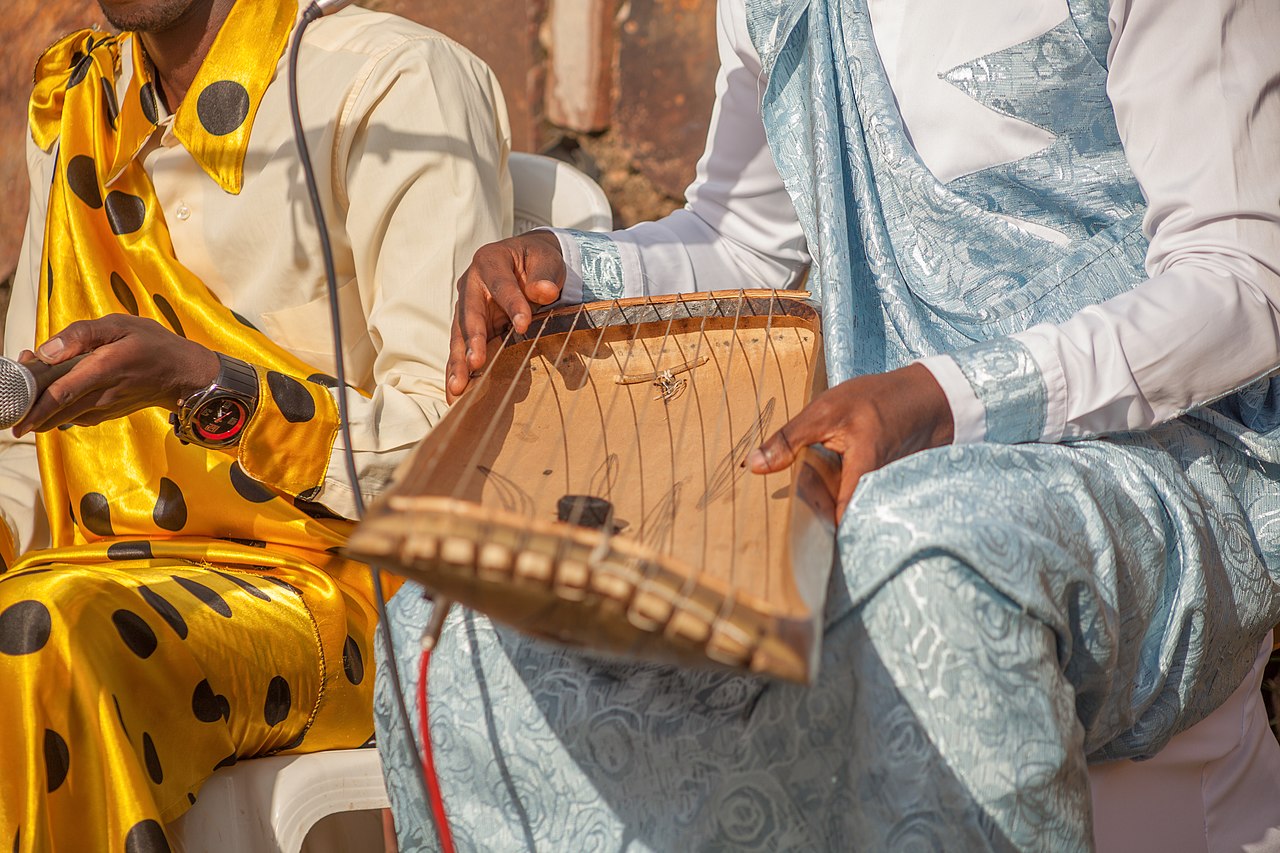
Shabanmasengesho · CC BY-SA 4.0
- Name
- Inanga
- Field
- plucked string instrument · trough zithers without resonator
VALÉORINE Encyclopedia
VALÉORINE documentary reading
Documentary summary
The inānga (also known as enanga, ennanga, ikivuvu, and indimbagazo) is a traditional musical instrument played in Burundi, Rwanda, Uganda, and parts of the Democratic Republic of Congo. It consists of a slightly concave soundboard framed by a thick notched rim which holds strings in place over the board. Ināngas typically have between six and eight strings.
Admitted source layer · organised and presented by VALÉORINE
Reference Check
Propose documentary evidence for inanga. A contribution is never written directly as fact: identity, source, rights and evidence gates still decide.
Sign in to contribute
World of VALÉORINE
Documentary connections
Only confirmed graph relationships appear here. Images are shown only when their identity and reuse rights both pass the documentary gate.

Documentary evidence
Documentary basis
Authority files
wikidata · Q1660902
In this article
Key facts
Key facts
• Name — Inanga • Background — string • Names — enanga, ennanga, ikivuvu, indimbagazo • Classification — trough zither • Hornbostel Sachs — 315.1 (without resonator) or 315.2 (with resonator) • Hornbostel Sachs Desc — Trough zithers. Instruments in which strings are stretched across the mouth of a trough. • Developed — Modern examples come from Africa, especially the Great Lakes Region of East Africa.
Construction & use
Construction & use
Ināngas range from 75 cm to 1 m in length, and 25 to 30 cm in width. There are two types of decorations for the soundboard: star-shaped or oval incisions, which are referred to as "the eyes of the inanga" and serve to distribute sound, and burnt wood markings. Ināngas are made of a number of trees, including the igiháhe, umwūngo, umukoni or umunyáre. • Illustration — An inanga performance in Busongora, Uganda. Natural fibers are used to make the strings; traditionally, animal guts or muscle was used, but nowadays, nylon and metal strings can be used. These strings are typically grouped into the following: the imihanuro, the top two strings, the imirya y'amajwi-ihibongoza, the middle strings, and the imyakiro, the last two strings. The strings actually consist only of one, very long string that's threaded through the notches. It is then fastened to a wooden peg. The inānga follows the pentatonic scale. The player tunes the instrument by tightening and loosening the instrument accordingly. The player assumes a sitting posture, resting the instrument against the player's lap. The strings are plucked at full length, but timbral distinctions can be made by plucking at different points along the strings' length. The inānga is almost always played to accompany the player singing a repeated, melodic motif in a distinct, whispery voice. These songs usually concern traditional folklore, historical events, personal experiences, or everyday incidents.
Culture
Culture
• Illustration — A souvenir inanga from Kabale, Uganda. In the past, the inānga was primarily played by professional musicians for chiefs; they typically sang epic and historical songs praising their patron. Children are not usually taught to play inānga. A father generally keeps his inānga in a visible place, and the child learns to play on his own. Inānga playing is typically considered to be a male activity, and most known inānga players are male. In Burundi, the inānga was traditionally played for the mwamis of Burundi as they rested at night. The inānga was also played to cows, for it was thought that they loved the sound. It is considered to be the first instrument to be invented in the country. In Rwanda, the inānga is considered to be one of the important and revered music instruments. Some notable Rwandan inānga players include: Thomas Kirusu, Victor Kabarira, Sentore Masamba, Vianney Mushabizi, Jules Sentore, Joseph Sebatunzi, Daniel Ngarukiye, and Sophie Nzayisenga.
Notes from the source article
Cited by Wikipedia
Notes from the source article
These works are cited by the source article, in its own numbering. They are recorded as its citations, not as sources VALÉORINE has verified.
- 1.Classification of Musical Instruments: Translated from the Original German by Anthony Baines and Klaus P. Wachsmann. The Galpin Society Journal. 14. 3–29. March 1961. 10.2307/842168.
- 2.Inanga. music.africamuseum.be.
- 3.inanga · Grinnell College Musical Instrument Collection · WMI Testing. omeka-s.grinnell.edu.
- 4.Inanga: Rwanda's centuries-old music instrument. The New Times Rwanda. 2016-09-10.
- 5.The Inanga musical instrument. The New Times Rwanda. 2012-11-20.
- 6.Thomas Kirusu dies at 80. The New Times. 4 December 2022.
References
Citations
References
Each reference names the institution holding it, so a reader may go to the document itself.
reference work
Secondary witness
The Encyclopedia exists whether or not anything is for sale. Corrections are recorded rather than overwritten, and every version of this record is kept. Published 14 August 2026.
Elsewhere in Collectables
20,755 published records in this field, each with its sources named.
- In the GrooveWork
- In the HuntWork
- In Verbis VirtusWork
- in-ear monitorTerminology
- Inazuma Eleven 2Work
- Inazuma Eleven 3Work
- Inazuma Eleven GO Strikers 2013Work
- Inazuma Eleven StrikersWork
Best supported in this field
For owners
Own an object connected with inanga?
A specialist will read what you send and tell you what the house can establish, what it cannot, and whether the object is suited to sale. There is no charge and no obligation. The object stays with you throughout; nothing is shipped to us unless it is arranged in writing beforehand.