
hummel
Illustration — Hummel in collection of KUBEN, Aust-Agder museum og arkiv in Arendal, Norway. The hummel (also hommel or humle) is an old Northern European stringed instrument similar to an older type of zither and is related to the Norwegian langeleik.
Also recorded as langharpe · noordsche balk · humle · noardske balke
hummel

Pascal Curin · Fond de EDK et dessin de moi-même · CC0
- Field
- plucked string instrument
VALÉORINE Encyclopedia
VALÉORINE documentary reading
Documentary summary
Illustration — Hummel in collection of KUBEN, Aust-Agder museum og arkiv in Arendal, Norway. The hummel (also hommel or humle) is an old Northern European stringed instrument similar to an older type of zither and is related to the Norwegian langeleik.
Admitted source layer · organised and presented by VALÉORINE
Note VALÉORINE
No house-authored Note is published until its assertions and sources pass the VALÉORINE evidence contract. The documentary article remains available in full while that enrichment is being consolidated.
Documentary enrichment in progress · no unsupported statement published
Reference Check
Propose documentary evidence for hummel. A contribution is never written directly as fact: identity, source, rights and evidence gates still decide.
Sign in to contribute
World of VALÉORINE
Documentary connections
Only confirmed graph relationships appear here. Images are shown only when their identity and reuse rights both pass the documentary gate.

Documentary evidence
Evidence Panel
not yet certified
- Identity
- resolved
- Independent source families
- 0
- Admitted assertions
- 0
- Open conflicts
- 0
Authority files
wikidata · Q2094724
In this article
History
History
The hummel is probably from the Middle Ages, when it was found all over Europe in slightly differing variants. The instrument was common in the Netherlands, Flanders, Northern Germany and Denmark during the 18th century. The earliest evidence of the instrument in Swedish folk culture is from the 17th century, and it seems to have been most common in the southern parts of the country. During the 19th century, the hummel was considered to be a primitive peasant instrument and its popularity dwindled. In Flanders, these instruments appeared during the 17th century and were popular with soldiers in the trenches during World War I, climaxing in the 1920s and 1930s but by the 1930s they returned to obscurity. They were mainly a family instruments and were widely played by women. Some enthusiasts have taken up playing it again since the folk revival of the 1970s.
Construction
Construction
The hummel has many related forms. Common to all varieties is a flat top and bottom. There are variations in the type of wood it is made from, but the wood is always thin. On the top of the instrument are one or more soundholes. The strings vary in number, but often include a smaller number of melody strings and a greater number of accompanying strings. It is not uncommon to have three melody strings: two tuned identically, and the third tuned one octave below the others. Under the melody strings, either directly on the body or attached to a fretboard, are about 17 frets. The body comes in two main forms, either a pear-shaped form with the strings in the middle, or a half-pear with the strings near the edge.
Playing
Playing
The hummel is placed on a table like a zither, to amplify the sound. The melody strings are sounded by being plucked downwards, either with fingers or a plectrum. The identically tuned melody strings are often fretted in unison or so to create a major third. It is possible to play a sixth interval, through using the octave string. The strings are played with a plectrum and are often all played at once. This is common because the accompaniment strings are tuned to a suitable chord that is relatively open, for example all the strings may be tuned to D or A.

Jean-Pierre Van Hees, Hommel - Marc Put, viool - Muziekclub « Le Trou Perrette » Liége 1978
Jean-Pierre Van Hees · collection Jean-Pierre Van Hees
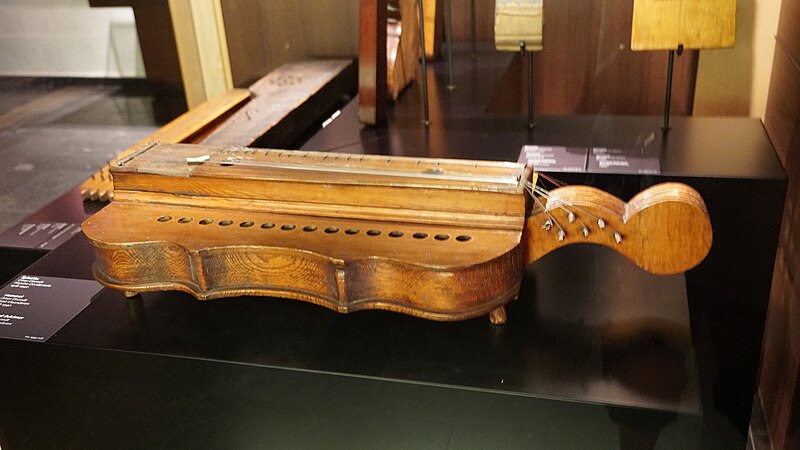
Hommel (1918 / 1940 by Omer Dhondt, West Flanders, Belgium. Inv.1994.028) - MIM Brussels (2018-05-26 10.36.02 by Miguel Discart @Flickr 46323498981)
Miguel Discart · 2018-05-26_10-36-02_ILCE-6500_DSC09402
Citations
References
Each reference names the institution holding it, so a reader may go to the document itself.
reference work
Partially resolved
The Encyclopedia exists whether or not anything is for sale. Corrections are recorded rather than overwritten, and every version of this record is kept. Published 14 August 2026.
Elsewhere in Collectables
20,755 published records in this field, each with its sources named.
- HumankindWork
- Humber LimitedOrganisation
- Humber MotorcyclesOrganisation
- humbuckerTerminology
- hümmelchenTerminology
- HummerWork
- Hummer BadlandsWork
- HundraWork
Best supported in this field
For owners
Own an object connected with hummel?
A specialist will read what you send and tell you what the house can establish, what it cannot, and whether the object is suited to sale. There is no charge and no obligation. The object stays with you throughout; nothing is shipped to us unless it is arranged in writing beforehand.