
High-Energy-Gamma-Ray Astronomy
HEGRA, which stands for High-Energy-Gamma-Ray Astronomy, was an atmospheric Cherenkov telescope for Gamma-ray astronomy. It was located at Roque de los Muchachos Observatory on La Palma at a height of 2200 m above sea level. It was operated by an international collaboration of research institutes and universities, such as the Max Planck Institute for Physics in Munich, the Universidad Complutense de Madrid, the German Max Planck Institute for Nuclear Physics, the University of Wuppertal, the IFKKI in Kiel or the University of Hamburg.
Also recorded as HEGRA
High-Energy-Gamma-Ray Astronomy

Wikimedia Commons · CC BY-SA 3.0
- Region
- Spain
VALÉORINE Encyclopedia
VALÉORINE documentary reading
Documentary summary
HEGRA, which stands for High-Energy-Gamma-Ray Astronomy, was an atmospheric Cherenkov telescope for Gamma-ray astronomy. It was located at Roque de los Muchachos Observatory on La Palma at a height of 2200 m above sea level. It was operated by an international collaboration of research institutes and universities, such as the Max Planck Institute for Physics in Munich, the Universidad Complutense de Madrid, the German Max Planck Institute for Nuclear Physics, the University of Wuppertal, the IFKKI in Kiel or the University of Hamburg.
Admitted source layer · organised and presented by VALÉORINE
Reference Check
Propose documentary evidence for High-Energy-Gamma-Ray Astronomy. A contribution is never written directly as fact: identity, source, rights and evidence gates still decide.
Sign in to contribute
World of VALÉORINE
Documentary connections
Only confirmed graph relationships appear here. Images are shown only when their identity and reuse rights both pass the documentary gate.
Documentary evidence
Documentary basis
Authority files
gnd · 5059346-8 · wikidata · Q845962 · wikipedia · HEGRA
In this article
Overview
Overview
It consisted of several detector types for observing secondary particles from particle cascades in the atmosphere. The particle cascades detected by HEGRA were produced by cosmic ray particles in the energy range of 10 12 eV to 10 16 eV. The detectors with the lowest energy threshold were the atmospheric Cherenkov telescopes with "cameras" of photomultiplier tubes. They were sensitive to showers above 10 12 eV (1 TeV) but had to look towards possible sources and could be operated only during clear, moonless nights. They detected Cherenkov light from relativistic secondary particles in the air showers. The field of view was about 4.6°. There were a total of six of these telescopes in operation. They were dismantled in September 2002. The reflectors of the telescope is 3.9 meter in diameter and consisted of 30 spherical mirrors. The area of the reflector is 5 m 2. Another detector type for Cherenkov light was AIROBICC (AIRshower Observation By angle Integrating Cherenkov Counters) with one large photomultiplier looking at the sky above it. 49 of these detectors were spread in a 7-by-7 grid to observe the amplitude and the time of arrival of the front of Cherenkov light. Another 48 were added later on. These counters had a wide field of view but could only be operated during clear, moonless nights, like the atmospheric Cherenkov telescopes. Their energy threshold was a few 10 13 eV. The AIROBICC array has been dismantled. The first detector type of HEGRA was the array of 1 m 2 scintillation counters which were used to measure the numbers and arrival times of secondary particles in air showers arriving at ground level. More than 250 of these counters were in operation, spread over a 180-by-180 m 2 area. These detectors were operated day and night at any weather. The energy threshold of the scintillator array was between 40 and 100 TeV, depending on the kind of primary cosmic ray particle. The scintillator array has been dismantled as well. The scintillator array was sensitive to all types of charged secondary particles. To be able to select secondary muons in air showers there were the Muon 'Towers' with 16 m 2 area each. Seventeen of these detectors were installed on La Palma. There were two more types of detectors at the HEGRA site: the CRT (Cosmic Ray Tracking) and the CLUE (Cherenkov Light Ultraviolet Experiment). • Illustration — Schematic representation of cosmic ray shower detection A remarkable achievement of the instrument was the detection of the most energetic photons observed from an extragalactic object, at 16 TeV, originating from Markarian 501 (Mrk 501). It was shut down in 2002 in order to build the follow-up telescope MAGIC at the same site. A direct successor to the stereoscopic system of Cherenkov telescopes is the HESS experiment.
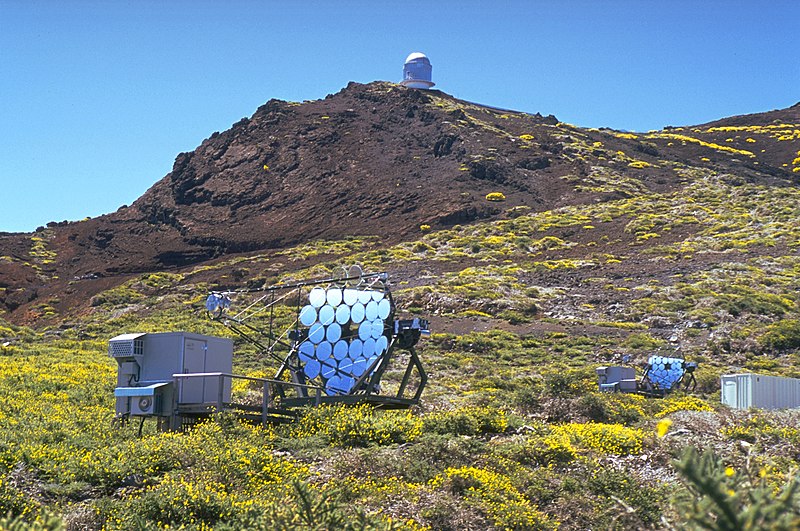
The HEGRA and the Nordic Optical Telescope at Roque de los Muchachos Observatory, La Palma
Bob Tubbs · Self-photographed
Key facts
Key facts
• Illustration — Overview of the HEGRA site in 1997 • Illustration — Schematic designs of the scintillation and AIROBICC counters
Chronology
Dated record
Chronology
The full dated record · 1 entries
2026
GPSP Atlas: Galactic Photon Survival Probability Atlas for Very-High- and Ultra-High-Energy Gamma-Ray Astronomy digitised by DataCite (Zenodo).
Places
Named by the record
Places
Only places the record itself states, plotted where the house gazetteer settles their coordinates. Nothing is inferred from a name or a nationality.
- Spain
Primary material
Digitised editions and texts
Galactic Photon Survival Probability Atlas for Very-High- and Ultra-High-Energy Gamma-Ray Astronomy (2026) — DataCite (Zenodo)
Literature
Literature
Literature
High-Energy Gamma-Ray Astronomy, 2022
Scholarly footprint
Literature
Scholarly footprint
A count of publications is evidence of attention, not of standing, and is given here only as a measure.
References
Citations
References
Each reference names the institution holding it, so a reader may go to the document itself.
reference work
Secondary witnessreference work
Secondary witness
Further particulars
Held on the record
Further particulars
Open the remaining particulars
Those registers additionally record the forms International Conference on High Energy Gamma-Ray Astronomy (1990: Ann Arbor, MI), High Energy Gamma-Ray Astronomy (1990: Ann Arbor, MI) and Gamma (1990: Ann Arbor, MI).
The Encyclopedia exists whether or not anything is for sale. Corrections are recorded rather than overwritten, and every version of this record is kept. Published 16 August 2026.
Elsewhere in Scientific instruments
736 published records in this field, each with its sources named.
- High Definition Earth Viewing camerasTerminology
- High Elevation Antarctic Terahertz TelescopeTerminology
- High Energy Stereoscopic SystemTerminology
- High Resolution Stereo CameraTerminology
- HinotoriTerminology
- HiRISETerminology
- HisakiTerminology
- Hobby–Eberly TelescopeTerminology
Best supported in this field
For owners
Own an object connected with High-Energy-Gamma-Ray Astronomy?
A specialist will read what you send and tell you what the house can establish, what it cannot, and whether the object is suited to sale. There is no charge and no obligation. The object stays with you throughout; nothing is shipped to us unless it is arranged in writing beforehand.