
Heywood Hardy
Heywood Hardy (25 November 1842 – 20 January 1933) was a British artist, in particular an animal painter and painter of horse riding scenes. He also painted landscapes and portraits, especially equestrian portraits.
Also recorded as Haywood Hardy · H. Hardy
Heywood Hardy
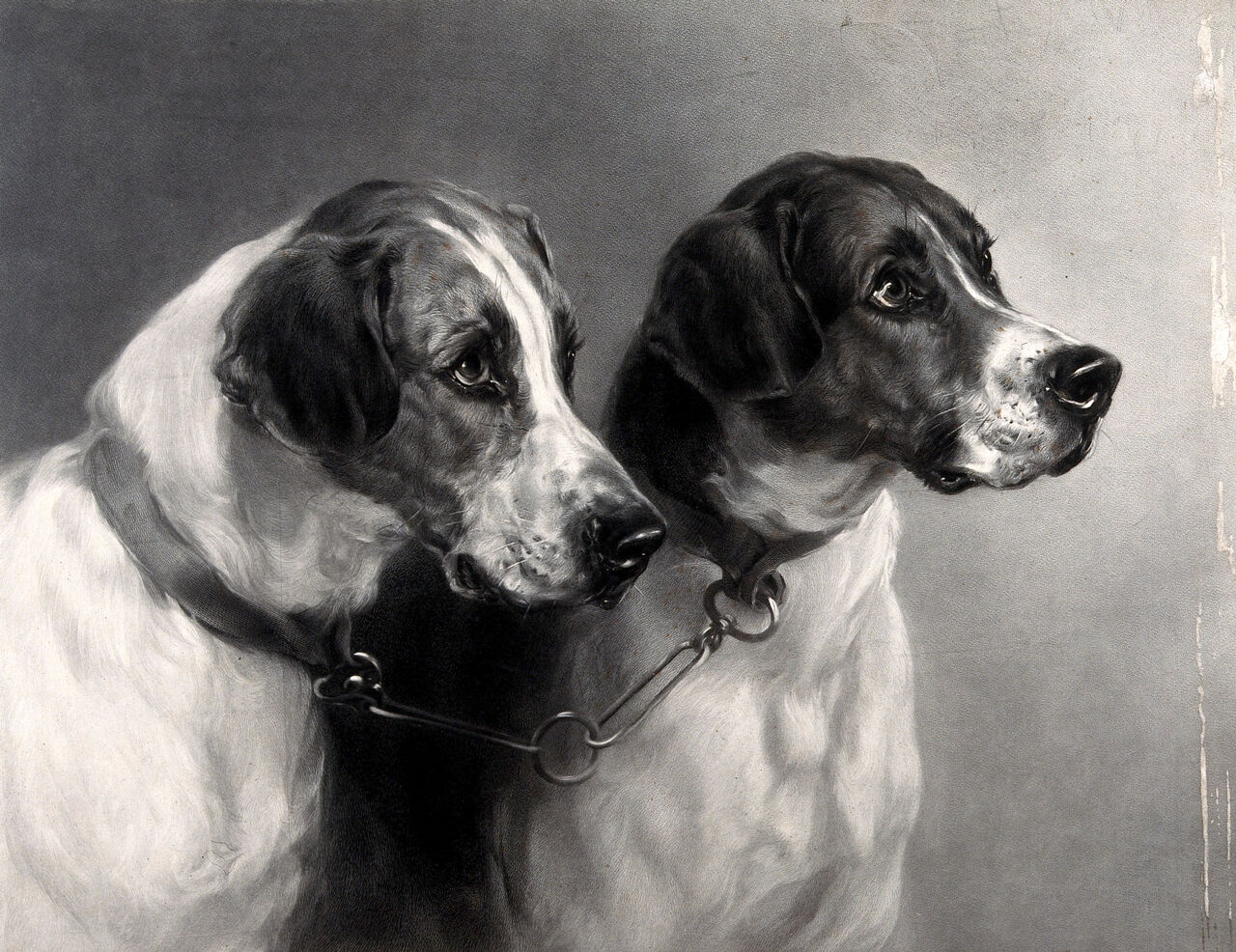
Heywood Hardy · Wellcome Collection, London · Wellcome Collection · Public Domain Mark
- Name
- Heywood Hardy
- Born
- 25 November 1842
- Birthplace
- Chichester, Sussex, England
- Died
- 20 January 1933
- Place of death
- Epsom, Surrey, England
- Known for
- Animal painting.
- Nationality
- United Kingdom
- Occupation
- painter · printmaker · etcher · graphic artist · illustrator
- Languages
- English
VALÉORINE Encyclopedia
VALÉORINE documentary reading
Documentary summary
Heywood Hardy (25 November 1842 – 20 January 1933) was a British artist, in particular an animal painter and painter of horse riding scenes. He also painted landscapes and portraits, especially equestrian portraits.
Admitted source layer · organised and presented by VALÉORINE
Note VALÉORINE
Heywood Hardy was an etcher, graphic artist and illustrator, among other activities, of British nationality. The etcher was born in Chichester and died in West Sussex.
Languages used include English. Works are held at Bury Art Museum, Guildhall Art Gallery and Laing Art Gallery, among others.
Composed from admitted, traceable facts · 27 September 2026
VALÉORINE
Reference Check
Propose documentary evidence for Heywood Hardy. A contribution is never written directly as fact: identity, source, rights and evidence gates still decide.
Sign in to contribute
World of VALÉORINE
Documentary connections
Only confirmed graph relationships appear here. Images are shown only when their identity and reuse rights both pass the documentary gate.
Documentary evidence
Documentary basis
Authority files
wikidata · Q1617043 · wikipedia · Heywood Hardy
In this article
Key facts
Key facts
• Name — Heywood Hardy • Born — 25 November 1842 • Birthplace — Chichester, Sussex, England • Died — 20 January 1933 • Place of death — Epsom, Surrey, England • Known for — Animal painting. Paintings of horse riding and hunting. Equestrian portraits
Early life
Early life
• Illustration — Corn Stooks by Bray Church (1872) Heywood Hardy was born on 25 November 1842 at Chichester in Sussex, the youngest of ten children of the artist James Hardy senior (1801 – 1879) and his wife Elizabeth. Before he became an artist his father was Principal Trumpet in the Private Band of Music of King George IV. Other artists in the family included Heywood's elder brothers, James junior and David, his sister Ada and his cousins, Frederick Daniel Hardy and George Hardy. Heywood's ancestors were from Horsforth in Yorkshire; Gathorne Gathorne-Hardy, First Earl of Cranbrook, was his second cousin. When he was 17 years old Heywood Hardy left the family home in Bath after an argument with his quick-tempered father and removed to Keynsham near Bristol. His first two paintings, landscapes, were accepted for exhibition at The Royal Academy in 1864 In the same year he was appointed an Ensign in the 7th Somersetshire Rifle Volunteer Corps, a part-time position. Later that year he left Keynsham to study at the École des Beaux-Arts in Paris where his principal teacher was Isidore Pils. Hardy spent much of his spare time copying paintings in the Louvre. After his years of bohemianism in Paris, Heywood returned to England via Antwerp and by 1869 was living at Goring in Oxfordshire, near the bridge over the Thames.
Animal painting
Animal painting
• Illustration — A Lion's Head (1878) In 1870 Hardy removed to St John's Wood in London and established himself as an animal painter. In 1873 The Times commented on his picture of fighting lions exhibited at The Royal Academy, "...we do not remember such a daring and determined piece of savage animal painting from an English hand – few from any hand since Rubens. The picture at once gives a great rise in artistic rank to the artist." Hardy visited Egypt in 1873 to paint wildlife. In London he studied the comparative anatomy of animals and birds with Professor Alfred Henry Garrod, Head of the Scientific Department at the London Zoo. He also made illustrations for Garrod's research on the horse gait. To assist his studies of lions, Hardy acquired a lioness that had died at the London Zoo and had it mounted by Rowland Ward, one of the foremost taxidermists of his day.
Horses and equestrian portraits
Horses and equestrian portraits
Horses and horse riding were the subjects of much of Hardy’s later work. His pictures of horse riding by the seashore and riders in 18th century settings are among his most popular paintings. Hardy painted three winners of the Grand National for their owners. He was much in demand to paint equestrian portraits and pictures of the most famous Hunts and foxhounds of his day. Notable portraits include that of Lady Ida Sitwell; her husband Sir George Sitwell commissioned it as a wedding present. In 1909 Heywood Hardy returned to live in Sussex, at East Preston, a few minutes walk from the beach. His last paintings were altarpieces for the thirteenth century Church of St Mary at Clymping in Sussex and for St Luke’s Church at the Royal Hospital Haslar, Gosport. Hardy’s ashes were buried at Clymping Church. Heywood Hardy was a founder member of the Royal Society of Portrait Painters, a founder member of the Royal Society of Painter-Etchers, a member of the Royal Institute of Oil Painters, and an Associate of the Royal Watercolour Society. • Illustration — Duty (1880) • Illustration — A Summer's Day in Cleveland (1889) • Illustration — Out for a Scamper (ca. 1900) • Illustration — Homewards. Oil on canvas. Signed Heywood Hardy (lower left). The title inscribed verso
Family and music
Family and music
Heywood's father was originally a musician and three uncles played in the Royal Private Band of Music, including his uncle William Hardy who was Conductor of Queen Adelaide’s Private Band. Heywood played the zither, mandolin and English guitar. He often participated in musical evenings, as a singer and musician, in the country houses that he visited to paint portraits and pictures of horses and dogs. In 1868 Hardy married Mary Beechey, daughter of Rear-Admiral Frederick William Beechey, FRS, President of the Royal Geographical Society. There were several artists in Mary’s family; her grandfather was the artist Sir William Beechey. Two of Hardy’s four daughters were artists. His eldest daughter, Nina, exhibited 15 paintings at the Royal Academy, mostly portraits of women and children. And Mabel Hardy, who was always known as “Beldy”, a blend of Mabel and Hardy, was an artist and musician who won first prize for her studies at the Paris Conservatory. Beldy married Charles Ormond Maugham, elder brother of writer Somerset Maugham and partner in the family law firm in Paris. Beldy’s daughter, Daphne Maugham Casorati, and her grandson, Francesco Casorati, were artists.
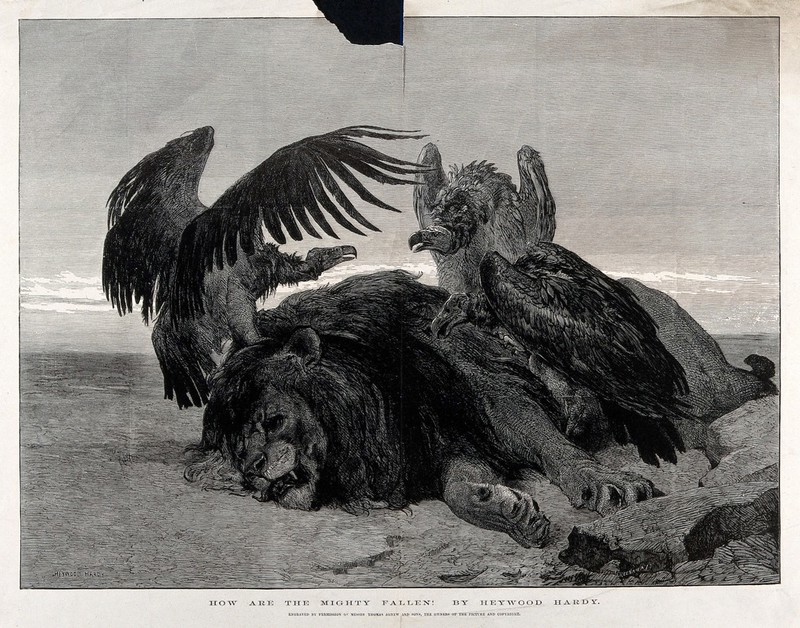
A dead lion being set-upon by three vultures. Wood engraving by J. Greenaway after H. Hardy, 1875., 1875, by Heywood Hardy
Heywood Hardy · Wellcome Collection, London · Wellcome Collection
Places
Named by the record
Places
Only places the record itself states, plotted where the house gazetteer settles their coordinates. Nothing is inferred from a name or a nationality.
Heywood Hardy was born in Chichester.
Birthplace
Heywood Hardy died in West Sussex.
Deathplace
Chichester.
Birth place
West Sussex.
Death place
Primary material
Documents and archives
reference work
- “Heywood Hardy”, English Wikipedia, consulted as further reading
Reputable secondary · Wikipedia
authority record
- Wikidata, structured authority record Q1617043: Heywood Hardy
General reference · Wikidata
Notes from the source article
Cited by Wikipedia
Notes from the source article
These works are cited by the source article, in its own numbering. They are recorded as its citations, not as sources VALÉORINE has verified.
- 1.Hardy, Kimber G. The Hardy Family of Artists: Frederick Daniel, George, Heywood, James and their descendants. ACC Art Books. 198–204. 2016. 978-185149-826-0.
- 2.Stewart, Brian. Chichester Artists. Bladon Press. 17. 1987. 0 9512814-0-2.
- 3.Graves, Algernon. The Royal Academy of Arts: a complete dictionary of contributors and their work from its foundation in 1769 to 1904. Henry Graves & Co Ltd. 387. 1905.
- 4.Commissions signed by the Lord Lieutenant of the County of Somerset. The London Gazette. 888. 26 February 1864.
- 5.Hardy (2016), p.71
- 6.Marks, John George. Life and Letters of Frederick Walker A.R.A. Macmillan & Co. Ltd. 145. 1896.
- 7.Hardy (2016), p.75
- 8.The Royal Academy Exhibition. The Times. 3 May 1873.
- 9.Hardy (2016), p.86
- 10.Hardy (2016), p.205
- 11.Professor's Garrod's Lecture on Animal Locomotion. The Illustrated London News. 230. 6 March 1875.
- 12.Hardy (2016) p.85
- 13.Hardy (2016), p.137
- 14.Sitwell, Osbert. Left Hand, Right Hand! An autobiography. Macmillan & Co. Ltd. 249, 250. 1945.
- 15.Hardy (2016), p.148
- 16.Hardy (2016), pp.148-150
- 17.Hardy (2016), pp.199-204
- 18.Layard, George Somes. The Life and Letters of Charles Samuel Keene. Sampson Low, Marston & Co. Ltd. 151. 1892.
- 19.Hardy (2016), pp.151,152
- 20.Graves (1905), p.389
- 21.Hardy (2016), p.152
- 22.Maugham, Robin. Somerset and all The Maughams. Longmans Heinemann. 165, 166. 1966. 0140039066.
- 23.Hardy (2016), pp.152,153
- 24.Hardy (2016), pp.154,155
References
Citations
References
Each reference names the institution holding it, so a reader may go to the document itself.
reference work
Secondary witnessauthority record
General reference
The Encyclopedia exists whether or not anything is for sale. Corrections are recorded rather than overwritten, and every version of this record is kept. Published 16 August 2026.
Elsewhere in Illustration
5,224 published records in this field, each with its sources named.
- Hermine StilkeIllustrator
- Herschel C. LoganIllustrator
- Hervé TulletIllustrator
- Hester WagstaffIllustrator
- Heywood SumnerIllustrator
- Hideko TakahashiIllustrator
- Hidenori HaraIllustrator
- Hideo YamamotoIllustrator
Best supported in this field
For owners
Own a work by Heywood Hardy?
A specialist will read what you send and tell you what the house can establish, what it cannot, and whether the object is suited to sale. There is no charge and no obligation. The object stays with you throughout; nothing is shipped to us unless it is arranged in writing beforehand.