
Henryk Mikolaj Górecki
Henryk Mikołaj Górecki (6 December 1933 – 12 November 2010) was a Polish composer of contemporary classical music. According to critic Alex Ross, no recent classical composer has had as much commercial success as Górecki. He became a leading figure of the Polish avant-garde during the post-Stalin cultural thaw.
Also recorded as Henryk-Mikolaj Górecki · Henryk Mikołaj Górecki · Henryk Gorecki
Henryk Mikolaj Górecki
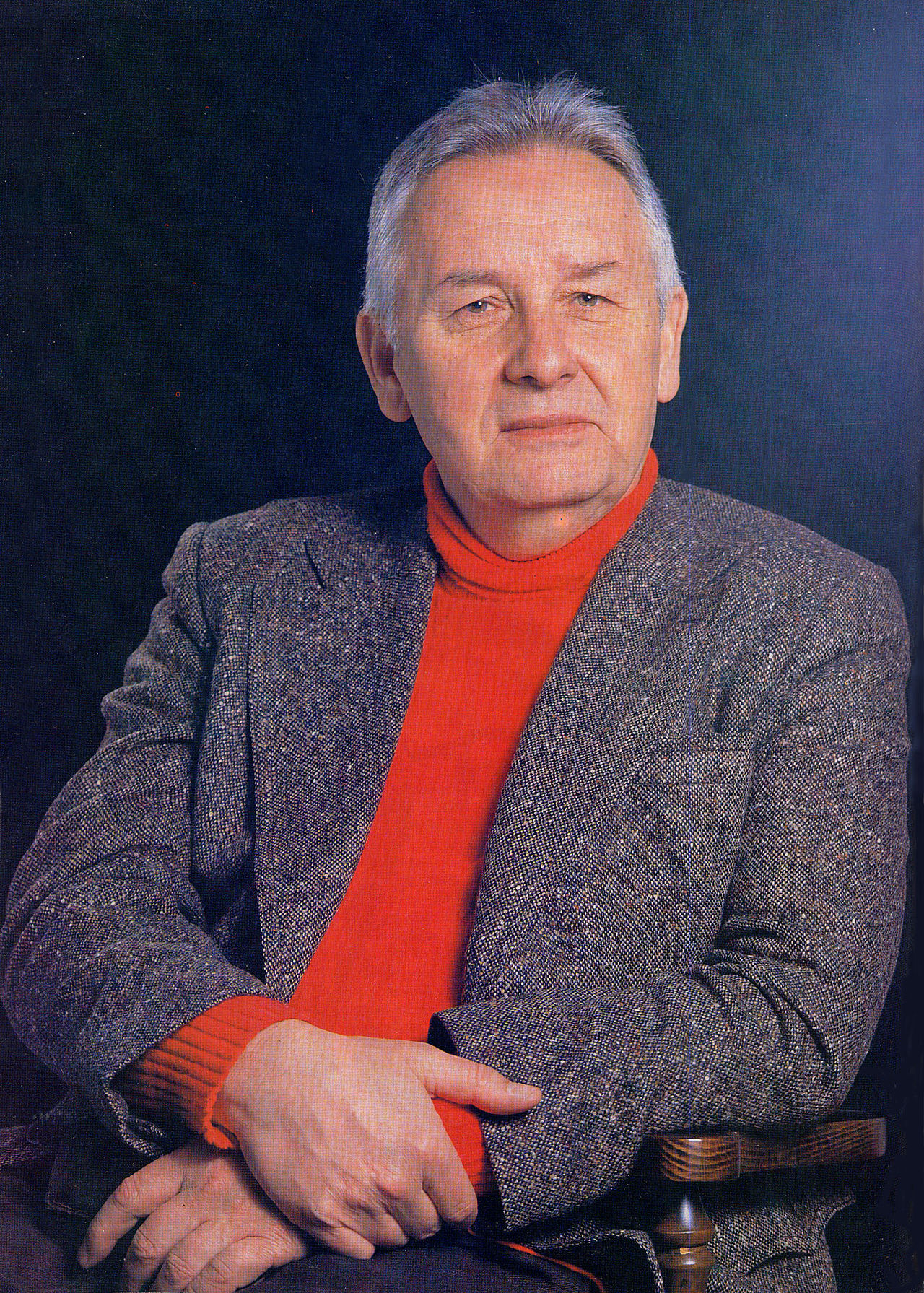
Lech Kowalski Włodzimierz Pniewski · scanned from Polish monthly "Studio" Nov/Dec 1993 page 8 · Public domain
- Name
- Henryk Górecki
- Birth Name
- Henryk Mikołaj Górecki
- Born
- 6 December 1933 Czernica, Silesia, Poland
- Died
- 12 November 2010 Katowice, Silesia, Poland
- Education
- Karol Szymanowski Academy of Music
- Known for
- Symphony of Sorrowful Songs
- Spouse
- Jadwiga Rurańska (pianist)
- Full name
- Henryk Mikołaj Górecki.
- Nationality
- Poland.
- Occupation
- pedagogue, musicologist, musician, composer and university teacher.
- Fields
- performing arts, art music and music education.
- Movements
- minimalist music and modernism.
VALÉORINE Encyclopedia
VALÉORINE documentary reading
Documentary summary
Henryk Mikołaj Górecki (6 December 1933 – 12 November 2010) was a Polish composer of contemporary classical music. According to critic Alex Ross, no recent classical composer has had as much commercial success as Górecki. He became a leading figure of the Polish avant-garde during the post-Stalin cultural thaw.
Admitted source layer · organised and presented by VALÉORINE
Note VALÉORINE
No house-authored Note is published until its assertions and sources pass the VALÉORINE evidence contract. The documentary article remains available in full while that enrichment is being consolidated.
Documentary enrichment in progress · no unsupported statement published
Reference Check
Propose documentary evidence for Henryk Mikolaj Górecki. A contribution is never written directly as fact: identity, source, rights and evidence gates still decide.
Sign in to contribute
Documentary evidence
Evidence Panel
not yet certified
- Identity
- resolved
- Independent source families
- 0
- Admitted assertions
- 0
- Open conflicts
- 0
Authority files
wikidata · Q294568
In this article
Biography
Biography
Górecki worked between 1933 and 2010 across classical composer, pedagogue, musicologist, musician and composer and 1 further recorded occupations. The registers place that work in minimalist music. This article rests on 117 catalogued compositions, 70 issued recordings, 2 digitised documents and 12 scholarly references drawn from named institutional registers. Every statement below returns to a source shown in the evidence panel; where the record is silent or divided, the article says so instead of resolving it.
Henryk Mikolaj Górecki studied at Academy of Music in Katowice and Szafrankowie Brothers State School of Music. Training under Bolesław Szabelski is recorded. The recorded working language is Polish. The field of work recorded is performing arts, art music and music education. Subjects and genres recorded for the work are minimalist music. Employment is recorded with Academy of Music in Katowice. Positions recorded include associate professor. Works named in the authority record are Symphony No. Distinctions recorded are Order of the White Eagle, Golden Medal for Merit to Culture, Knight Grand Cross of the Order of St.

grób kompozytora Henryka Mikołaja Góreckiego na cmentarzu przy ul. Henryka Sienkiewicza w Katowicach
Adrian Tync
Collage of photos of 32 Polish known figures – *1st row, left to right: Pope John Paul II, Mieszko I – c. 930, Mikołaj Kopernik – 1473, John III Sobieski – 1629, Casimir Pulaski – 1745, Tadeusz Kościuszko – 1746, Adam Mickiewicz – 1798, Emilia Plater – 1806, *2nd row, left to right: Juliusz Słowacki – 1809, Fryderyk Chopin – 1810, Stanisław Moniuszko – 1819, Jan Matejko – 1838, Helena Modjeska –
Various (See source images for details) · self-made from cropped versions of: This work is in the public domain in the United States because it is a work prepared by an officer or employee of the United States Government as part of that perso
Key facts
Key facts
• Name — Henryk Górecki • Birth Name — Henryk Mikołaj Górecki • Born — 6 December 1933 Czernica, Silesia, Poland • Died — 12 November 2010 Katowice, Silesia, Poland • Era — Contemporary • Education — Karol Szymanowski Academy of Music • List Of Works — List of works • Known for — Symphony of Sorrowful Songs • Spouse — Jadwiga Rurańska (pianist) • Children — Anna Górecka Mikołaj Górecki
Early years
Early years
Henryk Górecki was born on 6 December 1933, in the village of Czernica, in present-day Silesian Voivodeship, southwest Poland. His family lived modestly, though both parents had a love of music. His father Roman (1904–1991) worked at the goods office of a local railway station, but was an amateur musician, while his mother Otylia (1909–1935), played piano. Otylia died when her son was just two years old, and many of his early works were dedicated to her memory. Henryk developed an interest in music from an early age, though he was discouraged by both his father and new stepmother to the extent that he was not allowed to play his mother's old piano. He persisted, and in 1943 was allowed to take violin lessons with Paweł Hajduga, a local amateur musician, instrument maker, sculptor, painter, poet and chłopski filozof (peasant philosopher). In 1937, Górecki fell while playing in a neighbor's yard and dislocated his hip. The resulting suppurative inflammation was misdiagnosed by a local doctor, and delay in proper treatment led to tubercular complications in the bone. The illness went largely untreated for two years, by which time permanent damage had been sustained. He spent the following twenty months in a hospital in Germany, where he underwent four operations. Górecki continued to suffer ill health throughout his life and as a result said he had "talked with death often". In the early 1950s, Górecki studied in the Szafrankowie Brothers State School of Music in Rybnik. Between 1955 and 1960, he studied at the State Higher School of Music in Katowice. In 1965 He joined the faculty of his alma mater in Katowice, where he was made a lecturer in 1968, and then rose to provost before resigning in 1979.
Rydułtowy and Katowice
Rydułtowy and Katowice
• Illustration — View of Rydułtowy, where Górecki taught for two years from 1951 to 1953 Between 1951 and 1953, Górecki taught 10- and 11-year-olds at a school suburb of Rydułtowy, in southern Poland. In 1952, he began a teacher training course at the Intermediate School of Music in Rybnik, where he studied clarinet, violin, piano, and music theory. Through intensive studying, Górecki finished the four-year course in just under three years. During this time, he began to compose his own pieces, mostly songs and piano miniatures. Occasionally, he attempted more ambitious projects—in 1952, he adapted the Adam Mickiewicz ballad Świtezianka, though it was left unfinished. Górecki's life during this time was often difficult. Teaching posts were generally badly paid, while the shortage economy made manuscript paper at times difficult and expensive to acquire. With no access to radio, Górecki kept up to date with music by weekly purchases of such periodicals as Ruch muzyczny (Musical Movement) and Muzyka, and by purchasing at least one score a week. • Illustration — The Academy of Music in Katowice where Górecki lectured from 1968 Górecki continued his formal study of music at the Academy of Music in Katowice, where he studied under the composer Bolesław Szabelski, a former student of Karol Szymanowski. Szabelski drew much of his inspiration from Polish highland folklore. He encouraged Górecki's growing confidence and independence by giving him considerable space in which to develop his own ideas and projects; several of Górecki's early pieces were straightforwardly neo-classical, during a period when Górecki was also absorbing the techniques of twelve-tone serialism. He graduated from the Academy with honours in 1960.
Early modernist works
Early modernist works
The first public performances of Górecki's music in Katowice in February 1958 programmed works clearly displaying the influence of Szymanowski and Bartók. The Silesian State Philharmonic in Katowice held a concert devoted entirely to the 24-year-old Górecki's music. The event led to a commission to write for the Warsaw Autumn Festival. The Epitafium (Epitaph) he submitted marked a new phase in his development, and was said to represent "the most colourful and vibrant expression of the new Polish wave". The festival announced Górecki's arrival on the international scene, and he quickly became a favorite of the West's avant-garde musical elite. In 1991, the music critic James Wierzbicki wrote that at this time "Górecki was seen as a Polish heir to the new aesthetic of post-Webernian serialism, with his taut structures, lean orchestrations and painstaking concern for the logical ordering of pitches". Górecki wrote his First Symphony in 1959, and graduated with honours from the Academy the next year. At the 1960 Warsaw Autumn Festival, his Scontri for orchestra caused a sensation among critics due to its use of sharp contrasts and harsh articulations. By 1961, Górecki was at the forefront of the Polish avant-garde, having absorbed the modernism of Webern, Iannis Xenakis and Pierre Boulez, and his Symphony No. 1 gained international acclaim at the Paris Biennial Festival of Youth. He moved to Paris to continue his studies, and while there was influenced by contemporaries including Olivier Messiaen, Roman Palester, and Karlheinz Stockhausen. Górecki began to lecture at the Academy of Music in Katowice in 1968, where he taught score-reading, orchestration and composition. In 1972, he was promoted to assistant professor, and developed a fearsome reputation among his students for his often blunt personality. According to the Polish composer Rafał Augustyn, "When I began to study under Górecki it felt as if someone had dumped a pail of ice-cold water over my head. He could be ruthless in his opinions. The weak fell by the wayside but those who graduated under him became, without exception, respected composers". Górecki admits, "For quite a few years, I was a pedagogue, a teacher in the music academy, and my students would ask me many, many things, including how to write and what to write. I always answered this way: If you can live without music for 2 or 3 days, then don't write...It might be better to spend time with a girl or with a beer...If you cannot live without music, then write." Due to his commitments as a teacher and also because of bouts of ill health, he composed only intermittently during this period.
Move from modernism
Move from modernism
By the early 1970s, Górecki had begun to move away from his earlier radical modernism, and was working toward a more traditional mode of expression dominated by the human voice. His change of style affronted the avant-garde establishment, and although various Polish agencies continued to commission works from him, Górecki ceased to be viewed as an important composer. One critic later wrote, "Górecki's new material was no longer cerebral and sparse; rather, it was intensely expressive, persistently rhythmic and often richly colored in the darkest of orchestral hues". Górecki progressively rejected the dissonance, serialism and sonorism that had brought him early recognition, and pared and simplified his work. He began to favor large slow gestures and the repetition of small motifs. • Illustration — A performance of Górecki's Beatus Vir conducted by Włodzimierz Siedlik. The piece was composed to celebrate Karol Wojtyła's appointment as Pope. The Symphony No. 2, "Copernican" (II Symfonia Kopernikowska), was written in 1972 to celebrate the 500th anniversary of the birth of the astronomer Nicolaus Copernicus. Written in a monumental style for solo soprano, baritone, choir and orchestra, it features text from Psalms no. 145, 6 and 135 as well as an excerpt from Copernicus's De revolutionibus orbium coelestium. It is in two movements, and a typical performance lasts 35 minutes. It was commissioned by the Kosciuszko Foundation in New York, and presented an early opportunity for Górecki to reach an audience outside Poland. As was usual, he undertook extensive research on the subject, and was in particular concerned with the philosophical implications of Copernicus's discovery, not all of which he viewed as positive. As the historian Norman Davies commented, "His discovery of the earth's motion round the sun caused the most fundamental revolutions possible in the prevailing concepts of the human predicament". By the mid-1980s, Górecki began to attract a more international audience, and in 1989 the London Sinfonietta held a weekend of concerts in which his work was played alongside that of the Russian composer Alfred Schnittke. In 1990, the American Kronos Quartet commissioned and recorded his First String Quartet, Already It Is Dusk, Op. 62, an occasion that marked the beginning of a long relationship between the quartet and Górecki. Górecki's most popular piece is his Third Symphony, also known as the "Symphony of Sorrowful Songs" (Symfonia pieśni żałosnych). The work is slow and contemplative, and each of its three movements is for orchestra and solo soprano. The libretto for the first movement is taken from a 15th-century lament, while the second movement uses the words of a teenage girl, Helena Błażusiakówna (Helena Błażusiak), which she wrote on the wall of a Gestapo prison cell in Zakopane to invoke the protection of the Virgin Mary. The third uses the text of a Silesian folk song which describes the pain of a mother searching for a son killed in the Silesian Uprisings. The symphony's dominant themes are motherhood and separation through war. While the first and third movements are written from the perspective of a parent who has lost a child, the second is from that of a child separated from a parent. The completion of Górecki's Fourth Symphony, subtitled "Tansman Episodes", was delayed for many years, partly by Górecki's unease at his newfound fame. Indeed, it had not even been orchestrated when he died in 2010, and his son Mikołaj completed it after his death from the piano score and notes left behind by his father. It uses similar repetition techniques as the Second and Third Symphonies, but to very different effect; for example, its opening consists of a series of very loud, repeated cells that together spell out the name of the composer Alexandre Tansman via a musical cryptogram, punctuated with heavy strokes on the bass drum and clashing bitonality between the chords of A and E-flat.
Later works
Later works
Despite the Third Symphony's success, Górecki resisted the temptation to compose again in that style, and, according to AllMusic, continued to work, not to further his career or reputation, but largely "in response to inner creative dictates". In February 1994, the Kronos Quartet performed at the Brooklyn Academy of Music four concerts honoring postmodern revival of interest in new music. The first three concerts featured string quartets and the works of three living composers: two Americans (Philip Glass and George Crumb) and one Pole (Górecki). Górecki's later work includes a 1992 commission for the Kronos Quartet, Songs are Sung; Concerto-Cantata (written in 1992 for flute and orchestra); and Kleines Requiem für eine Polka (1993 for piano and 13 instruments). Concerto-Cantata and Kleines Requiem für eine Polka have been recorded by the London Sinfonietta and the Schönberg Ensemble, respectively. Songs are Sung is his third string quartet, inspired by a poem by Velimir Khlebnikov. When asked why it took almost 13 years to finish, he replied, "I continued to hold back from releasing it to the world. I don't know why."
Last decade
Last decade
During the last decade of his life, Górecki suffered from frequent illnesses. His Symphony No. 4 (oP. 85, 2006) was due to be premiered in London in 2010 by the London Philharmonic Orchestra, but the event was cancelled due to the composer's ill health. He died on 12 November 2010, in his home city of Katowice, from complications arising from a lung infection. Reacting to his death, the head of the Karol Szymanowski Academy of Music, Professor Eugeniusz Knapik, said "Górecki's work is like a huge boulder that lies in our path and forces us to make a spiritual and emotional effort". Adrian Thomas, professor of music at Cardiff University, said, "The strength and startling originality of Górecki's character shone through his music... Yet he was an intensely private man, sometimes impossible, with a strong belief in family, a great sense of humour, a physical courage in the face of unrelenting illness, and a capacity for firm friendship". He was married to Jadwiga, a piano teacher. His daughter, Anna Górecka-Stanczyk, is a pianist, and his son, Mikołaj Górecki, is a composer. He was survived by five grandchildren. President of the Republic of Poland Bronisław Komorowski awarded Górecki the Order of the White Eagle, Poland's highest honour, a month before his death. The Order was presented by Komorowski's wife in Górecki's hospital bed. Earlier, Górecki received the Order of Polonia Restituta II class and III class and the Order of St. Gregory the Great. The world premiere of his Symphony No. 4 took place on 12 April 2014. It was performed, as originally scheduled in 2010, by the London Philharmonic Orchestra at the Royal Festival Hall, London, but with Andrey Boreyko conducting instead of Marin Alsop. Symphony No. 4 is an extensive, 37-minute composition set for an approximately 100-person orchestra with piano and organ obbligato. The composer left a cryptogram that explains the way he built the theme for the symphony using musical letters from the first and last names of Alexandre Tansman. In 2004, Górecki left the piano reduction of Two Tristan Postludes and Chorale for orchestra, which received Op. 82. It was orchestrated by his son Mikolaj Górecki and premiered at the Tansman Festival, on 16 October 2016, at the Polish Radio Witold Lutosławski Studio Hall in Warsaw, by Jerzy Maksymiuk and the Sinfonia Varsovia orchestra.
Critical opinion
Critical opinion
When placing Górecki in context, musicologists and critics generally compare his work with such composers as Olivier Messiaen and Charles Ives. He himself said that he also felt kindred with such figures as Bach, Mozart and Haydn, though he felt most affinity with Franz Schubert, particularly in terms of tonal design and treatment of basic materials. In the Dutch documentary film series Toonmeesters, of which episode 4 (1994) is about Górecki, he likened playing Bach, Beethoven, and Mozart every day to eating healthy whole grain bread every day. In the same episode he said that in Mozart and Schubert he found many new things, new musical answers. Since Górecki moved away from serialism and dissonance in the 1970s, he is frequently compared to composers such as Arvo Pärt, John Tavener and Giya Kancheli. Although none have admitted to common influence, the term holy minimalism is often used to group these composers, due to their shared simplified approach to texture, tonality and melody, in works often reflecting deeply held religious beliefs. Górecki's modernist techniques are also compared to those of Igor Stravinsky, Béla Bartók, Paul Hindemith and Dmitri Shostakovich. In 1994, Boguslaw M. Maciejewski published the first biography of Górecki, Górecki – His Music And Our Times. It includes a great deal of detail about his life and work, including that he achieved cult status thanks to valuable exposure on Classic FM. Discussing his audience in a 1994 interview, Górecki said, I do not choose my listeners. What I mean is, I never write for my listeners. I think about my audience, but I am not writing for them. I have something to tell them, but the audience must also put a certain effort into it. But I never wrote for an audience and never will write for because you have to give the listener something and he has to make an effort in order to understand certain things. If I were thinking of my audience and one likes this, one likes that, one likes another thing, I would never know what to write. Let every listener choose that which interests him. I have nothing against one person liking Mozart or Shostakovich or Leonard Bernstein, but doesn't like Górecki. That's fine with me. I, too, like certain things. Górecki received an honorary doctorate from Concordia University, in Montreal, Quebec, Canada. Concordia professor Wolfgang Bottenberg called him one of the "most renowned and respected composers of our time", and said that Górecki's music "represents the most positive aspects of the closing years of our century, as we try to heal the wounds inflicted by the violence and intolerance of our times. It will endure into the next millennium and inspire other composers". In 2007, Górecki claimed 32nd place on the list of Top 100 Living Geniuses compiled by The Daily Telegraph. In 2008, he received an honorary doctorate from the Academy of Music in Kraków. At the awarding ceremony a selection of his choral works was performed by the choir of the city's Franciscan Church.
Life and work
Life and work
Henryk Mikolaj Górecki was born on 6 December 1933 in Czernica. Górecki held the nationality of Poland. Górecki was educated at Academy of Music in Katowice and Szafrankowie Brothers State School of Music. Górecki studied under Bolesław Szabelski. Recorded child: Mikołaj Górecki and Anna Górecka. Górecki worked as classical composer, pedagogue, musicologist and musician, and the authority record catalogues a further 2 occupations under the same name, among them composer and university teacher. Górecki was active from 1960 to 2010. Górecki held the posts of associate professor (1977). Górecki was employed by Academy of Music in Katowice. The fields Górecki worked in include minimalist music. Górecki worked in Polish. Górecki is placed by the collections within minimalist music and modernism. Górecki died on 12 November 2010 in Katowice. Górecki is buried at Cemetery on Sienkiewicza Street in Katowice.
Life and career
Dated record
Life and career
Explore 1933–2010
The full dated record · 7 entries
1933
Born at Czernica.
1977
Recorded as position held: associate professor.
1999
Receives Herder Prize.
2005
Receives Golden Medal for Merit to Culture.
2010
Receives Order of the White Eagle.
2010
Dies at Katowice.
2010
Henryk Mikolaj Górecki died in 2010 at Katowice.
Places
Named by the record
Places
Only places the record itself states, plotted where the house gazetteer settles their coordinates. Nothing is inferred from a name or a nationality.
Czernica.
Birth place
Katowice.
Death place
Style and compositions
Style and compositions
Górecki's music covers a variety of styles, but tends towards relative harmonic and rhythmical simplicity. He is considered a founder of the New Polish School. According to Terry Teachout, Górecki's "more conventional array of compositional techniques includes both elaborate counterpoint and the ritualistic repetition of melodic fragments and harmonic patterns." Górecki's first works, dating from the last half of the 1950s, were in the avant-garde style of Webern and other serialists of that time. Some of these twelve-tone and serial pieces include Epitaph (1958), First Symphony (1959), and Scontri (1960). At that time, Górecki's reputation was not lagging behind that of Penderecki and his status was confirmed in 1960s when Monologhi won a first prize. Even until 1962, he was firmly ensconced in the minds of the Warsaw Autumn public as a leader of the Polish Modern School, alongside Penderecki. Danuta Mirka has shown that Górecki's compositional techniques in the 1960s were often based on geometry, including axes, figures, one- and two-dimensional patterns, and especially symmetry. She proposes the term "geometrical period" for his works between 1962 and 1970. Building on Krzysztof Droba's classifications, she further divides this period into two phases: "the phase of sonoristic means" (1962–63) and "the phase of reductive constructicism" (1964–70). During the mid-1960s and early 1970s, Górecki progressively moved away from his early career as radical modernist, and began to compose in a more traditional, romantic mode of expression. His change of style was viewed as an affront to the then avant-garde establishment, and though he continued to receive commissions from various Polish agencies, by the mid-1970s Górecki was no longer regarded as a composer of importance. In the words of one critic, his "new material was no longer cerebral and sparse; rather, it was intensely expressive, persistently rhythmic and often richly colored in the darkest of orchestral hues".
Compositions, 1971–2017
Catalogued output
Compositions, 1971–2017
The entries below are works composed by the subject, as the institutional registers catalogue them; later performances and commercial recordings of the same music are listed separately. The 1970s are the densest part of the run, with 4 titles, and that concentration is a fact about what the registers have catalogued rather than a judgement on the work itself. They belong to a run of 67 titles in all, from 1971 to 2017.
8 compositions carry dates between 1971 and 2017
The run opens with Two Sacred Songs, Op
30 and closes with Flight Pattern
Two Sacred Songs, Op
30
1971
Beatus Vir
1979
Miserere
1981
Totus Tuus
1987
Flight Pattern
2017
Compositions without a settled date
Catalogued output
Compositions without a settled date
59 further compositions are catalogued under Górecki's name without a date the collections agree on, which is why they are set apart from the dated run rather than placed in it. A selection is set out below and the complete run may be opened beneath it. 9a — 9 catalogued parts. 1 — 4 catalogued parts. 66 — 4 catalogued parts. 13 — 5 catalogued parts. 53 — 3 catalogued parts. 63 — 3 catalogued parts. 75 — 5 catalogued parts. 11 — 4 catalogued parts. 54 — 5 catalogued parts. 65 — 4 catalogued parts. Lento, tranquillissimo, cantabilissimo, dolcissimo, IMPLORINGLY. 44 — 4 catalogued parts. Śpiewy instrumentalne, op.
Genesis I - Elementi
Kleines Requiem für eine Polka
String Quartet No
Sonata for 2 violins
Trois pièces dans le style ancien
From a Bird’s Nest, op
Four Preludes, op
Małe requiem dla pewnej polki, op
Five Pieces for Two Pianos, op
Good Night, op
Przybądź Duchu Święty, op
Elementi na trzy instrumenty smyczkowe, op
The complete catalogue · 35
Genesis I - Elementi
Kleines Requiem für eine Polka
String Quartet No
Sonata for 2 violins
Trois pièces dans le style ancien
From a Bird’s Nest, op
Four Preludes, op
Małe requiem dla pewnej polki, op
Five Pieces for Two Pianos, op
Good Night, op
Przybądź Duchu Święty, op
Elementi na trzy instrumenty smyczkowe, op
44: Domine Deus noster
Lento (♩ = 48-50), imploringly, dolce cantabile -
Pięć pieśni Kurpiowskich, op
Concerto for Five Instruments and String Quartet, op
Pieśni Maryjne, op
Concerto for Harpsichord and Strings, op
Molto lento - Poco più mosso ma lento assai (♩ = 58-60), imploringly, somewhat plaintively
Concerto for Piano and Strings, op
Pieśń Rodzin Katyńskich, op
Canticum graduum, op
Euntes ibant et flebant, op
For You, Anne-Lill, op
44: Miserere nobis
Lento (♩ = 52), imploringly, poco espressivo -
Lento (♩ = 54-56), imploringly, molto espressivo -
Allegro molto -
Muzyka staropolska, op
O Domina nostra, op
Chorus I, op
Beatus Vir, op
Poco più mosso, lento moderato (♩ = 69-72), molto espressivo, molto appassionato -
Salve, sidus Polonorum, op
Meno mosso, lento molto tranquillo (♩ = 46), imploringly, tenderly -
Use in film and television
Use in film and television
Some of Górecki's music has been adapted for film soundtracks, most notably fragments of his Symphony of Sorrowful Songs. They are featured in Peter Weir's 1993 film Fearless, Julian Schnabel's 1996 biographical drama film Basquiat, Shona Auerbach's 1996 film Seven, Jaime Marqués's 2007 film Ladrones, Terrence Malick's 2012 experimental romantic drama To the Wonder, Paolo Sorrentino's 2013 art drama film The Great Beauty, Felix van Groeningen's 2018 biographical film Beautiful Boy, and Malick's 2019 historical drama A Hidden Life. It has also appeared on television in numerous TV shows, including the American crime drama television series The Sopranos, American TV series Legion, crime thriller television series The Blacklist, and the historical drama The Crown. In 2017, Canadian choreographer Crystal Pite set the first movement of the Symphony of Sorrowful Songs as a ballet, Flight Pattern. In 2022, she set the whole symphony as a larger work, Light of Passage. French filmmaker Bertrand Blier used Beatus Vir in his 1996 film My Man.
Films and moving-image works
Catalogued output
Films and moving-image works
These entries are catalogued as moving-image works.
4 films carry dates between 1985 and 2017
The run opens with Police and closes with The Hidden River
Police
1985
My Man
1996
Wit
2001
The Hidden River
2017
Professorship
Professorship
In 1975, Górecki was promoted to professor of composition at the State Higher School of Music in Katowice, where his students included Eugeniusz Knapik, Andrzej Krzanowski, Rafał Augustyn, and Górecki's son, Mikołaj. Around this time, he came to believe the Polish Communist authorities were interfering too much in the academy's activities, and called them "little dogs always yapping". As a senior administrator but not a member of the Party, he was in almost perpetual conflict with the authorities in his efforts to protect his school, staff and students from undue political influence. In 1979, he resigned from his post in protest at the government's refusal to allow Pope John Paul II to visit Katowice, and formed a local branch of the "Catholic Intellectuals Club", an organisation devoted to the struggle against the Communist Party (Polish United Workers' Party). In 1981, he composed his Miserere for a large choir in remembrance of police violence against the Solidarity movement. In 1987, he composed Totus Tuus for John Paul II's visit to Poland.
Teaching
Teaching
The work is documented at Academy of Music in Katowice and Polish Academy of Learning.
Primary material
Recordings and discography
The discography assembled here shows how Górecki's work has been published in sound, not what Górecki made. 69 sound issues are catalogued, carrying dates from 1971 to 2026. An issue is a published recording, distinct from the composition it carries, from a printed score of that composition and from any single performance of it; none of the entries below is counted in the catalogue of compositions above, and several of them carry the same work in different readings. 46 issues were published within the subject's lifetime and 23 after 2010, so the greater part of this record is the work of later performers, editors and labels. The 1990s are the densest decade of publication, with 33 issues. The performers and issuing labels are as the discographic register states them; where it names no performer the article names none. 62 "Already It Is Dusk" / String Quartet no.
Church Songs, Op
84
2023
Complete Works for String Quartet
2025
Sinfonie der Klagelieder / Drei Stücke im alten Stil
1988
3 / Three Pieces in the Olden Style / Amen for Choir
1988
36 "Symphony of Sorrowful Songs"
1994
Whispers of Titans
2016
Concerto grosso no
3 "Symphony of Sorrowful Songs"
1992
3 / 3 Olden Style Pieces
1994
Preludes
2025
Pärt: De Profundis / Górecki: Totus Tuus
20th Century Choral Masterpieces
2013
Joan Carroll singt
1971
36 "Symphony of Sorrows"
2017
Concerto for Piano and Strings / Three Pieces in Old Style
1994
64 "Quasi una fantasia"
1993
Górecki: Sonata no
1 / Four Preludes / Pärt: Für Alina / Variationen zur Gesundung von Arinushka
1995
Veni Sancte Spiritus
1993
Kaleidoscopic
2018
Kleines Requiem / Lerchenmusik
1996
String Quartets Nos
1 and 2 / Genesis I: Elementi
2018
36, "Symphony of Sorrowful Songs" / Three Pieces in Old Style
1996
Songs
2019
Pieśń Rodzin Katyńskich
2008
A Place Between
2009
III Symfonia (Symfonia pieśni żałosnych, op
36)
1980
Minimalist
2024
Piano Concertos of Our Time
1994
3 “..songs are sung”
2007
Symphonie N° 3
2005
Clavecin XX
2026
A Century of Polish Piano Miniatures
2018
The Three String Quartets
2011
3 '…Songs Are Sung' / Sonata for Two Violins
2020
Ikos
1995
4 (Tansman Episodes)
2016
A Nonesuch Retrospective
2016
Sonatas for Two Violins
2020
Already It Is Dusk / Lerchenmusik
1991
A Celebration of Polish Music
1994
String Quartets
2008
20th Century Sacred Music
1991
Life Journey
2009
1 & 2 / Sonata for 2 Violins / Genesis 1
1994
Eastern European Piano Music
1996
1 „1959“ / Choros I / Three Pieces in the Old Style
1993
O Domina Nostra
1993
Polska
2015
Primary material
Documents and archives
scholarly publication
- Henryk Mikołaj Górecki, The Polish Review, 2012
Scholarly · Crossref registry · 2012
authority record
- Wikidata, structured authority record Q294568: Henryk Mikolaj Górecki
Unverified · Wikidata
Institutional memberships
Where the work is held
Institutional memberships
Górecki is recorded as a member of Polish Academy of Learning, Union of Polish Composers and Klub Inteligencji Katolickiej. Membership is stated by the bodies' own records and is not read here as evidence of office or of any particular role within them.
Honours and awards
Where the work is held
Honours and awards
They run from 1999 to 2010.
8 honours stand against the name
Knight Grand Cross of the Order of St
Gregory the Great
Commander with Star of the Order of Polonia Restituta. Honorary doctor of the Jagiellonian University of Krakow. Honorary doctorate from the Catholic University of Lublin
Order Ecce Homo
Herder Prize
1999
Golden Medal for Merit to Culture
2005
Order of the White Eagle
2010
Authority records
References
Citations
References
Each reference names the institution holding it, so a reader may go to the document itself.
scholarly publication
Henryk Mikołaj Górecki, The Polish Review, 2012Crossref registry
Verifiedauthority record
Partially resolved
Further particulars
Held on the record
Further particulars
Open the remaining particulars
Henryk Mikolaj Górecki studied at Academy of Music in Katowice and Szafrankowie Brothers State School of Music. The record notes the qualification scientific professorship degree. He trained under Bolesław Szabelski.
The Encyclopedia exists whether or not anything is for sale. Corrections are recorded rather than overwritten, and every version of this record is kept. Published 14 August 2026.
Elsewhere in Music memorabilia
42,307 published records in this field, each with its sources named.
- Henryk CzyżPerson
- Henryk GoldPerson
- Henryk JareckiPerson
- Henryk Melcer-SzczawińskiPerson
- Henryk OpieńskiPerson
- Henryk PachulskiPerson
- Henryk SztompkaPerson
- Henryk WarsPerson
Best supported in this field
For owners
Own a work by Henryk Mikolaj Górecki?
A specialist will read what you send and tell you what the house can establish, what it cannot, and whether the object is suited to sale. There is no charge and no obligation. The object stays with you throughout; nothing is shipped to us unless it is arranged in writing beforehand.