
Henri Du Mont
Illustration — Mid-18c watercolor, purportedly a portrait of Henri Dumont Henri Dumont (also Henry Du Mont, originally Henry de Thier) (1610 – 8 May 1684) was a baroque composer of the French school, born in the Prince-Bishopric of Liège.
Also recorded as Henry de Thier · Henri Dumont
Henri Du Mont
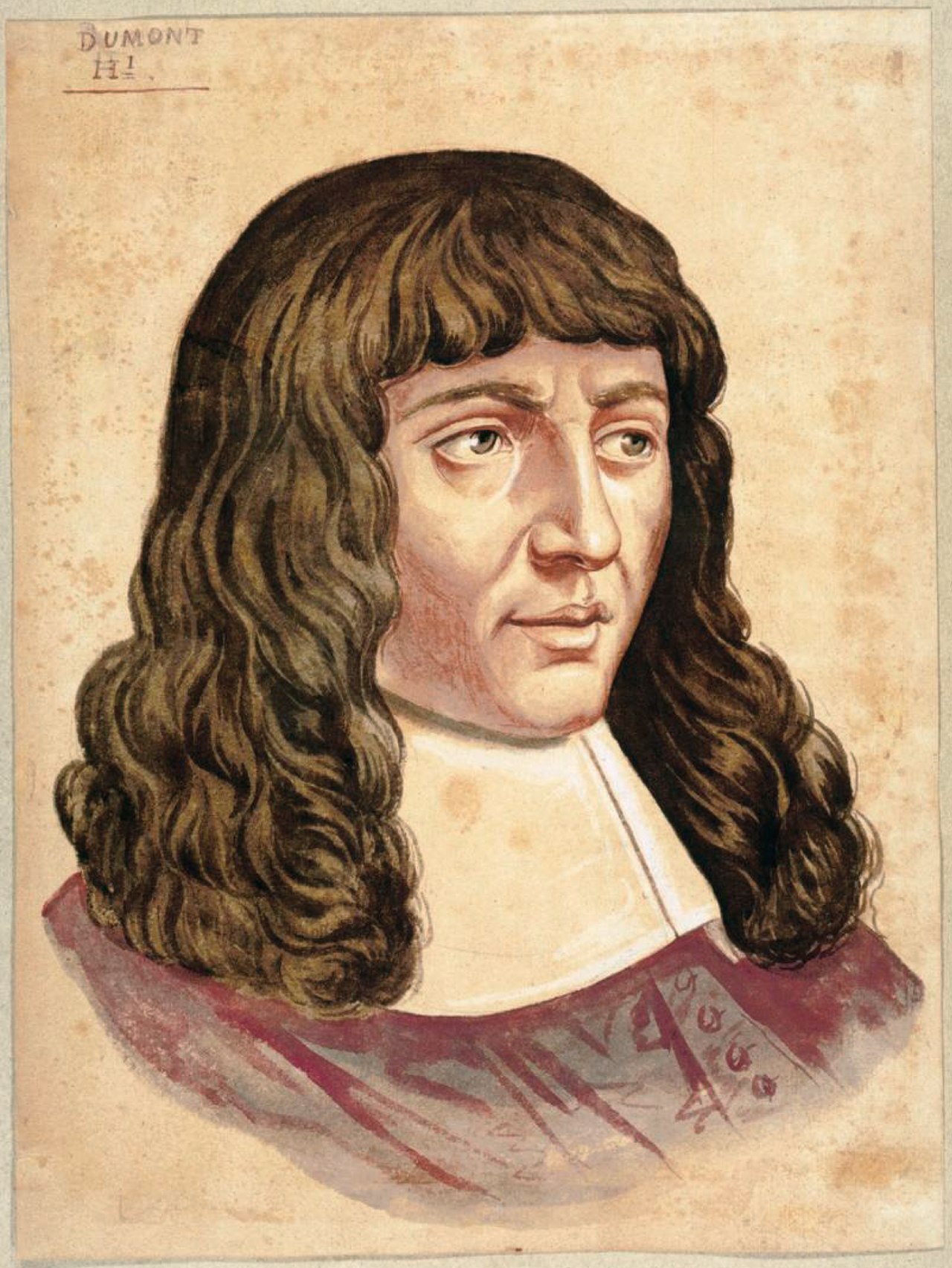
Monogrammiste JD [2] · Goethe Universität · Public domain
- Born
- 1610 · Borgloon.
- Died
- 1684 · Paris.
- Nationality
- France
- Occupation
- composer · organist
- Movements
- classical music · Baroque music
- Teachers
- Léonard de Hodémont · Lambert Pietkin
- Languages
- French
VALÉORINE Encyclopedia
VALÉORINE documentary reading
Documentary summary
Illustration — Mid-18c watercolor, purportedly a portrait of Henri Dumont Henri Dumont (also Henry Du Mont, originally Henry de Thier) (1610 – 8 May 1684) was a baroque composer of the French school, born in the Prince-Bishopric of Liège.
Admitted source layer · organised and presented by VALÉORINE
Note VALÉORINE
Henri Du Mont (1610–1684) was a French composer and organist. Born in Borgloon, the composer died in Paris. Henri Du Mont was associated with Baroque music and classical music.
Composed from admitted, traceable facts · 02 October 2026
VALÉORINE
Reference Check
Propose documentary evidence for Henri Du Mont. A contribution is never written directly as fact: identity, source, rights and evidence gates still decide.
Sign in to contribute
World of VALÉORINE
Documentary connections
Only confirmed graph relationships appear here. Images are shown only when their identity and reuse rights both pass the documentary gate.

Documentary evidence
Documentary basis
Authority files
bnf · gnd · loc · wikidata · Q1364326
In this article
Life
Life
Mont worked between 1610 and 1684 across composer and organist. This article rests on 13 catalogued compositions, 9 issued recordings and 43 scholarly references drawn from named institutional registers. Every statement below returns to a source shown in the evidence panel; where the record is silent or divided, the article says so instead of resolving it.
Dumont was born to Henry de Thier and Elisabeth Orban in Looz (Borgloon). The family moved to Maastricht in 1613, where Henri and his brother Lambert were choirboys at the church of Notre-Dame (i.e., the Basilica of Our Lady). In 1630 he was named organist and given a leave of two months to complete his education. In the principality of Liège (where he spent much of his time) he studied with Léonard de Hodémont (1575–1639), absorbing trends from Italy. On 1 December 1632, he resigned in favor of his brother. In 1639 he went to Paris to become organist at the important parish church of Saint-Paul. From this time he used the name Dumont or Du Mont in place of De Thier. From 1652 he was harpsichordist at the court of the Duke of Anjou (Philippe I, Duke of Orléans, the only brother of Louis XIV), and in 1660 he obtained that post on the household of Louis's young wife Marie-Thérése. In 1663 he became "maitre" of the Chapelle Royale in Versailles, in 1672 "Sous-maître de la musique du Roy" (with Pierre Robert) and in 1673 Master of the Queen's Music. In 1653 Dumont married Mechthild Loyens, daughter of the mayor of Maastricht. As a widower he acquired the substantial benefice of the abbey of Silly near Lisieux in Normandy. In 1683 he resigned the last of his posts and died a year later in Paris.
Works
Works
Source: With the exception of a few songs and the instrumental pieces in the 1657 Meslanges, Dumont was a composer of religious music. His output includes nearly a hundred Petits Motets, the principal French genre of his time; his illustrious successors were Jean-Baptiste Lully and François Couperin. Du Mont was the first to publish separate continuo partbooks in France. • Meslanges à II, III, IV et V parties, avec la basse continue (1657) • Cantica sacra II, III, IV cum vocibus tum instrumentibus modulata. Liber primus, Paris 1652 • Meslanges à II, III, IV et V parties, avec la basse continue (1657) • Cinq Messes en plain-chant musical (1660, reprinted 1701 as Messes Royales en plein chant) • Airs à 4 parties avec la basse continue... sur la paraphrase des psaumes (1663) • Motets à deux voix avec la basse continue (1668) • Motets à deux III et IV parties, pour voix et instruments, avec la basse continue (1681) The most important of these is Meslanges à II, III, IV & V parties avec le Bassecontinue contenant plusieurs chansons, motets, magnificats, Préludes et allemandes pour orgue et pour les viols. Et la litanie de la Vierge, [re]published in partbooks posthumously by Ballard under the title: Motets pour la Chapelle du Roy, mis en musique par Monsieur Dumont Abbé de Silly, et Maistre de la Musique de ladite Chapelle... Imprimez par exprès commandement de Sa Majesté. In addition, the Bibliothèque Nationale holds numerous works in manuscript among which is Dialogus de anima for five voices, a masterpiece that is his only true oratorio.
Grands Motets
Grands Motets
Dumont's grands motets for the Chapelle Royale are the first representatives of the genre. Unlike the later works of Lully, Delalande, Desmarest, Charpentier, Mondonville and Rameau they are not made of successive movements unified by key and thematic material - rather, the versets (without final barline, regardless of what appears in some modern editions) are linked and ordered with a constant eye towards contrast, which can also be seen in the deployment of the performing forces: soloists, groups of soloists, sub-choir, ripieno and orchestra all join, retire, engage in dialogue, and reunite, the solo voices rejoining the choir. The five-part writing is typical of the French grand motet and remained so until the 18th century. Dumont used two violins and two violas [sic], which is noteworthy because it reflects North European practice, whereas Lully used one violin part and three violas. (This likely means clefs; the violin family was not yet standardized.) • Note on pitch: The meantone temperament prevailed in France until the end of the 18th century, above all in religious music using the organ (Dumont's instrument). • Note on instrumentation: The orchestra for grands motets contained théorbos and harpsichord (and organ), violins and viols. His five plainchant masses, known as the Messes Royales, survived up to the mid-20th century (before Vatican II), though they display little of the genius developed in his motet writing. Nevertheless one can still hear them sung at major feasts in a few Catholic places of worship (for example at St Eugène in Paris) and his motets also continue to find a place in the liturgy. In the 1681 Motets à ii iii & iv parties the following note appears, suggesting four singers as the normal size for a choir (as Joshua Rifkin argues in Bach's Chorus: A Preliminary Report): "Quand on voudra deux pourrant chanter dans une mesme Partie, & la petit lettre italique signifie qu'une des deux doit chanter seul, & la grosse lettre ronde pour chanter Tous ensemble comme si c'estoir à deux choeurs."
Life and work
Life and work
Henri Du Mont was born on 1 January 1610 in Borgloon. Mont held the nationality of France. Mont studied under Léonard de Hodémont and Lambert Pietkin. Mont worked as composer and organist. Mont played the organ. Mont worked in French. Mont is placed by the collections within classical music and Baroque music.
Life and career
Dated record
Life and career
Explore 1610–1684
The full dated record · 3 entries
1610
Henri Du Mont was born on 1 January 1610.
1684
Dies at Paris.
1684
Henri Du Mont died on 8 May 1684.
Places
Named by the record
Places
Only places the record itself states, plotted where the house gazetteer settles their coordinates. Nothing is inferred from a name or a nationality.
Borgloon.
Birth place
Paris.
Death place
Catalogued output
Compositions
The entries below are works composed by the subject, as the institutional registers catalogue them; later performances and commercial recordings of the same music are listed separately. 11 further compositions are catalogued under Mont's name without a date the collections agree on, which is why they are set apart from the dated run rather than placed in it. Dum esset Rex — 3 catalogued parts.
The entries follow MusicBrainz
Dixième prélude en ré mineur
Messe Royale de Dumont: XVI. Magnificat du cinquième ton
Quæ est ista
Pavane en ré mineur
Veni sponsa mea
Laisse-moi soupirer, importune raison
Legacy
The anthology Cantica sacra published in 1652 contained motets for 1, 2, 3 or 4 soloists with continuo, the first of their kind in France. What was new was not the use of continuo (for which there was some precedent even among French composers, and there were abundant precedents in Italian scores) but the combining, in sacred music, of solo voices with obbligato instruments, particularly in the petits motets for one or two voices. Here there are many innovations, such as the introduction of typical Italian devices such as vocalise and echo. The grand motets also look forward to those later written for Versailles. The oratorio genre and the recitativo style are both prefigured in the dialogue motets. As to the continuo, if he did not introduce it to France, he was the first to print a separate partbook and thus did much to propagate its use. His grands motets pour la Chapelle Royale (1686) reunite all the formal experiments of his previous work. It is notable that Dumont's motets were sung in parish churches into the 1730s, that is, 60 years after his death.
Recordings
Recordings
• Motets pour la chapelle du roi, Magnificat (La Chapelle royale, Philippe Herreweghe) Harmonia Mundi 1981 • Motets à voix seule (Ricercar Consort, Henri Ledroit haute-contre) Ricercar 1984 • Motets et dialogue (Les Talens Lyriques, Christophe Rousset). Virgin veritas 2004. • Henry Du Mont: O Mysterium, Motets & Élévations, l'Ensemble Correspondances, conducted by Sébastien Daucé, Harmonia Mundi, 2016. • Les litanies de la vierge (Ensemble Dumont, Peter Bennet) Linn 2018 • Grands Motets, Magnificat, Ricercar Consort, Choeur de Chambres de Namur, dir Philippe Pierlot. Ricercar 2002 • A fairly extensive discography
Recordings and discography
Primary material
Recordings and discography
The discography assembled here shows how Mont's work has been published in sound, not what Mont made. 9 sound issues are catalogued, carrying dates from 1984 to 2025. An issue is a published recording, distinct from the composition it carries, from a printed score of that composition and from any single performance of it; none of the entries below is counted in the catalogue of compositions above, and several of them carry the same work in different readings. 1 issue was published within the subject's lifetime and 8 after 1684, so the greater part of this record is the work of later performers, editors and labels. The performers and issuing labels are as the discographic register states them; where it names no performer the article names none.
Motets pour la messe du roy
2002
Cantica Sacra
1992
O mysterium: Motets & Élévations pour la Chapelle de Louis XIV
2016
Partout amour me vient me chercher
2025
Motets à deux voix
1990
Motets Pour La Chapelle Du Roy
1988
Motets à voix seule
1984
Grands motets pour la Chapelle de Louis XIV au Louvre
2005
Authority records
Notes from the source article
Cited by Wikipedia
Notes from the source article
These works are cited by the source article, in its own numbering. They are recorded as its citations, not as sources VALÉORINE has verified.
- 1."New" Portrait.
- 2.CMBV. Grands Motets, Petits Motets, Airs spirituels, Musique instrumentale. boutique.cmbv.fr.
- 3.this note precedes number 37, Cantate Dominum
Bibliography printed in the source article · 1
- Laurence Decobert: Henry Dumont (1610–1684), sous-maître de la chapelle de Louis XIV : contribution à l'histoire de la musique religieuse au Grand Siècle (Lille, 1990)
References
Citations
References
Each reference names the institution holding it, so a reader may go to the document itself.
institutional register
Bibliothèque nationale de France authority file 138935018Bibliothèque nationale de France
Secondary witnessinstitutional register
Secondary witnessinstitutional register
Secondary witnessinstitutional register
GND (German National Library) authority file 11867269XGND (German National Library)
Secondary witnessinstitutional register
IdRef (French universities) authority file 050324659IdRef (French universities)
Secondary witnessinstitutional register
Secondary witnessinstitutional register
Library of Congress authority file n81139129Library of Congress
Secondary witnessinstitutional register
Secondary witness
Every cited source · 11
- 01
Bibliothèque nationale de France authority file 138935018
institutional register · General reference · Bibliothèque nationale de France
Consult the source - 02
Discogs authority file 2226719
institutional register · General reference · Discogs
Consult the source - 03
- 04
GND (German National Library) authority file 11867269X
institutional register · General reference · GND (German National Library)
Consult the source - 05
IdRef (French universities) authority file 050324659
institutional register · General reference · IdRef (French universities)
Consult the source - 06
ISNI authority file 0000000121430577
institutional register · General reference · ISNI
Consult the source - 07
Library of Congress authority file n81139129
institutional register · General reference · Library of Congress
Consult the source - 08
MusicBrainz artist authority
institutional register · General reference · MusicBrainz
Consult the source - 09
National Library of Australia authority file 35907467
institutional register · General reference · National Library of Australia
Consult the source - 10
- 11
Wikidata, structured authority record Q1364326: Henri Du Mont
institutional register · General reference · Wikimedia Foundation
Consult the source
People, houses and institutions
Knowledge graph
People, houses and institutions
Teachers, collaborators, publishers and institutions recorded against this person, each on a stated basis.
Died at
1- ParisPlace
Established from a fact already recorded on a verified source.
The Encyclopedia exists whether or not anything is for sale. Corrections are recorded rather than overwritten, and every version of this record is kept. Published 16 August 2026.
Elsewhere in Music memorabilia
43,117 published records in this field, each with its sources named.
- Henri DèsPerson
- Henri DesmaretsPerson
- Henri Deutsch de la MeurthePerson
- Henri DikonguéPerson
- Henri DuparcPerson
- Henri DutilleuxPerson
- Henri GagnebinPerson
- Henri GaratPerson
Best supported in this field
For owners
Own a work by Henri Du Mont?
A specialist will read what you send and tell you what the house can establish, what it cannot, and whether the object is suited to sale. There is no charge and no obligation. The object stays with you throughout; nothing is shipped to us unless it is arranged in writing beforehand.