
Heinrich Parler the Elder
Heinrich Parler the Elder (also Heinrich of Gmünd, Heinrich von Gemünd der Ältere; c. 1310 – c. 1370), was a German architect and sculptor.
Also recorded as Heinrich Parler · Heinrich I · Heinrich, le vieux Parler
Heinrich Parler the Elder
Gmünder · CC BY-SA 4.0
- Name
- Heinrich Parler the Elder Heinrich von Gemünd der Ältere
- Born
- c. 1310–1320
- Birthplace
- Cologne, Free City of the Holy Roman Empire
- Died
- c. 1370
- Place of death
- Schwäbisch Gmünd, Holy Roman Empire
- Nationality
- Germany
- Occupation
- architect · sculptor · master builder · master of the works
- Languages
- German
VALÉORINE Encyclopedia
VALÉORINE documentary reading
Documentary summary
Heinrich Parler the Elder (also Heinrich of Gmünd, Heinrich von Gemünd der Ältere; c. 1310 – c. 1370), was a German architect and sculptor.
Admitted source layer · organised and presented by VALÉORINE
Reference Check
Propose documentary evidence for Heinrich Parler the Elder. A contribution is never written directly as fact: identity, source, rights and evidence gates still decide.
Sign in to contribute
World of VALÉORINE
Documentary connections
Only confirmed graph relationships appear here. Images are shown only when their identity and reuse rights both pass the documentary gate.
Documentary evidence
Documentary basis
Authority files
wikidata · Q92241 · wikipedia · Heinrich Parler
In this article
Biography
Biography
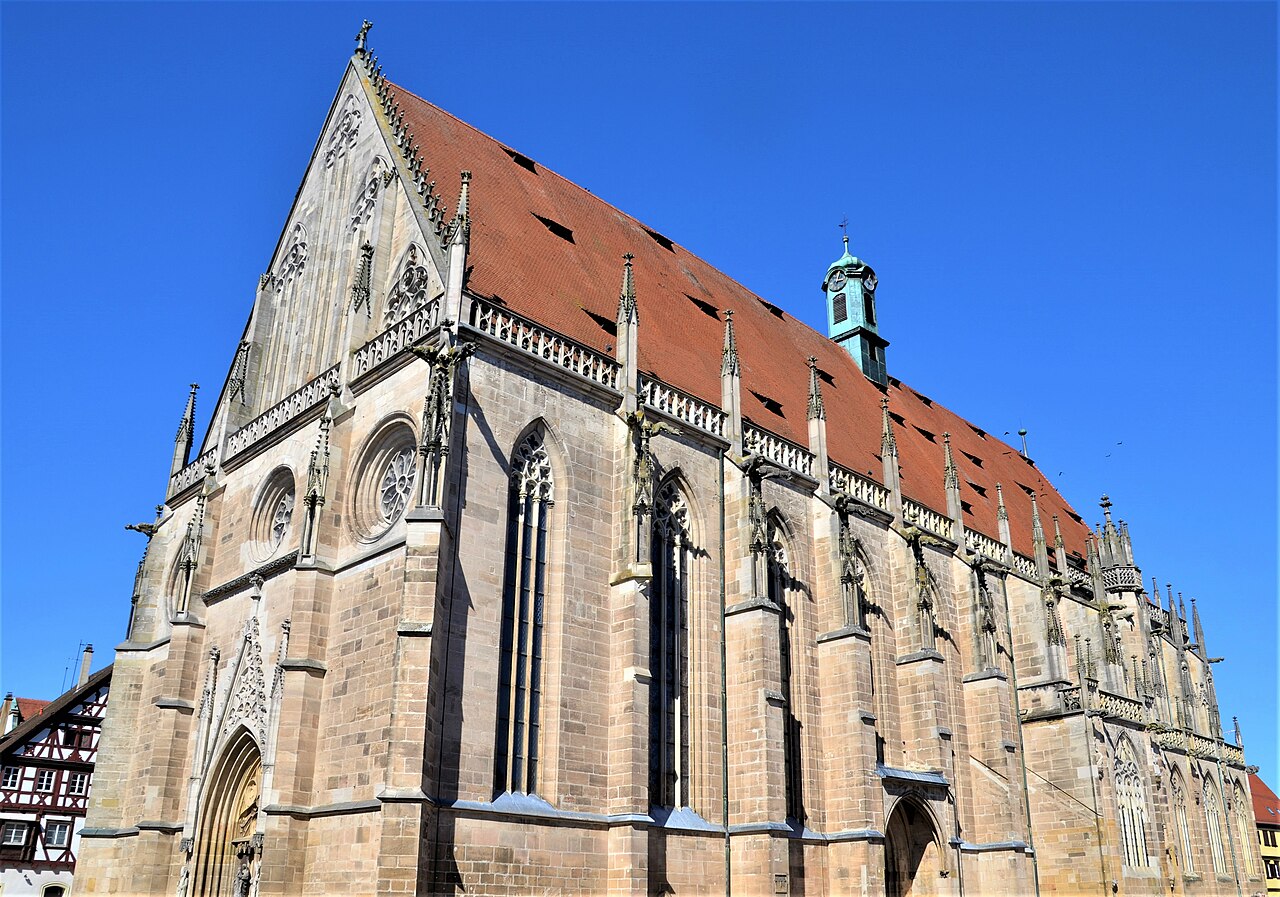
His masterpiece is Holy Cross Minster, an influential milestone of late Gothic architecture in the town of Schwäbisch Gmünd, Baden-Württemberg, Germany. Parler also founded the Parler family of master builders and his descendants worked in various parts of central Europe, especially Bohemia. His son, Peter Parler, became one of the major architects of the Middle Ages. The family name is derived from the word Parlier, meaning "foreman".
Key facts
Key facts
• Name — Heinrich Parler the Elder Heinrich von Gemünd der Ältere • Born — c. 1310–1320 • Birthplace — Cologne, Free City of the Holy Roman Empire • Died — c. 1370 • Place of death — Schwäbisch Gmünd, Holy Roman Empire • Children — Johann Parler the Elder Michael Parler Peter Parler • Significant Buildings — Holy Cross Minster Nuremberg Frauenkirche • Significant Design — Late Gothic
Life and work
Life and work
• Illustration — Nave of Holy Cross Minster • Illustration — Choir of Holy Cross Minster, showing "Parler style" sculptural details depicting the Old Testament Heinrich Parler was probably born in Cologne between 1300 and 1310, where his earliest known work was supervising the construction of Cologne Cathedral. He later lived and worked in Gmünd, an Imperial City (Reichsstädte) of the Holy Roman Empire. Sometime around 1333, Parler was invited to become construction manager of the Holy Cross Minster (Heilig-Kreuz-Münster) in Gmünd. Construction had already begun in 1315 to replace an existing Romanesque church with a Gothic basilica form. He amended the plan of this new building and completed the nave as a hall church (Hallenkirche), the first of its kind in southern Germany. Rounded pillars with leaf wreath capitals, elongated tracery windows, and complex colored vaults are the first tangible evidence of his new style, which became even more pronounced with the laying of the foundation stone of the choir in 1351. His son Peter Parler (1333–1399) began working alongside him on the choir, designed as an ambulatory with chapels lying flat between the buttresses. The number of required internal support columns was therefore reduced and the aisles were built as tall as the nave, creating an expanded sense of space. Heinrich Parler was also responsible for experimental, more lifelike sculptures than had hitherto been created in previous churches. Holy Cross therefore marks an important milestone in late Gothic architecture and sculpture. Father and son did not live to see the consecration of the church, which took place in 1410. Work continued into the 16th century. As was customary, Heinrich the Elder was also responsible for other construction sites in addition to Schwäbisch Gmünd. Although undocumented, he most likely designed the Frauenkirche, Nuremberg working with his son Peter. The relationship between the design of the church is strikingly close to the prototype of Holy Cross Minster. This comparison also applies to the choir of Augsburg Cathedral, begun in 1356. He may also have had a hand in the design of Ulm Minster, begun in 1366 and today the tallest church in the world, although his family members are more clearly documented as carrying forward the work.
Places
Named by the record
Places
Only places the record itself states, plotted where the house gazetteer settles their coordinates. Nothing is inferred from a name or a nationality.
Cologne.
Birth place
Schwäbisch Gmünd.
Death place
Legacy
Heinrich Parler's architectural style and contemporary sculptural designs were taken up by many other masons and further developed, ranking him as one of the most influential craftsman of the 14th century. What became known as the "Parler style" spread across central Europe and can be seen at St. Martin's Church, Landshut; St. Lorenz, Nuremberg; St. George's Minster, Dinkelsbühl; St. Stephen's Cathedral, Vienna; and numerous examples throughout the Hanseatic League from the Netherlands to Poland. Examples can also be found in Scandinavia, such as at St. Mary's, Helsingør, Denmark. Heinrich Parler's son, Peter Parler, became one of the greatest architects of the Gothic era. Heinrich's eldest son, Johann Parler the Elder, worked as a builder in Zwettl and then at Basel Cathedral. Heinrich could have had a brother, the foreman Peter von Reutlingen, who presumably built the Marienkirche and the Nikolaikirche in Reutlingen, Germany.
Primary material
Documents and archives
reference work
- “Heinrich Parler”, English Wikipedia, consulted as further reading
Reputable secondary · Wikipedia
authority record
- Wikidata, structured authority record Q92241: Heinrich Parler the Elder
General reference · Wikidata
Citations
References
Each reference names the institution holding it, so a reader may go to the document itself.
reference work
Secondary witnessauthority record
General reference
The Encyclopedia exists whether or not anything is for sale. Corrections are recorded rather than overwritten, and every version of this record is kept. Published 16 August 2026.
Elsewhere in Sculpture
6,174 published records in this field, each with its sources named.
- Heinrich CharraskyArtist
- Heinrich Karl ScholzArtist
- Heinrich Max ImhofArtist
- Heinrich MeyringArtist
- Heinrich StegemannArtist
- Heinrich WaderéArtist
- Heinz GollArtist
- Heinz HemrichArtist
Best supported in this field
For owners
Own a work by Heinrich Parler the Elder?
A specialist will read what you send and tell you what the house can establish, what it cannot, and whether the object is suited to sale. There is no charge and no obligation. The object stays with you throughout; nothing is shipped to us unless it is arranged in writing beforehand.