
Harry Rountree
Harry Rountree (26 January 1878 – 26 September 1950) was a New Zealand-British illustrator and painter. He worked in England around the turn of the 20th century. Harry Rountree was born in Auckland, New Zealand, he moved to London in 1901, when he was 23 years old.
Harry Rountree
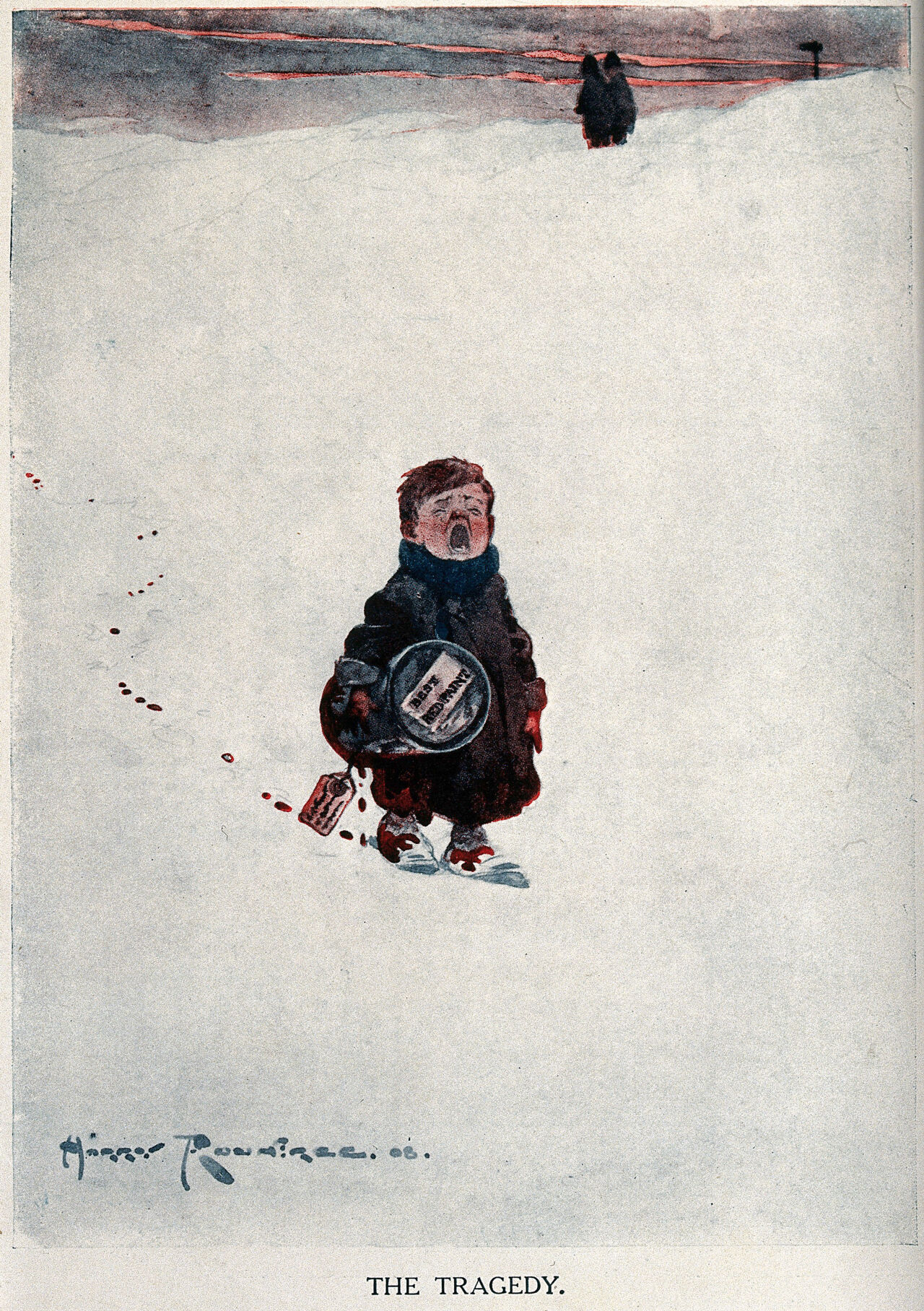
Harry Rountree · Wellcome Collection, London · Wellcome Collection · Public Domain Mark
- Name
- Harry Rountree
- Born
- 26 January 1878
- Birthplace
- Auckland, New Zealand
- Died
- 26 September 1950
- Place of death
- St Ives, Cornwall, England
- Occupation
- Illustrator
- Nationality
- United Kingdom · United Kingdom of Great Britain and Ireland · New Zealand
- Fields
- young adult literature · book illustration
- Languages
- English
VALÉORINE Encyclopedia
VALÉORINE documentary reading
Documentary summary
Harry Rountree (26 January 1878 – 26 September 1950) was a New Zealand-British illustrator and painter. He worked in England around the turn of the 20th century. Harry Rountree was born in Auckland, New Zealand, he moved to London in 1901, when he was 23 years old.
Admitted source layer · organised and presented by VALÉORINE
Reference Check
Propose documentary evidence for Harry Rountree. A contribution is never written directly as fact: identity, source, rights and evidence gates still decide.
Sign in to contribute
World of VALÉORINE
Documentary connections
Only confirmed graph relationships appear here. Images are shown only when their identity and reuse rights both pass the documentary gate.
Documentary evidence
Documentary basis
Authority files
wikidata · Q5672037 · wikipedia · Harry Rountree
In this article
Biography
Biography
The recorded working language is English. The field of work recorded is young adult literature and book illustration. Subjects and genres recorded for the work are landscape. Work by Harry Rountree is recorded in the collections of Auckland Art Gallery and Alexander Turnbull Library.
Key facts
Key facts
• Name — Harry Rountree • Born — 26 January 1878 • Birthplace — Auckland, New Zealand • Died — 26 September 1950 • Place of death — St Ives, Cornwall, England • Occupation — Illustrator • Children — 2
Life
Life
Harry Rountree was born in 1878 to Irish banker, Stephen Gilbert Rountree and Julia Bartley, the niece of New Zealand architect Edward Bartley. Rountree was educated at Auckland's Queen's College, and began working at Wilson and Horton Printers in the city, designing show-cards, advertisements, and product labels. He progressed to become special artist for the Auckland Weekly News, published by Wilson and Horton, with his earliest signed drawings, quite serious in tone and subject matter, appearing in 1899. New Zealand formed part of the readership of the London periodical press at this time and Rountree developed the ambition to join the ranks of its most prominent illustrators. As he later stated in an interview with A B Cooper for The Boy's Own Paper: The first stage to realizing his ambition came with his departure from his employer at the beginning of March 1901: He travelled to England on the Orient Line steamship RMS Omrah, taking with him a portfolio of his work to impress British art editors. Going via the Suez Canal, he left Sydney on 10 April 1901 with members of the New Zealand bowling team. His sketches of one of their number, J V Dingle, completed on arrival in London, were sent home for publication by his former employer. Rather than travel by ship the whole way, Rountree added a Continental flavour to the close of his journey, as was described for the New Zealand Herald by "Our own correspondent. London, June 8": At that time the market for magazine illustration was flourishing: The advent of the halftone block in the late nineteenth century had spawned a great number of successful, long-lived illustrated periodicals such as The Strand (1891) and The Sketch (1893), as well as a number of short-lived ones such as The King. This innovation carried along in its wake a host of capable artists who were as comfortable in wash as in line drawing. Although Rountree contributed many illustrations to The King magazine in mid-late 1901, he struggled to make very much progress towards his objective. His first encounters with art editors provided him with few commissions and little encouragement, so he enrolled in the life drawing class under Percival Gaskell at the Regent Street Polytechnic's School of Art for the academic year 1901-02. He was awarded a second-class pass in July 1902, but by that time had already met Sam Hield Hamer, editor of Little Folks magazine, who invited him to illustrate his story Extracts from the Diary of a Duckling '. By this fortunate meeting, Rountree discovered his forte in animal illustration, which he developed by frequent sketching visits to London Zoo. It was after this commission that Rountree's career began to flourish and he became in demand as an illustrator. Rountree is noted for his illustrations of British golf courses and golfing caricatures. His work features in publications such as The Strand Magazine, Cassell's Magazine, Pearson's, The Sketch, The Illustrated London News, Playtime, Little Folks, and many others. Rountree was one of the leading illustrators selected by Percy Bradshaw for inclusion in his The Art of the Illustrator (1917-1918) which presented a separate portfolio for each of twenty illustrators. Rountree also served as a consultant at the Percy Bradshaw's Press Art School, a school teaching painting, drawing, and illustration by correspondence. The consultants gave feedback on the work submitted by the students. During the First World War, he served as a captain in the Royal Engineers. Rountree produced well-liked cartoons for the magazine Punch from 1905 to 1939, and also created advertising, posters and book illustrations for writers such as P. G. Wodehouse and Arthur Conan Doyle.
Death
Death
Harry Rountree died of cancer in the West Cornwall Hospital, Penzance, Cornwall on 26 September 1950, aged 72 years, being survived by his wife and two children. Fellow artist Bernard Ninnes wrote an appreciation of his work to accompany his obituary in the St Ives Times: As an artist he stood alone in his own sphere as the supreme delineator of bird and animal life. His drawings and paintings in this specialised field bore the authentic stamp of deepest study and intimate familiarity of these subjects; the expression of anatomical diversity, with the constructional variety of fur and feather revealed the sum of a lifetime's keenest observation...To his animals and birds he often gave a whimsical or semi-human twist which has made them loved by generations of children... When first I knew him some twenty years ago at the London Sketch Club and The Savage his charming personality, the wit of his drawings and rare ability as a raconteur made him outstanding in a group which included such names as John Hassall, W Heath Robinson and Lawson Wood. He was one of the grand company of illustrators of the Edwardian and first Georgian period [George V 1910-1936], a time when illustration had reached a pinnacle of excellence, and Harry Rountree was in the van. The probate valuation of his estate was £4581 1s 7d. A commemorative bronze plaque by the sculptor W. C. H. King was erected on Smeaton's Pier, St Ives for his contribution to the artistic and civic life of the town.
Periodicals
Periodicals
By title, including annuals, containing Harry Rountree's illustrations within the years (not necessarily all) indicated. A representative sample from a total in excess of 100. Source: • Auckland Weekly News, Wilson and Horton, 1899-1936 • Blackie's Children's Annual, Blackie and Son, 1913-1935 • Blighty, W. Speaight & Sons, 1916-1917; 1939-1943 • The Boy's Own Paper, Religious Tract Society, 1902-1944 • Bystander, H. R. Baines & Co., 1903-1930 • The Captain, George Newnes, 1901-1923 • Cassell's Children's Annual, Cassell, 1916-1933 • Fry's Magazine, George Newnes, 1905-1914 • Golf Illustrated, Golf Illustrated, 1909-1932 • The Humorist, George Newnes, 1922-1929 • Illustrated Sporting & Dramatic News, Illustrated Newspapers, 1911-1932 • I Pass This On To You, Women's Gas Council, 1940-1951 • Joy Street, Basil Blackwell, 1924-1936 • The King, George Newnes, 1901-1902 • Little Folks, Cassell, 1902-1933 • London Opinion, George Newnes, 1909-1931 • The Merry-Go-Round, Basil Blackwell, 1923-1939 • Little Dots|Our Little Dots/Little Dots, RTS, 1928-1936 • The Passing Show, Odhams, 1915-1934 • Pearson's Magazine, Pearson, 1905-1935 • Playtime, Amalgamated Press, 1919-1920 • The Prize, Wells Gardner, Darton and Co., 1910-1933 • Punch, or the London Charivari, Punch Office, 1906-1939 • The Quiver, Cassell, 1903-1932 • Radio Times, BBC, 1929-1944 • The Red Magazine, Amalgamated Press, 1910-1920 • The Royal Magazine, Pearson, 1904-1922 • The Sketch, Illustrated London News & Sketch, 1905-1942 • The Strand Magazine, George Newnes, 1902-1930 • Sunday Reading for the Young, Wells Gardner, Darton, and Co., 1902-1915 • The Tatler, Nineteen Hundred Publishing, 1904-1937 • Tiny Tots, Cassell, 1907-1926 • The Wide World Magazine, George Newnes, 1902-1924 • Wonderland Annual, Amalgamated Press, 1920-1929 • Zoo, Odhams, 1936-1938
Identity
Identity
Harry Rountree is recorded as a citizen of United Kingdom of Great Britain and Ireland. Recorded with the occupation landscape painter. Classed in the genre landscape painting.
Life and career
Dated record
Life and career
The full dated record · 2 entries
1878
Harry Rountree was born on 26 January 1878.
1950
Harry Rountree died on 26 September 1950.
Places
Named by the record
Places
Only places the record itself states, plotted where the house gazetteer settles their coordinates. Nothing is inferred from a name or a nationality.
Auckland.
Birth place
Penzance.
Death place
Books
Illustrated, and occasionally authored or co-authored, by Harry Rountree. A representative sample from a total, with editions, numbering in excess of 400. Source: • Harry Rountree, The Animal Game Book, George Allen, 1903 • Harry Rountree, The Child's Book of Knowledge, Grant Richards, 1903 • Harry Rountree & S H Hamer, Quackles Junior, Cassell, 1903 • Harry A. Spurr (ed.), Fairy Tales by Dumas, Frederick A. Stokes, 1904 • Harry Rountree & S H Hamer, Archibald's Amazing Adventure, Or, The Tip-top Tale, Cassell, 1905 • E. Nesbit, Pug Peter, Alf Cooke, 1905 • S H Hamer & Harry Rountree, The Young Gullivers, Cassell, 1906 • Amy Steadman (ed.), Stories from Grimm, T C & E C Jack, 1906 • Joel Chandler Harris, Uncle Remus, Thomas Nelson, 1906 • J James Ridge, Toksikatem Castle, S W Partridge, 1906 • Harry Rountree, Harry Rountree's Annual, Cassell, 1907 • Alton Towers, Billy Bunce, Alf Cooke, 1907 • G. E. Mitton (ed.), The Swiss Family Robinson, A & C Black, 1907 • Bertram Atkey, Folk of the Wild, Grant Richards, 1907 • Lewis Carroll, Alice's Adventures in Wonderland, Thomas Nelson, 1908 • S H Hamer, The Forest Foundling, Duckworth, 1908 • S H Hamer, The Dolomites, Methuen, 1910 • Bernard Darwin, The Golf Courses of the British Isles, Duckworth, 1910 • Baldwin S Harvey, The Magic Dragon, Duckworth, 1911 • various writers, The Spell of the Open Air, T N Foulis, c.1912 • Richard Jefferies, Bevis, The Story of a Boy, Duckworth, 1913 • Charles S Bayne (ed.), My Book of Best Fairy Tales, Cassell, 1915 • Harry Rountree, Rountree's Ridiculous Rabbits (1 & 2), H Stevenson, 1916 • Christine Chaundler, Little Squirrel Tickletail, Cassell, 1917 • Albert Bigelow Paine, The Arkansaw Bear, George G. Harrap, 1919 • Sir William Schooling, The Hudson's Bay Company 1670-1920, HBC, 1920 • Blanche Winder (retold by), Aesop's Fables, Ward, Lock, 1924 • Mabel Marlowe, The Wiggly Weasel, Basil Blackwell, 1924 • Who's Who at the Zoo, Dean's Rag Book Co., 1925 • Mabel Marlowe, Lazy Lob, Basil Blackwell, 1926 • Lewis Carroll, Alice in Wonderland & Through the Looking Glass, Collins Clear-Type Press, 1928 • Hector Bolitho, The New Zealanders, J. M. Dent, 1928 • Richard P Russ, Caesar, The Life Story of a Panda Leopard, G. P. Putnam's Sons, 1930 • Lynda Rountree, Ronald, Rupert and Reg, Frederick Warne, 1930 • L & H Rountree and C E Bradley, Dicky Duck & Wonderful Walter, Frederick Warne, 1931 • Olwen Bowen, Beetles and Things, Elkin Mathews, 1931 • Aesop's Fables, Collins, Children's Press, 1934 • A Book about Animals, Blackie & Son, 1934 • Peter Lawless (ed.), The Golfer's Companion, J M Dent, 1937 • High Jinks, Birn Brothers, 1937 • Olive Dehn, The Nixie from Rotterdam, Basil Blackwell, 1937 • Viola Bayley, The Ways of Wonderland, James Nisbet, 1937 • Enid Blyton, The Children of Cherry Tree Farm, Country Life, 1940 • Enid Blyton, The Secret Mountain, Basil Blackwell, 1941 • Christine Chaundler, The Odd Ones, Country Life, 1941 • Little Things, WHC [W H Cornelius], c.1944 • Charles Heslop, The Farmyard in Spring [one of four], c.1945 • Winifred Humphreys, Wog & Wig, Franklyn Ward & Wheeler, 1947 • Hugh Gardner, Bruno Bear, Edmund Ward, 1951
Primary material
Documents and archives
scholarly publication
- Rountree, Harry (1878–1950), illustrator and commercial artist, Oxford Dictionary of National Biography, 2018
Scholarly · Crossref registry · 2018
reference work
- “Harry Rountree”, English Wikipedia, consulted as further reading
Reputable secondary · Wikipedia
authority record
- Wikidata, structured authority record Q5672037: Harry Rountree
General reference · Wikidata
Notes from the source article
Cited by Wikipedia
Notes from the source article
These works are cited by the source article, in its own numbering. They are recorded as its citations, not as sources VALÉORINE has verified.
- 1.1939 England and Wales Register
- 2.Deaths. The Times. 1. 27 September 1950.
- 3.Mr. Harry Rountree. The Times. 6. 27 September 1950.
- 4.1911 England Census
- 5.Bartley Archive: Julia Bartley and Steven Rountree. 4 May 2015.
- 6.Harry Rountree Science Museum Group Collection. collection.sciencemuseumgroup.org.uk.
- 7.Cooper, A B. Men of Today: A 'BOP' chat with Mr Harry Rountree. Boy's Own Paper. 32. 1615. 204–207. 25 Dec 1909.
- 8.New Zealand Herald. p2 suppl., 22 Mar 1901
- 9.Auckland Weekly News p11, 26 July 1901.
- 10.New Zealand Herald, p6, 10 July 1901.
- 11.Pirie, Michael. "Studies in Illustration," Imaginative Book Illustration Society No. 59 (Spring 2015), p. 12.
- 12.Pirie, Michael. "Rountree, Harry (1878-1950)," Oxford Dictionary of National Biography (09 May 2018).
- 13.Bernard Richard Meirion Darwin, Harry Rountree (illus). The Golf Courses of the British Isles, published by London: Duckworth, 1910, via Internet Archive
- 14.JVJ Illustrators. Retrieved Apr. 20, 2021.
- 15."Harry Rountree Cartoons," Punch website. Retrieved Apr. 20, 2021.
- 16."Passing of a Great Artist", St Ives Times, 29 September 1950, p. 6.
- 17.Rountree, Harry. CGPLA Eng. & Wales. 22 Feb 1951.
- 18.Studies in Illustration No. 63, Imaginative Book Illustration Society (Summer 2016).
- 19.Studies in Illustration No. 62, Imaginative Book Illustration Society (Spring 2016).
- 20.The Connisseur Bookself. The Connoisseur: An Illustrated Magazine for Collectors. 51. 204. 223. 1918-08-01.
- 21.Harry Rountree: Harry Rountree and His Work: The Art of the Illustrator (Limited Edition Prints). Illustration Art Gallery with The Book Palace.
- 22.Bryant, Mark. Dictionary of Twentieth-Century British Cartoonists and Caricaturists. Routledge. 2018.
References
Citations
References
Each reference names the institution holding it, so a reader may go to the document itself.
scholarly publication
Rountree, Harry (1878–1950), illustrator and commercial artist, Oxford Dictionary of National Biography, 2018Crossref registry
Institutional witnessreference work
Secondary witnessauthority record
General reference
The Encyclopedia exists whether or not anything is for sale. Corrections are recorded rather than overwritten, and every version of this record is kept. Published 16 August 2026.
Elsewhere in Comics and comic art
9,920 published records in this field, each with its sources named.
- Harry JuliusArtist
- Harry LampertArtist
- Harry MayerovitchArtist
- Harry PaschallArtist
- Hart AmosArtist
- Haru Natsu Aki FuyuSeries
- Haru no NoroiSeries
- Haruka FukushimaArtist
Best supported in this field
For owners
Own a work by Harry Rountree?
A specialist will read what you send and tell you what the house can establish, what it cannot, and whether the object is suited to sale. There is no charge and no obligation. The object stays with you throughout; nothing is shipped to us unless it is arranged in writing beforehand.