
hand mortar
The hand mortar is a firearm and early predecessor of modern grenade launchers that was used in the late 17th century and 18th century to throw fused grenades. The action was similar to a flintlock, matchlock, or wheellock firearm (depending on the date of production), but the barrel was short, usually 2 inches (5.1 cm) to 4 inches (10 cm) long (though some are reported to have barrels up to 13 inches (33 cm) long), and had a large bore to accommodate the grenade; usually between 2 and 2.5 inches (5.1 and 6.4 centimetres).
hand mortar

Gun Powder Ma · CC BY-SA 3.0
- Field
- firearm.
- Period
- 1681.
VALÉORINE Encyclopedia
VALÉORINE documentary reading
Documentary summary
The hand mortar is a firearm and early predecessor of modern grenade launchers that was used in the late 17th century and 18th century to throw fused grenades. The action was similar to a flintlock, matchlock, or wheellock firearm (depending on the date of production), but the barrel was short, usually 2 inches (5.1 cm) to 4 inches (10 cm) long (though some are reported to have barrels up to 13 inches (33 cm) long), and had a large bore to accommodate the grenade; usually between 2 and 2.5 inches (5.1 and 6.4 centimetres).
Admitted source layer · organised and presented by VALÉORINE
Note VALÉORINE
No house-authored Note is published until its assertions and sources pass the VALÉORINE evidence contract. The documentary article remains available in full while that enrichment is being consolidated.
Documentary enrichment in progress · no unsupported statement published
Reference Check
Propose documentary evidence for hand mortar. A contribution is never written directly as fact: identity, source, rights and evidence gates still decide.
Sign in to contribute
World of VALÉORINE
Documentary connections
Only confirmed graph relationships appear here. Images are shown only when their identity and reuse rights both pass the documentary gate.

Documentary evidence
Evidence Panel
original value insufficient · checked 25 September 2026
- Identity
- resolved
- Independent source families
- 0
- Admitted assertions
- 0
- Open conflicts
- 0
Authority files
wikidata · Q3863211 · wikipedia · Hand mortar
In this article
Usage
Usage
After priming the firearm and adding the gunpowder, the shooter would light a grenade fuse, place the grenade in the muzzle of the mortar, then fire it at the enemy. However, accidents could occur if the weapon misfired and the lit grenade remained in the barrel. Additional modifications attempted to light the grenade using the burning gunpowder, but accounts say that the fuse would be forced into the grenade, detonating it prematurely. The low number of surviving specimens of this firearm indicate that it was not a popular weapon, possibly due to the safety issues. In his essay on the weapon, Hewitt opines that the mortar is among a variety of "projects for destruction which have never destroyed anything but the fortunes of their inventors." In fact, under military exhibitions in The Official Report of the Calcutta International Exhibition, 1883–84 a hand mortar is described as "only a toy... never intended for service." Hand mortars were also to be found in the New World. References to a hand mortar being transferred in Maryland are found in the record of The Proceedings of the Council of Maryland in 1698.
Naval usage
Inventors
Inventors
At least one version of the hand mortar was probably invented by John Tinker in 1681. However, his mortar may have been an improvement on an earlier piece. A reference to this mortar may have appeared in a work titled Ancient Armour which refers to a tinker's mortar. Another account refers to a hand mortar as a coehorn, and attributes its invention to a Dutch engineer, Menno Van Coehoorn, who lived from 1641 to 1704.
Production
Production
Between 1672 and 1740, the Royal Foundry of Berlin (Königliches Gießhaus zu Berlin) produced 302 hand mortars (Handmörser). Additionally, a mortar at the Museum of Artillery in Woolwich, Great Britain bears the inscription Fondeur á Strasbourg (made in Strasbourg (France)) and several other surviving pieces bear the coat of arms of Württemberg indicating that they might have been made there.
Ammunition
Ammunition
The first references to the type of grenade used in a hand mortar occur in a 1472 work titled Valturius, where an incendiary prototype may have been produced. However, widespread use of the explosive grenade does not occur until the early-to-mid-16th century under Francis I of France. An early casualty of this type of grenade was Count de Randan who died of shrapnel wounds to the legs from a grenade during the Siege of Rouen (probably the battle of Issoire) in 1562. Explosive grenades were made from brass, glass, and possibly clay, and incendiary projectiles were made from canvas, however, Nathanael Nye, Master Gunner of the City of Worcester in a work titled Art of Gunnery published in 1647, remarks that the soldiers of his day were not fond of handling the grenades because they were too dangerous. While there are substantial records of infantry units called grenadiers throughout the 18th century in Europe, these units generally threw the grenades by hand.

Wheellock and matchlock hand mortar dating from 1590s now in the british museum reg number 1881,8-2,135 or 1881,0802.135
Geni · Photo by user:geni
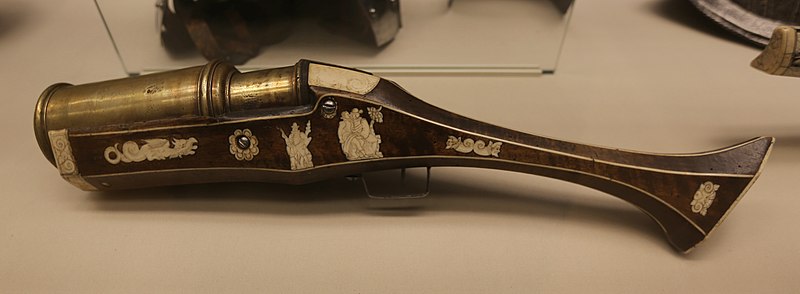
Wheellock and matchlock hand mortar dating from 1590s now in the british museum reg number 1881,8-2,135 or 1881,0802.135
Geni · Photo by user:geni
Chronology
Dated record
Chronology
Explore 1681
The full dated record · 3 entries
1681
hand mortar first recorded.
1681
hand mortar is recorded from 1681.
1681
hand mortar was established or created in 1681.
Primary material
Documents and archives
reference work
- “Hand mortar”, English Wikipedia, consulted as further reading
Reputable secondary · Wikipedia
authority record
- Wikidata, structured authority record Q3863211: hand mortar
Unverified · Wikidata
Notes from the source article
Cited by Wikipedia
Notes from the source article
These works are cited by the source article, in its own numbering. They are recorded as its citations, not as sources VALÉORINE has verified.
- 1.Hand mortars: An early grenade launchers used from the 1500s through the early 1800s. 29 October 2016.
- 2.Claude Blair, Pollards History of Firearms Ed. 1983, pp 56–58, 92
- 3.gentlemenoffortune.com. handmortar.
- 4.Hewitt, John. The Archaeological Journal. Longman, Rrown (sic), Green, and Longman. 1866.
- 5.Bengal Secretariat Press. Official Report of the Calcutta International Exhibition, 1883–84: Compiled Under the Orders of the Executive Committee. 2. 676. 1885.
- 6.Maryland Historical Society. Archives of Maryland. 23. 459. 1903.
- 7.Forbes, R.B. Life-boats, Projectiles and Other Means for Saving Life. W. P. Lunt. 24. 1872.
- 8.Blair, pp 92
- 9.Meyer, H.J. Meyers Konversations-Lexikon: Eine Encyklopädie des allgemeinen Wissens. Bibliographisches Institut. 4. 195. 1889.
- 10.F. P. Harper. The Red river of the North. 428. 1897.
- 11.:de:Königliches Gießhaus
- 12.James, G.P.R. The Life of Henry the Fourth, King of France and Navarre. Harper & Brothers. v. 1–2. 1–261. 1847.
- 13.Illustrated Naval and Military Magazine: A Monthly Journal Devoted to All Subjects Connected with Her Majesty's Land and Sea Forces. 8. 310. 1888.
References
Citations
References
Each reference names the institution holding it, so a reader may go to the document itself.
reference work
Partially resolvedauthority record
Unverified
Connections
Knowledge graph
Connections
Each connection was recorded deliberately, with the basis for it kept on the internal record.
Broader subject
1- firearmTerminology
Established from a fact already recorded on a verified source.
The Encyclopedia exists whether or not anything is for sale. Corrections are recorded rather than overwritten, and every version of this record is kept. Published 14 August 2026.
Elsewhere in Militaria
6,095 published records in this field, each with its sources named.
- Hamada Type pistolTerminology
- hamayaTerminology
- hand cannonTerminology
- hand grenadeTerminology
- handgunTerminology
- Hanyang 88Terminology
- Harbin Z-19 Black WhirlwindTerminology
- Hard Mobile LauncherTerminology
Best supported in this field
For owners
Own an object connected with hand mortar?
A specialist will read what you send and tell you what the house can establish, what it cannot, and whether the object is suited to sale. There is no charge and no obligation. The object stays with you throughout; nothing is shipped to us unless it is arranged in writing beforehand.