
H. S. Wong
Illustration — H. "Newsreel" Wong • Illustration — "Bloody Saturday", Wong's most famous photograph H. "Newsreel" Wong (1900March 9, 1981) was a Chinese newsreel photojournalist. He is most notable for Bloody Saturday, a photograph of a crying baby in Shanghai that he took during the Second Sino-Japanese War. Wong was also known as Wang Haisheng or Wang Xiaoting.
Also recorded as H.S. Wong · Newsreel Wong · Wang Haisheng · Wang Xiaoting
H. S. Wong

H. S. Wong · Public domain
- Born
- 1900 · Beijing.
- Died
- 1981 · Taipei.
- Occupation
- photographer · photojournalist · camera operator · journalist
- Fields
- photography
VALÉORINE Encyclopedia
VALÉORINE documentary reading
Documentary summary
Illustration — H. "Newsreel" Wong • Illustration — "Bloody Saturday", Wong's most famous photograph H. "Newsreel" Wong (1900March 9, 1981) was a Chinese newsreel photojournalist. He is most notable for Bloody Saturday, a photograph of a crying baby in Shanghai that he took during the Second Sino-Japanese War. Wong was also known as Wang Haisheng or Wang Xiaoting.
Admitted source layer · organised and presented by VALÉORINE
Reference Check
Propose documentary evidence for H. S. Wong. A contribution is never written directly as fact: identity, source, rights and evidence gates still decide.
Sign in to contribute
Documentary evidence
Documentary basis
Authority files
wikidata · Q262117 · wikipedia · H. S. Wong
In this article
Career
Career
He owned a camera shop in Shanghai. For capturing moving images he used an Eyemo newsreel camera, and for still photography he used a Leica.
In the 1920s and 1930s, H. S. Wong worked in China and provided photographs and films for various newspapers and agencies, such as Hearst Metrotone News and Shanghai News. Wong's most famous photo, "Bloody Saturday" or "Shanghai Baby", was taken during the Battle of Shanghai in the Second Sino-Japanese War. It shows a baby sitting up and crying amid the bombed-out wreckage of Shanghai South Railway Station. Within a year of its publishing, the photo was seen by more than 136 million people. In 2010, Wong was honored as a pioneering Asian-American journalist by the Asian American Journalists Association. Wong filmed more newsreels covering Japanese attacks in China, including the Battle of Xuzhou in May 1938 and aerial bombings in Guangzhou in June. At times, he placed himself in danger to get a photo; once was subjected to bombing and strafing by Japanese aircraft. After angering the Japanese by documenting the violence of their attacks, the Japanese government put a bounty of $50,000 on his head. In China, he operated under British protection, but continued death threats from Japanese nationalists drove him to leave Shanghai with his family and to relocate to Hong Kong.
Later life and death
Later life and death
Wong retired to Taipei in the 1970s and died of diabetes at his home at the age of 81 on March 9, 1981.

This terrified baby was almost the only human being left alive in Shanghai's South Station after brutal Japanese bombing. China, August 28, 1937. H.S. Wong. (OWI) NARA FILE #: 208-AA-132N-2 WAR CONFLICT BOOK #: 1131
H. S. Wong · http: t=2
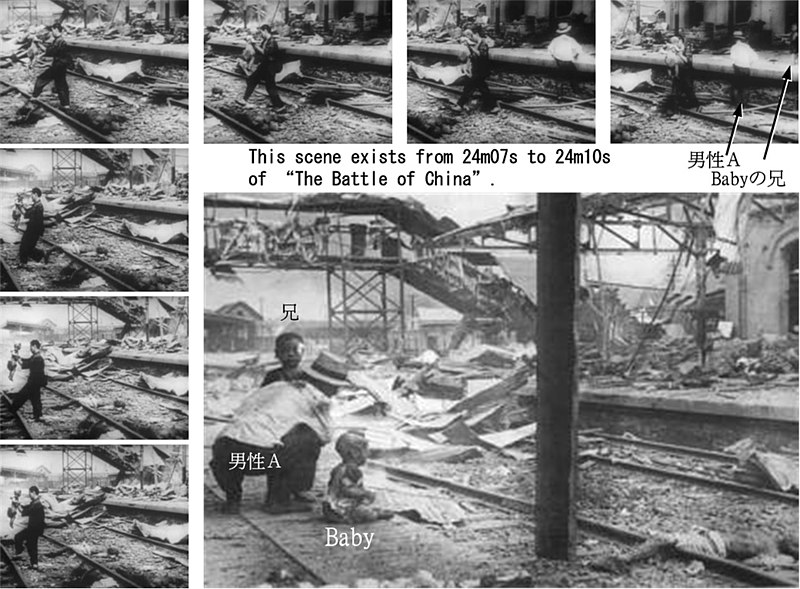
The removal of the baby in "Bloody Saturday" from the other dead and wounded in Shanghai's old South Railway station during the Japanese terror bombing of civilian Shanghai (1937). The Japanese text claims that the older boy is the baby's brother (兄) and omits mention of other victims, including the baby's dead mother. (男性A simply means "Man A".) Contrary to the sourcing below, only the baby being
H. S. Wong (王小亭), Frank Capra · ja:File:The baby setuped by Wang s staff.jpg uploaded by ja:User:Hare-Yukai, Battle of China
Places
Named by the record
Places
Only places the record itself states, plotted where the house gazetteer settles their coordinates. Nothing is inferred from a name or a nationality.
Beijing.
Birth place
Taipei.
Death place
Notes from the source article
Cited by Wikipedia
Notes from the source article
These works are cited by the source article, in its own numbering. They are recorded as its citations, not as sources VALÉORINE has verified.
- 1.Time, Inc. Cinema: Shanghai, Shambl. Time. September 13, 1937.
- 2.imagecoffee.net. 王小亭 1900~1983. 《他們是歷史的目擊者》─民國40年代台灣攝影記者作品展.
- 3.邢定威. 王小亭"觀看"的力量. 台灣記協 (Association of Taiwan Journalists). 2005-09-01.
- 4.Van der Veen, Maurits. Uriel's Legacy. Trafford Publishing. 262. 2003. 1-55395-462-9.
- 5.Asian American Journalists Association. Honor Roll List: Pioneers, past and present. December 24, 2010.
- 6.UCLA Film and Television Archive. Library Contents Listed Year-by-Year: 1938. The 1930s: Prelude to War Video Library.
- 7.Ezickson, A. J. Get That Picture! – The Story of the News Cameraman. National Library Press. 148. 1938.
- 8.French, Paul. Through the looking glass: China's foreign journalists from opium wars to Mao. Hong Kong University Press. 192. 2009. 978-962-209-982-1.
- 9.Faber, John. Great news photos and the stories behind them. Courier Dover Publications. 74–75. 1978. 0-486-23667-6.
- 10.'Newsreel' Wang succumbs at 81. Taiwan Today. May 1, 1981.
References
Citations
References
Each reference names the institution holding it, so a reader may go to the document itself.
reference work
Secondary witnessreference work
Secondary witness
The Encyclopedia exists whether or not anything is for sale. Corrections are recorded rather than overwritten, and every version of this record is kept. Published 18 August 2026.
Elsewhere in Photography
11,393 published records in this field, each with its sources named.
- H. H. BennettPhotographer
- H. H. TilbrookPhotographer
- H. R. LockePhotographer
- H. ReidPhotographer
- H. W. BradleyPhotographer
- Hadoram ShirihaiPhotographer
- Haim SteinbachPhotographer
- Haje Jan KampsPhotographer
Best supported in this field
For owners
Own a work by H. S. Wong?
A specialist will read what you send and tell you what the house can establish, what it cannot, and whether the object is suited to sale. There is no charge and no obligation. The object stays with you throughout; nothing is shipped to us unless it is arranged in writing beforehand.