
Gunnar Fischer
Gunnar Fischer (18 November 1910 – 11 June 2011) was a Swedish cinematographer who worked with director Ingmar Bergman on several of the director's best-known films, including Smiles of a Summer Night (1955) and The Seventh Seal (1957). In addition to his career as cinematographer, Gunnar Fischer directed short films, wrote screenplays (1933–41) and published books for children.
Gunnar Fischer
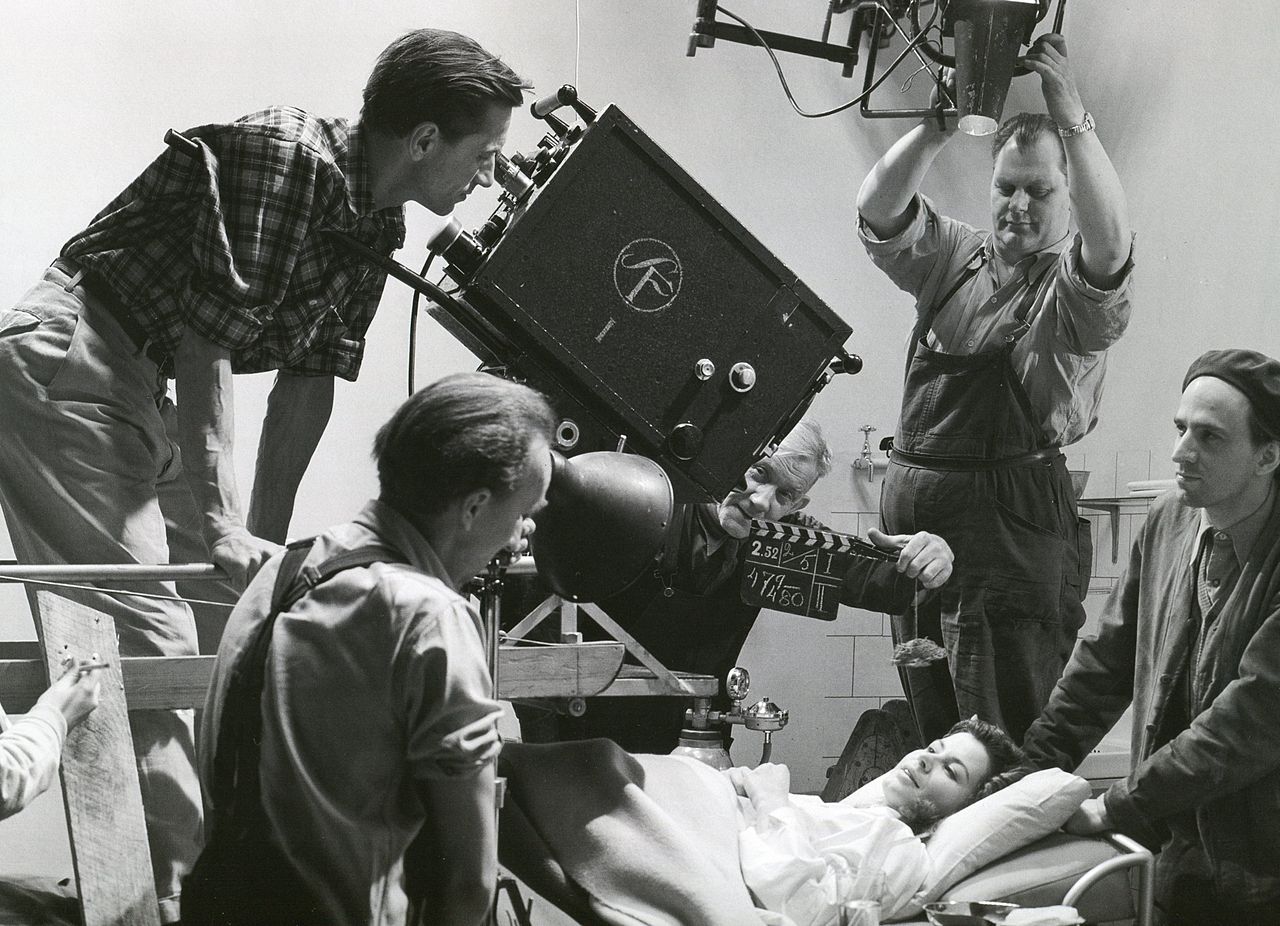
Louis Huch · Svensk Filmindustri · Public domain
- Name
- Gunnar Fischer
- Born
- 18 November 1910
- Birthplace
- Ljungby, Sweden
- Died
- 11 June 2011
- Place of death
- Stockholm, Sweden
- Occupation
- Photography director, cinematographer
- Nationality
- Sweden
- Honours
- Ingmar Bergman Award
VALÉORINE Encyclopedia
VALÉORINE documentary reading
Documentary summary
Gunnar Fischer (18 November 1910 – 11 June 2011) was a Swedish cinematographer who worked with director Ingmar Bergman on several of the director's best-known films, including Smiles of a Summer Night (1955) and The Seventh Seal (1957). In addition to his career as cinematographer, Gunnar Fischer directed short films, wrote screenplays (1933–41) and published books for children.
Admitted source layer · organised and presented by VALÉORINE
Note VALÉORINE
No house-authored Note is published until its assertions and sources pass the VALÉORINE evidence contract. The documentary article remains available in full while that enrichment is being consolidated.
Documentary enrichment in progress · no unsupported statement published
Reference Check
Propose documentary evidence for Gunnar Fischer. A contribution is never written directly as fact: identity, source, rights and evidence gates still decide.
Sign in to contribute
Documentary evidence
Evidence Panel
not yet certified
- Identity
- resolved
- Independent source families
- 0
- Admitted assertions
- 0
- Open conflicts
- 0
Authority files
wikidata · Q965067 · wikipedia · Gunnar Fischer
In this article
Key facts
Key facts
• Name — Gunnar Fischer • Born — 18 November 1910 • Birthplace — Ljungby, Sweden • Died — 11 June 2011 • Place of death — Stockholm, Sweden • Occupation — Photography director, cinematographer • Children — Jens Fischer, Peter Fischer
Early life
Early life
• Illustration — Fischer (behind the camera), Maj-Britt Nilsson (lying down) and Ingmar Bergman (right) on the set of Secrets of Women, 1952. • Illustration — Fischer (at the top of the ladder) on the set of The Seventh Seal, 1957. Gunnar Fischer was born in Ljungby, Sweden, on 18 November 1910, the son of Gunnar Fischer and Greta Fischer. Greta’s foster father was J. H. Lallerstedt. His paternal grandfather was Elis Fischer, a bank director at Skandia. His family later moved to Ronneby, where Fischer spent most of his childhood. After the death of his father in 1931, the family moved to Stockholm.
Education
Education
Fischer studied painting with Otte Sköld before electing to join the Swedish Navy for 3 years. His passion for film led him to the Svensk Filmindustri in 1935 where he learned cinematography from Victor Sjöström's photographer Julius Jaenzon. Acting as an assistant cameraman for 16 feature films, he made his debut as director of photography in 1942.
Career
Career
Known for his work with directors Bergman and Carl Theodor Dreyer (Two People, 1945), as well as work with Walt Disney, Fischer received an honorary Guldbagge Award for lifetime achievement in 2002, as well as the Ingmar Bergman Award in 1992. His first collaboration with Bergman was on the melodrama Port of Call (1948), a partnership which continued until The Devil's Eye (1960). Fischer has been quoted saying the two men were never each other's "bowing servants" yet his admiration for Bergman stood firm: "I felt privileged collaborating with Bergman." "Fischer's great skill was in monochrome," according to the British film historian Peter Cowie. "He gave Bergman's films that unique expressionist look, with their brilliant contrasts in every gradation of black and white." His style was drawn from the landscapes of Carl Theodore Dreyer and Victor Sjöström, whom he knew well. The International Dictionary of Films and Filmmakers describes Fischer's style as "in the mainstream of the Scandinavian tradition," and celebrates the close and "intensely psychological close-ups and two-shots." Widely recognized for his striking imagery and cold lighting, Fischer was the "first cinematographer to capture with unparalleled beauty the cruelty, sensuality and selfishness that often collided in the same scene among Bergman's anguished characters." Almost as striking was the camerawork for Bergman’s historical feature The Seventh Seal, which depicted a medieval encounter between a knight back from the Crusades and the figure of Death. Told in stark black and white, its most famous scene featured them playing chess together on a bleak Nordic beach. Borrowing a trick from the stage, Fischer lit the shot so that both men were seen in sharp relief against the dark, brooding waves. Pedants insisted that this image was impossible as it implied the existence of two suns in different quarters of the sky; Fischer dismissed the criticism on the ground that if the very notion of a knight playing chess with Death were accepted, two suns in the sky should be no more incredible.
Personal life
Personal life
Fischer was married to Gull Söderblom, sister of the popular actor Åke Söderblom. He died on 11 June 2011 at the age of 100. One of his nephews was the financier Tomas Fischer.
Biography
Biography
• Gunnar Fischer: Metamorphosis of Light (2021)
Selected cinematography
Selected cinematography
• Just a Bugler (1938) • Whalers (1939) • It Is My Music (1942) • Night in Port (1943) • Don't Give Up (1947) • Soldier's Reminder (1947) • Private Bom (1948) • Port of Call (1948) • Thirst (1949) • This Can't Happen Here (1950) • To Joy (1950) • Beef and the Banana (1951) • Summer Interlude (1951) • Skipper in Stormy Weather (1951) • Secrets of Women (1952) • Summer with Monika (1953) • Hidden in the Fog (1953) • Uncle's (1955) • Smiles of a Summer Night (1955) • The Hard Game (1956) • The Seventh Seal (1957) • Encounters in the Twilight (1957) • Wild Strawberries (1957) • Playing on the Rainbow (1958) • The Magician (1958) • The Devil's Eye (1960) • Siska (1962)

Gunnar Fischer talks about his work as a cinematographer during a visit to his home by student Glen Gustafson in 1985. Photo taken and uploaded by Glen Gustafson.
glendalf
Life and career
Dated record
Life and career
The full dated record · 2 entries
1910
Gunnar Fischer born at Ljungby.
2011
Gunnar Fischer died at Stockholm.
Places
Named by the record
Places
Only places the record itself states, plotted where the house gazetteer settles their coordinates. Nothing is inferred from a name or a nationality.
Ljungby.
Birth place
Stockholm.
Death place
Honours and awards
• Guldbagge Honorary Award – 2002
References
Citations
References
Each reference names the institution holding it, so a reader may go to the document itself.
reference work
Partially resolvedreference work
Partially resolved
Further particulars
Held on the record
Further particulars
Open the remaining particulars
He was the child of Gunnar Fischer and Ester Elisabet Margareta Lokrantz. Other recorded relations include Elis Fischer, Elisabeth von Düben, Axel Vilhelm Lokrantz and Hildur Fredrika Abenius. Recorded as cinematographer, camera operator, director, writer and screenwriter.
Identity and origins
The Encyclopedia exists whether or not anything is for sale. Corrections are recorded rather than overwritten, and every version of this record is kept. Published 14 August 2026.
Elsewhere in Film memorabilia
37,408 published records in this field, each with its sources named.
- Gunilla NyroosPerson
- Gunilla OlssonPerson
- Gunn WållgrenPerson
- Gunnar BjörnstrandPerson
- Gunnar HansenPerson
- Gunnar HellströmPerson
- Gunnar OlssonPerson
- Gunnar SommerfeldtPerson
Best supported in this field
For owners
Own a work by Gunnar Fischer?
A specialist will read what you send and tell you what the house can establish, what it cannot, and whether the object is suited to sale. There is no charge and no obligation. The object stays with you throughout; nothing is shipped to us unless it is arranged in writing beforehand.