
Guitar Slim
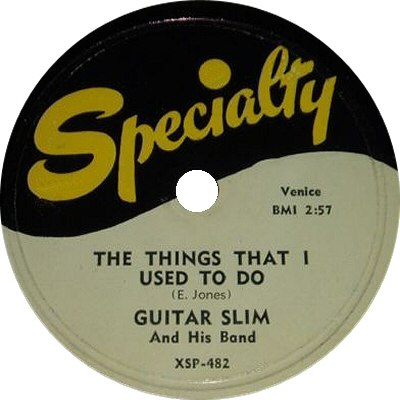
Eddie Jones (December 10, 1926 – February 7, 1959), known as Guitar Slim, was an American guitarist in the 1940s and 1950s, best known for the million-selling song "The Things That I Used to Do", for Specialty Records. It is listed in the Rock and Roll Hall of Fame's 500 Songs That Shaped Rock and Roll. Slim had a major impact on rock and roll and experimented with distorted tones on the electric guitar a full decade before Jimi Hendrix.
Guitar Slim
Public domain
- Born
- 1926.
- Died
- 1959.
- Nationality
- United States.
- Occupation
- songwriter, guitarist, singer, musician, dancer and blues musician.
- Fields
- blues.
VALÉORINE Encyclopedia
VALÉORINE documentary reading
Documentary summary
Eddie Jones (December 10, 1926 – February 7, 1959), known as Guitar Slim, was an American guitarist in the 1940s and 1950s, best known for the million-selling song "The Things That I Used to Do", for Specialty Records. It is listed in the Rock and Roll Hall of Fame's 500 Songs That Shaped Rock and Roll. Slim had a major impact on rock and roll and experimented with distorted tones on the electric guitar a full decade before Jimi Hendrix.
Admitted source layer · organised and presented by VALÉORINE
Note VALÉORINE
No house-authored Note is published until its assertions and sources pass the VALÉORINE evidence contract. The documentary article remains available in full while that enrichment is being consolidated.
Documentary enrichment in progress · no unsupported statement published
Reference Check
Propose documentary evidence for Guitar Slim. A contribution is never written directly as fact: identity, source, rights and evidence gates still decide.
Sign in to contribute
Documentary evidence
Evidence Panel
wikipedia incomplete · checked 25 September 2026
- Identity
- resolved
- Independent source families
- 0
- Admitted assertions
- 0
- Open conflicts
- 0
Authority files
gnd · 1089604173 · museum · 017151db-3920-4b4d-ab17-c8c5b6616648 · wikidata · Q607448 · wikipedia · Guitar Slim
In this article
Early life
Early life
Jones was born in Greenwood, Mississippi. His mother died when he was five, and he was raised by his grandmother. In his teen years, he worked in cotton fields and spent his free time at juke joints, where he started sitting in as a singer or dancer; he was good enough as a dancer that he was nicknamed "Limber Leg".
Recording career
Recording career
After returning from military service during World War II, he started playing in clubs around New Orleans, Louisiana. Bandleader Willie D. Warren introduced him to the guitar. He was particularly influenced by T-Bone Walker and Clarence "Gatemouth" Brown. About 1950 he adopted the stage name Guitar Slim and became known for his wild stage act. He wore bright-colored suits and dyed his hair to match them. He had an assistant who followed him around the audience with up to 350 feet of cord between his guitar and his amplifier, and occasionally rode on his assistant's shoulders or even took his guitar outside the club, bringing traffic to a stop. His sound was just as unusual—he played his guitar with distortion more than a decade before rock guitarists did, and his gospel-influenced vocals were easily identifiable. He got together with Muddy Waters in Los Angeles, California, for some lively playing.
Life and career
Dated record
Life and career
The full dated record · 1 entries
1959
Guitar Slim died at New York City.
Death and legacy
Jones died of pneumonia in New York City, at the age of 32. He is buried in a small cemetery in Thibodaux, Louisiana, where his manager, Hosea Hill, resided. Buddy Guy, Albert Collins and Frank Zappa were influenced by Guitar Slim. Other musicians have used the nickname "Guitar Slim." The North Carolina blues guitarist James Stephens had several releases under this billing. One of Jones's sons bills himself as Guitar Slim Jr. around the New Orleans circuit. His repertoire includes many of his father's songs. New Orleans R&B artist, Al Reed, said "I think [Jones] had a greater impact on the electric sound than any other guitarist...he could exhilarate you, he would lift you above and beyond clouds as he played, he would create sensations within your body that really played tricks with your mind. He was the first man to do this.”
Recordings
His first recording session was in 1951. He had a minor rhythm and blues hit in 1952 with "Feelin' Sad", which Ray Charles covered. His biggest success was "The Things That I Used to Do" (1954), produced by the young Ray Charles and released by Art Rupe's Specialty Records. The song spent weeks at number one on the Billboard R&B chart and sold over a million copies, soon becoming a blues standard. It also contributed to the development of soul music. He recorded for several labels, including Imperial, Bullet, Specialty, and Atco.
Primary material
Documents and archives
reference work
- “Guitar Slim”, English Wikipedia, consulted as further reading
Reputable secondary · Wikipedia
- Wikidata, structured authority record Q607448: Guitar Slim
Reputable secondary · Wikidata
Institutional database
- MusicBrainz artist record for Guitar Slim
Scholarly · MetaBrainz Foundation
authority file
- Gemeinsame Normdatei 1089604173, Guitar Slim.
Unverified · Deutsche Nationalbibliothek
Notes from the source article
Cited by Wikipedia
Notes from the source article
These works are cited by the source article, in its own numbering. They are recorded as its citations, not as sources VALÉORINE has verified.
- 1.Murrells, Joseph. The Book of Golden Discs. Barrie and Jenkins. 68–69. 1978. 0-214-20512-6.
- 2.Specialty Album Discography.
- 3.Aswell, Tom. Louisiana Rocks! The True Genesis of Rock & Roll. Pelican Publishing. 61–5. 2010. 978-1589806771.
- 4.Russell, Tony. The Blues: From Robert Johnson to Robert Cray. Carlton Books. 115. 1997. 1-85868-255-X.
- 5.Darwin Coleman (SHS). Guitar Slim, Mississippi Musician.
- 6.Allmusic.com. Biography by Bill Dahl.
- 7.Broven, John (1974). Rhythm and Blues in New Orleans. Gretna, Louisiana: Pelican Publishing. pp. 52–53. .
- 8.Hannusch, Jeff (1985). I Hear You Knockin . Ville Platte, Louisiana: Swallow Publications. p. 177. .
- 9.Braun, Hans-Joachim. Music and Technology in the Twentieth Century. Johns Hopkins University Press. 194. 2002. 0801868858.
- 10.Oliver, Paul. Blues Off the Record. Da Capo Press. 266. 1984. 0-306-80321-6.
- 11.Miller Freeman Press. Allmusic. 501. 1997. 0-87930-423-5.
- 12.Unterberger, R. (2003). "Louisiana Blues". In Bogdanov, V.; Woodstra, C.; Erlewine, S. T., eds. All Music Guide to the Blues: The Definitive Guide to the Blues (3d ed.). Milwaukee, Wisconsin: Backbeat Books. pp. 687–688. .
- 13.Scott, Frank. The Down Home Guide to the Blues. Chicago Review Press. 59. 1991. 1-55652-130-8.
- 14.Electric Don Quixote by Neil Slaven
- 15.Wirz.de. Illustrated James "Guitar Slim" Stephens Discography.
- 16.Broven, John. Walking to New Orleans: The Story of New Orleans Rhythm and Blues. Pelican Publishing. 53-54. 1978. 0-88289-433-1.
References
Citations
References
Each reference names the institution holding it, so a reader may go to the document itself.
Institutional database
MusicBrainz artist record for Guitar SlimMetaBrainz Foundation
Verifiedreference work
Partially resolvedauthority file
Gemeinsame Normdatei 1089604173, Guitar Slim.Deutsche Nationalbibliothek
Partially resolvedreference work
Partially resolved
The Encyclopedia exists whether or not anything is for sale. Corrections are recorded rather than overwritten, and every version of this record is kept. Published 14 August 2026.
Elsewhere in Music memorabilia
42,307 published records in this field, each with its sources named.
- Guiraut de CalansonPerson
- Guiraut RiquierPerson
- Guirne CreithPerson
- Guitar ShortyPerson
- Gulara AliyevaPerson
- Gülden KaraböcekPerson
- Güler DumanPerson
- Gullan BornemarkPerson
Best supported in this field
For owners
Own a work by Guitar Slim?
A specialist will read what you send and tell you what the house can establish, what it cannot, and whether the object is suited to sale. There is no charge and no obligation. The object stays with you throughout; nothing is shipped to us unless it is arranged in writing beforehand.