
Guillielmus de Grof
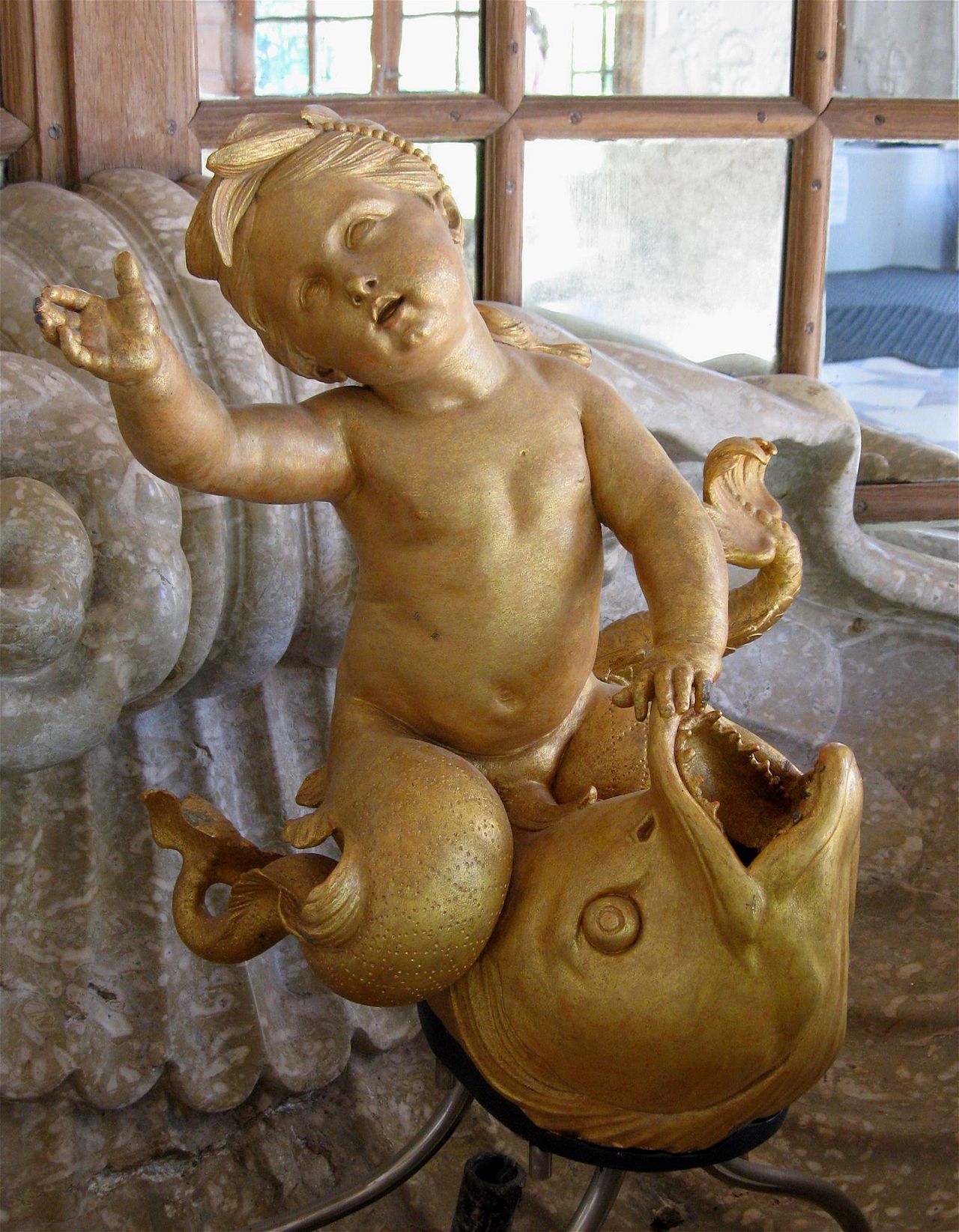
Illustration — Triton's children riding dolphins, 1722, Brandenburg, Nymphenburg Palace Park Guillielmus de Grof or Willem or Wilhelm de Grof (Antwerp, baptized on 13 November 1676 – Munich, 15 February 1759) was a Flemish sculptor, metal caster, stucco maker, frame maker and cabinet maker. After training in Antwerp he worked in Paris and Munich as court sculptor. In Paris he was a court sculptor to King Louis XIV and in Munich he was employed by the Elector Maximilian II Emanuel of Wittelsbach.
Also recorded as Wilhelm Groff · Wilhelm de Grof · Guillielmus de Groff
Guillielmus de Grof
Rufus46 · CC BY-SA 3.0
- Born
- 1676 · Antwerp.
- Occupation
- sculptor
- Languages
- Dutch · French · German
VALÉORINE Encyclopedia
VALÉORINE documentary reading
Documentary summary
Illustration — Triton's children riding dolphins, 1722, Brandenburg, Nymphenburg Palace Park Guillielmus de Grof or Willem or Wilhelm de Grof (Antwerp, baptized on 13 November 1676 – Munich, 15 February 1759) was a Flemish sculptor, metal caster, stucco maker, frame maker and cabinet maker. After training in Antwerp he worked in Paris and Munich as court sculptor. In Paris he was a court sculptor to King Louis XIV and in Munich he was employed by the Elector Maximilian II Emanuel of Wittelsbach.
Admitted source layer · organised and presented by VALÉORINE
Note VALÉORINE
Guillielmus de Grof (1676–1742) was a sculptor. Born in Antwerp, the sculptor died in Munich. Guillielmus de Grof worked in Antwerp, Munich and Paris.
Languages used include Dutch, French and German. Works by the sculptor are held at Museo del Prado.
Composed from admitted, traceable facts · 26 September 2026
VALÉORINE
Reference Check
Propose documentary evidence for Guillielmus de Grof. A contribution is never written directly as fact: identity, source, rights and evidence gates still decide.
Sign in to contribute
World of VALÉORINE
Documentary connections
Only confirmed graph relationships appear here. Images are shown only when their identity and reuse rights both pass the documentary gate.
Documentary evidence
Documentary basis
Authority files
wikidata · Q1533357 · wikipedia · Guillielmus de Grof
In this article
Life
Life
He is known for his large scale equestrian portraits as well as small scale decorative sculptures. He was one of the great pioneers of Rococo art in Munich. His style combined the court style of Louis XIV with the exuberant Flemish Baroque, which had its roots in Rubens' works. He had an important influence on the development of sculpture in Bavaria and Vienna.
Guillielmus de Grof was born in Antwerp as the son of Guillielmus and Anna Bulens. He was baptized on 13 November 1676. His father was a cartwright, originally from Grimbergen who had settled in Antwerp around 1670. Guillielmus received his artistic training from the Antwerp sculptor Frans Biddeloo and was registered as his pupil in the Antwerp Guild of Saint Luke in the guild year 1688–1689. There is no record of de Grof becoming a master in the Guild of Saint Luke. • Illustration — Apotheosis of Maximilian II Emanuel He continued his training in Paris, where he is recorded from 1700, and possibly also in Italy. From 1708 he was in the service of King Louis XIV in Paris. He married the Alsatian woman Rosalia Susanna Lamoureux. Of the couple's children are known: Charles (1712–1774), Claudius Achilles (b. 1716), Ferdinand Wilhelm (b. 1718) and Johanna Margaretha. • Illustration — Neptune, Nymphenburg In 1714 he created the impressive bronze Apotheosis of Maximilian II Emanuel, Elector of Bavaria (Bavarian National Museum, inv. no. R3973) for Maximilian Emanuel II who was at that time living in exile in Paris. He entered the employ of Maximilian Emanuel on 1 September 1714. In 1715, he was appointed by Maximilian Emanuel, who by that time had returned to Munich, as his court sculptor. De Grof set up a "state studio" in the Herzog-Max-Burg. It became a large workshop, which employed 14 journeymen and had a foundry. He worked on many of the commissions of Maximilian Emanuel including the now lost lead garden sculptures for the Nymphenburg Palace and the Schleißheim Palace. He provided decorations for the gardens of the various residences of the Elector. The Elector employed many other artists and spent massive sums on his construction projects leading to a large state debt. He was unable to pay his debts, including the commissions made by de Grof. This caused de Grof to suffer financial problems towards the end of his life. A highly celebrated artist, he died as an imperial councilor in Munich. His eldest son Charles succeeded him as court sculptor in Munich.
Works
Works
De Grof was a versatile sculptor who worked in many materials including marble, wood and stucco and as active as a metal sculptor, wax sculptor, caster, stucco maker, frame maker and cabinet maker. His style combined the court style of Louis XIV with the exuberant Flemish Baroque, which had its roots in Rubens' work. De Grof produced many bronze objects as well as a few marble sculptures such as the Neptune at Nymphenburg dated 1737. As he was in charge of the overall decoration of the architectural projects of Maximilian Emanuel, he made stucco ceilings such as in the stair-well in the Dachau Palace dated to the period 1716–1717. He also worked in silver. Several of his preparatory drawings exist.
Identity and origins
Identity and origins
The authorities additionally record the headings Wilhelm Groff, Wilhelm de Grof and Guillielmus de Groff. His recorded languages were Dutch, French and German.
Life and career
Dated record
Life and career
Explore 1676–1966
The full dated record · 3 entries
1676
Guillielmus de Grof born at Antwerp.
1966
Guillielmus de Grof, 1676-1742 (1966) is digitised and catalogued by Open Library.
1742
Guillielmus de Grof died at Munich.
Places
Named by the record
Places
Only places the record itself states, plotted where the house gazetteer settles their coordinates. Nothing is inferred from a name or a nationality.
Antwerp.
Birth place
Munich.
Death place
Primary material
Documents and archives
reference work
- Wikidata, structured authority record Q1533357: Guillielmus de Grof
Reputable secondary · Wikidata
- “Guillielmus de Grof”, English Wikipedia, consulted as further reading
Reputable secondary · Wikipedia
authority file
Notes from the source article
Cited by Wikipedia
Notes from the source article
These works are cited by the source article, in its own numbering. They are recorded as its citations, not as sources VALÉORINE has verified.
- 1.Guillielmus de Grof at the Netherlands Institute for Art History
- 2.Peter Vok, Grof [Groff], Guillielmus [Wilhelm] de. Grove Art Online. Oxford Art Online. Oxford University Press. Web. 11 March 2022.
- 3.Gerhard Woeckel: de Groff, Guillielmus. In: Neue Deutsche Biographie (NDB). Band 7, Duncker & Humblot, Berlin 1966, ISBN 3-428-00188-5, p. 119
- 4.Ph. Rombouts and Th. van Lerius (ed.), De liggeren en andere historische archieven der Antwerpsche sint Lucasgilde van 1453–1615, Volume 2, 1872–1876, Antwerp, p. 532, notes 3 and 4, p. 534
- 5.Guillielmus de Grof, Bust of Maximilian II Emanuel, Elector of Bavaria (1662-1726) at Sotheby’s
References
Citations
References
Each reference names the institution holding it, so a reader may go to the document itself.
authority file
Secondary witnessreference work
Secondary witnessreference work
Secondary witness
The Encyclopedia exists whether or not anything is for sale. Corrections are recorded rather than overwritten, and every version of this record is kept. Published 16 August 2026.
Elsewhere in Sculpture
6,174 published records in this field, each with its sources named.
- Guillermo CollazoArtist
- Guillermo LabordeArtist
- Guillermo TolentinoArtist
- Guillermo ZamorArtist
- Guiniforte SolariArtist
- Guiscardo AméndolaArtist
- Gülsün KaramustafaArtist
- Gulumbu YunupinguArtist
Best supported in this field
For owners
Own a work by Guillielmus de Grof?
A specialist will read what you send and tell you what the house can establish, what it cannot, and whether the object is suited to sale. There is no charge and no obligation. The object stays with you throughout; nothing is shipped to us unless it is arranged in writing beforehand.