
Govan Mbeki
Govan Archibald Mvunyelwa Mbeki (9 July 1910 – 30 August 2001) was a South African politician, military commander, Communist leader who served as the Secretary of Umkhonto we Sizwe, at its inception in 1961. He was also the younger son of Chief Skelewu Mbeki and Johanna Mabula and also the father of the former South African president Thabo Mbeki and political economist Moeletsi Mbeki. A leader of the South African Communist Party and the African National Congress.
Also recorded as Govan Archibald Mvuyelwa Mbeki
Govan Mbeki

South African Police · South African National Archives 1963-07 via Google Arts Culture — govan-mbeki/7wF0bj_S-3UC4w · Public domain
- Birth Name
- Govan Archibald Mvunyelwa Mbeki
- Born
- 9 July 1910
- Birthplace
- Mpukane Location, Nqamakwe district, Union of South Africa
- Died
- 30 August 2001
- Place of death
- Port Elizabeth, Eastern Cape, Republic of South Africa
- Occupation
- Anti-apartheid activist
- Nationality
- South Africa
- Education
- University of Fort Hare
- Honours
- Isitwalandwe Medal
- Languages
- English
VALÉORINE Encyclopedia
VALÉORINE documentary reading
Documentary summary
Govan Archibald Mvunyelwa Mbeki (9 July 1910 – 30 August 2001) was a South African politician, military commander, Communist leader who served as the Secretary of Umkhonto we Sizwe, at its inception in 1961. He was also the younger son of Chief Skelewu Mbeki and Johanna Mabula and also the father of the former South African president Thabo Mbeki and political economist Moeletsi Mbeki. A leader of the South African Communist Party and the African National Congress.
Admitted source layer · organised and presented by VALÉORINE
Note VALÉORINE
Govan Mbeki (1910–2001) was an activist, journalist and politician, among other activities, of South African nationality. The activist was born in Mbewuleni and died in Gqeberha.
Govan Mbeki was educated at University of Fort Hare. The activist held the position of member of the National Assembly of South Africa.
Languages used include English. Honours include Isitwalandwe Medal.
Composed from admitted, traceable facts · 01 October 2026
VALÉORINE
Reference Check
Propose documentary evidence for Govan Mbeki. A contribution is never written directly as fact: identity, source, rights and evidence gates still decide.
Sign in to contribute
World of VALÉORINE
Documentary connections
Only confirmed graph relationships appear here. Images are shown only when their identity and reuse rights both pass the documentary gate.
Documentary evidence
Documentary basis
Authority files
wikidata · Q1396109 · wikipedia · Govan Mbeki
In this article
Biography
Biography
After the Rivonia Trial, he was imprisoned (1963–1987) on charges of terrorism and treason; together with Nelson Mandela, Walter Sisulu, Raymond Mhlaba, Ahmed Kathrada and other eminent ANC leaders, for their role in the ANC's armed wing, Umkhonto we Sizwe (MK). He was sometimes mentioned by his nickname "Oom Gov".

Guitar of Govan Mbeki. Liberation movement archives, University of Fort Hare
Vysotsky
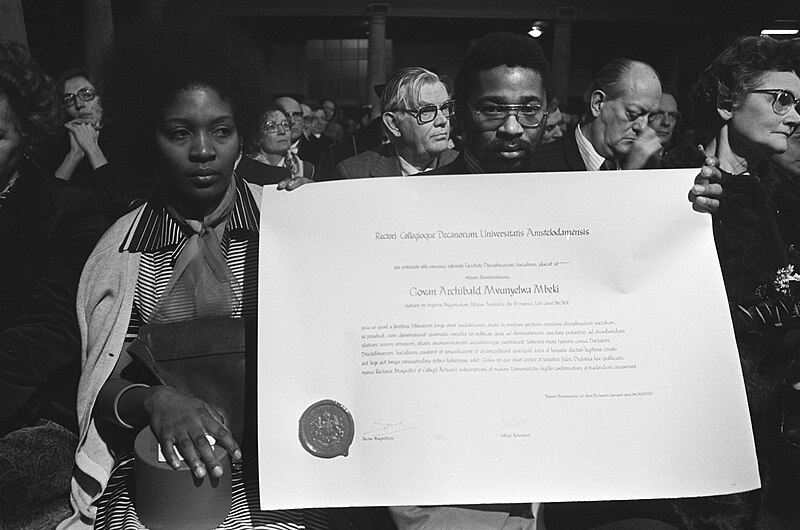
Honorary doctorate (social sciences) from University of Amsterdam to Govan Mbeki (1978). As Govan Mbeki was in prison, the doctorate was handed to his son Moeletsi Mbeki.
Hans Peters for Anefo · GaHetNa (Nationaal Archief NL) NL-HaNA 2.24.01.05 0 929-5163
Key facts
Key facts
• Birth Name — Govan Archibald Mvunyelwa Mbeki • Born — 9 July 1910 • Birthplace — Mpukane Location, Nqamakwe district, Union of South Africa • Office — Co-Deputy Chairperson of the National Council of Provinces • Term Start — 1997 • Term End — 1999 • Alongside — Bulelani Ngcuka • Predecessor — position established • Successor — Naledi Pandor • Office1 — Deputy President of the Senate of South Africa • Term Start1 — 1994 • Term End1 — 1997 • Predecessor1 — position established • Successor1 — position renamed • Office2 — Secretary of MK • Term Start2 — 1961 • Term End2 — 1963 • Predecessor2 — position established • Successor2 — position abolished • Died — 30 August 2001 • Place of death — Port Elizabeth, Eastern Cape, Republic of South Africa • Father — Chief Skelewu Mbeki • Mother — Johanna Mabula • Occupation — Anti-apartheid activist • Children — Linda Mbeki (daughter; born 1941, died 2003) Thabo Mbeki (son; born 1942) Moeletsi Mbeki (son; born 1945) Jama Mbeki (son; born 1948, died 1982) • Party — African National Congress South African Communist Party
Early years
Early years
Govan Mbeki was born in 1910 the Nqamakwe district of the Transkei region and was a part of the Xhosa ethnic group. Growing up, he attended a missionary boarding school. As a teenager, Mbeki worked as a newsboy and messenger in the cities, and because of this, he saw the poverty urban black Africans lived in, and the constant police raids they endured. He attended Fort Hare University, completing in 1936 a Bachelor of Arts degree in politics and psychology and a teaching diploma. Mbeki met other African struggle leaders while attending the university.
Teacher, trader and communist
Teacher, trader and communist
After graduating, Mbeki worked as a high school teacher in Durban, but lost his job because of his political activities. While teaching, he met his wife, Epainette Moerane. He was a member of the South African Communist Party (SACP, then the Communist Party of South Africa, or CPSA) from the late 1930s, and joined the African National Congress in 1935. He then set up a co-operative store in Idutywa and began a writing career. From 1938 to 1943, he was the editor of Inkundla Ya Bantu ("The People's Platform"), the only African-run newspaper at the time. Mbeki left journalism in 1944 and became a government-nominated member of the Transkei Territorial Authorities General Council until 1950. His role in the CPSA/ SACP was clandestine at the time, which helps explain why he received the nomination. Mbeki disparagingly referred to the council as a "toy telephone": "You can say what you like, but your words have no effect because the wires are not connected to an exchange." In 1948 Mbeki stood as a candidate for the Natives Representative Council but lost the election. When the CPSA/ SACP was banned in 1950 by the apartheid government, Mbeki remained in the African National Congress (ANC). In 1952, he was imprisoned together with Raymond Mhlaba and Vuyisile Mini for three months in Rooi Hel ('Red Hell' or North End Prison, Port Elizabeth) for disobeying apartheid laws by participating in the 'Campaign of Defiance against Injustice Laws' (Defiance Campaign). In 1954, a tornado destroyed Mbeki's store, and he was dismissed from teaching again (he would lose his job three times, and be blacklisted from others, from the 1930s onwards). Mbeki moved to Port Elizabeth and joined the editorial board of New Age, a prominent leftist newspaper linked to underground CPSA/ SACP networks. He played a crucial role in ensuring that the pages and columns reflected the conditions, demands, and aspirations of black working-class people, particularly in the countryside. He also worked on the Guardian, New Age, Fighting Talk and Liberation, and worked with 'Jock' Harold Strachan in the Port Elizabeth area, and assisted him to produce the newsletter Izwi Lomzi ("Home Voice"). Mbeki was meanwhile actively involved in the major campaigns of the day, including the revival of the African National Congress in the 1940s, the Defiance Campaign and the Congress of the People.
Armed struggle and Robben Island
Armed struggle and Robben Island
In 1960, the ANC was banned, and along with the underground SACP, formed Umkhonto we Sizwe (MK), which became ANC's armed wing. Mbeki was involved, and, at his urging, Strachan assisted MK by turning his hand to improvised explosive devices based on substances such as potassium permanganate, magnesium, glycerol and icing sugar. Mbeki led an MK cell in Port Elizabeth in 1961. In September 1962, he moved to Johannesburg, and then to Liliesleaf farm in Rivonia. Meanwhile, in November 1962, the then-Minister of Justice, John Vorster, banned New Age. When the editorial board came out with its successor publication, Spark, Vorster went one step further by banning not the newspaper but its editors and writers. This effectively ended Mbeki's role as editor and journalist in the country. On 11 July 1963, he was arrested with other MK high commanders at Liliesleaf farm. In 1964, he was an accused in the Rivonia Trial and sentenced to Robben Island. While in prison, he obtained an economics degree.
Release and post-apartheid role
Release and post-apartheid role
Mbeki was released from custody after serving 24 years in the Robben Island prison in November 1987. He served in South Africa's post-apartheid Senate from 1994 to 1997 as Deputy President of the Senate, and then the Senate's successor, the National Council of Provinces, from 1997 to 1999. Mbeki died in Port Elizabeth on 30 August 2001. He was given a state funeral during his son Thabo Mbeki's presidency, on 8 September 2001. Govan Mbeki's remains were the subject of controversy in 2006 when plans were made to exhume them, together with Raymond Mhlaba's remains, and place them in a museum. These plans were called off after both Mhlaba and Mbeki's family refused the request.
Life and career
Dated record
Life and career
The full dated record · 2 entries
1910
Govan Mbeki born at Mbewuleni.
2001
Govan Mbeki died at Gqeberha.
Places
Named by the record
Places
Only places the record itself states, plotted where the house gazetteer settles their coordinates. Nothing is inferred from a name or a nationality.
Mbewuleni.
Birth place
Gqeberha.
Death place
Books
In 1938, Mbeki published his first book, Transkei in the Making. A supporter of the 1950–1961 Pondoland peasant revolt, he wrote the pioneering study of the movement, South Africa: The Peasants' Revolt from 1958, which was published in 1964. Much of the book is an analysis of the political economy of the Transkei, rather than the revolt itself. He began writing the book on rolls of toilet paper and had to smuggle it out of prison. • Illustration — Govan Mbeki's guitar at Robben Island (Fort Hare Archives, 2016) Following the Rivonia Trial, Mbeki served a long-term on Robben Island, during which he managed to run education classes with prisoners, many on Marxist theory, and wrote a number of significant analyses in jail, which were kept on the island and used for discussions. The surviving copies have since been published. In 1992, he published The Struggle For Liberation in South Africa: A Short History and in 1996, Sunset at Midday: Latshonilangemini!
Primary material
Documents and archives
reference work
- Wikidata, structured authority record Q1396109: Govan Mbeki
Reputable secondary · Wikidata
- “Govan Mbeki”, English Wikipedia, consulted as further reading
Reputable secondary · Wikipedia
scholarly publication
- 5. Mbeki as journalist and author, 1955–1963, Govan Mbeki
Scholarly · Crossref registry
Awards and honours
Mbeki received an honorary doctorate in the Social Sciences from the University of Amsterdam in 1978. His son Moeletsi attended the ceremony, as Mbeki was imprisoned at Robben Island. • Illustration — Honorary doctorate, Amsterdam 1978 On 26 June 1980, the Secretary General of the then-illegal African National Congress, Alfred Nzo, announced the conferring of the Isitwalandwe Medal, the ANC's highest honour, on Mbeki. However, he was not present to receive the award, because he was serving a life imprisonment sentence on Robben Island. Mbeki received international recognition for his political achievements, including the renaming (at Mandela's suggestion) of the recently opened health building at Glasgow Caledonian University. The Govan Mbeki Health Building was inaugurated in 2001 at a ceremony featuring his son Thabo. The Govan Mbeki Local Municipality in Mpumulanga is named in his honour. Order for Meritorious Service in gold (2003). In 2004, he was voted 97th in the SABC 3's Great South Africans. In 2013, a large section of road between Swartklip and Baden Powell Road, running between the neighborhoods of Browns Farm, Gugulethu, Nyanga and Crossroads in Cape Town was renamed Govan Mbeki Road.
Notes from the source article
Cited by Wikipedia
Notes from the source article
These works are cited by the source article, in its own numbering. They are recorded as its citations, not as sources VALÉORINE has verified.
- 1.The O'Malley Archives. Govan Archibald Mbeki.
- 2.Bundy, Colin. Govan Mbeki Was a Brilliant Pioneer of African Marxism. Jacobin.
- 3.Govan Mbeki. The Washington Post. 2001-08-31. 0190-8286.
- 4.Govan Mbeki’s House – Mnquma Local Municipality.
- 5.James Barron. A Chronicler of Revolt, Defiant Behind Bars. The New York Times. 6 November 1987.
- 6.SACP website. Biography of Govan Mbeki.
- 7.Colin Bundy, 2012, Govan Mbeki, Johannesburg: Jacana, p. 147.
- 8.Mia Roth. The Communist Party in South Africa: Racism, Eurocentricity and Moscow, 1921-1950. Partridge Africa. 20 January 2016. 978-1-4828-0964-0.
- 9.Bundy, Colin (2012), Govan Mbeki, Johannesburg: Jacana, p. 149
- 10.Harold Strachan. Sunday Times. 10 May 1998.
- 11.Bundy, Colin. Govan Mbeki. Ohio University Press. 101. 2013. 9780821444597.
- 12.South African Democracy Education Trust. The Road to Democracy in South Africa: 1960-1970. Zebra. 121–123. 2004. 9781868729067.
- 13.Bundy, Colin. Govan Mbeki. Ohio University Press. 111. 2013. 9780821444597.
- 14.Cherry, Janet. Spear of the Nation: Umkhonto weSizwe: South Africa's Liberation Army, 1960s–1990s. Ohio University Press. 20–21. 2012. 9780821444436.
- 15.Molver, Zoe. Harold Strachan: Bram's Bow-maker. literarytourism.co.za. 5 March 2007.
- 16.Bundy, Colin (2012), Govan Mbeki, Johannesburg: Jacana, p. 161.
- 17.Mbeki, Govan (1964), South Africa: The Peasants' Revolt, Harmondsworth: Penguin Books).
- 18.Bundy, Colin (2012), Govan Mbeki, Johannesburg: Jacana, p. 93.
- 19.Mbeki, Govan (2015), Learning from Robben Island: The Prison Writings of Govan Mbeki, Cape Town: Kwela Books.
- 20.Govan Mbeki South African History Online. www.sahistory.org.za.
- 21.Helga van Staaden. Govan Mbeki reburial called off. News24.com. 23 January 2006.
- 22.Folia civitatis, vol. 31, no. 18 (24 December 1977).
- 23.Have You Heard From Johannesburg. www.clarityfilms.org.
- 24.Kasuka, Bridgette. Independence Leaders of Africa. Bankole Kamara Taylor. 2012-02-07. 978-1-4700-4175-5.
- 25.Barnes, Clayton. Six streets in Cape Town renamed. www.iol.co.za.
References
Citations
References
Each reference names the institution holding it, so a reader may go to the document itself.
scholarly publication
5. Mbeki as journalist and author, 1955–1963, Govan MbekiCrossref registry
Institutional witnessreference work
Secondary witnessreference work
Secondary witness
Further particulars
Held on the record
Further particulars
Open the remaining particulars
The authorities additionally record the heading Govan Archibald Mvuyelwa Mbeki. His recorded language was English. He married Epainette Mbeki. 3 children are recorded: Thabo Mbeki, Moeletsi Mbeki and Jama Mbeki. Recorded as politician, journalist, writer and activist.
Identity and origins
The Encyclopedia exists whether or not anything is for sale. Corrections are recorded rather than overwritten, and every version of this record is kept. Published 15 August 2026.
Elsewhere in Books
39,427 published records in this field, each with its sources named.
- Gottschalk of OrbaisAuthor
- Götz von BerlichingenAuthor
- Gourgen YanikianAuthor
- Gourish KaikiniAuthor
- Govardhanram TripathiAuthor
- Govert BidlooAuthor
- Govind Chandra PandeAuthor
- GovindadasAuthor
Best supported in this field
For owners
Own a work by Govan Mbeki?
A specialist will read what you send and tell you what the house can establish, what it cannot, and whether the object is suited to sale. There is no charge and no obligation. The object stays with you throughout; nothing is shipped to us unless it is arranged in writing beforehand.