
Göttweig Abbey
Göttweig Abbey (Stift Göttweig) is a Benedictine monastery near Krems in Lower Austria. It was founded in 1083 by Altmann, Bishop of Passau. In the middle ages the abbey was a seat of learning with a library and a monastic school.
Also recorded as Stift Göttweig · Göttweig
Göttweig Abbey
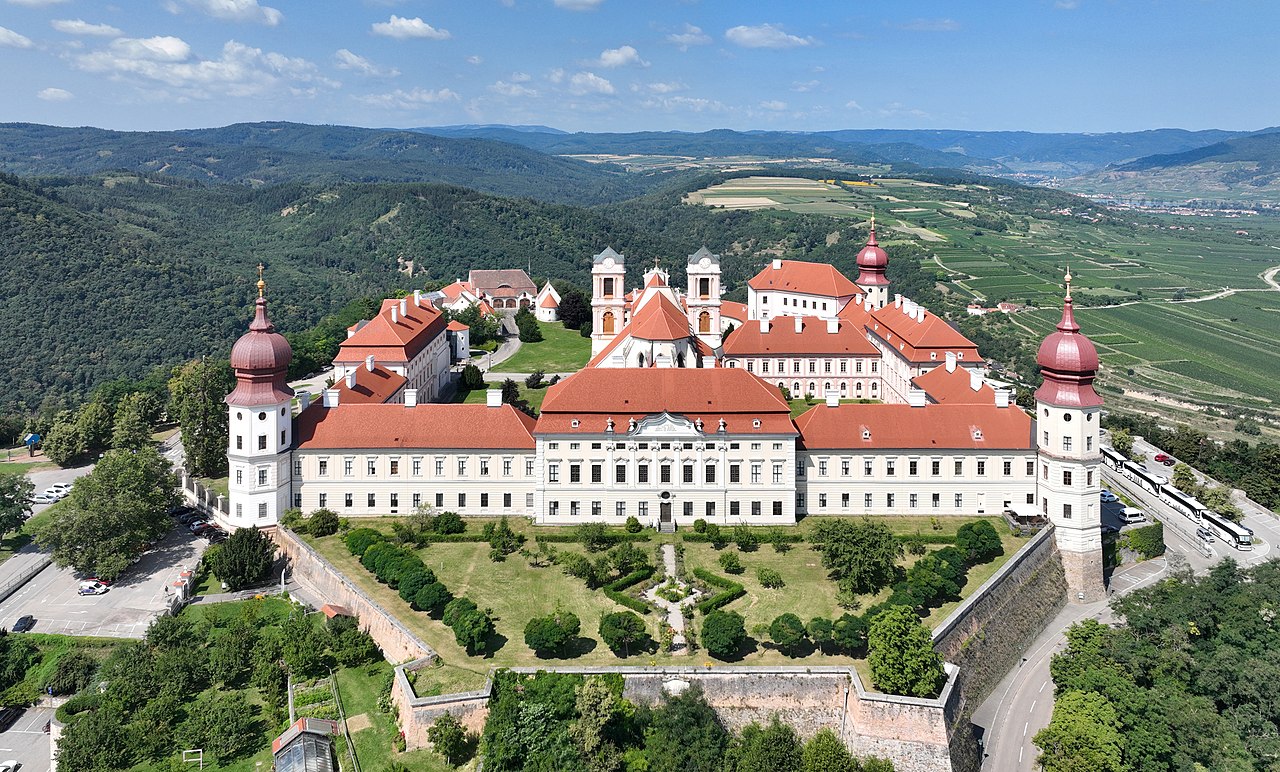
C.Stadler/Bwag · CC BY-SA 4.0
- Founded
- 1083
- Headquarters
- Austria
VALÉORINE Encyclopedia
VALÉORINE documentary reading
Documentary summary
Göttweig Abbey (Stift Göttweig) is a Benedictine monastery near Krems in Lower Austria. It was founded in 1083 by Altmann, Bishop of Passau. In the middle ages the abbey was a seat of learning with a library and a monastic school.
Admitted source layer · organised and presented by VALÉORINE
Reference Check
Propose documentary evidence for Göttweig Abbey. A contribution is never written directly as fact: identity, source, rights and evidence gates still decide.
Sign in to contribute
Documentary evidence
Documentary basis
Authority files
wikidata · Q697421 · wikipedia · Göttweig Abbey
In this article
History
History
The abbey went through a period of decline during the 15th and 16th centuries and in 1580 it was mostly destroyed by a fire. Under a new abbot brought in from Melk Abbey the monastery was rebuilt and restored. After another fire in 1718 the abbey had to be rebuilt again. The new building includes the largest Baroque staircase in Austria with a fresco that is considered a masterpiece of its era. Today the abbey is renowned for its library which holds a valuable collection of books, manuscripts, coins and antiquities. • Illustration — East view of Göttweig Abbey
• Illustration — Abbey Church and Cloister • Illustration — Göttweig Abbey library Göttweig Abbey was founded as a monastery of canons regular by Blessed Altmann (c. 1015–1091), Bishop of Passau. The high altar of a chapel was dedicated in 1072, but the monastery itself was not until 1083: the foundation charter, dated 9 September 1083, is still preserved in the abbey archives. By 1094, the discipline of the community had become so lax that Bishop Ulrich of Passau, with the permission of Pope Urban II, introduced the Rule of St. Benedict. Prior Hartmann of St. Blaise's Abbey in the Black Forest was elected abbot. He brought with him from St. Blaise's a number of chosen monks, among whom were Blessed Wirnto and Blessed Berthold, later abbots of Formbach and Garsten respectively. Under Hartmann (1094–1114) Göttweig became a famous seat of learning and strict monastic observance. He founded a monastic school, organized a library, and at the foot of the hill built a nunnery where it is believed that Ava, the earliest German language woman poet known by name (d. 1127), lived as an anchorite. The nunnery, which was afterwards transferred to the top of the hill, continued to exist until 1557. During the 15th and 16th centuries, however, the abbey declined to such an extent that between 1556 and 1564 it had no abbot at all, and in 1564 not a single monk remained. At this crisis, an imperial deputation arrived at Göttweig and elected Michael Herrlich, a monk of Melk Abbey, as abbot. The new abbot, who held his office until 1603, restored the monastery spiritually and financially, and rebuilt it after it had been almost entirely destroyed by fire in 1580. Abbots distinguished during the Reformation were George Falb (1612–1631) and David Corner (1631–1648), who successfully opposed the spread of Protestantism in the district. In 1718 the monastery burned down and was rebuilt on a grander scale during the abbacy of Gottfried Bessel (1714–1749) to designs by Johann Lucas von Hildebrandt inspired by the Escorial. The imperial staircase is the largest Baroque staircase in Austria. The fresco decorating the staircase is considered a masterpiece of Baroque architecture in Austria. Executed by Paul Troger in 1739, it represents the Holy Roman Emperor Charles VI as Apollo.
Present day
Present day
The abbey has a library of 150,000 books and manuscripts, a particularly important collection of religious engravings, and valuable collections of coins, antiquities, musical manuscripts and natural history, all of which survived the dangers of World War II and its immediate aftermath almost without loss. Since 1625 the abbey has been a member of the Austrian Congregation, now within the Benedictine Confederation; as of 2023, the monks number about 30. The abbey is part of the Wachau, a UNESCO World Heritage landscape. It is famous for apricot jams and wines crafted on location; the monastery is home to the highest apricot orchard in Austria's Wachau Valley. Göttweig Abbey is along the World Heritage Trail, the Dunkelsteinerwald Trail, or the Way of St. James.
Burials
Burials
• Hadmar I of Kuenring • Altmann of Passau
Commemorative Euro coin
Commemorative Euro coin
Göttweig Abbey was selected as the main motif of a very high-value collectors' coin: the Austrian Göttweig Abbey commemorative coin, minted on October 11, 2006. The obverse side shows the abbey with its fortress-like towers on top of the hill surrounded by trees and vineyards.
Gallery
Gallery
• Illustration — Abbey Church and Cloister • Illustration — Abbey church • Illustration — Nave, high altar, and pulpit • Illustration — Nave and organ • Illustration — Erentrudis Chapel • Illustration — Imperial Staircase: Apotheosis of Charles VI (fresco by Paul Troger, 1739) • Illustration — Tapestry room
Places
Named by the record
Places
Only places the record itself states, plotted where the house gazetteer settles their coordinates. Nothing is inferred from a name or a nationality.
- Austria
Named but not plotted · 1
Göttweig Abbey is associated with Austria.
Country
Notes from the source article
Cited by Wikipedia
Notes from the source article
These works are cited by the source article, in its own numbering. They are recorded as its citations, not as sources VALÉORINE has verified.
- 1."Göttweig Abbey", Donau Niederosterreich
- 2.Ott, Michael. "Abbey of Göttweig." The Catholic Encyclopedia Vol. 6. New York: Robert Appleton Company, 1909. 14 January 2023
- 3."Göttweig Abbey", Straße der Kaiser und Könige
- 4."Göttweig Abbey – the Austrian Montecassino", The World Heritage Journeys of the European Union project
Bibliography printed in the source article · 5
- Lechner, Gregor, 1988: Das Benediktinerstift Gottweig in der Wachau und seine Sammlungen. Munich: Schnell & Steiner.
- Geschichte des Stiftes Göttweig 1083–1983. Festschrift zum 900-Jahr-Jubiläum. EOS-Verlag, St. Ottilien 1983 (Studien und Mitteilungen zur Geschichte des Benediktiner-Ordens und seiner Zweige, Bd. 94, H. I–II)
- 900 Jahre Stift Göttweig 1083-1983. Ein Donaustift als Repräsentant benediktinischer Kultur, Katalog zur Jubiläumsausstellung, Stift Göttweig, Eigenverlag, 1983
- Lashofer, Clemens Anton,1983 : Professbuch des Benediktinerstiftes Göttweig. EOS-Verlag, St. Ottilien (Studien und Mitteilungen zur Geschichte des Benediktiner-Ordens und seiner Zweige, Erg.-Bd. 26)
- [http://othes.univie.ac.at/12715/ Aichinger-Rosenberger, Peter, 2011: „Ecclesia beate mariae in monte kottwich. Zur mittelalterlichen Baugeschichte der Stiftskirche von Göttweig – Ergebnisse einer Bauforschung“. Dissertation for Vienna University]
References
Citations
References
Each reference names the institution holding it, so a reader may go to the document itself.
reference work
Secondary witnessreference work
Secondary witness
The Encyclopedia exists whether or not anything is for sale. Corrections are recorded rather than overwritten, and every version of this record is kept. Published 14 August 2026.
Elsewhere in Institutions
3,152 published records in this field, each with its sources named.
- Gordion MuseumOrganisation
- Göteborgs konsthallOrganisation
- Gothenburg Museum of ArtOrganisation
- Gotoh MuseumOrganisation
- Gounaropoulos MuseumOrganisation
- Government Museum and Art Gallery, ChandigarhOrganisation
- Govett-Brewster Art Gallery/Len Lye CentreOrganisation
- Goya MuseumOrganisation
Best supported in this field
For owners
Own an object connected with Göttweig Abbey?
A specialist will read what you send and tell you what the house can establish, what it cannot, and whether the object is suited to sale. There is no charge and no obligation. The object stays with you throughout; nothing is shipped to us unless it is arranged in writing beforehand.