
Giuseppe Cades
Giuseppe Cades (March 4, 1750 – December 8, 1799) was a neo-classicist Italian draftsman, painter, engraver and sculptor, based in Rome.
Also recorded as Giuseppe Calves · Cades · Romain Joseph Cadès · Josephino Cades
Giuseppe Cades

Giuseppe Cades / After Raphael · Royal Academy of Arts, London · Public domain
- Born
- 1750 · Rome.
- Died
- 1799 · Rome.
- Nationality
- Papal States
- Occupation
- painter · sculptor · printmaker · draftsperson
- Known for
- Achilles in his Tent with Patroclus, Playing a Lyre, surprised by Ulysses and Nestor · Cornelia and Mother of the Gracchi
- Languages
- Italian
VALÉORINE Encyclopedia
VALÉORINE documentary reading
Documentary summary
Giuseppe Cades (March 4, 1750 – December 8, 1799) was a neo-classicist Italian draftsman, painter, engraver and sculptor, based in Rome.
Admitted source layer · organised and presented by VALÉORINE
Reference Check
Propose documentary evidence for Giuseppe Cades. A contribution is never written directly as fact: identity, source, rights and evidence gates still decide.
Sign in to contribute
World of VALÉORINE
Documentary connections
Only confirmed graph relationships appear here. Images are shown only when their identity and reuse rights both pass the documentary gate.
Documentary evidence
Documentary basis
Authority files
wikidata · Q326017 · wikipedia · Giuseppe Cades
In this article
Biography
Biography
The recorded working language is Italian. Places of work recorded in the authority are Rome. Works named in the authority record are Achilles in his Tent with Patroclus, Playing a Lyre, surprised by Ulysses and Nestor and Cornelia, Mother of the Gracchi. Work by Giuseppe Cades is recorded in the collections of Art Institute of Chicago, Finnish National Gallery, Nationalmuseum, Walters Art Museum and Hermitage Museum.
Cades was born in Rome. He studied at the Accademia di San Luca under Mancini and Domenico Corvi, having won a minor prize aged 12 he went on to gain a major prize in 1765, aged 16, with his picture of Tobias Recovering His Sight. In 1766, after quarreling with his master, he visited Florence. Two years later, he executed an altarpiece for the church of San Benedetto in Turin and in 1771 another for the church of Santi Apostoli. He also decorated the Palazzo Chigi with frescoes, landscapes, and scenes from Tasso. He has left two etchings, Christ Blessing Little Children and The Death of Leonardo da Vinci. Cades' early commissions were influenced by the Baroque Classicist painter Carlo Maratta. In the mid-1770s, Cades came to know Swiss painter Johann Heinrich Fuseli and toured Northern Italy, and his work began to show Mannerist and Renaissance influences as well. His oil on canvas painting “Achille jouant de la lyre avec Patrocle, sous sa tente, surpris par Ulysse et Nestor” (English: Achilles in his tent with Patroclus playing the lyre, surprised by Odysseus and Nestor) was produced ca 1782. It was acquired by the Louvre museum in 1980 and as of 2025 is on display in the Denon Wing, level 1, in room 718. Cades again joined the Accademia di San Luca of Rome, now as a fellow, in 1786. Late in life, Catherine the Great of Russia commissioned an artwork from him. He died in Rome. • Illustration — Giuseppe Cades - Astronomy
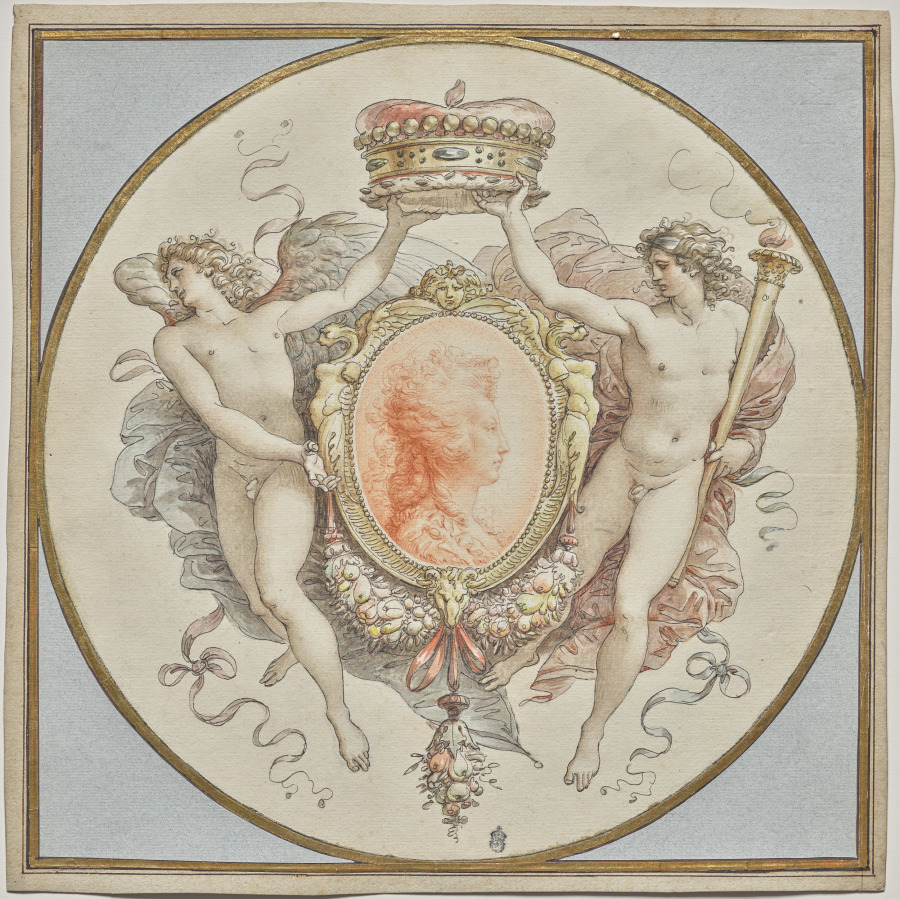
Portrait of a Lady with an Elaborate Cartouche, 1785, by Giuseppe Cades
Giuseppe Cades · The Cleveland Museum of Art · John L. Severance Fund
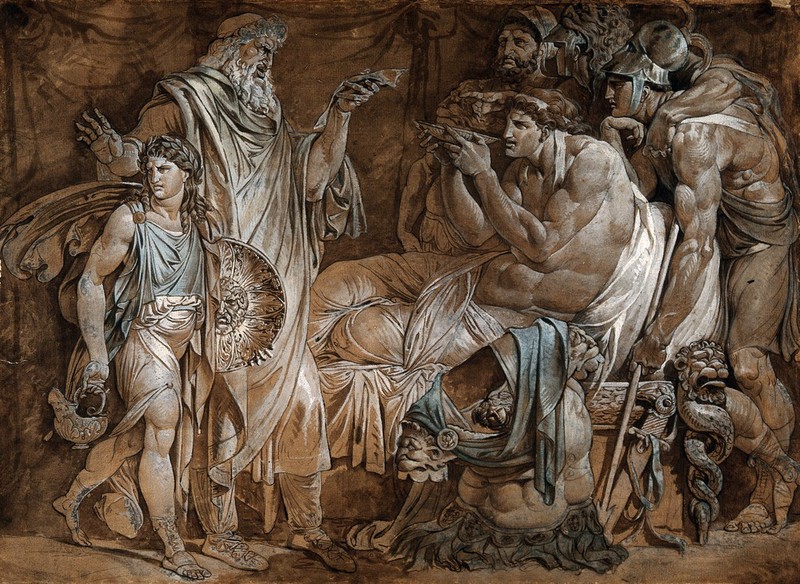
Alexander the Great demonstrating his trust in Philip, his physician, by drinking a medicinal draught prepared by him after receiving a letter from General Parmenio suggesting that Philip is poisoning him. Pen drawing attributed to an artist in the circle of G. Cades., by Giuseppe Cades
Giuseppe Cades · Wellcome Collection, London · Wellcome Collection
Life and career
Dated record
Life and career
The full dated record · 2 entries
1750
Giuseppe Cades born at Rome.
1799
Giuseppe Cades died at Rome.
Primary material
Documents and archives
reference work
- “Giuseppe Cades”, English Wikipedia, consulted as further reading
Reputable secondary · Wikipedia
authority record
- Wikidata, structured authority record Q326017: Giuseppe Cades
General reference · Wikidata
Notes from the source article
Cited by Wikipedia
Notes from the source article
These works are cited by the source article, in its own numbering. They are recorded as its citations, not as sources VALÉORINE has verified.
- 1.Giuseppe Cades. The British Museum.
- 2.Giuseppe Cades. Getty Museum.
- 3."Cades, Giuseppe." Graves, Robert Edmund, et al. Dictionary of Painters and Engravers: Biographical and Critical. United Kingdom, G. Bell and Sons, 1886. pp. 207-208.
- 4.Achille jouant de la lyre avec Patrocle, sous sa tente, surpris par Ulysse et Nestor. The Louvre.
- 5.Boni, Filippo de'. Biografia degli artisti ovvero dizionario della vita e delle opere dei pittori, degli scultori, degli intagliatori, dei tipografi e dei musici di ogni nazione che fiorirono da'tempi più remoti sino á nostri giorni. 2nd Edition. Presso Andrea Santini e Figlio. 164. 1852.
- 6.Bryan, Michael. Dictionary of Painters and Engravers, Biographical and Critical. George Bell and Sons. I: A-K. 207–208. 1886.
- 7.Giuseppe Cades - Astronomy. en.artsdot.com.
References
Citations
References
Each reference names the institution holding it, so a reader may go to the document itself.
reference work
Secondary witnessauthority record
General reference
The Encyclopedia exists whether or not anything is for sale. Corrections are recorded rather than overwritten, and every version of this record is kept. Published 16 August 2026.
Elsewhere in Prints
4,138 published records in this field, each with its sources named.
- Giuseppe AllegriniEngraver
- Giuseppe AsioliEngraver
- Giuseppe BaroniEngraver
- Giuseppe BiasiEngraver
- Giuseppe CamerataEngraver
- Giuseppe CanaleEngraver
- Giuseppe CantersaniEngraver
- Giuseppe CastiglioneEngraver
Best supported in this field
For owners
Own a work by Giuseppe Cades?
A specialist will read what you send and tell you what the house can establish, what it cannot, and whether the object is suited to sale. There is no charge and no obligation. The object stays with you throughout; nothing is shipped to us unless it is arranged in writing beforehand.