
Giovanni Paolo Panini
Giovanni Paolo, also known as Gian Paolo Panini or Pannini (17 June 1691 – 21 October 1765), was an Italian Baroque painter and architect who worked in Rome and is primarily known as one of the vedutisti ("view painters"). Among his most famous works are his view of the interior of the Pantheon (on behalf of Francesco Algarotti), and his vedute—paintings of picture galleries containing views of Rome. Most of his works, especially those of ruins, have a fanciful and unreal embellishment characteristic of capriccio themes.
Also recorded as Pannini · Giovan Paolo Pannini · Paolo Panini · Cavaliere Giovanni Paolo Pannini
Giovanni Paolo Panini
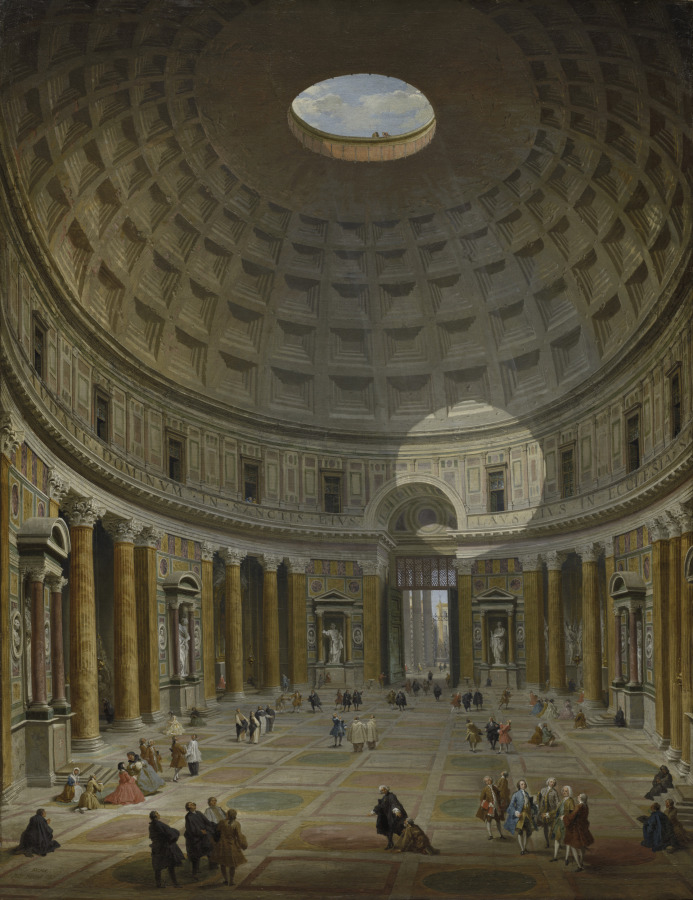
Giovanni Paolo Panini · The Cleveland Museum of Art · Purchase from the J. H. Wade Fund · CC0
- Born
- 1691. · Piacenza.
- Died
- 1765. · Rome.
- Occupation
- painter, architect and scenographer.
- Fields
- painting.
- Movements
- Baroque.
- Teachers
- Giuseppe Natali, Andrea Galluzzi, Francesco Galli Bibiena and Benedetto Luti.
- Known for
- Modern Rome (series of 4), Ancient Rome (series of 4), Roman Capriccio: The Pantheon and Other Monuments, Interior of the Pantheon and Rome.
- Languages
- Italian.
VALÉORINE Encyclopedia
VALÉORINE documentary reading
Documentary summary
Giovanni Paolo, also known as Gian Paolo Panini or Pannini (17 June 1691 – 21 October 1765), was an Italian Baroque painter and architect who worked in Rome and is primarily known as one of the vedutisti ("view painters"). Among his most famous works are his view of the interior of the Pantheon (on behalf of Francesco Algarotti), and his vedute—paintings of picture galleries containing views of Rome. Most of his works, especially those of ruins, have a fanciful and unreal embellishment characteristic of capriccio themes.
Admitted source layer · organised and presented by VALÉORINE
Reference Check
Propose documentary evidence for Giovanni Paolo Panini. A contribution is never written directly as fact: identity, source, rights and evidence gates still decide.
Sign in to contribute
Documentary evidence
Documentary basis
Authority files
wikidata · Q286670 · wikipedia · Giovanni Paolo Panini
In this article
Biography
Biography
In this they resemble the capricci of Marco Ricci. Panini also painted portraits, including one of Pope Benedict XIV.
Training under Giuseppe Natali, Andrea Galluzzi and Francesco Galli Bibiena is recorded. Giovanni Niccolò Servandoni is recorded as having studied under Giovanni Paolo Panini. The recorded working language is Italian. The field of work recorded is painting. Subjects and genres recorded for the work are landscape, history, architectural and portrait. Places of work recorded in the authority are Piacenza and Rome. Works named in the authority record are Modern Rome (series of 4), Ancient Rome (series of 4), Roman Capriccio: The Pantheon and Other Monuments and Interior of the Pantheon, Rome. Work by Giovanni Paolo Panini is recorded in the collections of Museum Boijmans Van Beuningen, Städel Museum, Museo del Prado, Art Institute of Chicago and The Nelson-Atkins Museum of Art.
As a young man, Panini trained in his native town of Piacenza, under Giuseppe Natali and Andrea Galluzzi, and with stage designer Francesco Galli-Bibiena. In 1711, he moved to Rome, where he studied drawing with Benedetto Luti. In 1724 he married Miss Gossert, sister-in-law of Wengkels, director of the French Academy in Rome, with whom he had two sons: Giuseppe Pannini (Rome, 1720-1812), the architect, and Francesco Panini (Rome, 1745 - 1812), the painter, who followed in his father's footsteps and manners. In Rome, Panini earned a name for himself as a decorator of palaces. Some of his works included the Villa Patrizi (1719–1725), the Palazzo de Carolis (1720), and the Seminario Romano (1721–1722). In 1719, Panini was admitted to the Congregazione dei Virtuosi al Pantheon. He taught in Rome at the Accademia di San Luca and the Académie de France, where he is said to have influenced Jean-Honoré Fragonard. In 1754, he served as the prince (director) of the Accademia di San Luca. The Spanish monarchs appreciated his work in such a way that, commissioned by Filippo Juvarra, he sent paintings to decorate the Lacquer Room of the Royal Palace of La Granja de San Ildefonso. In addition, King Carlos IV, when he was Prince, bought several of his works that are still preserved in the Prado Museum and in the royal palaces. Panini died in Rome on 21 October 1765.
Places
Named by the record
Places
Only places the record itself states, plotted where the house gazetteer settles their coordinates. Nothing is inferred from a name or a nationality.
Piacenza.
Birth place
Rome.
Death place
Legacy
Panini's studio included Hubert Robert and his son Francesco Panini. His style influenced other vedutisti, such as his pupils Antonio Joli and Charles-Louis Clérisseau, as well as Canaletto and Bernardo Bellotto, who sought to meet the need of visitors for painted "postcards" depicting the Italian environs. Some British landscape painters, such as Marlow, Skelton and Wright of Derby, also imitated his capricci. In addition to being a painter and architect, Panini was a professor of perspective and optics at the French Academy of Rome. His masterful use of perspective was later the inspiration for the creation of the "Panini Projection", which is instrumental in rendering panoramic views. [1][2] Panini's works are held in the permanent collections of many museums worldwide, including the Prado Museum, the Louvre, the Museo Nazionale di Capodimonte, the Museo Thyssen-Bornemisza, the Hermitage, the Pushkin Museum, the Staatsgalerie Stuttgart, the Staatliche Museen, the Palazzo del Quirinale, the Toledo Museum of Art, the University of Michigan Museum of Art, the Brooklyn Museum, the Saint Louis Art Museum, the Detroit Institute of Arts, the Museum of Fine Arts Boston, the Getty Center, the Metropolitan Museum of Art, the Nelson-Atkins Museum of Art, the Virginia Museum of Fine Arts, the Walters Art Museum, the Harvard Art Museums, the Philadelphia Museum of Art, and the Indianapolis Museum of Art.
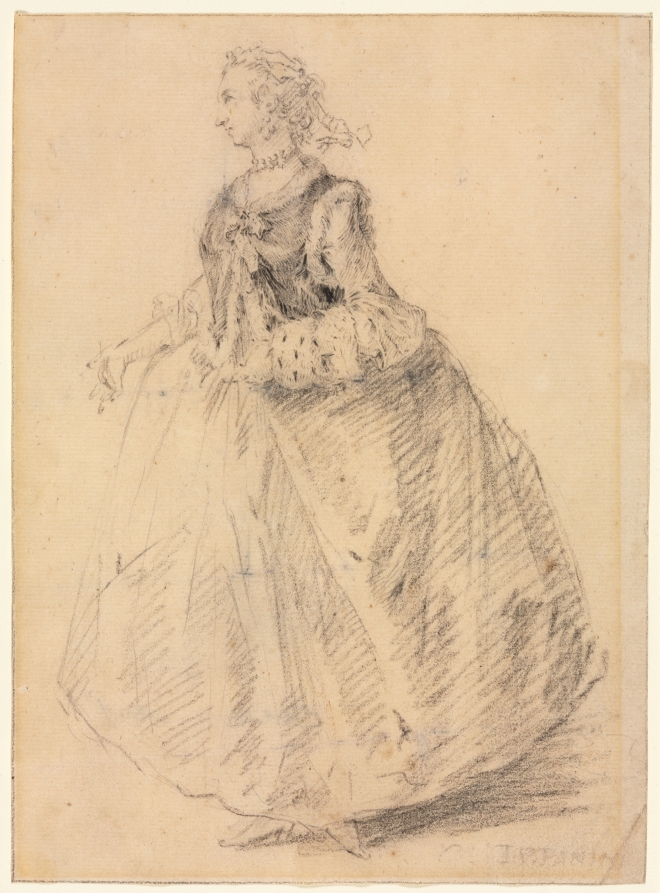
Standing Woman with an Ermine Muff, 18th century, by Giovanni Paolo Panini
Giovanni Paolo Panini · The Cleveland Museum of Art · Gift of Moselle Taylor Meals
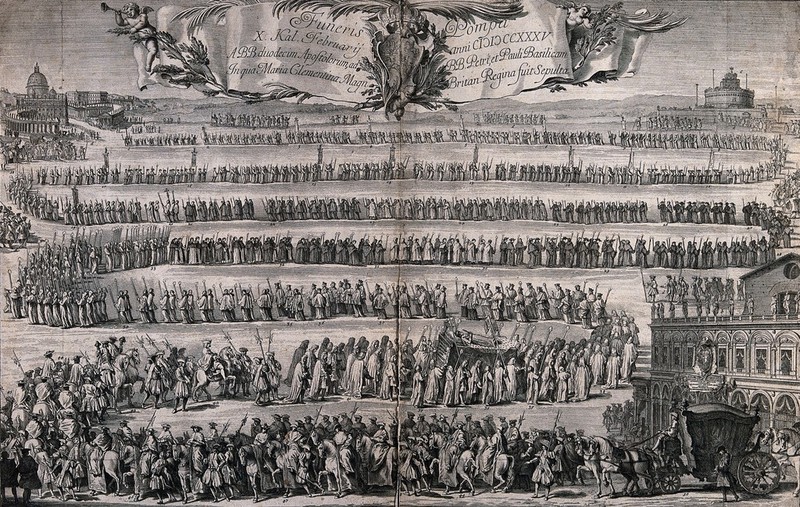
The funeral procession of Princess Maria Clementina in 1735. Line engraving with etching by Rocco Pozzi after G.P. Panini., 1735, by Giovanni Paolo Panini
Giovanni Paolo Panini · Wellcome Collection, London · Wellcome Collection
Notes from the source article
Cited by Wikipedia
Notes from the source article
These works are cited by the source article, in its own numbering. They are recorded as its citations, not as sources VALÉORINE has verified.
- 1.Bryan, Michael. Bryan's dictionary of painters and engravers. New York : Macmillan. 1903–1905.
- 2.Pannini, Giovanni Paolo nell'Enciclopedia Treccani. www.treccani.it.
- 3.PANNINI, Gian paolo in "Enciclopedia Italiana". www.treccani.it.
- 4.Panini, Giovanni Paolo - Colección - Museo Nacional del Prado. www.museodelprado.es.
- 5.Anna Maria Ferrari. "Panini, Giovanni Paolo." Grove Art Online. Oxford Art Online. 27 March 2010.
- 6.Louvre Museum Official Website. cartelen.louvre.fr.
- 7.Web Gallery of Art, searchable fine arts image database. www.wga.hu.
- 8.St. Peter's Square, Rome. emuseum.toledomuseum.org. December 2025.
- 9.Exchange: Landscape with Classical Ruins. exchange.umma.umich.edu.
- 10.Brooklyn Museum. www.brooklynmuseum.org.
- 11.Interior of St. Peter's, Rome. Saint Louis Art Museum.
- 12.View of the Colosseum. www.dia.org.
- 13.Picture Gallery with Views of Modern Rome. collections.mfa.org.
- 14.Three Figure Studies (Getty Museum). The J. Paul Getty in Los Angeles.
- 15.Giovanni Paolo Panini | Ancient Rome. www.metmuseum.org.
- 16.Giovanni Paolo Panini – Artists/Makers – The Nelson-Atkins Museum of Art. art.nelson-atkins.org.
- 17.The Colosseum and the Arch of Constantine (Primary Title) - (65.27). Virginia Museum of Fine Arts.
- 18.Giovanni Paolo Panini. The Walters Art Museum.
- 19.Harvard. From the Harvard Art Museums' collections Adoration of the Magi. harvardartmuseums.org.
- 20.Philadelphia Museum of Art - Collections Object : Roman Monuments. www.philamuseum.org.
- 21.Roman Capriccio: The Pantheon and Other Monuments. Indianapolis Museum of Art Online Collection.
Bibliography printed in the source article · 8
- Arisi, Ferdinando. Gian Paolo Panini e i fasti della Roma del '700. U. Bozzi. 1986. 88-7003-016-4.
- Arisi, Ferdinando,Giovanni Paolo Panini 1691-1765, Milano, 1993.
- Horak, Marco, Ritornato a Piacenza il dipinto di Panini passato all'asta lo scorso anno a Londra: si tratta dell' "opera prima", pendant di quello esposto alla Glauco Lombardi di Parma, in "Strenna Piacentina 2013", Piacenza, 2013.
- Horak, Marco, Quell'opera prima di Panini gemella del dipinto esposto al Lombardi di Parma, in "L'Urtiga - Quaderni di cultura Piacentina", Piacenza, n. 4, 2013.
- Horak, Marco, L'opera prima del Panini in una collezione privata, in "Panorama Musei", anno XVIII, n.3, dicembre 2013
- Horak, Marco, G.P. Panini al Fine Art Museum di San Francisco, in "Panorama Musei", anno XXI, n. 2, settembre 2016
- Horak, Marco, Giovanni Ghisolfi tra Salvator Rosa e Giovanni Paolo Panini, Piacenza, 2020
- Bryan, Michael. Bryan's Dictionary of Painters and Engravers. George Bell and Sons. IV: N-R. 62. 1904.
References
Citations
References
Each reference names the institution holding it, so a reader may go to the document itself.
reference work
Secondary witnessreference work
Secondary witness
The Encyclopedia exists whether or not anything is for sale. Corrections are recorded rather than overwritten, and every version of this record is kept. Published 14 August 2026.
Elsewhere in Design
11,558 published records in this field, each with its sources named.
- Giovanni Maria FontanaDesigner
- Giovanni MichelucciDesigner
- Giovanni MuzioDesigner
- Giovanni Niccolò ServandoniDesigner
- Giovanni Paolo RecchiDesigner
- Giovanni PellegriniDesigner
- Giovanni Pietro de PomisDesigner
- Giovanni Pietro LigarioDesigner
Best supported in this field
For owners
Own a work by Giovanni Paolo Panini?
A specialist will read what you send and tell you what the house can establish, what it cannot, and whether the object is suited to sale. There is no charge and no obligation. The object stays with you throughout; nothing is shipped to us unless it is arranged in writing beforehand.