
Giovanni Maria Bernardoni
Giovanni Maria Bernardoni (1541–1605) was a Jesuit and an Italian architect who was the first to design the Baroque style in Poland and the Grand Duchy of Lithuania.
Also recorded as Gian Maria Bernardoni
Giovanni Maria Bernardoni
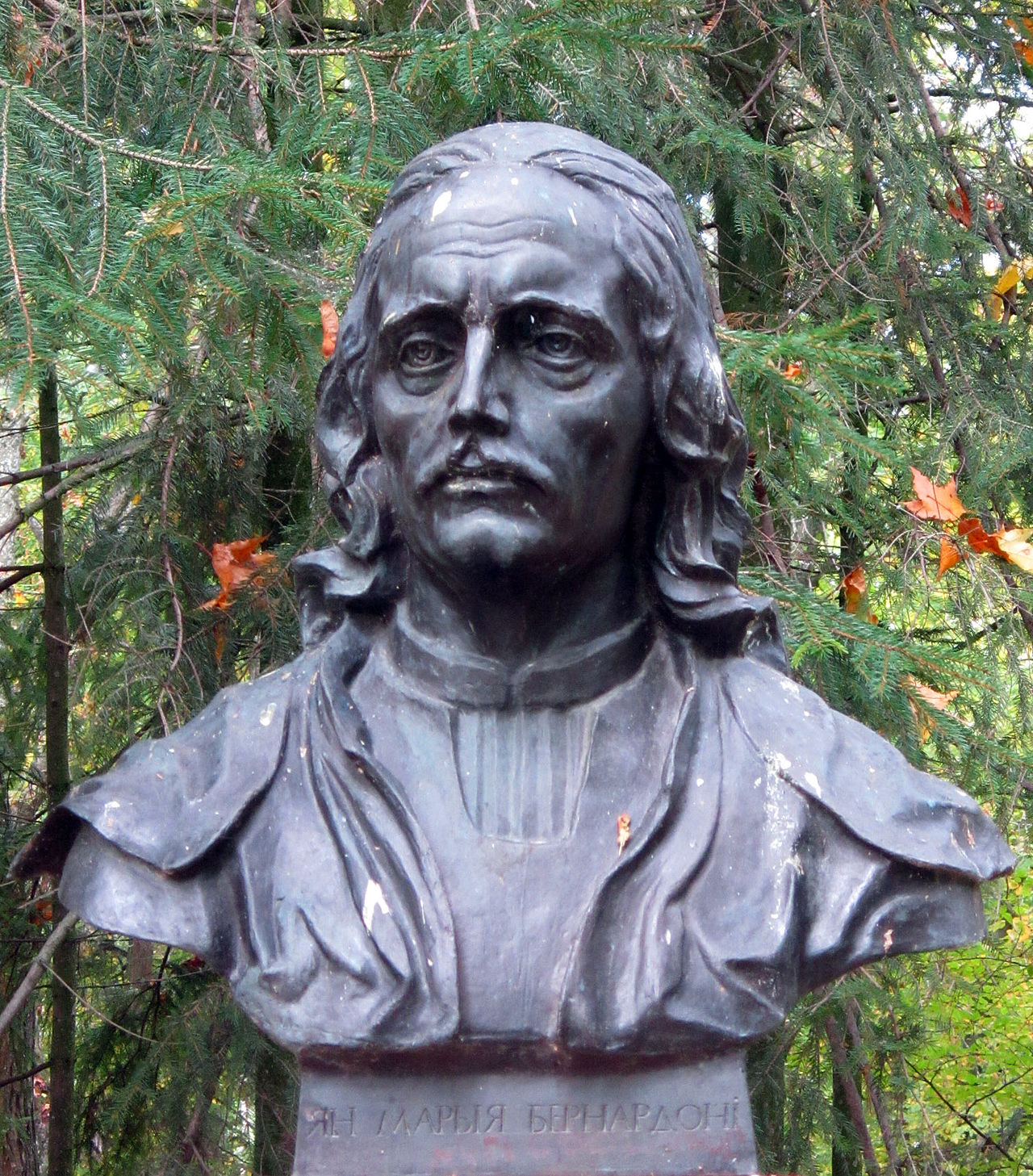
скульптор Сергей Гумилевский · Self-photographed · CC BY-SA 3.0
- Name
- Giovanni Maria Bernardoni
- Born
- 1541
- Birthplace
- Cagno, Italy
- Died
- 1605
- Place of death
- Kraków, Poland
- Nationality
- Duchy of Milan · Polish–Lithuanian Commonwealth
- Occupation
- architect
- Known for
- Corpus Christi Church in Niasviž · Nesvizh Castle
- Languages
- Italian
VALÉORINE Encyclopedia
VALÉORINE documentary reading
Documentary summary
Giovanni Maria Bernardoni (1541–1605) was a Jesuit and an Italian architect who was the first to design the Baroque style in Poland and the Grand Duchy of Lithuania.
Admitted source layer · organised and presented by VALÉORINE
Note VALÉORINE
Giovanni Maria Bernardoni (1541–1605) was an architect, a national of the Duchy of Milan and Polish–Lithuanian Commonwealth. The architect was born in Laino and died in Kraków. Giovanni Maria Bernardoni worked in Kalisz, Kraków and Niasviž, among others.
Among the works are Corpus Christi Church in Niasviž and Nesvizh Castle. Languages used include Italian.
Composed from admitted, traceable facts · 26 September 2026
VALÉORINE
Reference Check
Propose documentary evidence for Giovanni Maria Bernardoni. A contribution is never written directly as fact: identity, source, rights and evidence gates still decide.
Sign in to contribute
World of VALÉORINE
Documentary connections
Only confirmed graph relationships appear here. Images are shown only when their identity and reuse rights both pass the documentary gate.
Documentary evidence
Documentary basis
Authority files
wikidata · Q2858143 · wikipedia · Giovanni Maria Bernardoni
In this article
Key facts
Key facts
• Name — Giovanni Maria Bernardoni • Born — 1541 • Birthplace — Cagno, Italy • Died — 1605 • Place of death — Kraków, Poland • Significant Buildings — Church of St. Peter and Paul in Kraków, Church of Corpus Christi in Nyasvizh, Monastery of St. Bernardin in Kalwaria Zebrzydowska
Early life
Early life
Giovanni Maria Bernardoni was born in northern Italy in the commune of Cagno in 1541. He worked as a mason until he was 23 years old upon which he left for Rome to join the Order of the Jesuits and become an architect. The Order directed him towards the construction of their main church in Rome, the Church of the Gesù, where he worked for 6 years. The construction was under the supervision of the famous Italian architect and the inspector of the Order's construction projects, John Tristan.
Italy
Italy
• Illustration — Church of Saint Catherine, Sassari Starting in 1573, Bernardoni worked on the construction of churches in Milan, Florence, Naples, and Abruzzo. The Chief Vicar of the Province Bernardoni was in at the time wrote about him to the Superior General of the Society of Jesus saying: "We are happy that God has gladdened us by giving us this master who was essential in helping Father Giovanni". Later, he goes on to work in Sardinia, specifically Cagliari, where he founds the Church of St. Michael towards the end of 1578 and the Church of Saint Catherine in Sassari (1579-1609).
Lithuania and Poland
Lithuania and Poland
In 1583, by command of the head of the Jesuit Order, Bernardoni was sent to the Grand Duchy of Lithuania where Prince Nicholas Radziwill had already been asking for an architect for a long time. However, he wasn't able to make it to his new assignment since on the way there, Bernardoni was taken in Lublin by the rector of the Gdańsk Jesuit College, Christopher Warszewicki who was very influential in Poland. In Lublin, Bernardoni worked for 3 years doing projects for the Lublin College and churches in Poznań, Kalisz, and a restoration after a fire in the Bridgettines convent in Gdańsk.
Nyasvizh
Nyasvizh
• Illustration — Jesuit Church at Nyasvizh in the 19th century by artist Kazimezh Pyastushkevich • Illustration — Facade of the Corpus Christi Church in Nyasvizh • Illustration — Franciscan Monastery and Church in Kalwaria Zebrzydowska After the persistent reminders of Prince Radziwiłł to the Order of Jesuits for an architect, in 1586 Bernardoni comes to Nyasvizh and stays there for 13 years. There was a lot of work to do: firstly, the need to oversee the construction of Nyasvizh college which had just begun. The project had already been prepared in Rome by Giovanni de Rossi, Bernardoni only needed to make adjustments and corrections. The main project was the local Church of the Jesuits which had to be designed and built. The prototype for this church became the main church of the Order of the Jesuits in Rome. Work in Nyasvizh moved quickly although before Bernardoni was a difficult task: in addition to the need to keep the style of buildings dictated by the Jesuits, the wishes of Prince Radziwiłł had to also be considered - including that the temple be built as a tomb for the Radziwiłł's. Due to the multipurpose nature of the church, the project require a lot of precision. For example, there were four staircases to ensure there would be a different path to separate locations and choirs for members of the princely family, priests, students of the college, and the commoners. There was also established two separate entrances to the crypt-dungeons, where different parts of the dungeon held the coffins of princes, monks, and eminent members of the community. It is known that while working in Nyasvizh, Bernardoni helped Minsk-born former furrier Jan Frankiewicz, who after joining the Jesuits worked in Nyasvizh as a baker and was taught to be an architect by Bernardoni. Later, at the beginning of the 17th century, Frankiewicz built the St. Casimir's Church in Vilnius, which still stands at the Town Hall Square. Over the years, many churches in Nyasvizh were simplified, redone, and had additions made to them especially in the middle of the 18th century, but the stylistic basis of the building, both inside and outside remains unchanged since the times of Bernardoni. Apparently, the Radziwiłł's were involved in the design process of many of the buildings. In November 1593, the construction of the church was completed and the first services there were held. Jesuit churches in Nyasvizh were considered the first buildings built in the Baroque style on the territory of the Polish–Lithuanian Commonwealth simply because they were completed more quickly than others, even those that were started being built much earlier. This is thanks to the exclusive interest of Radziwiłł's in the project, who did not allow interruptions in the construction, who promptly gave money to such an extent that in the end amounted to more than the previously agreed cost. In 1993 a bust of Giovanni Bernardoni by sculptor Nicholas Gumilev was placed in the Old Nyasvizh Park.
Kraków
Kraków
• Illustration — Church of Sts. Peter and Paul Church in Kraków Upon completion of his works in Nyasvizh, in 1599 Bernardoni goes to Kraków for the construction of the Church of Sts. Peter and Paul as well as completing the Monastery of St. Bernard in Kalwaria Zebrzydowska and St. Casimir in Vilnius. In 1605, when the Church of Sts. Peter and Paul had only the dome left to build, the walls cracked to which Bernardoni orders the foundation to be dug so the walls could be strengthened; this was not his fault - the foundation was laid down by a different architect. Bernardoni managed to fix his predecessor's mistake and the dome was quickly erected where it remains till this day. He never saw the completion of his last work as he died that same year, in 1605.
Notable buildings
Notable buildings
• Church of St. Voytseha and St. Stanislav Bskupa in Kalisz (1592–1597) • Church of Corpus Christi in Nyasvizh (1587–1593) • Church of Sts. Peter and Paul in Kraków (1597–1619) • Basilica of Our Lady of the Angels in Kalwaria Zebrzydowska (1603–1609) • Church of St. Casimir in Vilnius (1604–1616) – designed by his student Jan Frankiewicz
Identity
Identity
Giovanni Maria Bernardoni is recorded as architect.
Life and career
Dated record
Life and career
The full dated record · 2 entries
1541
Giovanni Maria Bernardoni born at Laino.
1605
Giovanni Maria Bernardoni died at Kraków.
Places
Named by the record
Places
Only places the record itself states, plotted where the house gazetteer settles their coordinates. Nothing is inferred from a name or a nationality.
Laino.
Birth place
Kraków.
Death place
Literature
Scholarly footprint
A count of publications is evidence of attention, not of standing, and is given here only as a measure.
Notes from the source article
Cited by Wikipedia
Notes from the source article
These works are cited by the source article, in its own numbering. They are recorded as its citations, not as sources VALÉORINE has verified.
- 1.Michael J. Mikoś, Polish Baroque and Enlightenment Literature: An Anthology. Ed. Michael J. Mikoś. Columbus, Ohio/Bloomington, Indiana: Slavica Publishers. 1996. 104-108. Cultural background
- 2.http://bha.knihi.com/11/kal_e11.htm , Star way of Giovanni Maria Bernardoni, Valiancin Kalnin
- 3.L’architetto Gian Maria Bernardoni sj tra l'Italia e le terre dell’Europa centro–orientale
- 4.Salviucci Insolera L. Il periodo italiano di Giovan Maria Bernardoni //L'architetto Gian Maria Bernardoni… P. 13
- 5.Biographical Dictionary of Italians - Volume 9 (1967), BERNARDONI, Giovanni Maria, detto Bernardone, Jòsef Lepiarczyk
- 6.* Rūstis Kamuntavičius et alii, Artisti del lago di Lugano e del Mendrisiotto in Lituania, 2013, 20, 22, 23, 25.
- 7.Paszenda J. Kościół Bożego Ciała w Nieświeżu //Kwartalnik architektury i urbanistyki. T.XXI. R. 1976. Z. 3. S. 19-216
- 8.Paszenda J. Nieznane źódlo do driejów budowy kościoła Sw. Piotra w Krakowie // Biuletyn Historii Sztuki. T. XXVIII. N 1. 1996. S. 40-44
Bibliography printed in the source article · 13
- Габрусь Т. Архитектурное проектирование в Белоруссии. У истоков //Строительство и архитектура Белоруссии. 1990. № 4. pp. 36—38.
- Габрусь Т., Галенчанка Г. Правераная алгебрай гармонія. Пачатак архітэктуры новага часу на Беларусі // Мастацтва Беларусі. 1990. № 5. pp. 70—75.
- Барока ў беларускай культуры і мастацтве: зборнік / Нацыянальная акадэмія навук Беларусі, Інстытут мастацтвазнаўства, этнаграфіі і фальклору імя К.Крапівы; [навуковы рэдактар В. Ф. Шматаў]. ― Мн., 2005.
- Галенчанка Г. Альбом Бернардоні: Новая крыніца да гісторыі архітэктуры і будаўніцтва ў Нясвіжы (канец XVI— пачатак XVII ст.) // Ад Полацка і Нясвіжа да Падуі і Венецыі. ― Мінск, 1994. pp. 79—86.
- Калнін В. Архітэктар Я. М. Бернардоні — прадвеснік барока на Беларусі // Барока ў беларускай культуры і мастацтве. ― Мінск, 1998. pp. 124—139.
- Праблемы ідэнтыфікацыі мастацкай спадчыны Нясвіжа ў агульнаеўрапейскім кантэксце культуры: матэрыялы навуковай канферэнцыі (Нясвiж, 15 мая 2004 г.): у рамках IX Беларускага фестывалю камернай музыкi «Музы Нясвiжа — 2004» / [укладальнік Н. С. Стрыбульская; пад агульнай рэдакцыяй У. П. Скараходава]. ― 2004.
- L'architetto Gian Maria Bernardoni sj tra l'Italia e le terre dell’Europa centro-orientale / [Cur.]: Sante Graciotti, Jerzy Kowalczyk; Fondazione Giorgio Cini. 1999.
- L'architetto Gian Maria Bernardoni sj tra l'Italia e le terre dell’Europa centro-orientale (a cura di Sante Graciotti e Jerzy Kowalczyk). ― Rome, MCMIC [1999].
- Markowski F. Zamek Mikołaja Krzysztofa Radziwiłła Sierotki w Nieświeżu. // Kwartalnik architektury i urbanistyki, t.IX, z.2. ― Warsaw, 1964. S.185—192.
- Poplatek J., Paszenda J. Słownik jezuitów-artystów. ― Kraków, 1972. p. 83.
- Salviucci Insolera L. Il periodo italiano di Giovan Maria Bernardoni //L'architetto Gian Maria Bernardoni… p. 3.
- Załęski S. Kolegium jezuitów w Nieświeżu// Przegląd Powszechny, № 54, 1897, pp. 239–252.
- Rūstis Kamuntavičius et alii: Artisti del lago di Lugano e del Mendrisiotto in Lituania, in Gli artisti del lago di Lugano e del Mendrisiotto nel Granducato di Lituania (dal XVI al XVIII sec.), Hrsg Giorgio Mollisi, «Arte&Storia», Edizioni Ticino Management, anno 13, numero 59, agosto-ottobre 2013, Lugano 2013.
References
Citations
References
Each reference names the institution holding it, so a reader may go to the document itself.
reference work
Wikidata, structured authority record Q2858143: Giovanni Maria BernardoniWikimedia Foundation
Secondary witnessreference work
Secondary witness
The Encyclopedia exists whether or not anything is for sale. Corrections are recorded rather than overwritten, and every version of this record is kept. Published 16 August 2026.
Elsewhere in Design
11,558 published records in this field, each with its sources named.
- Giovanni Francesco LucchiniDesigner
- Giovanni Francesco MormandoDesigner
- Giovanni Giacomo MontiDesigner
- Giovanni GreppiDesigner
- Giovanni Maria FalconettoDesigner
- Giovanni Maria FontanaDesigner
- Giovanni MichelucciDesigner
- Giovanni MuzioDesigner
Best supported in this field
For owners
Own a work by Giovanni Maria Bernardoni?
A specialist will read what you send and tell you what the house can establish, what it cannot, and whether the object is suited to sale. There is no charge and no obligation. The object stays with you throughout; nothing is shipped to us unless it is arranged in writing beforehand.