
Giovanni Francesco Rustici
Illustration — Giovan Francesco Rustici, as depicted in the 1682 edition of Academy of Sciences and Arts, containing the lives, and historical eulogies of illustrious men • Illustration — Anghiari Battle after Leonardo da Vinci, Bargello museum • Illustration — A Group of Warriors by Giovanni Francesco Rustici, Palazzo Vecchio Giovan Francesco Rustici, or Giovanni Francesco Rustici, (1475–1554) was an Italian Renaissance painter and sculptor. He was born into a noble family of Florence, with an independent income. Rustici profited from study of the Medici sculpture in the garden at San Marco, and according to Giorgio Vasari, Lorenzo de' Medici placed him in the studio of Verrocchio, and that after Verrocchio's departure for Venice, he placed himself with Leonardo da Vinci, who had also trained in Verocchio's workshop.
Also recorded as Gianfrancesco Rustici · Giovan Francesco Rustici
Giovanni Francesco Rustici

Nicolas de Larmessin and Esme de Boulonais · Isaac Bullart. Académie Des Sciences Et Des Arts. Amsterdam: Elzevier, 1682. · Public domain
- Died
- 1554
- Occupation
- sculptor · architect
- Known for
- Battle of Horsemen · Madonna and Child with young Saint John the Baptist in a tondo
VALÉORINE Encyclopedia
VALÉORINE documentary reading
Documentary summary
Illustration — Giovan Francesco Rustici, as depicted in the 1682 edition of Academy of Sciences and Arts, containing the lives, and historical eulogies of illustrious men • Illustration — Anghiari Battle after Leonardo da Vinci, Bargello museum • Illustration — A Group of Warriors by Giovanni Francesco Rustici, Palazzo Vecchio Giovan Francesco Rustici, or Giovanni Francesco Rustici, (1475–1554) was an Italian Renaissance painter and sculptor. He was born into a noble family of Florence, with an independent income. Rustici profited from study of the Medici sculpture in the garden at San Marco, and according to Giorgio Vasari, Lorenzo de' Medici placed him in the studio of Verrocchio, and that after Verrocchio's departure for Venice, he placed himself with Leonardo da Vinci, who had also trained in Verocchio's workshop.
Admitted source layer · organised and presented by VALÉORINE
Note VALÉORINE
No house-authored Note is published until its assertions and sources pass the VALÉORINE evidence contract. The documentary article remains available in full while that enrichment is being consolidated.
Documentary enrichment in progress · no unsupported statement published
Reference Check
Propose documentary evidence for Giovanni Francesco Rustici. A contribution is never written directly as fact: identity, source, rights and evidence gates still decide.
Sign in to contribute
Documentary evidence
Evidence Panel
not yet certified
- Identity
- resolved
- Independent source families
- 0
- Admitted assertions
- 0
- Open conflicts
- 0
Authority files
wikidata · Q720384 · wikipedia · Giovanni Francesco Rustici
In this article
Major works
Major works
He shared lodgings with Leonardo while he was working on the bronze figures for the Florence Baptistry, for which he was ill paid and resolved, according to Vasari, not to work again on a public commission. Moreover, an echo of Leonardo's inspiration is unmistakable in the much-discussed and much-reviled wax bust of "Flora" in Berlin, ascribed to a circle of Leonardo and most probably to Rustici. At this time, Pomponius Gauricus, in De sculptura (1504), named him one of the principal sculptors of Tuscany, the peer of Benedetto da Maiano, Andrea Sansovino and Michelangelo. It may have been made in France, perhaps in the circle of Rustici, who entered Francis I's service in 1528. Vasari tells of the elaborate suppers given by Rustici and his comrades. Rustici's Mercury was commissioned by Cardinal Giuliano de' Medici in 1515 as a fountain figure for the courtyard of Palazzo Medici in Florence. The figure blew a jet of water that spun a whirligig with four vanes in the form of butterfly wings, according to Giorgio Vasari's description. According to James Draper, Rustici's figure drew inspiration from the mid-fifteenth century gilt-bronze fountain Winged Infant now at the Metropolitan Museum of Art. Vasari praised the sculpture, now in the Boscawen collection at the Fitzwilliam Museum, Cambridge. At the time of the siege of Florence, 1528, he went to France, where he was pensioned by King Francis I but after the king's death died in poverty at Tours. Baccio Bandinelli apprenticed with Rustici. Some glazed terracotta bas-reliefs in the technique familiar from the della Robbia workshops, are attributed to Rustici, notably a Madonna and Child in the Bargello and a Saint John the Baptist in the Museum of Fine Arts, Boston.
• Bust of Boccaccio (1503) for Giovanni Boccaccio's funeral monument at Certaldo. • John the Baptist with the Pharisee and the Levite. Three figures on the Baptistery, Florence. The work was commissioned in 1506 to replace Late Gothic figures by Tino da Camaino. • Mercury taking Flight. Commissioned by Cardinal Giulio de' Medici (later Pope Clement VII), to decorate a fountain in the garden court of Palazzo Medici, Florence, probably in 1515. It was probably installed above the fountain bowl that originally held Donatello's 'Judith'. • The Infant Jesus and Saint John the Baptist. Bas-relief marble and onyx tondo. Louvre Museum. • Virgin and Child Bas-relief bronze plaque, attributed to Rustici. Louvre Museum. • Battle scene. Terracotta. A horseman and four assailants, showing the influence of Leonardo's drawings. Louvre Museum. • Fountain, the design attributed to Leonardo. Formerly at Woolbeding House, Surrey (Victoria and Albert Museum)
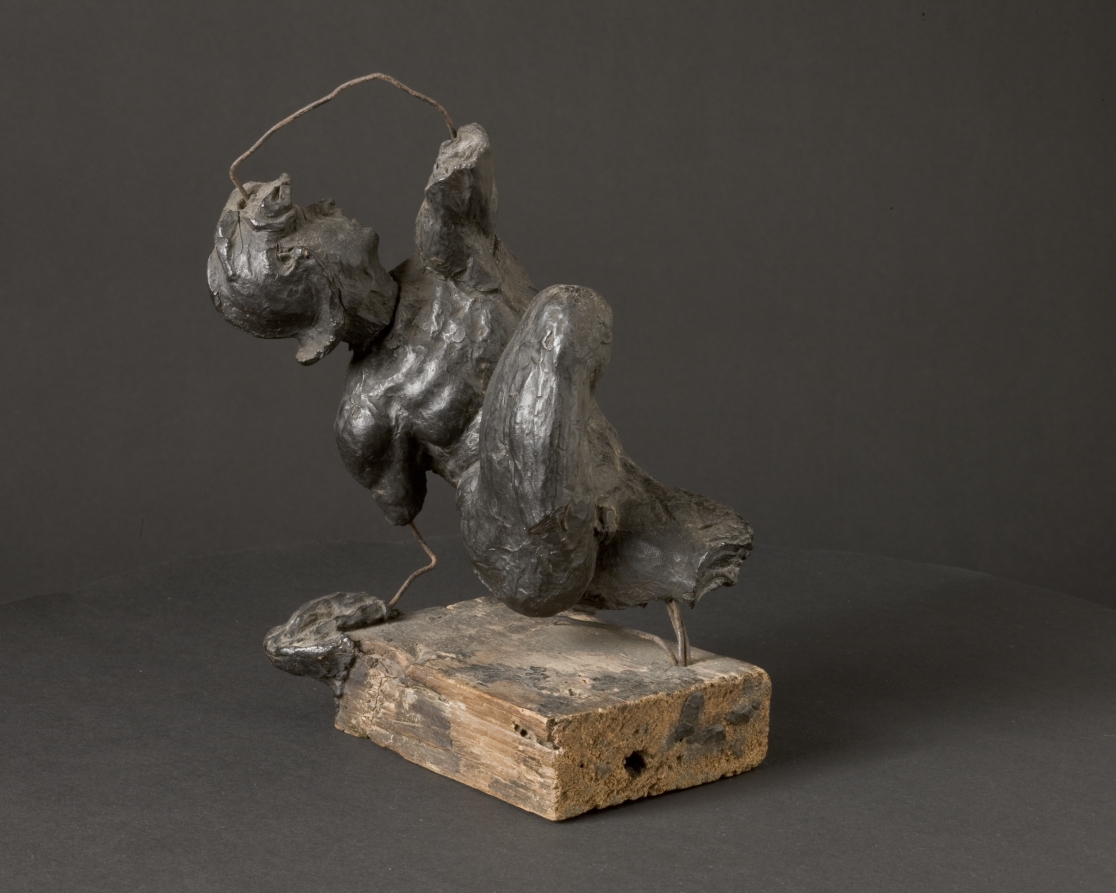
Model for a Fallen Warrior, c. 1520, by Giovanni Francesco Rustici
Giovanni Francesco Rustici · The Cleveland Museum of Art · John L. Severance Fund
Life and career
Dated record
Life and career
Explore 1474–1554
The full dated record · 3 entries
1474
Giovanni Francesco Rustici born at Florence.
1510
Neptune on the chariot is dated 1510.
1554
Giovanni Francesco Rustici died at Tours.
Primary material
Documents and archives
Institutional database
- Wikidata, structured authority record Q720384: Giovanni Francesco Rustici
Scholarly · Wikimedia Foundation
reference work
- “Giovanni Francesco Rustici”, English Wikipedia, consulted as further reading
Reputable secondary · Wikipedia
Notes from the source article
Cited by Wikipedia
Notes from the source article
These works are cited by the source article, in its own numbering. They are recorded as its citations, not as sources VALÉORINE has verified.
- 1.Avery, Charles. Rustici, Giovanni Francesco. Oxford Art Online. Oxford University Press.
- 2.Rùstici, Giovan Francesco. Treccani.
- 3.No paintings securely attributed to him survive.
- 4.Other sculptors from Verrocchio's atelier included Francesco di Simone and Agnolo di Polo.
- 5.Vasari, Vita of Giovanni Francesaco Rustici.
- 6.The connection to Rustici's Mercury of this figure by a sculptor "close to Donatello" was made by James David Draper, Notable Acquisitions (Metropolitan Museum of Art), No. 1983/1984 (1983-84), pp. 26-44
- 7.Press release ; the sculpture was illustrated on the cover of The Burlington Magazine 139 No. 1137 (December 1997).
- 8.Attributed to Leonardo by John Pope-Hennessy, in Victoria and Albert Museum Yearbook 4.
Bibliography printed in the source article · 2
- Minning, Martina. Giovan Francesco Rustici (1475-1554): Untersuchungen zu Leben und Werk des Florentiner Bildhauers. Rhema-Verlag. 2010. 978-3-930454-84-6.
- Mozzati, Tommaso. Giovanfrancesco Rustici: le Compagnie del paiuolo e della cazzuola ; arte, letteratura, festa nell'età della maniera. Leo S. Olschki Editore. 2008. 978-88-222-5725-3.
References
Citations
References
Each reference names the institution holding it, so a reader may go to the document itself.
Institutional database
Wikidata, structured authority record Q720384: Giovanni Francesco RusticiWikimedia Foundation
Verifiedreference work
Partially resolved
Further particulars
Held on the record
Further particulars
Open the remaining particulars
He trained under Leonardo da Vinci and Andrea del Verrocchio. Each of those relationships is stated by the authority record rather than inferred from style.
Work and production. Works recorded as notable number 2: Battle of Horsemen and Madonna and Child with young Saint John the Baptist in a tondo.
Recognition and collections
Work by Giovanni Francesco Rustici is
Cleveland Museum of Art, Museo dell'Opera del Duomo, Victoria and Albert Museum and Fitzwilliam Museum
The Encyclopedia exists whether or not anything is for sale. Corrections are recorded rather than overwritten, and every version of this record is kept. Published 14 August 2026.
Elsewhere in Sculpture
6,174 published records in this field, each with its sources named.
- Giovanni di CeccoArtist
- Giovanni di StefanoArtist
- Giovanni DupréArtist
- Giovanni FerrariArtist
- Giovanni Francesco SusiniArtist
- Giovanni ManzoliniArtist
- Giovanni Maria BenzoniArtist
- Giovanni Maria MorlaiterArtist
Best supported in this field
For owners
Own a work by Giovanni Francesco Rustici?
A specialist will read what you send and tell you what the house can establish, what it cannot, and whether the object is suited to sale. There is no charge and no obligation. The object stays with you throughout; nothing is shipped to us unless it is arranged in writing beforehand.