
Giovanni Dalmata
Illustration — Putto bearing the Cippico shield and torch, circa 1480. Trogir City Museum Giovanni Dalmata (Ivan Duknović; c. 1440 – c.
Also recorded as Giovanni Da Trau · Giovanni da Trau · Johannes Duknowich De Tragusia · Johannes Duknowich de Tragusia
Giovanni Dalmata

Sailko · CC BY-SA 3.0
- Born
- 1440
- Nationality
- Republic of Venice
- Occupation
- sculptor
- Movements
- Renaissance
VALÉORINE Encyclopedia
VALÉORINE documentary reading
Documentary summary
Illustration — Putto bearing the Cippico shield and torch, circa 1480. Trogir City Museum Giovanni Dalmata (Ivan Duknović; c. 1440 – c.
Admitted source layer · organised and presented by VALÉORINE
Note VALÉORINE
No house-authored Note is published until its assertions and sources pass the VALÉORINE evidence contract. The documentary article remains available in full while that enrichment is being consolidated.
Documentary enrichment in progress · no unsupported statement published
Reference Check
Propose documentary evidence for Giovanni Dalmata. A contribution is never written directly as fact: identity, source, rights and evidence gates still decide.
Sign in to contribute
Documentary evidence
Evidence Panel
not yet certified
- Identity
- resolved
- Independent source families
- 0
- Admitted assertions
- 0
- Open conflicts
- 0
Authority files
getty · 500030402 · wikidata · Q668864 · wikipedia · Giovanni Dalmata
In this article
Biography
Biography
1514), born Ioannes Stephani Duknovich de Tragurio, also known as Giovanni Duknovich di Traù in Italy and Ivan Stjepanov Duknović in Croatia, was a sculptor from Trogir, Dalmatia, who was mainly active in Rome, Hungary and his native country during the European Renaissance. Dalmata was, with Mino da Fiesole and Andrea Bregno, one of the leading sculptors in Rome in the second half of the 15th century.
He was born in Vinišće, a Dalmatian village (now a part of Marina) in Venetian Dalmatia around 1440. His father was Stjepan Duknović, a stonemason in Trogir. He came to Rome between 1460 and 1465 to work for Pope Paul II on the Palazzo di Venezia. Other works in and around Rome include the Tempietto of S. Giacomo in Vicovaro (near Tivoli), the tomb monuments of Pope Paul II in St. Peter's (now dismantled), the tomb of Cardinal Bartolomeo della Rovere in San Clemente, the tomb of Cardinal Bernardo Eroli (now in the Grotte Vaticane). Around 1488–1490, Giovanni went to the Court of King Matthias Corvinus in Buda, where he stayed for a few years, mastering a number of works which were unfortunately all either destroyed or badly damaged (e.g. the Fountain of Hercules in Visegrád). After his stay in Hungary, Giovanni Dalmata returned to Trogir (Traù in Italian) where he left a number of works, most important among those is the statue of St. John the Evangelist in the Orsini Chapel in Trogir Cathedral. He is also the creator of the sculpture of St. Magdalene in the Franciscan monastery of St. Anthony on the nearby Čiovo island and worked with Niccolò Fiorentino and Andrea Alessi on the Renaissance Cippico Palace in Trogir. Around 1503, he was in Rome again, working on the tomb of the papal protonotary Lomellino. In 1509 he executed the tomb of the Beato Giannelli for S. Ciriaco in Ancona. Some documents of 1513 and 1514 refer to one "Magistro Joanni lapicida" in Trogir where he presumably died soon afterwards. A newly discovered work (The Virgin and Child, a marble relief) was offered on auction in London's Katz gallery and bought for £250,000 by Trogir City Museum. The authenticity of this work remains doubtful.

Scultura italiana, Louvre
Sailko
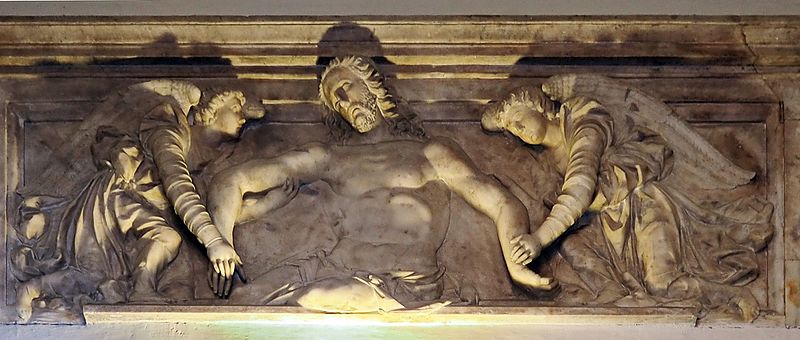
Sant'Agostino (Rom); Vestibül; Christus getragen von Engeln; Giovanni Dalmata
Peter1936F
Life and career
Dated record
Life and career
Explore 1440–1515
The full dated record · 4 entries
1440
Giovanni Dalmata was born in 1440.
1480
Madonna of Diósgyőr is dated 1480.
1484
Hercules Fountain in Visegrád is dated 1484.
1515
Giovanni Dalmata died at Trogir.
Primary material
Documents and archives
authority file
- Getty Union List of Artist Names 500030402, Giovanni Dalmata.
Unverified · The Getty Research Institute
- VIAF cluster 62350540 for Giovanni Dalmata, aggregating national library name authorities.
Unverified · OCLC
reference work
- Wikidata, structured authority record Q668864: Giovanni Dalmata
Reputable secondary · Wikimedia Foundation
- “Giovanni Dalmata”, English Wikipedia, consulted as further reading
Reputable secondary · Wikipedia
Notes from the source article
Cited by Wikipedia
Notes from the source article
These works are cited by the source article, in its own numbering. They are recorded as its citations, not as sources VALÉORINE has verified.
- 1.http://unesdoc.unesco.org/images/0015/001500/150036e.pdf Documento dell'Unesco con breve biografia di Giovanni Dalmata. Il riferimento a Mandoler è a pag.7
- 2.monumento funebre di Duknovic Ivan detto Giovanni Dalmata.
- 3.Magnificenze vaticane - tesori inediti dalla Fabbrica di San Pietro. De Luca. 2008. 9788880168577.
References
Citations
References
Each reference names the institution holding it, so a reader may go to the document itself.
authority file
Getty Union List of Artist Names 500030402, Giovanni Dalmata.The Getty Research Institute
Partially resolvedauthority file
Partially resolvedreference work
Wikidata, structured authority record Q668864: Giovanni DalmataWikimedia Foundation
Partially resolvedreference work
Partially resolved
The Encyclopedia exists whether or not anything is for sale. Corrections are recorded rather than overwritten, and every version of this record is kept. Published 14 August 2026.
Elsewhere in Sculpture
6,174 published records in this field, each with its sources named.
- Giovanni Battista MarmiArtist
- Giovanni CasiniArtist
- Giovanni da NolaArtist
- Giovanni da UdineArtist
- Giovanni De MartinoArtist
- Giovanni di BalduccioArtist
- Giovanni di CeccoArtist
- Giovanni di StefanoArtist
Best supported in this field
For owners
Own a work by Giovanni Dalmata?
A specialist will read what you send and tell you what the house can establish, what it cannot, and whether the object is suited to sale. There is no charge and no obligation. The object stays with you throughout; nothing is shipped to us unless it is arranged in writing beforehand.