
Giovanna Garzoni
Illustration — Giovanna Garzoni, self-portrait • Illustration — Still Life with Bowl of Citrons, late 1640s, now in J. Paul Getty Museum. Giovanna Garzoni (1600 – February 1670) was an Italian Baroque painter. She began her career painting religious, mythological, and allegorical subjects but gained fame for her still life botanical subjects painted in tempera and watercolour.
Also recorded as Giovana Garzoni · Giovanna Garzoni fiamminga · Garzoni · Gio. Garzioni
Giovanna Garzoni
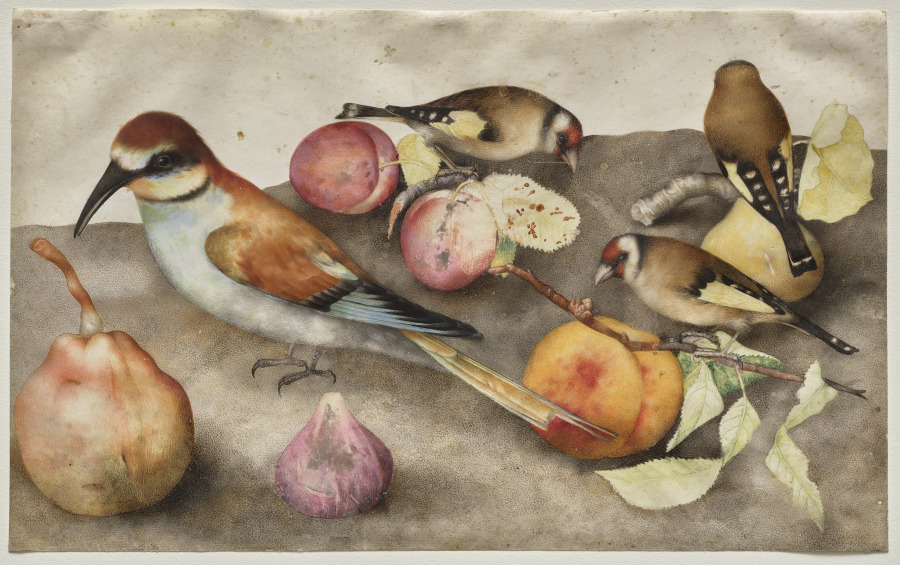
Giovanna Garzoni · The Cleveland Museum of Art · Bequest of Mrs. Elma M. Schniewind in memory of her parents Mr. and Mrs. Frank Geib · CC0
- Born
- 1600. · Ascoli Piceno.
- Died
- 1670. · Rome.
- Occupation
- painter, botanical illustrator, artist and draftsperson.
- Fields
- still life.
- Education
- Accademia di San Luca.
- Languages
- Italian.
VALÉORINE Encyclopedia
VALÉORINE documentary reading
Documentary summary
Illustration — Giovanna Garzoni, self-portrait • Illustration — Still Life with Bowl of Citrons, late 1640s, now in J. Paul Getty Museum. Giovanna Garzoni (1600 – February 1670) was an Italian Baroque painter. She began her career painting religious, mythological, and allegorical subjects but gained fame for her still life botanical subjects painted in tempera and watercolour.
Admitted source layer · organised and presented by VALÉORINE
Note VALÉORINE
Giovanna Garzoni (1600–1670) was an artist, botanical illustrator and draftsperson, among other activities. Born in Ascoli Piceno, the artist died in Rome.
Giovanna Garzoni studied at Accademia di San Luca. The artist worked in Naples, Rome and Turin, among others.
Genres include still life. Languages used include Italian. Works by Giovanna Garzoni are held at Accademia di San Luca, Gabinetto dei disegni e delle stampe and Galleria Palatina, among others.
Composed from admitted, traceable facts · 27 September 2026
VALÉORINE
Reference Check
Propose documentary evidence for Giovanna Garzoni. A contribution is never written directly as fact: identity, source, rights and evidence gates still decide.
Sign in to contribute
World of VALÉORINE
Documentary connections
Only confirmed graph relationships appear here. Images are shown only when their identity and reuse rights both pass the documentary gate.

Documentary evidence
Evidence Panel
not yet certified
- Identity
- resolved
- Independent source families
- 0
- Admitted assertions
- 0
- Open conflicts
- 0
Authority files
wikidata · Q507765 · wikipedia · Giovanna Garzoni
In this article
Early life
Early life
Her works were praised for their precision and balance and for the exactitude of the objects depicted. More recently, her paintings have been seen to have female bodily associations and proto-feminist sentiments. She combined objects very inventively, including Asian porcelain, exotic seashells, and botanical specimens. She was often called the Chaste Giovanna due to her vow to remain a virgin. Scholars have speculated Garzoni may have been influenced by fellow botanical painter Jacopo Ligozzi although details about Garzoni's training are unknown.
Giovanna Garzoni studied at Accademia di San Luca. The recorded working language is Italian. Subjects and genres recorded for the work are still life. Places of work recorded in the authority are Venice, Naples and Rome. Work by Giovanna Garzoni is recorded in the collections of J. Paul Getty Museum, Royal Collections of the Netherlands, Gallerie dell'Accademia, Accademia di San Luca and Royal Palace of Turin.
Giovanna Garzoni was born in 1600 in Ascoli Piceno in the Marche district of Italy to Giacomo Garzoni and Isabetta Gaia. Both of Garzoni's parents were of Venetian origin and are believed to have come from a long line of Venetian painters - a fact that is often disputed. Garzoni's grandfather Nicola and Uncle Vincenzo from her mother's side were both goldsmiths while her other uncle, Pietro Gaia, was a painter who studied under Palma the Younger. Historians have widely speculated that Garzoni started off her career as an apprentice under her uncle sometime before 1615. Garzoni also had a brother, Mattio, with whom she would travel throughout her career.
Career
Career
• Illustration — Taffeta antependium embroidered in silk with flowers around central medallion of God in splendour, 1640–1650. Uffizi Gallery. Garzoni's first known commission was in the city where she grew up, Rome. It was in 1616, from the chemist Giovanni Vorvino to paint a herbarium. Garzoni visited the Medici court in Florence sometime between 1618 and 1620, where she probably encountered Artemisia Gentileschi. Four years later in 1620 Garzoni arrived in Venice and painted a Saint Andrew for the Venetian Church of the Ospedale degli Incurabili. Garzoni stayed in Venice for a few more years and during that time attended the calligraphy school of Giacomo Rogni. Shortly after her studies, Garzoni produced a book of cursive characters illustrated with birds, flowers and insects called the Libro de'caratteri Cancellereschi Corsivi (Biblioteca Accademica di San Luca, Rome). After finishing her education, Garzoni and her brother Mattio left Venice in 1630 for Naples where she worked for the Spanish viceroy, the Duke of Alcalá. Garzoni may have travelled with Gentileschi. Garzoni remained in Naples for a year before returning to Rome in 1631. Garzoni's stay in Rome was short lived however, due to Christina of France's persistent efforts to have the artist come to Turin to serve as the miniaturist for the Turinese court. Garzoni reached Turin in 1632 and lived there until 1637. After staying in Turin, Garzoni became familiar with the work of fellow artists Fede Galizia and Panfilo Nuvolone. A few years later in 1640, Garzoni arrived in Paris and stayed there until 1642 when she went to Rome. Garzoni traveled back and forth from Rome to Florence until 1651 where her primary clients were in the Medici Family, particularly Grand Duke Ferdinando II, Grand Duchess Victoria, and Cardinal Giovan Carlo. After serving the Medici Court, Garzoni decided to settle in Rome in 1651 where she worked continue producing work for the Florentine Court. As well as painting, Garzoni attended the Accademia di San Luca, where she followed events and discussion aimed at educating, socializing, and professionalizing painters, architects and sculptors of Rome. It is noted by several historians that Garzoni's pieces were so well received by the public; she was able to ask any price for her paintings.
Notable works and clients
Notable works and clients
• Illustration — Plate with White Beans, ca. 1650–1662. Gouache on parchment. Galleria Paletina, Florence. • Illustration — Piatto di ciliege con rose, baccello e ape legnaiola • Illustration — Vaso cinese con tulipani e altri fiori, due susine e due piselli, c.1641-52 One of Garzoni's earliest works, Self-portrait as Apollo in which she appears rational and contained, appears to have been modelled on Gentileschi's Self-portrait as a Lute Player, although to very different ends. Around 1626–1633, Cassiano dal Pozzo acquired several studies of citrus fruit painted in watercolor on parchment by Garzoni for a treatise about the fruit. One study of citrus fruit from dal Pozzo's collection, attributed to Garzoni, was sold Sotheby's, New York, 25 January 2011, Lot 122. She probably had links to the Accademia dei Lincei. In 1635, Garzoni made the first known portrait miniature of a Black person, Ethiopian traveller Zaga Christ (c. 1616–1638), possibly commissioned by Christ himself as a present for the French court. Plate with White Beans: Plate with White Beans was one of the several works of art commissioned by the Medici family. The still life, painted sometime between 1650 and 1662, is a naturalistic study of beans in various stages of ripeness and decay. It is collection of the Galleria Palatina in Florence. Portrait of Carlo Emanuele I, Duke of Savory: Created between 1623 and 1637 when Garzoni was invited to work for the court of Turin by Christina of France in 1632, this painting is now located in Palazzo Reale, Turin and was last restored in 1995. Still Life with a Basket of Fruit, a Vase with Carnations and Shells on a Table: This gouache on vellum piece is one of the twenty still-life miniatures that Garzoni produced for the Medici family from the years 1650–1662. The piece depicts carnations, conch shells, as well as a basket of fruit. Due to her work for the Medici Court, Garzoni became a favorite within the Florentine court for her depictions of nature and botanical subjects. It is now located in the Wallace and Wilhelmina Holladay Collection in Washington, DC. Two important manuscript notebooks by Garzoni exist. The rare books library in Washington DC, Dumbarton Oaks, contains a self-portrait of the elderly artist, in addition to a number of botanical studies. Another album, held by the Accademia di San Luca, the artists' institute to which Garzoni left her estate, includes flower studies and still lifes.
Personal life
Personal life
• Illustration — Portrait of Giovanna Garzoni by Carlo Maratti, c. 1665 It is believed by historians that Garzoni never married, but others speculate that the artist was once married to Venetian portrait painter Tiberio Tinelli in 1622. If so, the marriage was short lived, possibly resulting in separation in 1624.
Death
Death
In 1666, Garzoni devised a will that left her estate to the Church of Santa Martina, the church of the Accademia di San Luca on the basis that she would be buried in the church. Garzoni died in Rome in February 1670 at the age of 70. Today, Garzoni's tomb remains at the Church of Santa Martina but it was not interred there until 1698, nearly 29 years after her death. Roman painter Giuseppe Ghezzi's portrait of Garzoni is also located at the Accademia.
Exhibitions
Exhibitions
"La grandezza del universo" nell'arte di Giovanna Garzoni / "The immensity of the universe" in the art of Giovanna Garzoni, Florence, Gallerie degli Uffizi, Palazzo Pitti, Andito degli Angiolini, 28 May - 28 June 2020, exhib. cat. edited by Sheila Barker. Le Signore dell'Arte. Storie di donne tra '500 e '600, Milan, Palazzo Reale, 02.03.2021 to 22.08.2021, curated by Anna Maria Bava, Gioia Mori and Alain Tapié, exhib. cat published by Skira. By Her Hand: Artemisia Gentileschi and Women Artists in Italy, 1500–1800, Wadsworth Atheneum and the Detroit Institute of Arts, September 30, 2021 – January 9, 2022, exhib. cat Yale University Press, edited by Eve Straussman-Pflanzer and Oliver Tostmann Making Her Mark: A History of Women Artists in Europe, 1400-1800, Baltimore Museum of Art and the Art Gallery of Ontario, October 1, 2023 – July 1, 2024, exhib. cat Goose Lane, edited by Andaleeb Banta, Alexa Greist, and Theresa Kutasz Christensen
Life and career
Dated record
Life and career
The full dated record · 2 entries
1600
Giovanna Garzoni was born in 1600 at Ascoli Piceno.
1670
Giovanna Garzoni died in 1670 at Rome.
Places
Named by the record
Places
Only places the record itself states, plotted where the house gazetteer settles their coordinates. Nothing is inferred from a name or a nationality.
Ascoli Piceno.
Birth place
Rome.
Death place
Primary material
Documents and archives
scholarly publication
- :<i>Giovanna Garzoni: "Insigne miniatric" 1600-1700</i>, The Sixteenth Century Journal, 1998
Scholarly · Crossref registry · 1998
- 8. Giovanna Garzoni and Venetian Witchcraft: Still Lifes as Natural Enchantments, Women Artists and Artisans in Venice and the Veneto, 1400-1750, 2024
Scholarly · Crossref registry · 2024
- Garzoni, Giovanna, Benezit Dictionary of Artists, 2011
Scholarly · Crossref registry · 2011
- Giovanna Garzoni and Venetian Witchcraft: Still Lifes as Natural Enchantments, Women Artists and Artisans in Venice and the Veneto, 1400-1750, 2024
Scholarly · Crossref registry · 2024
reference work
- Wikidata, structured authority record Q507765: Giovanna Garzoni
Reputable secondary · Wikimedia Foundation
- “Giovanna Garzoni”, English Wikipedia, consulted as further reading
Reputable secondary · Wikipedia
Notes from the source article
Cited by Wikipedia
Notes from the source article
These works are cited by the source article, in its own numbering. They are recorded as its citations, not as sources VALÉORINE has verified.
- 1.Still Life with Bowl of Citrons (Getty Museum). The J. Paul Getty in Los Angeles.
- 2.Jordi Vigué. Great Women Masters of Art. (New York: Watson-Guptill, 2003), 77.
- 3.Fumagalli, Elena. Giovanna Garzoni: Still Lifes. Bibliotheque de l'Image. 2000.
- 4.Sheila McTighe. "Foods and the Body in Italian Genre Paintings, about 1580: Campi,Passarotti, Carracci". The Art Bulletin, College Art Association 86 (2004):301–323,accessed October 23, 2014, doi 10.2307/3177419.
- 5.Garrard, Mary D. Two of a Kind: Giovanna Garzoni and Artemisia Gentileschi. Art Herstory. 20 April 2020.
- 6.Steinkraus, Emma. The Protofeminist Insects of Giovanna Garzoni and Maria Sibylla Merian. Art Herstory. 9 August 2019.
- 7.Letvin, Alexandra. Giovanna Garzoni's Portrait of Zaga Christ (Ṣägga Krǝstos). Art Herstory. 17 August 2021.
- 8.Jane Fortune, and Linda Falcone.Invisible Women. (Florence: The Florentine Press, 2010), 101.
- 9.Giovanna Garzoni (Italian, 1600 - 1670) (Getty Museum). The J. Paul Getty in Los Angeles.
- 10.Jordi Vigué. Great Women Masters of Art. (New York: Watson-Guptill, 2003), 77.
- 11.Carole Collier Frick, Stefania Biancani, and Elizabeth S. G. Nicholson. Italian Women Artists: from Renaissance to Baroque. (Milano: Skira, 2007), 220.
- 12.Carole Collier Frick, Stefania Biancani, and Elizabeth S. G. Nicholson. Italian Women Artists: from Renaissance to Baroque. (Milano: Skira, 2007), 220–21.
- 13.Carole Collier Frick, Stefania Biancani, and Elizabeth S. G. Nicholson. Italian Women Artists: from Renaissance to Baroque. (Milano: Skira, 2007), 221.
- 14.Carole Collier Frick, Stefania Biancani, and Elizabeth S. G. Nicholson. Italian Women Artists: from Renaissance to Baroque. (Milano: Skira, 2007), 221.
- 15.Carole Collier Frick, StefaniaBiancani, and Elizabeth S. G. Nicholson. Italian Women Artists: from Renaissance to Baroque. (Milano: Skira, 2007), 221.
- 16.Carole Collier Frick, StefaniaBiancani, and Elizabeth S. G. Nicholson. Italian Women Artists: from Renaissance to Baroque. (Milano: Skira, 2007), 221.
- 17.The History of the Accademia di San Luca, c. 1590–1635: Documents from the Archivio di Stato di Roma.
- 18.National Gallery of Art - the Flowering of Florence: Botanical Art for the Medici.
- 19.Watercolours from the Paper Museum of Cassiano dal Pozzo. V&A. December 2020.
- 20.Property From The Collection Of Charles Ryskamp Sold For The Primary Benefit Of Princeton University. Sotheby's New York. 25 January 2011.
- 21.Jordi Vigué. Great Women Masters of Art. (New York: Watson-Guptill, 2003), 79.
- 22.Carole Collier Frick, Stefania Biancani, and Elizabeth S. G. Nicholson. Italian Women Artists: from Renaissance to Baroque. (Milano: Skira, 2007), 222.
- 23.Carole Collier Frick, Stefania Biancani, and Elizabeth S. G. Nicholson. Italian Women Artists: from Renaissance to Baroque. (Milano: Skira, 2007), 238.
- 24.Tongiorgi Tomasi, Lucia. The flowering of Florence: botanical art for the Medici. National Gallery of Art. 77–81. 2002-01-01. 0894682881.
- 25.Francesca Bottacin, Appunti per il soggiorno veneziano di Giovanna Garzoni: documenti inediti, in "Arte Veneta", 52, 1998, pp. 141–147
- 26.Jane Fortune and Linda Falcone. Invisible Women. (Florence: The Florentine Press, 2010), 103.
- 27.Matthews-Grieco, Sara. La grandezza del universo" nell'arte di Giovanna Garzoni / "The grandeur of the universe" in the art of Giovanna Garzoni. Art Herstory. 10 July 2020.
- 28.Gamberini, Cecilia. The Ladies of Art are in Milan. Art Herstory. 5 July 2021.
Bibliography printed in the source article · 7
- Ferraro, Joanne M. Marriage Wars in Late Renaissance Venice. (New York: Oxford University Press, 2001).
- Fortune, Jane, and Linda Falcone. Invisible Women. (Florence: The Florentine Press, 2010).
- Frick, Carole Collier, Stefania Biancani, and Elizabeth S. G. Nicholson. Italian Women Artists: from Renaissance to Baroque. (Milano: Skira, 2007).
- McTighe, Sheila. Foods and the Body in Italian Genre Paintings, about 1580: Campi, Passarotti, Carracci. The Art Bulletin, College Art Association 86 (2004):301–323, doi 10.2307/3177419.
- Anon. The Flowering of Florence: Botanical Art for the Medici. National Gallery of Art. Accessed October 22, 2014.
- The History of the Accademia di San Luca, c. 1590–1635: Archived from the Archivio di Stato di Roma. National Gallery of Art.
- Vigué, Jordi. Great Women Masters of Art. (New York: Watson-Guptill, 2003).
References
Citations
References
Each reference names the institution holding it, so a reader may go to the document itself.
scholarly publication
:<i>Giovanna Garzoni: "Insigne miniatric" 1600-1700</i>, The Sixteenth Century Journal, 1998Crossref registry
Verifiedscholarly publication
8. Giovanna Garzoni and Venetian Witchcraft: Still Lifes as Natural Enchantments, Women Artists and Artisans in Venice and the Veneto, 1400-1750, 2024Crossref registry
Verifiedscholarly publication
Garzoni, Giovanna, Benezit Dictionary of Artists, 2011Crossref registry
Verifiedscholarly publication
Giovanna Garzoni and Venetian Witchcraft: Still Lifes as Natural Enchantments, Women Artists and Artisans in Venice and the Veneto, 1400-1750, 2024Crossref registry
Verifiedreference work
Wikidata, structured authority record Q507765: Giovanna GarzoniWikimedia Foundation
Partially resolvedreference work
Partially resolved
The Encyclopedia exists whether or not anything is for sale. Corrections are recorded rather than overwritten, and every version of this record is kept. Published 14 August 2026.
Elsewhere in Paintings
18,792 published records in this field, each with its sources named.
- Giovan Battista Dell'EraArtist
- Giovan Battista della CervaArtist
- Giovan Battista LangettiArtist
- Giovanna FratelliniArtist
- Giovanna SandriArtist
- Giovanni Agostino CassanaArtist
- Giovanni Agostino da LodiArtist
- Giovanni AlbertiArtist
Best supported in this field
For owners
Own a work by Giovanna Garzoni?
A specialist will read what you send and tell you what the house can establish, what it cannot, and whether the object is suited to sale. There is no charge and no obligation. The object stays with you throughout; nothing is shipped to us unless it is arranged in writing beforehand.