
Giant Ukrainian Radio Telescope
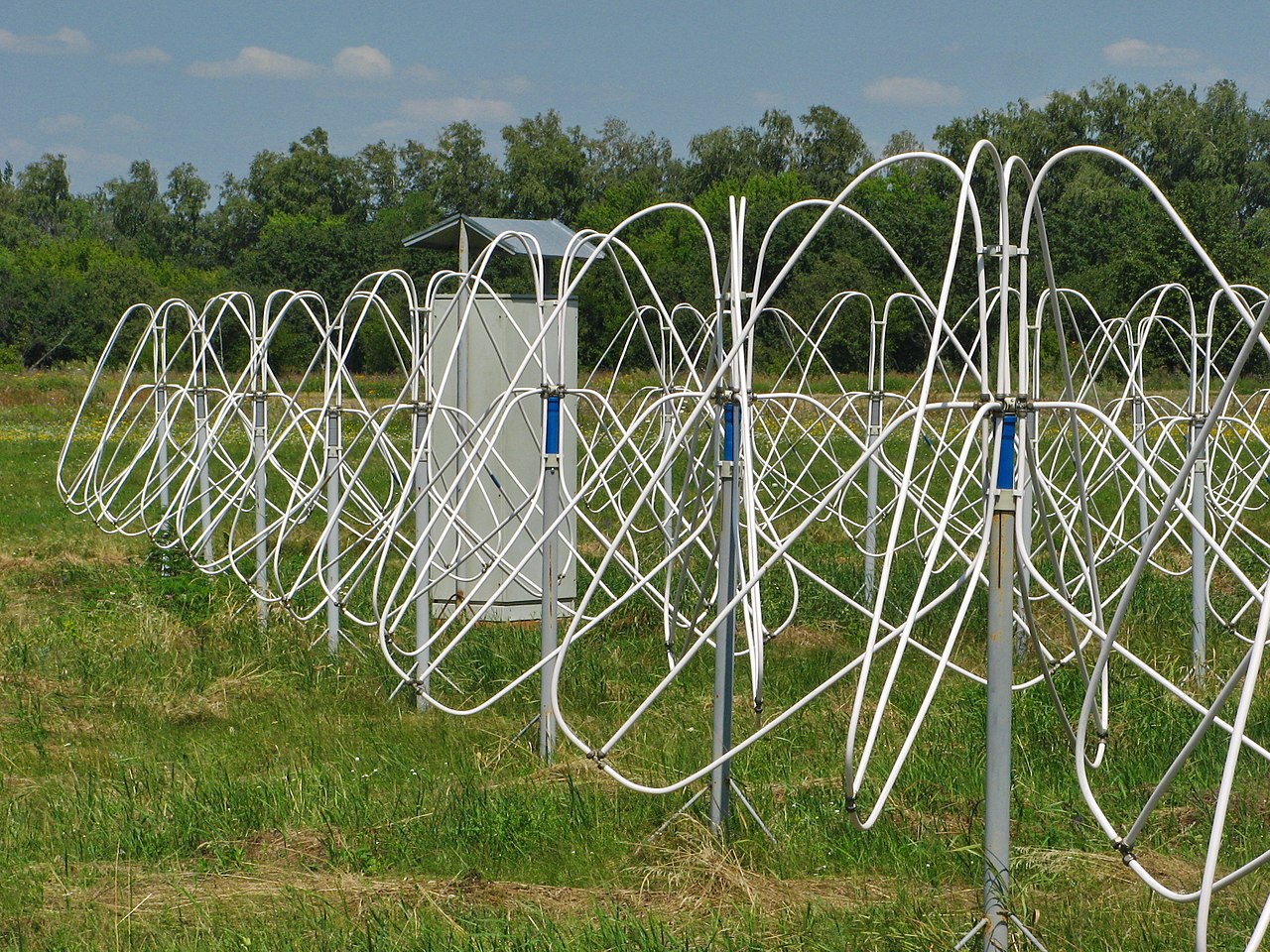
Illustration — Cluster of GURT subarrays Giant Ukrainian Radio Telescope (GURT, ГУРТ) is a low frequency (8-80 MНz) radio telescope which is being developed, built and operated by Institute of Radio Astronomy of National Academy of Sciences of Ukraine (IRA NASU). It is located at S. Braude radio astronomical observatory in Kharkiv oblast of Ukraine. The GURT system is designed to be an extension of Ukrainian T-shaped Radio telescope, second modification (UTR-2) in terms of spatial dimensions and frequency range.
Also recorded as GURT
Giant Ukrainian Radio Telescope
YeS (Serge Yerin) · CC BY-SA 4.0
- Region
- Ukraine
VALÉORINE Encyclopedia
VALÉORINE documentary reading
Documentary summary
Illustration — Cluster of GURT subarrays Giant Ukrainian Radio Telescope (GURT, ГУРТ) is a low frequency (8-80 MНz) radio telescope which is being developed, built and operated by Institute of Radio Astronomy of National Academy of Sciences of Ukraine (IRA NASU). It is located at S. Braude radio astronomical observatory in Kharkiv oblast of Ukraine. The GURT system is designed to be an extension of Ukrainian T-shaped Radio telescope, second modification (UTR-2) in terms of spatial dimensions and frequency range.
Admitted source layer · organised and presented by VALÉORINE
Reference Check
Propose documentary evidence for Giant Ukrainian Radio Telescope. A contribution is never written directly as fact: identity, source, rights and evidence gates still decide.
Sign in to contribute
World of VALÉORINE
Documentary connections
Only confirmed graph relationships appear here. Images are shown only when their identity and reuse rights both pass the documentary gate.
Documentary evidence
Documentary basis
Authority files
wikidata · Q12098684 · wikipedia · Giant Ukrainian Radio Telescope
In this article
System overview
System overview
The goals of creating this new instrument include enhancement of UTR-2 functional properties and contribution to the progress of low frequency radio astronomy in synergy with other distant instruments.
• Illustration — Active dipoles of low-frequency Giant Ukrainian Radio Telescope (GURT) phased array. Kharkiv oblast, Ukraine GURT is a large phased array composed of identical subarrays consisting of 25 antenna elements. Subarrays are currently being added, with the finished array planned to incorporate 100 subarrays for a total of 2500 elements. The individual antenna element consists of two wideband dipoles of copper tubing at right angles to each other, at ±45° to the Earth's meridian, mounted 1.6 meters above the ground. The elements in a subarray are spaced 3.75 meters apart. The antenna elements of the two orthogonal polarizations are connected in separate identical phased arrays. The crossed dipoles are grouped into square 5×5 subarrays. The subarray design provides a wide frequency coverage from 8 to 80 MHz, high sensitivity (the galactic background level exceeds their self-noise by more than 7 dB), and high RFI immunity (achieved due to high dynamic range of the dipole amplifier: input IP3 is 30 dBm). The effective area at the central frequency is about 350 m 2. The phase shift network inside a subarray is analogue, consisting of different lengths of coaxial cable delay line switched into the signal path, whereas the phasing between subarrays is planned to be digital. The beamwidth (HPBW) of a single subarray beam at 40 MHz is about 20.4°. The estimate is consistent with the direct measurements that give 22±2°. The GURT subarray geometry provides a high filling factor that is important for a number of research tasks. A powerful dedicated digital recorder for the GURT system has been developed at the IRA NASU. It is designed for spectral analysis of a band up to 80 MHz (at a sampling frequency of 160 MHz), with high spectral and temporal resolutions, high dynamic range and several operation modes including real time FFT, waveform recording, auto- and cross-correlation spectral measurements, addition and subtraction regime between the two input channels, normalization, and programmable signal delay.
Current status
Current status
• Illustration — Dynamic spectra of solar bursts of type III and IIIb-III received with GURT subarrays #9 and #10 on November 30, 2016 • Illustration — Dynamic spectra of a group of Type III bursts, Type II and Type IV bursts observed during solar coronal mass ejection on 2017 April 18 with GURT radio telescope subarray Four GURT subarrays have already been installed, equipped, and are operational now. For now most of the time subarrays are used for radio astronomical observations separately because of limited resources for digital phasing system. It has been found that in spite of comparatively small effective area and sensitivity of the subarray it is possible to observe a number of important astrophysical phenomena in a wide frequency range (8–80 MHz). They have proven their ability to address many radio astronomical problems, e.g. for observations of solar bursts, Jovian Io-related decametric radiation, ionospheric scintillation, ground-based support for spacecraft missions, emission of pulsars, etc. The presence of large and well-studied UTR-2 at the same observatory opens vast opportunities in antenna testing in the shared frequency range. The sensitivity and other parameters of the GURT active antenna and subarray are studied using computer simulations and their results are verified with noise measurements.
Future prospects
Future prospects
GURT, currently under construction, will consist of many (up to 100) identical subarrays. The available area of the S. Y. Braude observatory exceeds one square kilometer. Construction of new subarrays is successive, spanning over a period of time, as resources become available. With increase of number of subarrays and effective area the number of astrophysical problems to be solved by GURT will increase significantly. Joint simultaneous observations of radio astronomical sources with many instruments all over the world are very important at low frequencies due to many hindering factors. Various RFI conditions, different impact of ionosphere at the site of radio telescope, various configurations and parameters of distant radio telescopes increase significantly the informativity of received signals.
Places
Named by the record
Places
Only places the record itself states, plotted where the house gazetteer settles their coordinates. Nothing is inferred from a name or a nationality.
- Ukraine
Primary material
Documents and archives
authority record
- Wikidata, structured authority record Q12098684: Giant Ukrainian Radio Telescope
General reference · Wikidata
reference work
- “Giant Ukrainian Radio Telescope”, English Wikipedia, consulted as further reading
Reputable secondary · Wikipedia
Notes from the source article
Cited by Wikipedia
Notes from the source article
These works are cited by the source article, in its own numbering. They are recorded as its citations, not as sources VALÉORINE has verified.
- 1.Falkovich, I.S., Konovalenko, A.A., Gridin, A.A., et al.: Wide-band high linearity active dipole for low frequency radio astronomy. Exp. Astron. 32, 127–145 (2011)
- 2.Konovalenko, A.A., Falkovich, I.S., Kalinichenko, N.N., et al.: Thirty-elements active antenna array as a prototype of a huge low-frequency radio telescope. Exp. Astron. 16(3), 149–164 (2005)
- 3.Konovalenko, A.A., Falkovich, I.S., Gridin, A.A., et al.: UWB Active Antenna Array for Low Frequency Radio Astronomy. Proc. of the VI-th Intern. Conf. on Ultrawideband and Ultrashort Impulse Signals (UWBUSIS’12), Sevastopol, Ukraine, 17–21 Sept. 39–43 (2012)
- 4.A. Konovalenko, L. Sodin, V. Zakharenko, P. Zarka, O. Ulyanov, M. Sidorchuk, S. Stepkin et al. "The modern radio astronomy network in Ukraine: UTR-2, URAN and GURT." Experimental Astronomy. vol. 42, 11-48 (2016). DOI: 10.1007/s10686-016-9498-x
- 5.Konovalenko, O.O., Tokarsky, P.L., Yerin, S.N.: Effective Area of Phased Antenna Array of GURT Radio Telescope. Proc. of the VII-th Intern. Conf. on Ultrawideband and Ultrashort Impulse Signals (UWBUSIS’14), Kharkiv, Ukraine, 15–19 Sept. 25–29 (2014)
- 6.A. A. Stanislavsky, I. N. Bubnov, A. A. Konovalenko, V. V. Shevchenko, L. A. Stanislavsky, D. V. Mukha, and A. A. Koval, "First radio astronomy examination of the lowfrequency broadband active antenna subarray". Advances in Astronomy, vol. 2014, ID 517058 (2014). DOI: 10.1155/2014/517058
- 7.V. N. Melnik, A. A. Konovalenko, S. M. Yerin, I. M. Bubnov, A. I. Brazhenko, A. V. Frantsuzenko, V. V. Dorovskyy, M. V. Shevchuk, and H. O. Rucker, “First Observation of the Solar Type III Burst Decay and Its Interpretation”, Astrophysical Journal, vol. 885, no. 1, 2019. DOI: 10.3847/1538-4357/ab46aa
- 8.A. A. Stanislavsky, I. N. Bubnov, A. A. Koval, and S. N. Yerin, "Parker Solar Probe detects solar radio bursts related with a behind-the-limb active region", Astronomy and Astrophysics, vol. 657, A21 (2022). DOI: 10.1051/0004-6361/202141984
- 9.Zakharenko, V., Yerin, S., Bubnov, I., Vasilieva, I. and Kravtsov, I., 2016, October. Using of pulsar spectra catalogue at frequencies below 80 MHz for astronomical calibration of phased antenna arrays. In Applied Physics and Engineering (YSF), 2016 II International Young Scientists Forum on (pp. 210-213). IEEE.
- 10.P. Tokarsky, A. Konovalenko, S. Yerin, “Sensitivity of an Active Antenna Array Element for the Low-Frequency Radio Telescope GURT,” IEEE Transactions on Antennas and Propagation, vol. 65, is. 9, p. 4636–4644, 2017. DOI: 10.1109/TAP.2017.2730238
- 11.P. L. Tokarsky, A. A. Konovalenko, S. N. Yerin and I. N. Bubnov, “An Active Antenna Subarray for the Low-Frequency Radio Telescope GURT–Part I: Design and Theoretical Model,” IEEE Transactions on Antennas and Propagation, vol. 67, is. 12, p. 7304–7311, 2019. DOI: 10.1109/TAP.2019.2927841
- 12.P. L. Tokarsky, A. A. Konovalenko, S. N. Yerin and I. N. Bubnov, “An Active Antenna Subarray for the Low-Frequency Radio Telescope GURT– Part II: Numerical Analysis and Experiment,” IEEE Transactions on Antennas and Propagation, vol. 67, is. 12, p. 7312–7319, 2019. DOI: 10.1109/TAP.2019.2929322
References
Citations
References
Each reference names the institution holding it, so a reader may go to the document itself.
authority record
Secondary witnessreference work
Secondary witness
The Encyclopedia exists whether or not anything is for sale. Corrections are recorded rather than overwritten, and every version of this record is kept. Published 16 August 2026.
Elsewhere in Scientific instruments
736 published records in this field, each with its sources named.
- Geostationary Carbon Cycle ObservatoryTerminology
- Giant Magellan TelescopeTerminology
- Giant Metrewave Radio TelescopeTerminology
- Giant Radio Array for Neutrino DetectionTerminology
- Global Ecosystem Dynamics InvestigationTerminology
- Global Ozone Monitoring by Occultation of StarsTerminology
- Global-scale Observations of the Limb and DiskTerminology
- Globe of MatelicaTerminology
Best supported in this field
For owners
Own an object connected with Giant Ukrainian Radio Telescope?
A specialist will read what you send and tell you what the house can establish, what it cannot, and whether the object is suited to sale. There is no charge and no obligation. The object stays with you throughout; nothing is shipped to us unless it is arranged in writing beforehand.