
George Hepplewhite
George Hepplewhite (1727? – 21 June 1786) was a cabinetmaker. He is regarded as having been one of the "big three" English furniture makers of the 18th century, along with Thomas Sheraton and Thomas Chippendale. There are no pieces of furniture made by Hepplewhite or his firm known to exist but he gave his name to a distinctive style of light, elegant furniture that was fashionable between about 1775 and 1800 and reproductions of his designs continued through the following centuries.
George Hepplewhite
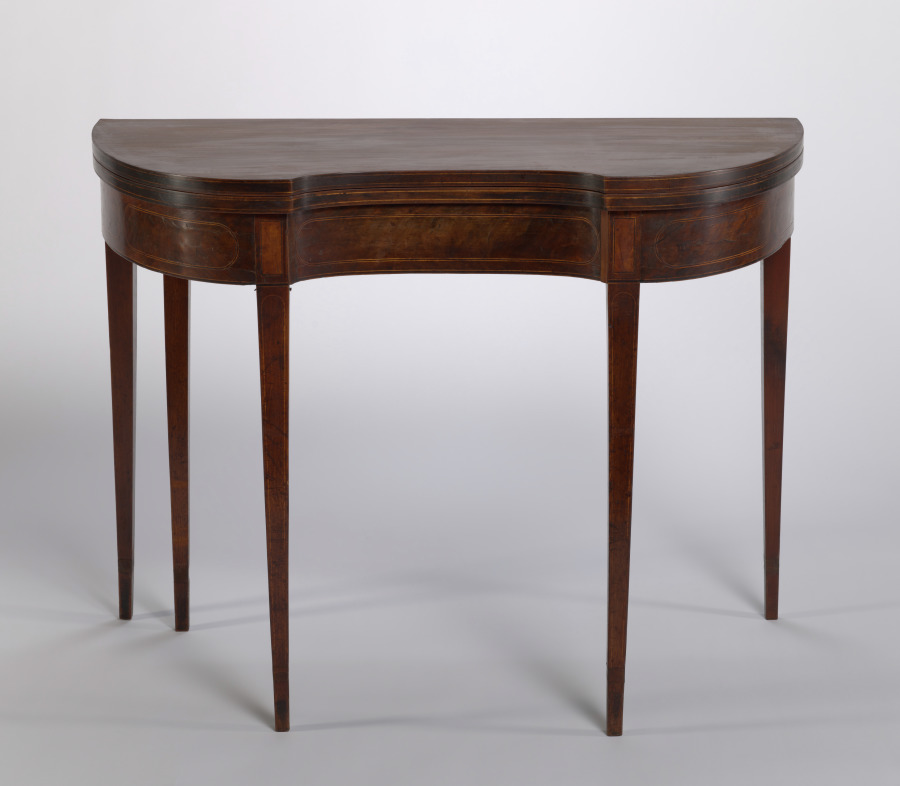
George Hepplewhite · The Cleveland Museum of Art · Gift of Mrs. Clyde Comstock · CC0
- Born
- 1727.
- Died
- 1786.
- Nationality
- Kingdom of Great Britain.
- Occupation
- joiner, businessperson, designer, furniture designer and cabinetmaker.
VALÉORINE Encyclopedia
VALÉORINE documentary reading
Documentary summary
George Hepplewhite (1727? – 21 June 1786) was a cabinetmaker. He is regarded as having been one of the "big three" English furniture makers of the 18th century, along with Thomas Sheraton and Thomas Chippendale. There are no pieces of furniture made by Hepplewhite or his firm known to exist but he gave his name to a distinctive style of light, elegant furniture that was fashionable between about 1775 and 1800 and reproductions of his designs continued through the following centuries.
Admitted source layer · organised and presented by VALÉORINE
Note VALÉORINE
No house-authored Note is published until its assertions and sources pass the VALÉORINE evidence contract. The documentary article remains available in full while that enrichment is being consolidated.
Documentary enrichment in progress · no unsupported statement published
Reference Check
Propose documentary evidence for George Hepplewhite. A contribution is never written directly as fact: identity, source, rights and evidence gates still decide.
Sign in to contribute
World of VALÉORINE
Documentary connections
Only confirmed graph relationships appear here. Images are shown only when their identity and reuse rights both pass the documentary gate.

Documentary evidence
Evidence Panel
wikipedia incomplete · checked 25 September 2026
- Identity
- resolved
- Independent source families
- 0
- Admitted assertions
- 0
- Open conflicts
- 0
Authority files
wikidata · Q320552 · wikipedia · George Hepplewhite
In this article
Life and work
One characteristic that is seen in many of his designs is a shield-shaped chair back, where an expansive shield appeared in place of a narrower splat design.
Very little is known about Hepplewhite himself. Some established sources list no birth information; however a "George Hepplewhite" was born in 1727 in Ryton, County Durham, England. According to some sources, he served his apprenticeship with Gillows in Lancaster, but the Oxford Dictionary of National Biography is sceptical about this. He was a member of the London Society of Cabinet Makers. He based himself in London, where he opened a shop. After he died in 1786, the business was continued by his widow, Alice. In 1788 she published a book with about 300 of his designs, The Cabinet-Maker and Upholsterer's Guide, with two further editions in 1789 and 1794. It was not until years after his death that his designs started to receive recognition. While some have attempted to attribute the furniture design to his wife Alice, there is no evidence that she was the original creative force behind the work beyond her publication of the reference guide after his death. With contemporaries such as Thomas Chippendale producing pieces in a variety of styles, Hepplewhite's famed style is more easily identifiable. Hepplewhite produced designs that were slender, more curvilinear in shape and well balanced. There are some characteristics that hint at a Hepplewhite design, such as shorter more curved chair arms, straight legs, shield-shape chair backs, all without carving. The design would receive ornamentation from paint and inlays used on the piece. The book influenced cabinet makers and furniture companies for several generations. The work of these generations influenced in turn copies of the original designs and variants of them through the 19th and 20th centuries.
Primary material
Documents and archives
reference work
- “George Hepplewhite”, English Wikipedia, consulted as further reading
Reputable secondary · Wikipedia
authority record
- Wikidata, structured authority record Q320552: George Hepplewhite
Unverified · Wikidata
Notes from the source article
Cited by Wikipedia
Notes from the source article
These works are cited by the source article, in its own numbering. They are recorded as its citations, not as sources VALÉORINE has verified.
- 1.Americas First Lady and the Roddams of North West Durham. www.users.on.net.
- 2.FurniturEbuying.com. Hepplewhite 1778–1792. 2014.
- 3.Simon Jervis, 'Hepplewhite, George (1727?–1786)', Oxford Dictionary of National Biography, Oxford University Press, 2004 accessed 9 Nov 2014.
- 4.George Hepplewhite | British cabinetmaker.
- 5.Hepplewhite Combined Straight Lines and Bold Curves.
References
Citations
References
Each reference names the institution holding it, so a reader may go to the document itself.
reference work
Partially resolvedauthority record
Unverified
People, houses and institutions
Knowledge graph
People, houses and institutions
Teachers, collaborators, publishers and institutions recorded against this person, each on a stated basis.
Died at
1- LondonPlace
Established from a fact already recorded on a verified source.
The Encyclopedia exists whether or not anything is for sale. Corrections are recorded rather than overwritten, and every version of this record is kept. Published 14 August 2026.
Elsewhere in Modern design
3,254 published records in this field, each with its sources named.
- George AuriolDesigner
- George Brinton McClellanDesigner
- George BrooksDesigner
- George Gillis HaanenDesigner
- George LoisDesigner
- George NakashimaDesigner
- George NelsonDesigner
- George OatesDesigner
Best supported in this field
For owners
Own a work by George Hepplewhite?
A specialist will read what you send and tell you what the house can establish, what it cannot, and whether the object is suited to sale. There is no charge and no obligation. The object stays with you throughout; nothing is shipped to us unless it is arranged in writing beforehand.