
George Godwin
George Godwin (28 January 1813 – 27 January 1888) was an influential British architect, journalist, and editor of The Builder magazine.
George Godwin
George Godwin · Wellcome Collection, London · Wellcome Collection · Public Domain Mark
- Name
- George Godwin
- Born
- 28 January 1813
- Birthplace
- Kensington
- Died
- 27 January 1888
- Known for
- architect, journalist, and editor of The Builder
- Occupation
- architect, journalist, and editor
- Nationality
- United Kingdom of Great Britain and Ireland
- Honours
- Fellow of the Royal Society · Royal Gold Medal
- Languages
- English
VALÉORINE Encyclopedia
VALÉORINE documentary reading
Documentary summary
George Godwin (28 January 1813 – 27 January 1888) was an influential British architect, journalist, and editor of The Builder magazine.
Admitted source layer · organised and presented by VALÉORINE
Note VALÉORINE
George Godwin (1813–1888) was a British architect, editor and journalist. Born in Brompton, the architect died in Kensington. George Godwin was a member of Royal Society.
Languages used include English. The architect received Fellow of the Royal Society and Royal Gold Medal.
Composed from admitted, traceable facts · 26 September 2026
VALÉORINE
Reference Check
Propose documentary evidence for George Godwin. A contribution is never written directly as fact: identity, source, rights and evidence gates still decide.
Sign in to contribute
World of VALÉORINE
Documentary connections
Only confirmed graph relationships appear here. Images are shown only when their identity and reuse rights both pass the documentary gate.
Documentary evidence
Documentary basis
Authority files
wikidata · Q5539780 · wikipedia · George Godwin
In this article
Key facts
Key facts
• Name — George Godwin • Born — 28 January 1813 • Birthplace — Kensington • Died — 27 January 1888 • Place of death — Kensington • Known for — architect, journalist, and editor of The Builder • Occupation — architect, journalist, and editor • Title — FRS
Life
Life
He was one of nine children of the architect George Godwin senior (1780–1863) and trained at his father's architectural practice in Kensington, where he set up in business with his brother Henry (1831–1917). Encouraged by his friend the antiquary John Britton, he pursued an interest in architectural history and wrote several volumes on The Churches of London (1839), mason's marks and Gothic Revival style. He was also interested in new materials, and wrote on the use of concrete (1836). He soon joined the Institute of British Architects and the Society of Antiquaries, and became a Fellow of the Royal Society. He was a co-founder of the Royal Architectural Museum in 1851.
The Builder
The Builder
• Illustration — Godwins's funerary monument, Brompton Cemetery, London The Builder was first published as a weekly magazine in 1842 by Joseph Hansom, inventor of the Hansom cab. In 1844 Godwin became its third editor and immediately expanded its scope and coverage beyond new works and architectural issues to include history, archaeology, arts, sanitation and social issues. It described itself as 'An illustrated weekly magazine for the architect, engineer, constructor, sanitary reformer, and art lover'. This broadened its appeal beyond the construction trade, and he took a campaigning stance to improve the circumstances of the working classes. Godwin wrote on slums and republished edited collections of his articles as reforming books. In addition to self-improvement, he promoted the use of public baths, wash-houses, charitable housing trusts, and pavilion-styled hospitals. In 1881, he set up the Godwin Bursary which was administered by the Royal Institute of British Architects. This yearly competitive prize was to enable young British architects to study modern techniques of construction outside of Great Britain. Winners were encouraged to spend at least five weeks within a country of their choice, and then to submit reports on what they learnt. The first five winners all went to the United States. He edited the magazine until 1883. It was renamed Building in 1966, and is still published.
Other works
Other works
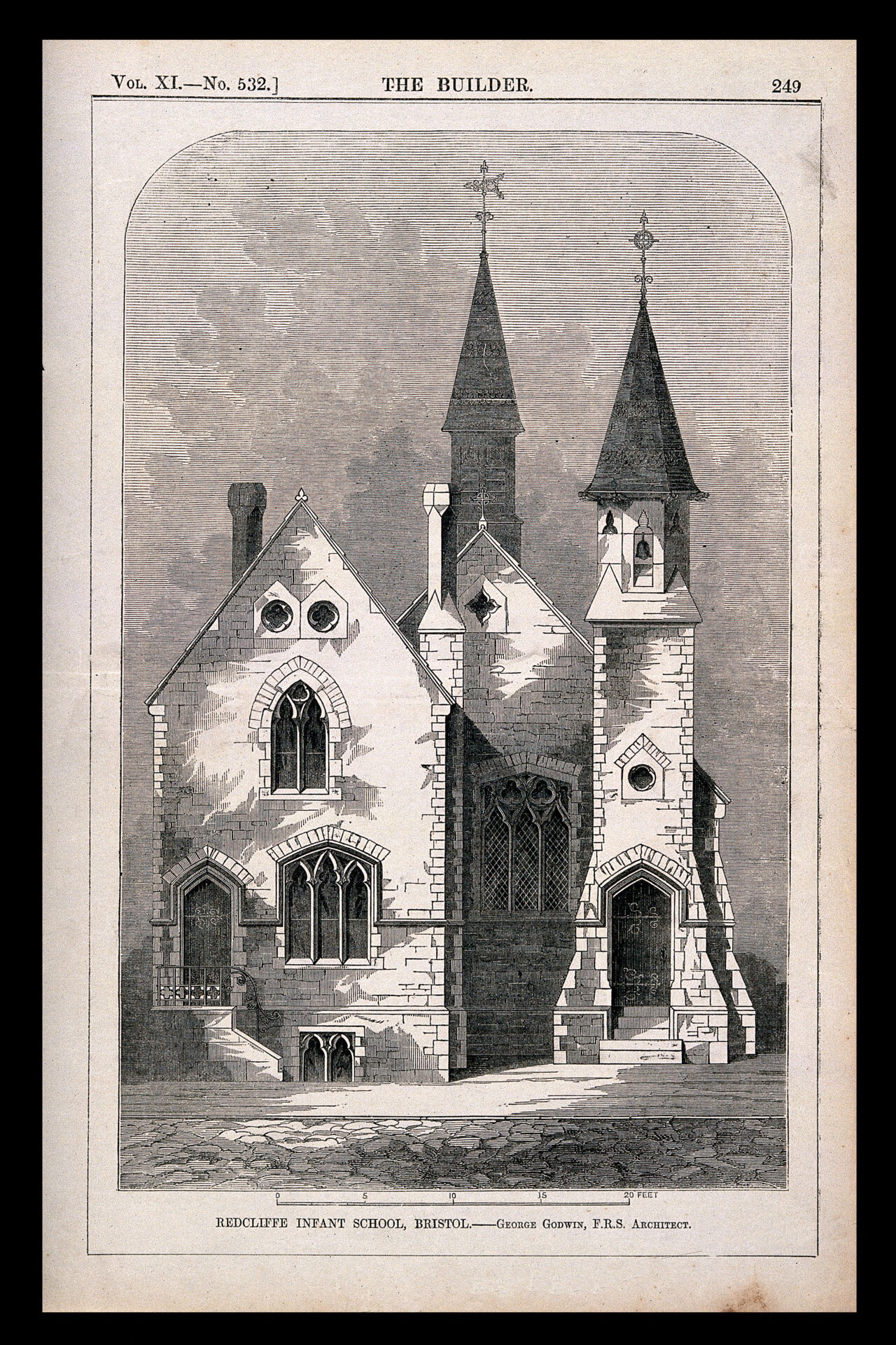
Throughout his editorship he worked in the family architectural practice. His works included churches, housing and public buildings, amongst them Redcliffe Square, Kensington; The Boltons, Kensington; St Mary's, The Boltons; Elm Park Gardens, Chelsea; St Luke's, Kensington; and the restorations of St Mary Redcliffe, Bristol, and St Mary's, Ware. He was largely responsible for the design of large areas of South Kensington and Earl's Court, including five public houses—among them the Finborough Arms, now the Finborough Theatre. Godwin was retained as district surveyor for south Islington between 1853 and 1874. In 1884, he reported to the Royal Commission that was producing recommendations for improving working-class housing. He also wrote plays, and co-founded the Art Union of London.
Death
Death
Godwin died on 27 January 1888 at Kensington, and is buried in Brompton Cemetery. He lies to the east side of the main path, between the north entrance and the colonnades. Although set back behind other monuments, his memorial is easily spotted due to its unique design; containing a portrait medallion, and being topped by the mourning figures of Faith and Charity, it is Grade II listed. His extensive art collection was sold at Christie's, London, on 12 April 1888; it numbered 98 lots.
Identity
Identity
George Godwin is recorded as having received Fellow of the Royal Society and Royal Gold Medal.
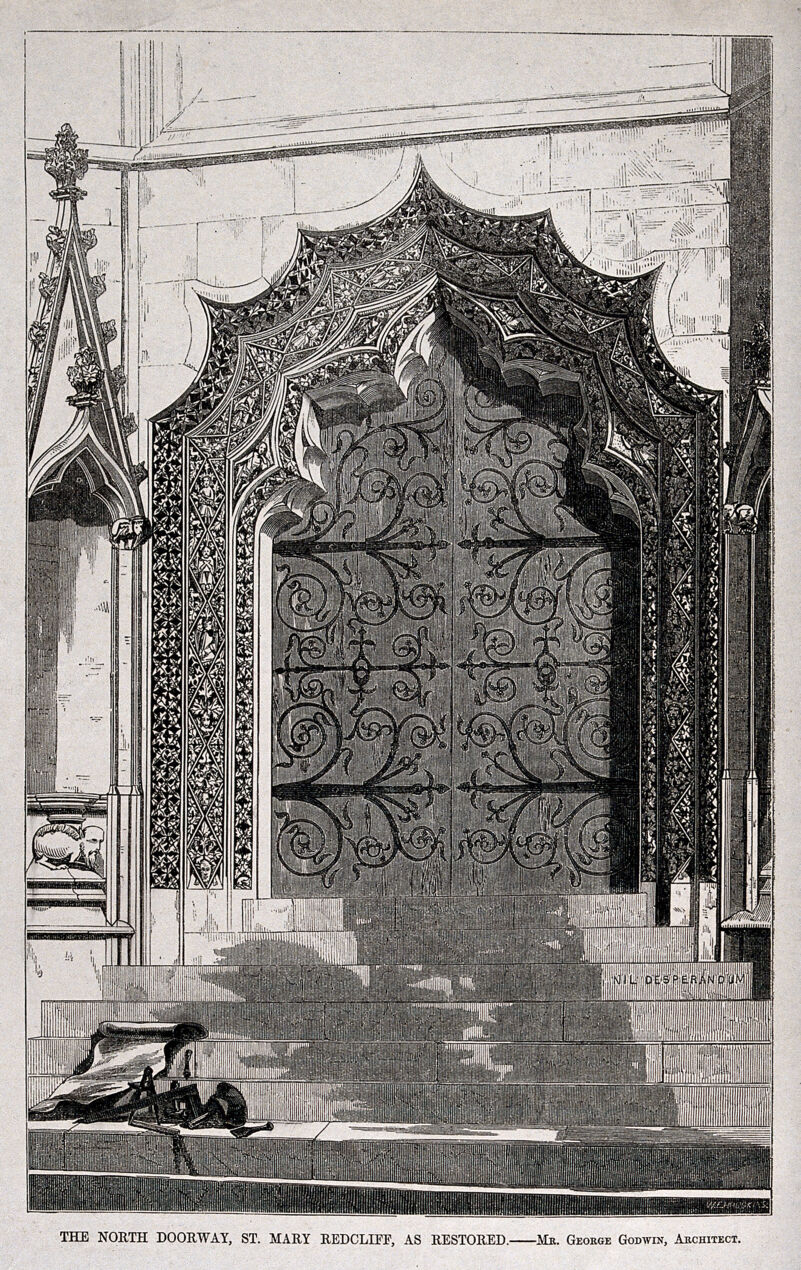
Architecture: a restored carved doorway at St. Mary Redcliffe, Bristol. Wood engraving by W. E. Hodgkin, 1853, after G. Godwin., 1853, by George Godwin
George Godwin · Wellcome Collection, London · Wellcome Collection
Life and career
Dated record
Life and career
The full dated record · 2 entries
1813
George Godwin was born in 1813 at Brompton.
1888
George Godwin died in 1888 at Kensington.
Places
Named by the record
Places
Only places the record itself states, plotted where the house gazetteer settles their coordinates. Nothing is inferred from a name or a nationality.
Brompton.
Birth place
Kensington.
Death place
Notes from the source article
Cited by Wikipedia
Notes from the source article
These works are cited by the source article, in its own numbering. They are recorded as its citations, not as sources VALÉORINE has verified.
- 1.Smith, G. B. Godwin, George (1813–1888), architect and journal editor. 2004. 10.1093/ref:odnb/10891.
- 2.Lewis, Arnold. An Early Encounter with Tomorrow: Europeans, Chicago's Loop, and the World's Columbian Exposition. University of Illinois Press. 107. 1997. 978-0252069659.
- 3.LCC 1983. Brompton Cemetery Survey of London: Volume 41, Brompton. British History Online.
Bibliography printed in the source article · 2
References
Citations
References
Each reference names the institution holding it, so a reader may go to the document itself.
reference work
Secondary witnessreference work
Secondary witness
The Encyclopedia exists whether or not anything is for sale. Corrections are recorded rather than overwritten, and every version of this record is kept. Published 17 August 2026.
Elsewhere in Design
11,558 published records in this field, each with its sources named.
- George Frederick BodleyDesigner
- George G. AdamsDesigner
- George Gilbert ScottDesigner
- George Gilbert Scott Jr.Designer
- George GoldieDesigner
- George Gordon HoskinsDesigner
- George Grant ElmslieDesigner
- George Grenfell BainesDesigner
Best supported in this field
For owners
Own a work by George Godwin?
A specialist will read what you send and tell you what the house can establish, what it cannot, and whether the object is suited to sale. There is no charge and no obligation. The object stays with you throughout; nothing is shipped to us unless it is arranged in writing beforehand.