
Georg Melchior Kraus
Illustration — Self-portrait (1775) Georg Melchior Kraus (26 July 1737 – 5 November 1806) was a German painter. He was a co-founder of the Weimar Princely Free Drawing School, together with Friedrich Justin Bertuch, in 1776.
Also recorded as Georg Melchior Krause · J. M. Kraus · Georg Melchior Krauss · Kraus
Georg Melchior Kraus
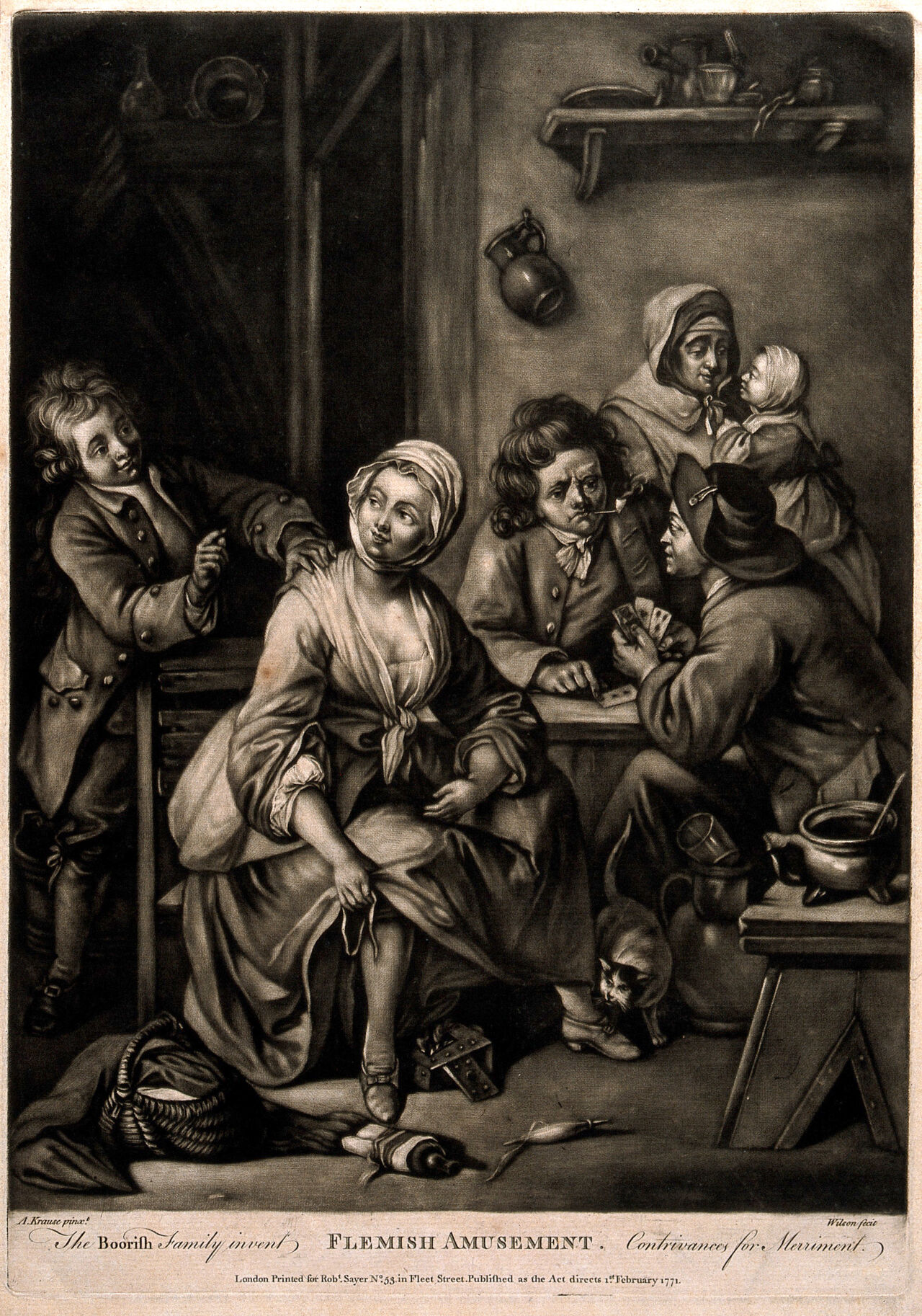
Georg Melchior Kraus · Wellcome Collection, London · Wellcome Collection · Public Domain Mark
- Born
- 1737 · Frankfurt.
- Died
- 1806 · Weimar.
- Nationality
- Germany
- Occupation
- painter · printmaker · etcher
- Languages
- German
VALÉORINE Encyclopedia
VALÉORINE documentary reading
Documentary summary
Illustration — Self-portrait (1775) Georg Melchior Kraus (26 July 1737 – 5 November 1806) was a German painter. He was a co-founder of the Weimar Princely Free Drawing School, together with Friedrich Justin Bertuch, in 1776.
Admitted source layer · organised and presented by VALÉORINE
Reference Check
Propose documentary evidence for Georg Melchior Kraus. A contribution is never written directly as fact: identity, source, rights and evidence gates still decide.
Sign in to contribute
World of VALÉORINE
Documentary connections
Only confirmed graph relationships appear here. Images are shown only when their identity and reuse rights both pass the documentary gate.
Documentary evidence
Documentary basis
Authority files
wikidata · Q871199 · wikipedia · Georg Melchior Kraus
In this article
Life
Life
Ferdinand Jagemann and Sophie von La Roche are recorded as having studied under Georg Melchior Kraus. The recorded working language is German. Positions recorded include head teacher. Work by Georg Melchior Kraus is recorded in the collections of Städel Museum, Hessen Kassel Heritage, Germanisches Nationalmuseum and Goethe-Nationalmuseum.
He was born in Frankfurt am Main as the sixth of nine children, five of whom died while infants. His parents, Cornelia and Johann, operated an inn called "Zur weissen Schlangen" (At the White Snakes) in Frankfurt. Cornelia died when he was eight, and Johann remarried that same year. From 1759 to 1762, he worked with Johann Heinrich Tischbein at his studio in Kassel, which was attached to the court of Frederick II, Landgrave of Hesse-Kassel. In 1762, he travelled to Paris to study with the engraver Johann Georg Wille. While there, he also befriended the genre painter Jean-Baptiste Greuze. After returning to Frankfurt, in 1766, he worked as a private drawing teacher. His notable students included Sophie von La Roche, Friedrich Heinrich Jacobi and Johann Wolfgang von Goethe. In 1767, he gathered signatures on a petition to establish an art academy there, but was not successful. Over the next few years, he was an itinerant painter, but maintained his home base in Frankfurt. It was in Erfurt in 1773 that he met Christoph Martin Wieland and Friedrich Justin Bertuch, who introduced him at the court in Weimar. As it turned out, Bertuch was the confidential secretary to Duke Karl August. In 1774, he and Bertuch proposed to create a drawing school. The following year, after contacting Goethe to tell him about the situation in Weimar, he settled there permanently. In 1776, when Karl August took over the government, his first two acts were inviting Goethe to come there, and establishing what would become known as the "Princely Free Drawing School". Kraus was appointed the first Director and held that position until his death. In 1786, he and Bertuch began publishing the Journal des Luxus und der Moden, generally considered to be one of the world's first fashion magazines. Kraus provided the copper engravings, taken from drawings produced at the school. It was published until 1827. After 1790, they also created picture books for children. In 1806, following the Battle of Jena–Auerstedt, victorious French troops overran and plundered Weimar. Kraus' home was raided and he was seriously injured. Bertuch rescued him and cared for him, but he died just over two weeks later. He was interred at the Jacobsfriedhof.
Gallery
Gallery
• Illustration — The Powder House and Johannistor in Jena • Illustration — The Klusfelsen, near Goslar • Illustration — Duchess Anna Amalia of Brunswick-Wolfenbüttel • Illustration — Johann Wolfgang von Goethe • Illustration — The Hübichenstein, in Harz • Illustration — Princess Louise of Hesse-Darmstadt • Illustration — Siege of Mainz (1793) • Illustration — The Fair at Plundersweilern alt=The Fair at Plundersweilen [de]
Literary work
Literary work
• Georg Melchior Kraus: ABC des Zeichners, von G. M. Kraus, Herzogl. S. W. Rath und Director der herzogl. Freien Zeichenschule in Weimar, 5. Aufl. Weimar 1810.
Places
Named by the record
Places
Only places the record itself states, plotted where the house gazetteer settles their coordinates. Nothing is inferred from a name or a nationality.
Frankfurt.
Birth place
Weimar.
Death place
Notes from the source article
Cited by Wikipedia
Notes from the source article
These works are cited by the source article, in its own numbering. They are recorded as its citations, not as sources VALÉORINE has verified.
- 1.Todesanzeige durch Fr. J. Bertuch in: Weimarisches Wochenblatt vom 8. November 1806, S. 375.
- 2.Johann Wolfgang Goethe. Aus meinem Leben. Dichtung und Wahrheit. 1985.
References
Citations
References
Each reference names the institution holding it, so a reader may go to the document itself.
reference work
Secondary witnessreference work
Secondary witness
The Encyclopedia exists whether or not anything is for sale. Corrections are recorded rather than overwritten, and every version of this record is kept. Published 16 August 2026.
Elsewhere in Prints
4,138 published records in this field, each with its sources named.
- Georg Hermann GelbkeEngraver
- Georg HeroldEngraver
- Georg LembergerEngraver
- Georg Martin PreislerEngraver
- Georg Philipp Rugendas the ElderEngraver
- Georg Siegmund FaciusEngraver
- Georg Wolfgang KnorrEngraver
- George AllenEngraver
Best supported in this field
For owners
Own a work by Georg Melchior Kraus?
A specialist will read what you send and tell you what the house can establish, what it cannot, and whether the object is suited to sale. There is no charge and no obligation. The object stays with you throughout; nothing is shipped to us unless it is arranged in writing beforehand.