
Gaspar Melchor de Jovellanos
Gaspar Melchor "Jovino" de Jovellanos (born Gaspar Melchor de Jove y Llanos, 5 January 1744 – 27 November 1811) was a Spanish neoclassical statesman, author, philosopher and a major figure of the Age of Enlightenment in Spain. Selecting law as his profession, he studied at Oviedo, Ávila, and the University of Alcalá, before becoming a criminal judge at Seville in 1767. • Illustration — Jovellanos Street in Madrid
Also recorded as Gaspar de Jovellanos · Jovellanos
Gaspar Melchor de Jovellanos
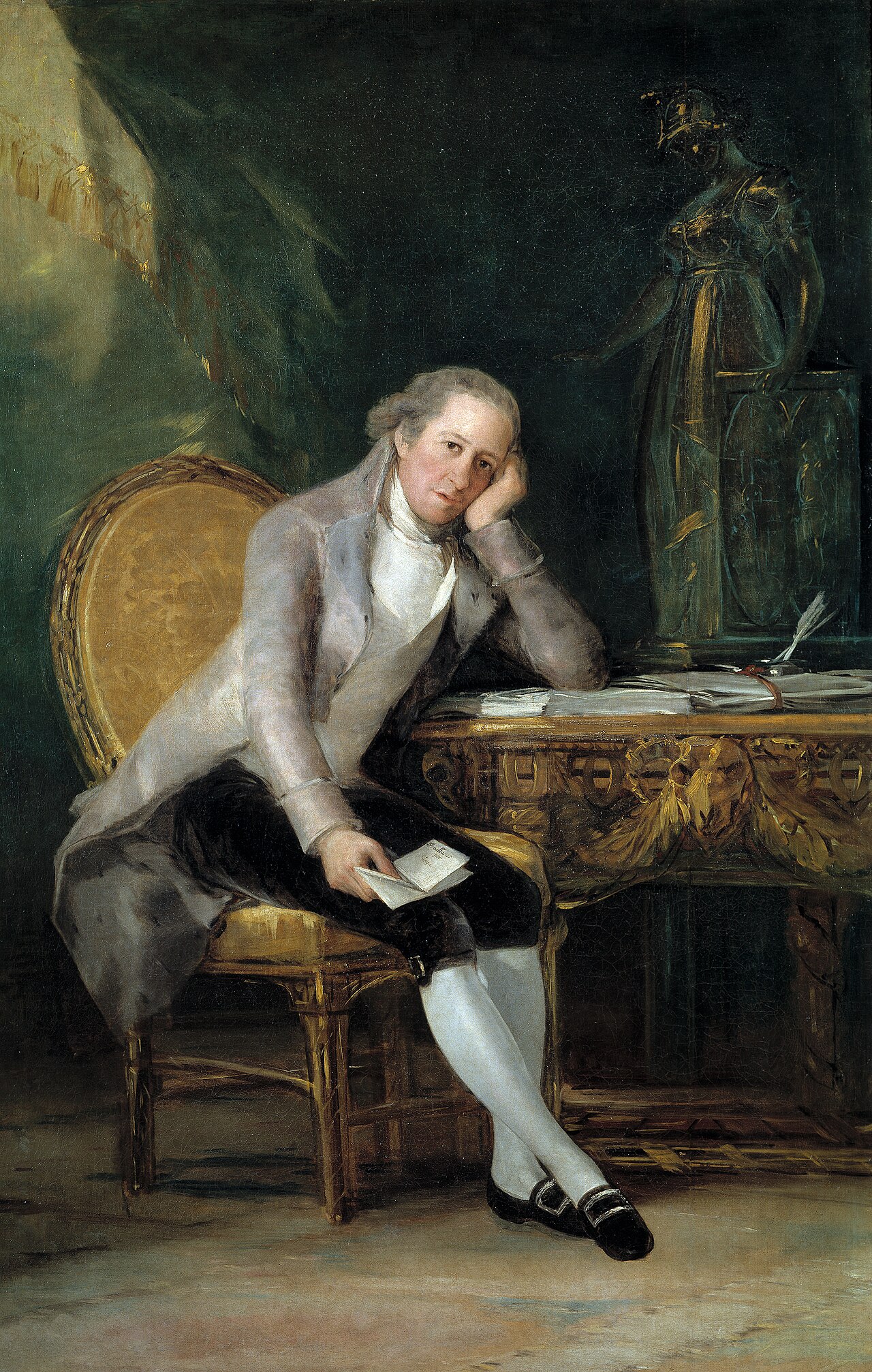
[1] · Public domain
- Name
- Gaspar Melchor de Jovellanos
- Born
- 5 January 1744
- Birthplace
- Gijón, Spain
- Died
- 27 November 1811
- Place of death
- Vega de Navia, Spain
- Occupation
- * Author
- Birth Name
- Baltasar Melchor Gaspar María
- Full name
- Baltasar Melchor Gaspar María de Jovellanos.
- Nationality
- Spain
- Fields
- economics
- Education
- Royal Monastery of St. Thomas · University of Oviedo
- Languages
- Spanish · Asturian
VALÉORINE Encyclopedia
VALÉORINE documentary reading
Documentary summary
Gaspar Melchor "Jovino" de Jovellanos (born Gaspar Melchor de Jove y Llanos, 5 January 1744 – 27 November 1811) was a Spanish neoclassical statesman, author, philosopher and a major figure of the Age of Enlightenment in Spain. Selecting law as his profession, he studied at Oviedo, Ávila, and the University of Alcalá, before becoming a criminal judge at Seville in 1767. • Illustration — Jovellanos Street in Madrid
Admitted source layer · organised and presented by VALÉORINE
Note VALÉORINE
Gaspar Melchor de Jovellanos (1744–1811) was a Spanish economist, jurist and lawyer, among other activities. Born Baltasar Melchor Gaspar María de Jovellanos in Gijón, the economist died in Puerto de Vega.
Gaspar Melchor de Jovellanos studied at University of Oviedo. The economist was a member of Royal Spanish Academy and held the positions of Member of the Royal Spanish Academy and Minister of Grace and Justice, among others. Gaspar Melchor de Jovellanos lived in Museo Jovellanos. The economist was active in economics. Languages used include Asturian and Spanish.
Composed from admitted, traceable facts · 27 September 2026
VALÉORINE
Reference Check
Propose documentary evidence for Gaspar Melchor de Jovellanos. A contribution is never written directly as fact: identity, source, rights and evidence gates still decide.
Sign in to contribute
World of VALÉORINE
Documentary connections
Only confirmed graph relationships appear here. Images are shown only when their identity and reuse rights both pass the documentary gate.
Documentary evidence
Evidence Panel
not yet certified
- Identity
- resolved
- Independent source families
- 0
- Admitted assertions
- 0
- Open conflicts
- 0
Authority files
gnd · 4483355-6 · wikidata · Q282498 · wikipedia · Gaspar Melchor de Jovellanos
In this article
Biography
Biography
Gaspar Melchor de Jovellanos studied at Royal Monastery of St. Thomas and University of Oviedo. The recorded working language is Spanish and Asturian. The field of work recorded is economics. Residence is recorded at Museo Jovellanos. Positions recorded include Minister of Grace and Justice and Member of the Royal Spanish Academy.

Restos de Gapar Melchor de Jovellanos, Capilla Nuestra Señora de los Remedios
Malopez 21

Capilla Nuestra Señora de los Remedios
Malopez 21
Key facts
Key facts
• Name — Gaspar Melchor de Jovellanos • Born — 5 January 1744 • Birthplace — Gijón, Spain • Died — 27 November 1811 • Place of death — Vega de Navia, Spain • Occupation — * Author • philosopher • Birth Name — Baltasar Melchor Gaspar María
Life and influence
Life and influence
After commencing his legal career, Jovellanos' integrity and ability were rewarded in 1778 by a judgeship in Madrid, and in 1780 by appointment to the council of military orders. In the capital Jovellanos was a respected member of the literary and scientific societies; he was commissioned by the Society of Friends of the Country (Madrid's economic society) in 1787 to write his most well-known and influential work, Informe en el expediente de ley agraria ("A report on the dossier of the Agrarian Law"), a project which he completed in 1794, and published in 1795. In his work on agrarian law, he called on the crown to eliminate the concentration of land ownership in the entailment of landed estates, ownership of land by the Catholic Church, and the existence of common lands unavailable to private ownership. In his view, Spain's wealth lay in its agricultural productivity which would allow its population to grow and prosper. In the eighteenth-century regime of land tenure, productivity was stifled by the latifundia (large landed estates) of the political elites and the Catholic Church as an institution, and common lands where there was no incentive for individuals to invest in its productivity. Jovellanos was influenced by Adam Smith's The Wealth of Nations (1776), which saw self-interest as the motivating force for economic activity.[1] Jovellanos's recommendations were not implemented in Spain, but did influence thinking about agrarian land reform in the viceroyalty of New Spain by Bishop Manuel Abad y Queipo in the early nineteenth century before its independence in 1821. In turn, his writings influenced Alexander von Humboldt's thinking and writing on land issues in Mexico.[2] Jovellanos also influenced thinking about agrarian land reform in Mexico in the late period of President Porfirio Díaz's regime by Andrés Molina Enríquez, who was the intellectual father of the article that empowered the State to expropriate land and other resources following the Mexican Revolution Constitution of 1917.[3] Involved in the disgrace of his friend, Francisco de Cabarrús, Jovellanos spent the years 1790 to 1797 in what amounted to exile at Gijón, engaged in literary work and in founding the Asturian institution for agricultural, industrial, social and educational reform throughout his native province. He was summoned again to public life in 1797 when, turning down the post of ambassador to Russia, he accepted that of minister of grace and justice, under "the prince of peace", Godoy, whose attention had been directed to him by Cabarrús, then one of his favorites. Displeased with Godoy's policy and conduct, Melchor de Jovellanos combined with his colleague Saavedra to procure his dismissal. Godoy returned to power in 1798 and Jovellanos was again sent away to Gijón. Together with Asturian intellectual colleagues such as González Posada, Caveda y Solares and his sister Xosefa Xovellanos, Jovellanos then focused on the study of Asturias. He intended to start several projects in the study of his native Asturian language, including an Academy of Asturian Language and an Asturian dictionary, but in 1801 he was imprisoned in Bellver Castle (Mallorca) and was forced to put all his cultural projects on hold. The Peninsular War, and the advance of the French into Spain, set him once more at liberty. Joseph Bonaparte, having gained the Spanish throne, made Jovellanos the most brilliant offers, but the latter rejected them all and joined the patriotic opposition. He became a member of the Supreme Central Junta and contributed to reorganizing the Cortes Generales. This accomplished, the Junta at once fell under suspicion, and Jovellanos was involved in its fall. In 1811 he was enthusiastically welcomed to Gijón; but the approach of the French forced him to leave once more. The vessel in which he sailed was compelled by bad weather to put in at Vega de Navia (now known as Puerto de Vega) in Asturias, and there he died from pneumonia on November 27, 1811. Pedro de Silva, the second President of the Principality of Asturias, is a direct descendant of Gaspar Melchor de Jovellanos through his mother, María Jesús Cienfuegos-Jovellanos Vigil-Escalera.[4]
Works
Works
Jovellanos's prose works, especially those on political and legislative economy, constitute his real claim to literary fame. In them, depth of thought and clear-sighted sagacity are couched in a certain Ciceronian elegance and classical purity of style. Besides the Ley agraria, he wrote Elogios, and a most interesting set of diaries or travel journals (1790–1801, first published in 1915) reflecting his trips across Northern Spain. He also published several other political and social essays. His poetical works comprises a tragedy, Pelayo, the comedy El delincuente honrado, satires and miscellaneous pieces such as a translation of a French tragedy by Jean Racine, La Ifigenia[5] and a translation of the first book of Paradise Lost.
Life and career
Dated record
Life and career
Explore 1744–1811
The full dated record · 4 entries
1744
Gaspar Melchor de Jovellanos born at Gijón.
1794
Informe sobre la Ley Agraria (Jovellanos, 1794) (1794) is digitised and catalogued by Internet Archive.
1796
Memoria sobre las diversiones públicas / escrita por Gaspar Melchor de Jovellanos... y leída en junta pública de la Real Academia de la Historia el 11 de julio de 1796 (2020) is digitised and catalogued by Internet Archive.
1811
Gaspar Melchor de Jovellanos died at Puerto de Vega.
Places
Named by the record
Places
Only places the record itself states, plotted where the house gazetteer settles their coordinates. Nothing is inferred from a name or a nationality.
Museo Jovellanos
Residences
Gijón.
Birth place
Puerto de Vega.
Death place
Primary material
Documents and archives
scholarly publication
- GASPAR MELCHOR DE JOVELLANOS, A Critical Anthology of Spanish Verse, 1950
Scholarly · Crossref registry · 1950
- Gaspar Melchor de Jovellanos, Great Christian Jurists in Spanish History
Scholarly · Crossref registry
reference work
- Wikidata, structured authority record Q282498: Gaspar Melchor de Jovellanos
Reputable secondary · Wikidata
- “Gaspar Melchor de Jovellanos”, English Wikipedia, consulted as further reading
Reputable secondary · Wikipedia
authority file
- Gemeinsame Normdatei 4483355-6, Noticias históricas de don Gaspar Melchor de Jovellanos.
Unverified · Deutsche Nationalbibliothek
Notes from the source article
Cited by Wikipedia
Notes from the source article
These works are cited by the source article, in its own numbering. They are recorded as its citations, not as sources VALÉORINE has verified.
- 1.D.A. Brading, The First America, Cambridge University Press 1991, pp. 510-511
- 2.Brading, The First America, p. 565.
- 3.Stanley F. Shadle, Andrés Molina Enríquez: Land Reformer of the Mexican Revolutionary Era. Tucson: University of Arizona Press 1994, pp. 23-25.
- 4.Fallece a los 85 años la madre de Pedro de Silva. La Voz de Asturias. 2004-08-10.
- 5.Frederick A. de Armas, "Jovellanos e Ifigenia: Racine, Boscan y la tradicion pictorica," Homenaje a Josep M. Sala-Valldaura, Scriptura 26 (2019): 63-72.
Bibliography printed in the source article · 3
- Polt, John Herman Richard. Gaspar Melchor De Jovellanos. New York: Twayne Publishers, 1971.
- Fernández-Medina, Nicolás. "Gaspar Melchor de Jovellanos y el vitalismo en la España ilustrada: Una visión poética y reformista de la naturaleza." Saberes en acción - La Societat Catalana d’Història de la Ciència i de la Tècnica y el Institut Interuniversitari López Piñero (UMH-UA-UJI-UV), 2021.
- Jovellanos, Gaspar Melchor de. 15. 525–526.
References
Citations
References
Each reference names the institution holding it, so a reader may go to the document itself.
scholarly publication
Verifiedscholarly publication
Verifiedauthority file
Gemeinsame Normdatei 4483355-6, Noticias históricas de don Gaspar Melchor de Jovellanos.Deutsche Nationalbibliothek
Partially resolvedreference work
Partially resolvedreference work
Partially resolved
Further particulars
Held on the record
Further particulars
Open the remaining particulars
Gaspar Melchor de Jovellanos was recorded at birth as Baltasar Melchor Gaspar María de Jovellanos. The authorities additionally record the headings Gaspar de Jovellanos and Jovellanos. His recorded languages were Spanish and Asturian. Jovellanos worked in economics. Recorded positions include Minister of Grace and Justice, Member of the Royal Spanish Academy and president. He belonged to Royal Spanish Academy. He worked at Museo Jovellanos. Recorded as politician, writer, philosopher, economist and lawyer.
Identity and origins
Career and activity
The Encyclopedia exists whether or not anything is for sale. Corrections are recorded rather than overwritten, and every version of this record is kept. Published 14 August 2026.
Elsewhere in Books
38,991 published records in this field, each with its sources named.
- Gaspar da CruzAuthor
- Gaspar Gil PoloAuthor
- Gáspár HeltaiAuthor
- Gaspar MarcanoAuthor
- Gáspár Miklós TamásAuthor
- Gáspár NagyAuthor
- Gaspar NoéAuthor
- Gaspar Núñez de ArceAuthor
Best supported in this field
For owners
Own a work by Gaspar Melchor de Jovellanos?
A specialist will read what you send and tell you what the house can establish, what it cannot, and whether the object is suited to sale. There is no charge and no obligation. The object stays with you throughout; nothing is shipped to us unless it is arranged in writing beforehand.