
Frontiers Media
Frontiers Media SA is a publisher of peer-reviewed, open access, scientific journals currently active in science, technology, and medicine. It was founded in 2007 by Kamila and Henry Markram. Frontiers is based in Lausanne, Switzerland, with offices in the United Kingdom, Spain, and China.
Also recorded as Frontiers Media S.A. · Frontiers · Frontiers Loop · Frontiers Media SA
Frontiers Media

Michel Laurin, Graciela H. Piñeiro · Fig. 1 in: A Reassessment of the taxonomic position of mesosaurs, and a surprising phylogeny of Early Amniotes. Frontiers in Earth Science 5:88, doi:10.3389/feart.2017.00088 · CC BY 4.0
- Name
- Frontiers Media
- Founded
- 2007
- Headquarters
- Lausanne
- Part of
- Beall's list of predatory open access journals
VALÉORINE Encyclopedia
VALÉORINE documentary reading
Documentary summary
Frontiers Media SA is a publisher of peer-reviewed, open access, scientific journals currently active in science, technology, and medicine. It was founded in 2007 by Kamila and Henry Markram. Frontiers is based in Lausanne, Switzerland, with offices in the United Kingdom, Spain, and China.
Admitted source layer · organised and presented by VALÉORINE
Note VALÉORINE
No house-authored Note is published until its assertions and sources pass the VALÉORINE evidence contract. The documentary article remains available in full while that enrichment is being consolidated.
Documentary enrichment in progress · no unsupported statement published
Reference Check
Propose documentary evidence for Frontiers Media. A contribution is never written directly as fact: identity, source, rights and evidence gates still decide.
Sign in to contribute
World of VALÉORINE
Documentary connections
Only confirmed graph relationships appear here. Images are shown only when their identity and reuse rights both pass the documentary gate.
Documentary evidence
Evidence Panel
not yet certified
- Identity
- resolved
- Independent source families
- 0
- Admitted assertions
- 0
- Open conflicts
- 0
Authority files
gnd · 1209890305 · wikidata · Q80796 · wikipedia · Frontiers Media
In this article
Overview
Overview
In 2022, Frontiers employed more than 1,400 people, across 14 countries. All Frontiers journals are published under a Creative Commons Attribution License. The quality of editorial rigour at Frontiers journals has been the subject of serious scrutiny. In 2015, Frontiers Media was classified as a possible predatory publisher by Jeffrey Beall, though Beall's list was taken offline two years later after Frontiers applied pressure to Beall's employer, the University of Colorado, in a decision that remains controversial. In 2022, various Swiss authors and institutions had a national publishing agreement with Frontiers through the Consortium of Swiss Academic Libraries (CSAL).

Original figure caption: Two specimens of Mesosaurus tenuidens with the stapes. Almost complete fetus at an advanced stage of development (FC-DPV 2504) in (A) general view, with a picture (B) and labeled line drawing (C) of the braincase, including occipital elements and stapes, which have been displaced from the rest of the specimen. Picture (D) and labeled line drawing (E) of a second, almost co
Michel Laurin, Graciela H. Piñeiro · Fig. 3 in: A Reassessment of the taxonomic position of mesosaurs, and a surprising phylogeny of Early Amniotes. Frontiers in Earth Science 5:88, doi:10.3389/feart.2017.00088
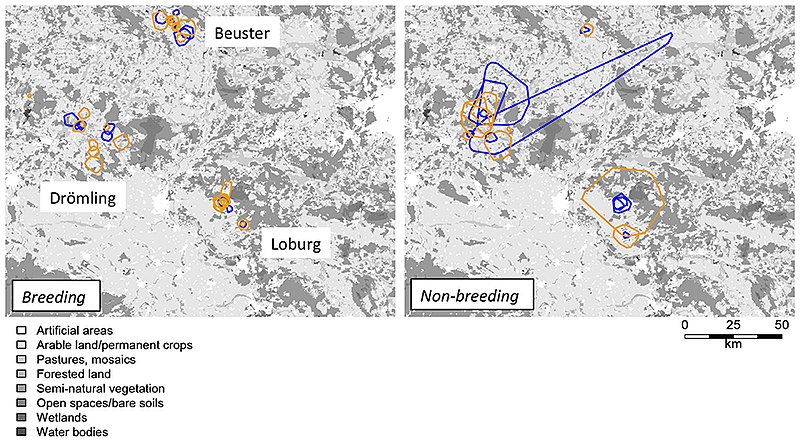
Home ranges of breeding and non-breeding (including brood loss) white storks in years 2013 (blue) and 2014 (orange). Presented are the 95% minimum convex polygons. Gray shading indicates Corine land cover types from 2006.
Zurell Damaris, von Wehrden Henrik, Rotics Shay, Kaatz Michael, Groß Helge, Schlag Lena, Schäfer Merlin, Sapir Nir, Turjeman Sondra, Wikelski Martin, Nathan Ran, Jeltsch Florian · Home Range Size and Resource Use of Breeding and Non-breeding White Storks Along a Land Use Gradient. (2018) Frontiers in Ecology and Evolution 6
Key facts
Key facts
• Name — Frontiers Media • Founder — Kamila Markram and Henry Markram • Country — Switzerland • Headquarters — Lausanne • Publications — Open access scientific journals • Topics — Medicine, life sciences, technology • Numemployees — >1,400 (2022) • Url — http: www.frontiersin.org/
History
History
The first journal published was Frontiers in Neuroscience, which opened for submission as a beta version in 2007. In 2010, Frontiers launched a series of another 11 journals in medicine and science. In February 2012, the Frontiers Research Network was launched, a social networking platform for researchers, intended to disseminate the open access articles published in the Frontiers journals, and to provide related conferences, blogs, news, video lectures and job postings. In February 2013, the Nature Publishing Group (NPG) (now Nature Research) acquired a controlling interest in Frontiers Media, however collaboration between the Nature Publishing Group and Frontiers ended in 2015. Frontiers for Young Minds was launched in November 2013 during the Annual Meeting of the Society for Neuroscience in collaboration with NPG as a web-based science journal that involves young people in the review of scientific articles with the help of scientists who act as mentors. In early September 2014, Frontiers received the ALPSP Gold Award for Innovation in Publishing from the Association of Learned and Professional Society Publishers. In October 2015, Frontiers (in collaboration with NPG) launched Loop, a research network that is open to be integrated into any publisher's or academic organization's website, and Loop soon included a collaboration with ORCID to link and synchronize researcher profile information. The Technical University of Madrid was the first university to link their Loop profile to their institutional website. In 2019, Frontiers joined the Initiative for Open Citations. In May 2020, Frontiers Media launched its Artificial Intelligence Review Assistant software to external editors. The software helps identify conflicts of interest and plagiarism, assesses manuscript and peer review quality, and recommends editors and reviewers, although the software does not flag all forms of conflict of interest, such as undisclosed funding sources or affiliations. In 2022, a group of publishers including Frontiers Media joined the International Association of Scientific, Technical, and Medical Publishers' STM Integrity Hub, an initiative to provide publishers with tools to combat journal article submissions with integrity issues from research paper mills.
List of journals
List of journals
The Frontiers journals use open peer review, where the names of reviewers of accepted articles are made public. In February 2016, the company published 54 journals, a number that grew to over 230 journals by 2024. The collection of all the journals in the series is sometimes considered a megajournal, as is the BioMed Central series. Some journals, such as Frontiers in Human Neuroscience or Frontiers in Microbiology are considered megajournals on their own. Some journals published by Frontiers are: as well as
Indexing and abstracting
Indexing and abstracting
As of 2026, 159 Frontiers journals are listed in the Norwegian Scientific Index, of which 2 have a rating of "level 2" (top 20% of all journals in their field), over 145 have a rating of "level 1" (standard academic), and 5 have a rating of "level 0" (not academic). As of 2026, Frontiers publishes over 222 academic journals, including 69 journals indexed within the Science Citation Index Expanded, and 5 journals indexed within the Social Sciences Citation Index, with a total of 146 journals ranked with an impact factor. Furthermore, as of 2021, 15 Frontiers Media journals have been selected for inclusion in MEDLINE. In broader databases, Frontiers has over 221 journals indexed in the Directory of Open Access Journals (DOAJ), over 60 journals listed in PubMed Central (PMC), and over 164 journals listed in Scopus. The publisher has been on DOAJ's advisory board and council since 2019. Frontiers is also a member of the Open Access Scholarly Publishers Association (OASPA); a participating publisher and supporter of the Initiative for Open Citations; a member of the Committee on Publication Ethics (COPE); and a member of the International Association of Scientific, Technical, and Medical Publishers (STM). As of 2023 Frontiers publishes over 220 academic journals, and following the 2023 release of the Web of Science Group's Journal Citation Reports (JCR 2022) and Scopus' CiteScore, 72 of the journals published by Frontiers have a Journal Impact Factor and 79 journals have a CiteScore.
Editorial concerns
Editorial concerns
In May 2015, Frontiers Media removed the entire editorial boards of Frontiers in Medicine and Frontiers in Cardiovascular Medicine after editors complained that Frontiers Media staff were "interfering with editorial decisions and violating core principles of medical publishing". In total 31 editors were removed. Following this incident, Nature Publishing Group ended its collaboration with Frontiers with the intent "never to mention again that Nature Publishing Group has some kind of involvement in Frontiers". In June 2015, Retraction Watch referred to the publisher as one with "a history of badly handled and controversial retractions and publishing decisions". According to researchers referenced in a 2015 blog post quoted by Allison and James Kaufman in the 2018 book Pseudoscience: The Conspiracy Against Science, "Frontiers has used an in-house journals management software that does not give reviewers the option to recommend the rejection of manuscripts" and the "system is setup to make it almost impossible to reject papers". However, as of 2022, Frontiers maintains that reviewers are given the option to reject papers with specific recommendations. In 2017, further editors were removed, allegedly for their rejection rate being high. In December 2017, Adam Marcus and Ivan Oransky of Retraction Watch wrote in the magazine Nautilus that the acceptance rate of manuscripts in Frontiers journals was reported to be near 90%. In 2022, the editors of a special issue with the online journal Frontiers in Research Metrics and Analytics voiced their concerns about the editorial practices at Frontiers, including flaws in the peer review process, unwillingness to discuss these concerns, and forbidding the editors from writing about their concerns in the editorial of the special issue. In January 2023, Zhejiang Gongshang University (浙江工商大学) in Hangzhou, China announced it would no longer include articles published in Hindawi, MDPI, and Frontiers journals when evaluating researcher performance. Also in January 2023, Inria released recommendations on "grey-zone publishers", namely Frontiers and MDPI, highlighting stark differences in editorial process between titles owned by Frontiers and other journals in the fields of Computer Science and Mathematics, and urging "extreme vigilance about the quality of articles published by Frontiers." In 2024, a study highlighted how MDPI, Frontiers, and Hindawi journals had massively increased their publishing of special issue articles, associated with very rapid article acceptances. This has raised concerns over the quality of the Frontiers peer review process. A 2026 study found that over 20% of papers published by Frontiers in the field of cancer research were likely the product of fraudulent research paper mills.
Inclusion in Beall's list
Inclusion in Beall's list
In October 2015, Frontiers was added to Beall's List of "Potential, possible, or probable" predatory open-access publishers. The inclusion was met with backlash among some researchers. Daniël Lakens, researcher at the Eindhoven University of Technology, said "articles people have published in Frontiers are no longer judged based on their own quality, but are now seen as less valuable because Frontiers is on Beall's list" and that "[h]aving a single influential individual cast doubt on such a huge journal feels very unfair". At the time, the Committee on Publication Ethics (COPE) said that "there have been vigorous discussions about, and some editors are uncomfortable with, the editorial processes at Frontiers" but that "the processes are declared clearly on the publisher's site and we do not believe there is any attempt to deceive either editors or authors about these processes". Frontiers was a member of COPE; the statement concluded that "we have no concerns about Frontiers being a COPE member and are happy to work with them". For transparency, COPE added that one of Frontiers' employees, Mirjam Curno, sits on COPE's council, although that employee was not involved in the statement. In July 2016 the maintainer of Beall's List, Jeff Beall, recommended that academics not publish their work in Frontiers journals, stating "the fringe science published in Frontiers journals stigmatizes the honest research submitted and published there", and in October of that year Beall reported that reviewers have called the review process "merely for show". In September 2016, Frontiers demanded that the university where Beall worked force him to retract his claims. Beall deleted his blacklist in January 2017. Pressure by Frontiers was reported to be a large factor in the controversial shutdown of Beall's List.
Controversial articles
Controversial articles
• Illustration — This widely-mocked AI-generated figure was captioned "Spermatogonial stem cells, isolated, purified and cultured from rat testes". In April 2013, Frontiers in Psychology retracted a controversial article linking climate change denialism and "conspiracist ideation"; the retraction was itself also controversial and led to the resignations of at least three editors. In late September 2014, Frontiers in Public Health published a controversial article that supported HIV denialism; three days later the publisher issued a statement of concern and announced an investigation into the review process of the article. It was eventually decided that the article would not be retracted but instead was reclassified as an opinion piece. It has since been retracted. In November 2016, a paper in Frontiers in Public Health linking vaccines to autism was provisionally-accepted, then retracted. Public criticism noted the paper relied on flawed methodology for reliable results, basing its conclusions only on an online questionnaire, filled in by 415 mothers of school children who self-reported whether their children had neurodevelopmental disorders, and their vaccination status. In 2021, a provisionally accepted controversial paper in Frontiers in Pharmacology on COVID-19 and the use of the antiparasitic drug ivermectin was ultimately rejected by the editors as it contained "unsubstantiated claims and violated the journal's editorial policies". This drew anger from the authors of the paper, who called the move "censorship". Retraction Watch noted that this was not the first time Frontiers provisionally accepted and then rejected a controversial paper. A study published in Frontiers in Virology in February 2022 said that Moderna had patented a 19 nucleotide genetic sequence uniquely matching a part of the SARS-CoV-2 spike protein three years prior to the pandemic, arguing it was evidence that the virus was manufactured as part of a lab leak conspiracy. The study has been widely derided for its misunderstanding of statistical likelihood, particularly as the 19 nucleotide sequence is not unique to SARS-CoV-2, and is also found in organisms like bacteria and birds. Craig Wilen, an immunobiology professor of the Yale School of Medicine, likened the study to "complete garbage" and a "conspiracy theory" rather than legitimate research. A now-retracted 2024 paper published in Frontiers in Cell and Developmental Biology was criticized for having figures AI generated with Midjourney, described as featuring "garbled text and a wildly incorrect diagram of a rat penis". Microbiologist and scientific integrity consultant Elisabeth Bik described it as being "a sad example of how scientific journals, editors, and peer reviewers can be naive—or possibly even in the loop—in terms of accepting and publishing AI-generated crap".
Identity
Identity
Frontiers Media is associated with Switzerland. Recorded from 2007.
Institutional history
Dated record
Institutional history
The full dated record · 2 entries
2007
Frontiers Media established.
2007
Frontiers Media is recorded from 2007.
Places
Named by the record
Places
Only places the record itself states, plotted where the house gazetteer settles their coordinates. Nothing is inferred from a name or a nationality.
- Switzerland
Primary material
Documents and archives
reference work
- Wikidata, structured authority record Q80796: Frontiers Media
Reputable secondary · Wikidata
- “Frontiers Media”, English Wikipedia, consulted as further reading
Reputable secondary · Wikipedia
authority file
- Gemeinsame Normdatei 1209890305, Frontiers Media.
Unverified · Deutsche Nationalbibliothek
Citations
References
Each reference names the institution holding it, so a reader may go to the document itself.
authority file
Gemeinsame Normdatei 1209890305, Frontiers Media.Deutsche Nationalbibliothek
Partially resolvedreference work
Partially resolvedreference work
Partially resolved
The Encyclopedia exists whether or not anything is for sale. Corrections are recorded rather than overwritten, and every version of this record is kept. Published 14 August 2026.
Elsewhere in Publishers and printers
5,459 published records in this field, each with its sources named.
- Friedrich Hofmeister MusikverlagOrganisation
- Friedrich Pustet KGOrganisation
- Friends of LuluOrganisation
- Frontier DevelopmentsOrganisation
- FSpace PublicationsOrganisation
- Fudan University PressOrganisation
- Fujimi ShoboOrganisation
- Fujisankei Communications InternationalOrganisation
Best supported in this field
For owners
Own an object connected with Frontiers Media?
A specialist will read what you send and tell you what the house can establish, what it cannot, and whether the object is suited to sale. There is no charge and no obligation. The object stays with you throughout; nothing is shipped to us unless it is arranged in writing beforehand.