
Friedrich Wilhelm Weber
Friedrich Wilhelm Weber (25 December 1813 – 5 April 1894) was a German doctor, politician of the Prussian House of Deputies, and poet.
Friedrich Wilhelm Weber

ludger1961 · CC BY-SA 3.0
- Born
- 1813. · Alhausen.
- Died
- 1894. · Nieheim.
- Nationality
- Germany.
- Occupation
- poet, writer, politician, physician and translator.
- Education
- University of Greifswald, University of Wrocław and Gymnasium Theodorianum.
- Languages
- German.
VALÉORINE Encyclopedia
VALÉORINE documentary reading
Documentary summary
Friedrich Wilhelm Weber (25 December 1813 – 5 April 1894) was a German doctor, politician of the Prussian House of Deputies, and poet.
Admitted source layer · organised and presented by VALÉORINE
Note VALÉORINE
No house-authored Note is published until its assertions and sources pass the VALÉORINE evidence contract. The documentary article remains available in full while that enrichment is being consolidated.
Documentary enrichment in progress · no unsupported statement published
Reference Check
Propose documentary evidence for Friedrich Wilhelm Weber. A contribution is never written directly as fact: identity, source, rights and evidence gates still decide.
Sign in to contribute
World of VALÉORINE
Documentary connections
Only confirmed graph relationships appear here. Images are shown only when their identity and reuse rights both pass the documentary gate.

Documentary evidence
Evidence Panel
wikipedia incomplete · checked 25 September 2026
- Identity
- resolved
- Independent source families
- 0
- Admitted assertions
- 0
- Open conflicts
- 0
Authority files
wikidata · Q77492 · wikipedia · Friedrich Wilhelm Weber
In this article
Biography
Biography
Weber was born in Alhausen, near Bad Driburg, in Westphalia. His father was forester for the Count of Asseburg. Weber first attended the village school, then when thirteen years old he went to the Gymnasium at Paderborn, and afterwards studied medicine at the University of Greifswald. His talent for poetry had been evidenced at the gymnasium; at university, it grew. After spending two years at Greifswald he went to Breslau, where he became acquainted with Gustav Freitag. After a year, however, he returned to Greifswald, where he obtained a doctorate; thence he went to Berlin, where he passed the state medical examination with great honour. After a brief journey for recreation to southern Germany he settled as a physician in Driburg, where he spent twenty-six years. His practice as a doctor did not keep him from writing poetry. In 1887 he settled permanently at Nieheim. In 1863 he was made Sanitätsrat (honorary title given to a distinguished doctor) in recognition of his medical services; he was made an honorary doctor of philosophy by the academy in Munich, and when he celebrated his semi-centennial as a physician he received the Order of the Red Eagle, fourth class, while three years before his death he received the further honour of the title of Geheimen Sanitätsrat. He was elected a member of the Prussian House of Deputies. He remained a member of the Centre Party until 1893, when he declined a re-election on account of his health.
Work
Work
Weber's poetry fell into the genres of epic, lyric, and didactic. His early poems were frequently imitations of foreign poets. He was also one of the translators who made Scandinavian and English poetry accessible to Germans, including Tennyson's Enoch Arden, Aylmers Field and Maud, and Esaias Tegnér's Axel. His reputation, however, was founded on his epic, Dreizehnlinden (1878). It enjoyed a wide circulation, and was arranged for the stage; composers Ludwig Bonvin and Maria Vespermann also set it to music. Weber was nicknamed 'Dreizehnlinden-Weber' after it. His second work is his Goliath (1892). His Gedichte (1881) and Herbstblätter (1895) were published after his death. Other works include Marienblumen (1885), and two other religious poems written for special occasions, Vater unser and Das Leiden unseres Heilandes (1892).

Bad Lippspringe: Gedenkstein Friedrich Wilhelm Weber, Rückseite Inschrift: WONNIG IST'S IN / FRUEHLINGSTAGEN / NACH DEM / WANDERSTAB ZU / GREIFEN / UND DEN / BLUMENSTRAUSS / AM HUTE / GOTTES GARTEN ZU / DURCHSTREIFEN
ludger1961
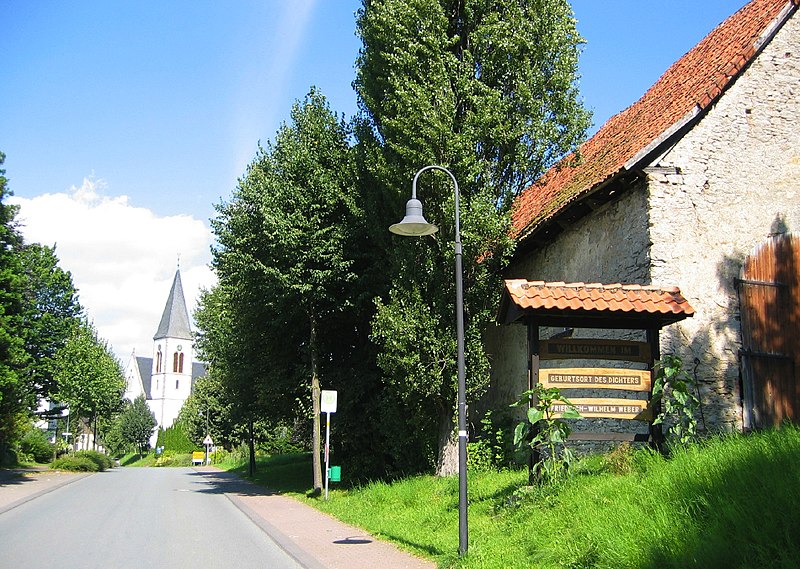
Blick von Südosten entlang der Straße „Auf der Steinbrücke“ auf die St.-Vitus-Kirche im Ortskern von Alhausen, Bad Driburg, Deutschland. Vorne rechts die hölzerne Tafel „Willkommen im Geburtsort des Dichters Friedrich-Wilhelm Weber“.
bdk
Places
Named by the record
Places
Only places the record itself states, plotted where the house gazetteer settles their coordinates. Nothing is inferred from a name or a nationality.
Alhausen.
Birth place
Nieheim.
Death place
Primary material
Documents and archives
reference work
- “Friedrich Wilhelm Weber”, English Wikipedia, consulted as further reading
Reputable secondary · Wikipedia
authority record
- Wikidata, structured authority record Q77492: Friedrich Wilhelm Weber
Unverified · Wikidata
Notes from the source article
Cited by Wikipedia
Notes from the source article
These works are cited by the source article, in its own numbering. They are recorded as its citations, not as sources VALÉORINE has verified.
Bibliography printed in the source article · 2
- , (1884)
- , (1900)
References
Citations
References
Each reference names the institution holding it, so a reader may go to the document itself.
reference work
Partially resolvedauthority record
Unverified
The Encyclopedia exists whether or not anything is for sale. Corrections are recorded rather than overwritten, and every version of this record is kept. Published 14 August 2026.
Elsewhere in Books
38,342 published records in this field, each with its sources named.
- Friedrich Wilhelm GrimmeAuthor
- Friedrich Wilhelm Joseph SchellingAuthor
- Friedrich Wilhelm RiemerAuthor
- Friedrich Wilhelm RüstowAuthor
- Friedrich WolfAuthor
- Friedrich WoltersAuthor
- Friedrich-Wilhelm HauckAuthor
- Frigyes KarinthyAuthor
Best supported in this field
For owners
Own a work by Friedrich Wilhelm Weber?
A specialist will read what you send and tell you what the house can establish, what it cannot, and whether the object is suited to sale. There is no charge and no obligation. The object stays with you throughout; nothing is shipped to us unless it is arranged in writing beforehand.