
Friedrich von Thiersch
Illustration — Friedrich von Thiersch (date unknown) Friedrich Maximilian Thiersch, after 1897 Ritter von Thiersch (18 April 1852, Marburg – 23 December 1921, Munich), was a German architect and painter in the late Historicist style.
Also recorded as Ritter von Thiersch · Friedrich Max Ritter von Thiersch · Friedrich Maximilian Thiersch · Friedrich Thiersch
Friedrich von Thiersch

Immobilien Report · Public domain
- Born
- Friedrich von Thiersch was born on 18 April 1852.
- Died
- Friedrich von Thiersch died, sources differ on the date (on 23 December 1921 and on 22 December 1921).
- Nationality
- Germany
- Occupation
- architect · university teacher · art historian
- Known for
- Justizpalast · Festhalle Frankfurt · Maximilian Bridge
VALÉORINE Encyclopedia
VALÉORINE documentary reading
Documentary summary
Illustration — Friedrich von Thiersch (date unknown) Friedrich Maximilian Thiersch, after 1897 Ritter von Thiersch (18 April 1852, Marburg – 23 December 1921, Munich), was a German architect and painter in the late Historicist style.
Admitted source layer · organised and presented by VALÉORINE
Note VALÉORINE
No house-authored Note is published until its assertions and sources pass the VALÉORINE evidence contract. The documentary article remains available in full while that enrichment is being consolidated.
Documentary enrichment in progress · no unsupported statement published
Reference Check
Propose documentary evidence for Friedrich von Thiersch. A contribution is never written directly as fact: identity, source, rights and evidence gates still decide.
Sign in to contribute
World of VALÉORINE
Documentary connections
Only confirmed graph relationships appear here. Images are shown only when their identity and reuse rights both pass the documentary gate.
Documentary evidence
Evidence Panel
not yet certified
- Identity
- resolved
- Independent source families
- 0
- Admitted assertions
- 0
- Open conflicts
- 0
Authority files
wikidata · Q75204 · wikipedia · Friedrich von Thiersch
In this article
Life and work
Life and work
His father, H. W. J. Thiersch, was a prominent theologian and his uncle, Ludwig, was a painter. His older brother, August Thiersch, and his nephew, Paul, were also architects. From 1868 to 1873, he studied architecture at the Technische Hochschule Stuttgart. He then worked for the firm of Karl Jonas Mylius and Alfred Friedrich Bluntschli, in Frankfurt-am-Main. Following a series of professional disputes, he became a free-lance architect in 1878. He took several trips around Europe, notably Greece, to acquire a knowledge of building history. In 1882, he passed the exam for his habilitation and was appointed a Professor at the Technische Hochschule München. Although he stayed there until his retirement (serving as Rector from 1906 to 1908), he designed and built projects throughout Germany. • Illustration — Justizpalast, Munich (2006) In 1882, he participated in the second competition to design a new Reichstag Building in Berlin. The jury had trouble coming to a decision, so both he and Paul Wallot were formally given first prize but, as only one design could be used, the contract went to Wallot. Three years later, he entered another competition, to design the Reichsgericht in Leipzig. Ludwig Hoffmann won the contract, but Thiersch's work made such a positive impression that he was awarded a contract for the Justizpalast in Munich two years later. During this time, he married Auguste Eibler, daughter of the Kommerzialrat (Commerce Councilor) Eduard Eibler (1844-1915), from Lindau. They had eight children, including the writer, Berta Thiersch and the graphic designer, Frieda Thiersch, who was also the head of a major bookbindery. He was occupied with the Justizpalast project from 1891 to 1897, and was unable to accept an offered position at the Technische Hochschule in Charlottenburg (now Technische Universität Berlin). However, when it was completed, he was awarded the Knight's Medal by Luitpold, Prince Regent of Bavaria, and elevated to the nobility. After only five years of use, the Justizpalast proved to be too small, so he designed an addition, known as the Neues Justizgebäude (München), which was built from 1902 to 1905. At the same time, Emperor Wilhelm II engaged him to design a building to replace the aging spa in Wiesbaden. The new, monumental structure, known as the Kurhaus, was inaugurated in 1907. Its luxurious concert and event hall was named after Thiersch. He also won a competition to design the Festhalle in Frankfurt-am-Main; which was completed in 1909. • Illustration — The Festhalle Frankfurt in 2016 The last decade of his life was marked by personal losses. In January of 1914, he lost his daughter, Marie. Later that same year, his son Ernst was killed in World War I. His brother, August, died in 1917, and his son-in-law, Albrecht Zeller, died in 1918, followed by his second son, Friedrich, in 1920. He died the following year, during the Christmas holidays, and was interred at the Waldfriedhof.
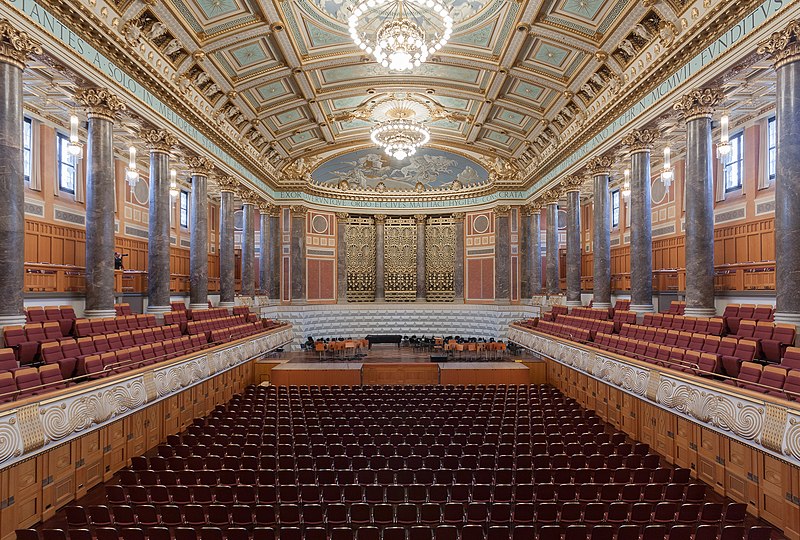
This image was uploaded as part of Wiki Loves Monuments 2013.
User:Martin Kraft · Martin Kraft photo.martinkraft.com

German architect, Friedrich von Thiersch (1852-1921)
Life and career
Dated record
Life and career
Explore 1852–1921
The full dated record · 3 entries
1852
Friedrich von Thiersch was born on 18 April 1852.
1860
Gedächtnissrede auf Friedrich von Thiersch (1860) is digitised and catalogued by Open Library.
1921
Friedrich von Thiersch died on 22 December 1921.
Places
Named by the record
Places
Only places the record itself states, plotted where the house gazetteer settles their coordinates. Nothing is inferred from a name or a nationality.
Friedrich von Thiersch was born at Marburg.
Birthplace
Friedrich von Thiersch died at Munich.
Deathplace
Primary material
Documents and archives
reference work
- “Friedrich von Thiersch”, English Wikipedia, consulted as further reading
Reputable secondary · Wikipedia
- Wikidata, structured authority record Q75204: Friedrich von Thiersch
Reputable secondary · Wikimedia Foundation
scholarly index
- OpenAlex author record A5070293766 for Friedrich von Thiersch.
Unverified · OpenAlex
authority file
Notes from the source article
Cited by Wikipedia
Notes from the source article
These works are cited by the source article, in its own numbering. They are recorded as its citations, not as sources VALÉORINE has verified.
Bibliography printed in the source article · 2
- Hermann Thiersch: Friedrich von Thiersch, der Architekt (1852–1921). Ein Lebensbild. Weidmannsche Buchhandlung, Berlin 1925.
- Johann-Georg Fuchs: Friedrich von Thiersch. Ein Münchner Maler und Zeichner. Cardamina Verlag, Plaidt 2013
References
Citations
References
Each reference names the institution holding it, so a reader may go to the document itself.
reference work
Partially resolvedscholarly index
Partially resolvedauthority file
VIAF cluster 62345630 for Friedrich von Thiersch, aggregating national library name authorities.OCLC
Partially resolvedreference work
Wikidata, structured authority record Q75204: Friedrich von ThierschWikimedia Foundation
Partially resolved
A further 1 witness is held back from this article because the person or object named in it is not yet resolved to this record. They are kept, not discarded, and return once the identity is established.
The Encyclopedia exists whether or not anything is for sale. Corrections are recorded rather than overwritten, and every version of this record is kept. Published 14 August 2026.
Elsewhere in Design
11,558 published records in this field, each with its sources named.
- Friedrich St. FlorianDesigner
- Friedrich SustrisDesigner
- Friedrich Theodor FischerDesigner
- Friedrich von GärtnerDesigner
- Friedrich Wilhelm DietrichsDesigner
- Friedrich Wilhelm RauschenbergDesigner
- Friedrich Wilhelm von ErdmannsdorffDesigner
- Friedrich ZollingerDesigner
Best supported in this field
For owners
Own a work by Friedrich von Thiersch?
A specialist will read what you send and tell you what the house can establish, what it cannot, and whether the object is suited to sale. There is no charge and no obligation. The object stays with you throughout; nothing is shipped to us unless it is arranged in writing beforehand.