
Friedrich Rehberg
Illustration — Portrait of Karl Philipp Moritz (1790) Friedrich Rehberg (22 October 1758 – 20 August 1835) was a German portrait and historical painter.
Also recorded as Frederich Rehberg · Rehberg · f. rehberg · rehberg friedr.
Friedrich Rehberg

AralGuillaume · CC BY-SA 4.0
- Born
- 1758 · Hanover.
- Died
- 1835 · Munich.
- Nationality
- Germany
- Occupation
- painter · medalist
- Fields
- history · portrait
- Languages
- German
VALÉORINE Encyclopedia
VALÉORINE documentary reading
Documentary summary
Illustration — Portrait of Karl Philipp Moritz (1790) Friedrich Rehberg (22 October 1758 – 20 August 1835) was a German portrait and historical painter.
Admitted source layer · organised and presented by VALÉORINE
Reference Check
Propose documentary evidence for Friedrich Rehberg. A contribution is never written directly as fact: identity, source, rights and evidence gates still decide.
Sign in to contribute
World of VALÉORINE
Documentary connections
Only confirmed graph relationships appear here. Images are shown only when their identity and reuse rights both pass the documentary gate.
Documentary evidence
Documentary basis
Authority files
wikidata · Q5503892 · wikipedia · Friedrich Rehberg
In this article
Life and work
Life and work
Rehberg was born into a middle-class protestant family in Hanover in 1758, the son of a secretary for the estates of Calenberg (one of the duchies of Hannover). His elder brother, August Wilhelm Rehberg (1757–1836), became a notable politician, philosopher and writer. Friedrich, himself, studied first with Oeser in Leipzig, then with Giovanni Battista Casanova and Johann Eleazar Zeissig, in Dresden. In 1777, he went to Rome, where he studied the Old Masters, such as Caracci, Domenichino and Michelangelo, under Anton Raphael Mengs. Here he became a close friend of fellow-painter David. In 1783 he returned to Hanover, where his reputation was now well-established, and received many commissions to paint portraits, including those of the Duke Wilhelm and the Bishop of Osnabrück. In 1784 he became drawing master at the Philanthropinum, a progressive school in Dessau where he taught art to the crown prince, Frederick. In 1786, he was made a fellow at the Prussian Academy of Arts in Berlin, becoming professor in 1787. He then returned to Rome to manage the satellite Prussian art academy which was to be built there. For political reasons, this project never materialised but Rehberg remained in the city. There he painted "Belisarius", "Oedipus and Antigone", "The Death of Abel", "Bacchus", "Orpheus and Eurydice" and "Jupiter and Venus". In 1791 he went to Naples and made a series of drawings of Lady Hamilton posing as classical statuary, which were published in book form in 1794. In 1813 he went to London, and, in 1814, painted an allegory of Napoleon's fall. In the same year he returned for a time to Rome, but eventually settled at Munich, where he published, in 1824, "Raffael Sanzio von Urbino": the Elements of Lithographic Drawing" ("Anfangs gründe des Steinzeichners'), with thirteen of his own lithographs. • Illustration — Friedrich Rehberg, Too late to see him, watercolour, signed with monogramm FR, circa 1805 Rehberg died in Munich on 20 August 1835.
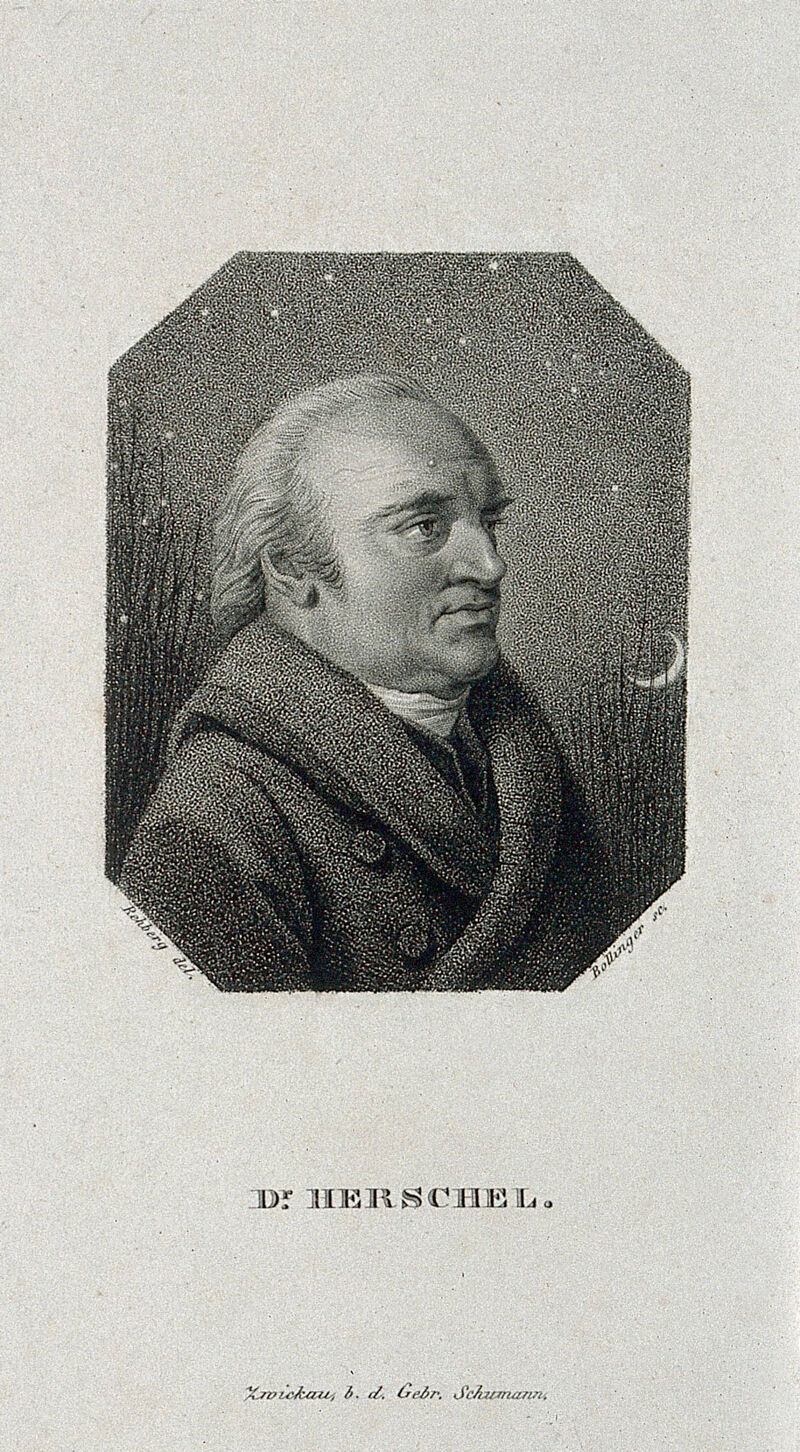
Sir William Herschel. Stipple engraving by J. W. Bollinger after F. Rehberg, 1814., by Friedrich Rehberg
Friedrich Rehberg · Wellcome Collection, London · Wellcome Collection
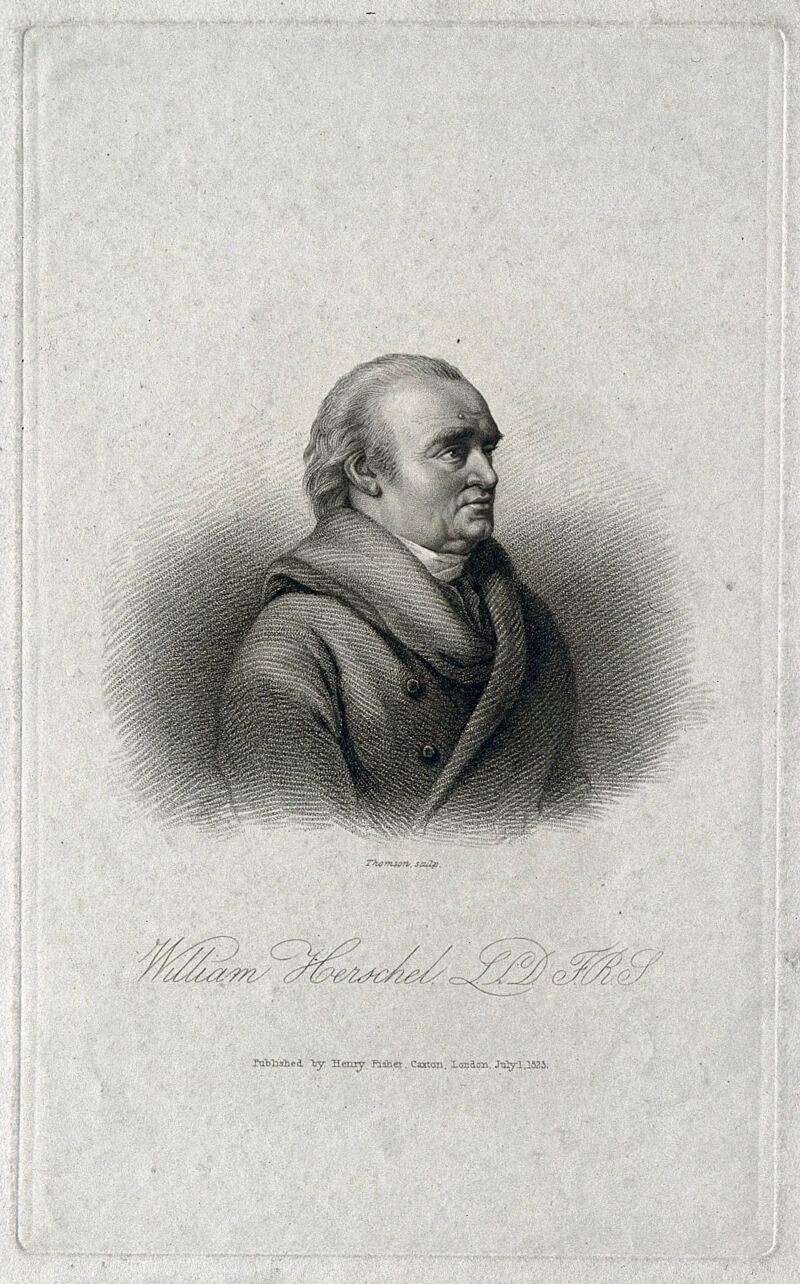
Sir William Herschel. Stipple engraving by J. Thomson, 1823, after F. Rehberg, 1814., by Friedrich Rehberg
Friedrich Rehberg · Wellcome Collection, London · Wellcome Collection
Places
Named by the record
Places
Only places the record itself states, plotted where the house gazetteer settles their coordinates. Nothing is inferred from a name or a nationality.
Hanover.
Birth place
Munich.
Death place
Notes from the source article
Cited by Wikipedia
Notes from the source article
These works are cited by the source article, in its own numbering. They are recorded as its citations, not as sources VALÉORINE has verified.
- 1.Friedrich Rehberg in Bryan's "Bryan's dictionary of painters and engravers" (New York : Macmillan, 1903) p. 206.
- 2.August Wilhelm Rehberg, 25 February 2011.
- 3.Andresen and Wessely, 1866, pp. 61-88.
- 4.Belisarius (The Jefferson Encyclopedia).
- 5.The full title of this work was, "Drawings faithfully copied from Nature at Naples and, with permission, dedicated to the Right Honorable Sir William Hamilton, his Brittanic Majesty's Envoy Extraordinary and plenipotentiary at the court of Naples" (1794).
Bibliography printed in the source article · 1
References
Citations
References
Each reference names the institution holding it, so a reader may go to the document itself.
reference work
Secondary witnessreference work
Secondary witness
The Encyclopedia exists whether or not anything is for sale. Corrections are recorded rather than overwritten, and every version of this record is kept. Published 19 August 2026.
Elsewhere in Paintings
18,875 published records in this field, each with its sources named.
- Friedrich NerlyArtist
- Friedrich PlaschkeArtist
- Friedrich Preller the ElderArtist
- Friedrich Preller the YoungerArtist
- Friedrich SchaarschmidtArtist
- Friedrich SchilcherArtist
- Friedrich SturmArtist
- Friedrich von AmerlingArtist
Best supported in this field
For owners
Own a work by Friedrich Rehberg?
A specialist will read what you send and tell you what the house can establish, what it cannot, and whether the object is suited to sale. There is no charge and no obligation. The object stays with you throughout; nothing is shipped to us unless it is arranged in writing beforehand.