
Friedrich Gottlieb Klopstock
Friedrich Gottlieb Klopstock (German: [ˈklɔpʃtɔk]; 2 July 1724 – 14 March 1803) was a German poet. His best known works are the epic poem Der Messias ("The Messiah") and the poem Die Auferstehung ("The Resurrection"), with the latter set to music in the finale of Gustav Mahler's Symphony No. One of his major contributions to German literature was to open it up to exploration outside of French models.
Friedrich Gottlieb Klopstock

User Gleiberg on de.wikipedia · Wikimedia Commons · Public domain
- Born
- 1724.
- Nationality
- Germany.
- Occupation
- poet, playwright, writer, linguist, in-home tutor, literary scholar and librettist.
- Fields
- hexameter.
- Movements
- Sentimentalism and Sturm und Drang.
- Known for
- Der Messias, The Death of Adam and Die Frühlingsfeier.
VALÉORINE Encyclopedia
VALÉORINE documentary reading
Documentary summary
Friedrich Gottlieb Klopstock (German: [ˈklɔpʃtɔk]; 2 July 1724 – 14 March 1803) was a German poet. His best known works are the epic poem Der Messias ("The Messiah") and the poem Die Auferstehung ("The Resurrection"), with the latter set to music in the finale of Gustav Mahler's Symphony No. One of his major contributions to German literature was to open it up to exploration outside of French models.
Admitted source layer · organised and presented by VALÉORINE
Note VALÉORINE
Friedrich Gottlieb Klopstock (1724–1803) was an in-home tutor, librettist and linguist, among other activities, of German nationality. The in-home tutor was associated with Sentimentalism and Sturm und Drang.
Among the works are Der Messias, Die Frühlingsfeier and The Death of Adam. The work spans hexameter.
Composed from admitted, traceable facts · 27 September 2026
VALÉORINE
Reference Check
Propose documentary evidence for Friedrich Gottlieb Klopstock. A contribution is never written directly as fact: identity, source, rights and evidence gates still decide.
Sign in to contribute
Documentary evidence
Evidence Panel
not yet certified
- Identity
- resolved
- Independent source families
- 0
- Admitted assertions
- 0
- Open conflicts
- 0
Authority files
gnd · 1091653216 · wikidata · Q154367 · wikipedia · Friedrich Gottlieb Klopstock
In this article
Early life
Early life
Klopstock was born on 2 July 1724 at Quedlinburg, the eldest son of a lawyer. Both in his birthplace and on the estate of Friedeburg on the Saale, which his father later rented, he spent a happy childhood. Having been given more attention to his physical than to his mental development, he grew up strong and healthy and was considered an excellent horseman. In his thirteenth year, he returned to Quedlinburg and attended the gymnasium there, and in 1739 went on to the famous classical school named Schulpforta. Here he soon became adept in Greek and Latin versification, and wrote some meritorious idylls and odes in German. His original intention of making Henry the Fowler the hero of an epic was abandoned in favor of a religious epic, under the influence of Milton's Paradise Lost, with which he became acquainted through Bodmer's translation. While still at school, he had already drafted the plan of Der Messias on which most of his fame rests. On 21 September 1745 he delivered, on quitting school, a remarkable "departing oration" on epic poetry—Abschiedsrede über die epische Poesie, kultur- und literargeschichtlich erläutert—and next proceeded to Jena as a student of theology, where he drew up in prose the first three cantos of the Messias. Finding life at that university not to his liking, he transferred in the spring of 1746 to Leipzig, where he joined a circle of young men of letters who contributed to the Bremer Beiträge. In this periodical the first three cantos of Der Messias were published anonymously in hexameter verse in 1748.
Denmark and Germany
Denmark and Germany
A new era in German literature had commenced, and the identity of the author soon became known. In Leipzig he also wrote a number of odes, the best known of which is An meine Freunde (1747), afterwards recast as Wingolf (1767). He left the university in 1748 and became a private tutor in the family of a relative at Langensalza, where unrequited love for a cousin (the "Fanny" of his odes) disturbed his peace of mind. For that reason he gladly accepted in 1750 an invitation from Bodmer, the translator of Paradise Lost, to visit him in Zürich, where Klopstock was initially treated with every kindness and respect and rapidly recovered his spirits. Bodmer, however, was disappointed to find in the young poet of the Messias a man of strong worldly interests, and a coolness sprang up between the two men. At this juncture Klopstock received from Frederick V of Denmark, on the recommendation of his minister Count von Bernstorff (1712–1772), an invitation to settle in Copenhagen with an annuity of 400 thalers, in the hope that he would complete Der Messias there. The offer was accepted. On his way to the Danish capital, Klopstock met in Hamburg the woman who later in 1754 became his wife, Margareta or Meta Moller, the "Cidli" of his odes. She was the daughter of a Hamburg merchant and an enthusiastic admirer of his poetry. His happiness was short, as she died in childbirth in 1758, leaving him broken-hearted. His grief at her loss finds pathetic expression in the fifteenth canto of the Messias. The poet subsequently published his wife's writings, Hinterlassene Werke von Margareta Klopstock (1759), which give evidence of a tender, sensitive and deeply religious spirit. See also Memoirs of Frederick and Margaret Klopstock (English translation by Elizabeth Smith, London, 1808) and her correspondence with Samuel Richardson, published 1818.
Depression and Messias
Depression and Messias
Klopstock now relapsed into melancholy; new ideas failed him, and his poetry became more introspective. He continued to live and work in Copenhagen, however, and next, following Heinrich Wilhelm von Gerstenberg, turned his attention to northern mythology, which in his view should replace classical subjects in a new school of German poetry. In 1770, when King Christian VII dismissed Count Bernstorff from office, he retired with the latter to Hamburg but retained his pension, together with the rank of councillor of legation. In 1773 were published the last five cantos of the Messias. In the following year he published a scheme for the regeneration of German letters, Die Gelehrtenrepublik (1774). In 1775 he traveled south, and making the acquaintance of Goethe on the way, spent a year at the court of the Margrave of Baden at Karlsruhe. Thence, in 1776, with the title of Hofrath and a pension from the Margrave, which he retained along with that from the king of Denmark, he returned to Hamburg where he spent the remainder of his life.
Last years
Last years
His latter years he passed, as had always been his inclination, in retirement, only occasionally relieved by socializing with his most intimate friends, occupied in philological studies and taking scant interest in the new developments in German literature. However, he was enthusiastic about the American War of Independence and the French Revolution. The French Republic sent him a diploma of honorary citizenship; but, horrified at the terrible scenes the Revolution had enacted in the name of liberty, he returned it. At the age of 67 he undertook a second marriage, to Johanna Elisabeth von Winthem, a widow and a niece of his late wife, who for many years had been one of his most intimate friends. He died in Hamburg on 14 March 1803, mourned throughout Germany, and was buried with great ceremony next to his first wife in the churchyard of the village of Ottensen.
Der Messias
Der Messias
The Messias follows from the aspirations to become an epic poet, which Klopstock nurtured in his early years. The leitmotif of the work is the Redemption, which is given an epic treatment. He resorted to Christian literary traditions in trying to circumscribe the subject-matter within the dogmas of the Church. Milton's Paradise Lost was one of the models Klopstock had in mind in giving form to his poem. The poem took twenty-five years to complete. The work aroused intense public enthusiasm at its commencement. It has been translated into seventeen languages, and led to numerous imitations.
Odes and dramas
Odes and dramas
In his odes Klopstock had more scope for his distinctive talent. Some have Nordic mythological inspiration, while others emphasize religious themes. Among the most celebrated and translated are An Fanny; Der Zürchersee; Die tote Klarissa; An Cidli; Die beiden Musen; Der Rheinwein; Die frühen Gräber, Mein Vaterland. His religious odes mostly take the form of hymns, of which the most beautiful is Die Frühlingsfeier. In some of his dramas, notably Hermanns Schlacht (1769) and Hermann und die Fürsten (1784), Klopstock celebrated the deeds of the ancient German hero Arminius, and in others, Der Tod Adams (1757) and Salomo (1764), he took his materials from the Old Testament. These also represent an important part of his body of work. Composer Sigrid Henriette Wienecke used Klopstock's writings as the text for her musical drama Fader Vor. He immortalized his 1750s visit at the Swiss Au peninsula in his Ode an den Zürichsee ("Ode to Lake Zurich"). It has been said that Klopstock's hymn "Die Auferstehung" at the funeral of Hans von Bülow in 1894 gave Gustav Mahler the inspiration for the final movement of his Second Symphony. Mahler incorporated the hymn with extra verses he wrote himself to bring a personal resolution to this work. Klopstock published odes and hymns, including Der am Kreuz ist meine Liebe, which is in shortened and revised form part of the 2013 Catholic hymnal Gotteslob.
Prose
Prose
In addition to Die Gelehrtenrepublik, he was also the author of Fragmente über Sprache und Dichtkunst (1779) and Grammatische Gespräche (1794), works in which he made important contributions to philology and to the history of German poetry.
Correspondence
Correspondence
As was common in the period, Klopstock kept up an abundant correspondence with his contemporaries, friends, and colleagues, and this has been published in diverse collections. Some of them are listed below: K. Schmidt, Klopstock und seine Freunde (1810); this is the basis for Klopstock and his friends. A series of familiar letters, written between the years 1750 and 1803, translated and introduced by Elizabeth Benger (London, 1814). Christian August Heinrich Clodius, Klopstocks Nachlass (1821). J. M. Lappenberg, Briefe von und an Klopstock (1867).
Life and career
Dated record
Life and career
The full dated record · 2 entries
1724
Friedrich Gottlieb Klopstock born at Quedlinburg.
1803
Friedrich Gottlieb Klopstock died at Hamburg.
Goethe's description
Goethe in his autobiography recorded his personal impression of Klopstock: "He was of small stature, but well built. His manners were grave and decorous, but free from pedantry. His address was intelligent and pleasing. On the whole, one might have taken him for a diplomatist. He carried himself with the self-conscious dignity of a person who has a great moral mission to fulfil. He conversed with facility on various subjects, but rather avoided speaking of poetry and literary matters."
Editions
Klopstock's Werke first appeared in seven quarto volumes (1798–1809). At the same time a more complete edition in twelve octavo volumes was published (1798–1817), to which six additional volumes were added in 1830. Other nineteenth-century editions were published in 1844–1845, 1854–1855, 1879 (ed. by R. Boxberger), 1884 (ed. by R. Hamel) and 1893 (a selection edited by F. Muncker). A critical edition of the Odes was published by F. Muncker and J. Pawel in 1889; a commentary on these by H. Düntzer (1860; 2nd ed., 1878).
Legacy
Klopstock's enrichment of poetic vocabulary and attention to prosody did great service to the poets who immediately followed him. In freeing German poetry from its exclusive interest in Alexandrine verse, he became the founder of a new era in German literature, so that Schiller and Goethe were artistically indebted to him. An 800-year-old oak tree where Klopstock spent time in Denmark was named after him.
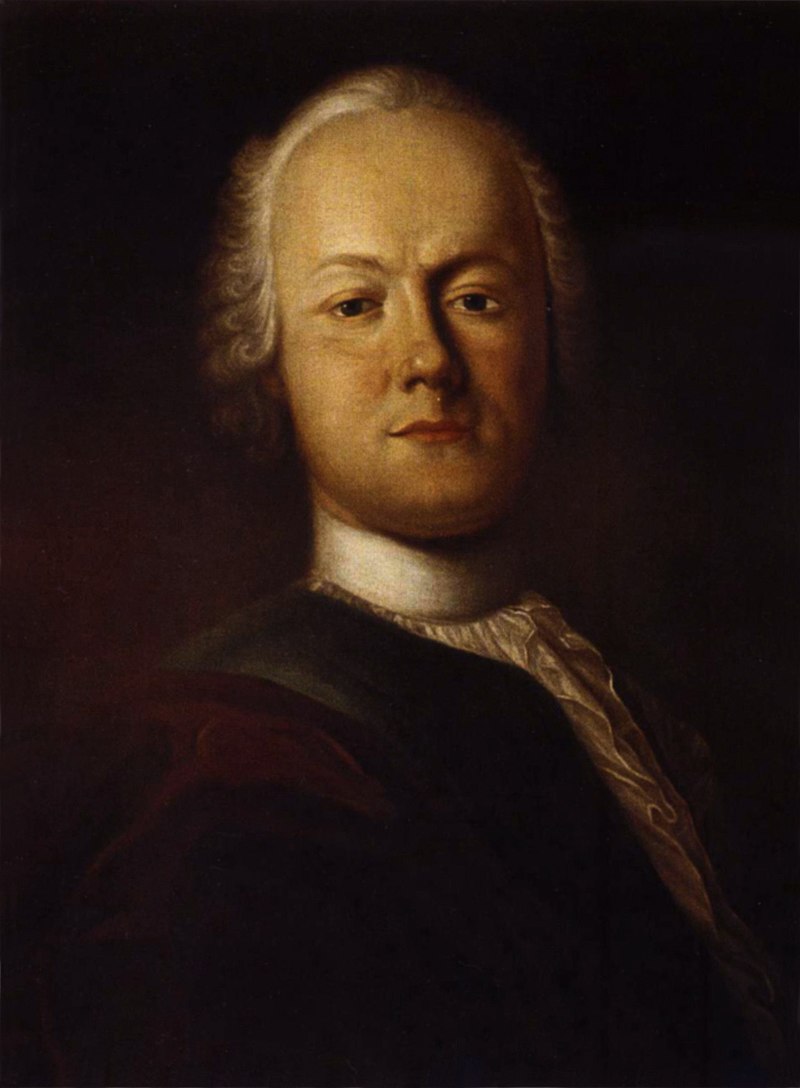
Friedrich Gottlieb Klopstock, Klopstock (Füßli)
Johann Caspar Füssli · Das Jahrhundert der Freundschaft. Johann Wilhelm Ludwig Gleim und seine Zeitgenossen, ed. Ute Pott (Göttingen: Wallstein, 2004), p. 25. Uploader: James Steakley

Friedrich Gottlieb Klopstock, Klopstock (Juel)
Jens Juel · http: oges=850
Notes from the source article
Cited by Wikipedia
Notes from the source article
These works are cited by the source article, in its own numbering. They are recorded as its citations, not as sources VALÉORINE has verified.
- 1.Cite Americana wstitle=Klopstock, Friedrich Gottlieb
- 2.Klopstock, Friedrich Gottlieb, 1724-1803. Library of Congress. 4 August 2025.
- 3.Cite AmCyc wstitle=Klopstock, Friedrich Gottlieb
- 4.Steinberg, Michael. The Symphony. Oxford University Press. 291. 1995. 0-19-506177-2.
- 5.EB1911 wstitle=Klopstock, Gottlieb Friedrich inline=1 volume=15 pages=847–848
- 6.1905.
- 7.Cite Collier's wstitle=Klopstock, Friedrich Gottlieb
- 8.Danish Tree Register. dendron.dk.
Bibliography printed in the source article · 5
- Carl Friedrich Cramer, Klopstock, Er und über ihn (1780–1792)
- J.G. Gruber, Klopstocks Leben (1832)
- R. Hamel, Klopstock-Studien (1879–1880)
- F. Muncker, F. G. Klopstock, the most authoritative biography, (1888)
- E. Bailly, Étude sur la vie et les œuvres de Klopstock (Paris, 1888)
References
Citations
References
Each reference names the institution holding it, so a reader may go to the document itself.
reference work
Wikidata, structured authority record Q154367: Friedrich Gottlieb KlopstockWikimedia Foundation
Partially resolvedreference work
Partially resolved
A further 1 witness is held back from this article because the person or object named in it is not yet resolved to this record. They are kept, not discarded, and return once the identity is established.
The Encyclopedia exists whether or not anything is for sale. Corrections are recorded rather than overwritten, and every version of this record is kept. Published 14 August 2026.
Elsewhere in Books
38,661 published records in this field, each with its sources named.
- Friedrich DelitzschAuthor
- Friedrich EggersAuthor
- Friedrich FröbelAuthor
- Friedrich Georg JüngerAuthor
- Friedrich Gottlieb WelckerAuthor
- Friedrich GundolfAuthor
- Friedrich HaugAuthor
- Friedrich HebbelAuthor
Best supported in this field
For owners
Own a work by Friedrich Gottlieb Klopstock?
A specialist will read what you send and tell you what the house can establish, what it cannot, and whether the object is suited to sale. There is no charge and no obligation. The object stays with you throughout; nothing is shipped to us unless it is arranged in writing beforehand.