
French Academy in Rome
The French Academy in Rome (Académie de France à Rome) is an academy located in the Villa Medici, within the Villa Borghese, on the Pincio (Pincian Hill) in Rome, Italy.
French Academy in Rome
- Name
- French Academy in Rome
VALÉORINE Encyclopedia
VALÉORINE documentary reading
Documentary summary
The French Academy in Rome (Académie de France à Rome) is an academy located in the Villa Medici, within the Villa Borghese, on the Pincio (Pincian Hill) in Rome, Italy.
Admitted source layer · organised and presented by VALÉORINE
Note VALÉORINE
No house-authored Note is published until its assertions and sources pass the VALÉORINE evidence contract. The documentary article remains available in full while that enrichment is being consolidated.
Documentary enrichment in progress · no unsupported statement published
Reference Check
Propose documentary evidence for French Academy in Rome. A contribution is never written directly as fact: identity, source, rights and evidence gates still decide.
Sign in to contribute
World of VALÉORINE
Documentary connections
Only confirmed graph relationships appear here. Images are shown only when their identity and reuse rights both pass the documentary gate.

Educated At · incoming
Abel de Pujol
Artist
originally uploaded to de.wikipedia by Der Bischof mit der E-Gitarre ( talk · contribs ) on 18 January 2008, 20:31 under the file name Alexandre Abel de Pujol.jpg . ( +/− )

Educated At · incoming
Abel Dimier
Artist
Own work
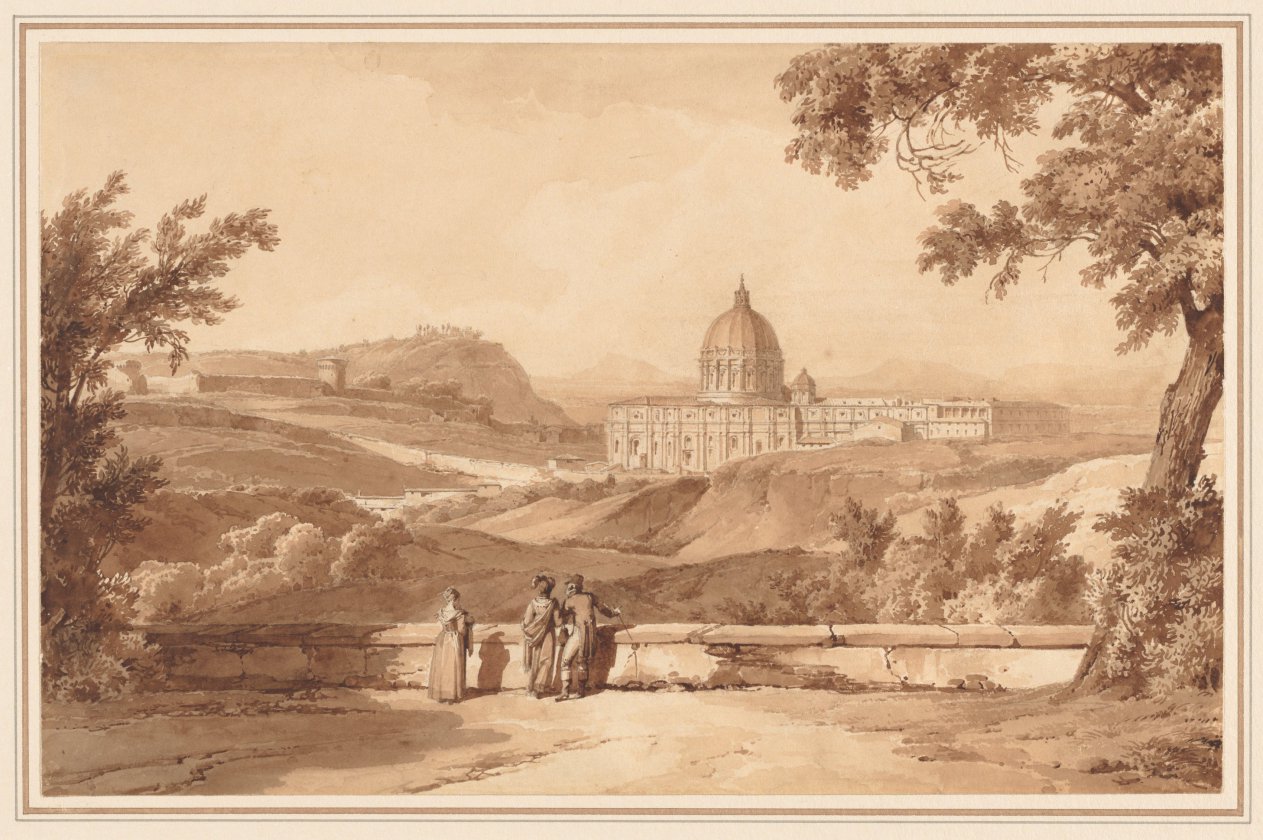
Educated At · incoming
Achille Etna Michallon
Artist
Bequest of Dr. Paul J. Vignos Jr.

Educated At · incoming
Adolphe Déchenaud
Artist
http://images.delcampe.com/img_large/auction/000/175/343/564_001.jpg

Educated At · incoming
Aimé Morot
Artist
Aimé Nicolas Morot and Charles Moreau-Vauthier, L'œuvre d'Aimé Morot : membre de l'Académie des Beaux-Arts , Paris, Librairie Hachette et Cie, 7 p., 60 gravures, in folio, 1906.

Educated At · incoming
Alexandre Cabanel
Artist
https://artinflanders.be/en/artwork/0038428000

Educated At · incoming
Alexandre Menjaud
Artist
https://www.pba-auctions.com/en/lot/11115/2213792-alexandre-menjaud-paris-177318

Educated At · incoming
Alfred de Curzon
Artist
http://digitalgallery.nypl.org/nypldigital/dgkeysearchdetail.cfm?trg=1 strucID=178997 imageID=1129368 total=1 num=0 word=Curzon%2C%20Alfred%20de%2C%201820-1895 s=3 notword= d= c= f=2 k=0 lWord= lField

Educated At · incoming
Alphonse Monchablon
Artist
collections (lesquelles?)

Educated At · incoming
Alphonse-Amédée Cordonnier
Artist
Own work

Educated At · incoming
Amable-Paul Coutan
Artist
Artcurial

Educated At · incoming
Amédée Doublemard
Artist
Own work

Educated At · incoming
Amos Cassioli
Designer
https://www.sammlung.pinakothek.de/en/bookmark/artwork/apG9OO8nxZ

Educated At · incoming
André César Vermare
Artist
Own work

Educated At · incoming
André Devambez
Engraver
Maison de Victor Hugo
Educated At · incoming
André Giroux
Photographer
John L. Severance Fund
Documentary evidence
Evidence Panel
not yet certified
- Identity
- unresolved
- Independent source families
- 0
- Admitted assertions
- 0
- Open conflicts
- 0
In this article
Key facts
Key facts
• Name — French Academy in Rome • Established — 1666 • Location — Rome, Italy • Type — Academy • President — Sam Stourdzé (2020–present)
History
History
• Illustration — The French Academy seen from the Piazza Trinità dei Monti above the Spanish Steps The Academy was founded at the Palazzo Capranica in 1666 by Louis XIV under the direction of Jean-Baptiste Colbert, Charles Le Brun and Gian Lorenzo Bernini. The Academy was from the 17th to 19th centuries the culmination of study for select French artists who, having won the prestigious Prix de Rome (Rome Prize), were honored with a 3, 4 or 5-year scholarship (depending on the art discipline they followed) in the Eternal City for the purpose of the study of art and architecture. Such scholars were and are known as pensionnaires de l'Académie (Academy pensioners). One recipient of the scholarship in the 17th century was Pierre Le Gros the Younger. The Academy was housed in the Palazzo Capranica until 1737, and then in the Palazzo Mancini from 1737 to 1793. The Scottish artists Alexander Clerk, Allan Ramsay and Alexander Cunyngham enrolled as day students at the Academy during this period. In 1803 Napoleon Bonaparte moved it to the Villa Medici, with the intention of perpetuating an institution once threatened by the French Revolution and, thus, of retaining for young French artists the opportunity to see and copy the masterpieces of the Antiquity or the Renaissance and send back to Paris their "envois de Rome", the results of the inspiration they had gained in Rome. These "envois" were annual works, sent to Paris to be judged, and were a compulsory requirement for all the pensionaries. At first, the villa and its gardens were in a sad state and had to be renovated to house the winners of the Prix de Rome. The competition was interrupted during the first World War, and Mussolini confiscated the villa in 1941, forcing the academy of France in Rome to withdraw to Nice then to Fontainebleau until 1945. The competition and Prix de Rome were eliminated in 1968 by André Malraux (the last Grand Prix for architecture came to an end as early as 1967, the events of 1968 preventing its continuation). The Académie des Beaux-Arts in Paris and the Institut de France then lost their guardianship of the Villa Medici to the Ministry of the Culture and the State. From that time on, the boarders no longer belonged solely to the traditional disciplines (painting, sculpture, architecture, medal-engraving, precious-stone engraving, musical composition) but also to new or previously neglected artistic fields (art history, archaeology, literature, stagecraft, photography, movies, video, restoration, writing and even cookery). These artists-in-residence are known as pensionnaires. The French word fr refers to the room and board these generally young and promising artists receive. The artists are no longer recruited by a competition but by application, and their stays vary from six to eighteen months and even, more rarely, two years. Between 1961 and 1967, the artist Balthus, then at the head of the Academy, carried out a vast restoration campaign of the palace and its gardens, providing them with modern equipment. Balthus participated "hands on" in all the phases of the construction. Where the historic décor had disappeared, Balthus proposed personal alternatives. He invented a décor that was a homage to the past and, at the same time, radically contemporary: The mysterious melancholic decor he created for Villa Medici has become, in turn, historic and was undergoing an important restoration campaign in 2016. Work continued under the direction of director Richard Peduzzi, and the Villa Medici resumed organizing exhibitions and shows created by its artists in residence. Under director Frédéric Mitterrand the Academy opened up its guest rooms to the general public at times when they are not used by pensionnaires or other official guests.
List of directors
List of directors
• Illustration — Portrait of Louise Vernet, 1830. Horace Vernet, the director of the academy, painted his daughter in front of the Villa Medici. • Illustration — Pedro II, Emperor of Brazil, visiting the French Academy in Rome Many famous artists have been director of the Academy: • 1666–1672: Charles Errard • 1673–1675: Noël Coypel • 1675–1684: Charles Errard • 1684–1699: Matthieu de La Teullière • 1699–1704: René-Antoine Houasse • 1704–1725: Charles-François Poerson • 1725–1737: Nicolas Vleughels • 1737–1738: Pierre de L'Estache • 1738–1751: Jean-François de Troy • 1751–1775: Charles-Joseph Natoire • 1775: Noël Hallé • 1775–1781: Joseph-Marie Vien • 1781–1787: Louis Jean François Lagrenée • 1787–1792: François-Guillaume Ménageot • 1792–1807: Joseph-Benoît Suvée • 1807: Pierre-Adrien Pâris • 1807–1816: Guillaume Guillon Lethière • 1816–1823: Charles Thévenin • 1823–1828: Pierre-Narcisse Guérin • 1829–1834: Horace Vernet • 1835–1840: Jean-Auguste-Dominique Ingres • 1841–1846: Jean-Victor Schnetz • 1847–1852: Jean Alaux • 1853–1866: Jean-Victor Schnetz • 1866–1867: Joseph-Nicolas Robert-Fleury • 1867–1873: Ernest Hébert • 1873–1878: Jules Eugène Lenepveu • 1879–1884: Louis-Nicolas Cabat • 1885–1890: Ernest Hébert • 1891–1904: Jean-Baptiste-Claude-Eugène Guillaume • 1905–1910: Charles-Emile-Auguste Durand, a.k.a. Carolus-Duran • 1913–1921: Albert Besnard • 1921–1933: Denys Puech • 1933–1937: Paul-Maximilien Landowski • 1937–1960: Jacques Ibert • 1961–1977: Comte Balthazar Klossowski de Rola, a.k.a. Balthus • 1979–1985: Jean Leymarie • 1985–1994: Jean-Marie Drot • 1994–1997: Pierre-Jean Angremy, a.k.a. Pierre-Jean Rémy • 1997–2002: Bruno Racine • 2002–2008: Richard Peduzzi • 2008–2009: Frédéric Mitterrand • 2009–2015: Eric de Chassey • 2015–2018: Muriel Mayette-Holtz • 2020–present: Sam Stourdzé
Knowledge graph
People and holdings
Those recorded as working within this institution, and the records it holds or is connected with.
Studied at
15- Aimé MorotArtist
Established from a fact already recorded on a verified source.
- André DevambezEngraver
Established from a fact already recorded on a verified source.
- Antonin MerciéArtist
Established from a fact already recorded on a verified source.
- Edgar-Henri BoutryArtist
Established from a fact already recorded on a verified source.
- Félix-Joseph BarriasArtist
Established from a fact already recorded on a verified source.
- François JouffroyArtist
Established from a fact already recorded on a verified source.
The Encyclopedia exists whether or not anything is for sale. Corrections are recorded rather than overwritten, and every version of this record is kept. Published 27 September 2026.
Elsewhere in General
22,759 published records in this field, each with its sources named.
- FreistadtPlace
- FréjusPlace
- FremontPlace
- Fremont Federation of High SchoolsOrganisation
- French CanadaPlace
- French Equatorial AfricaPlace
- French Fourth RepublicPlace
- French IndiaPlace
Best supported in this field
For owners
Own an object connected with French Academy in Rome?
A specialist will read what you send and tell you what the house can establish, what it cannot, and whether the object is suited to sale. There is no charge and no obligation. The object stays with you throughout; nothing is shipped to us unless it is arranged in writing beforehand.