
François Marius Granet
François Marius Granet (17 December 1775 – 21 November 1849) was a French painter, primarily of architectural subjects.
Also recorded as François-Marius Granet · Francois-Marius Granet · François-Marius Grenet · Francois Marius Granet
François Marius Granet

Jean-Auguste-Dominique Ingres · The Yorck Project (2002) 10.000 Meisterwerke der Malerei (DVD-ROM), distributed by DIRECTMEDIA Publishing GmbH. ISBN: 3936122202. · Public domain
- Name
- Francois Marius Granet
- Birthplace
- Aix-en-Provence, France
- Field
- Painting
- Training
- Jean-Antoine Constantin Jacques-Louis David Simon Denis
- Born
- 1775
- Died
- 1849
- Nationality
- France
- Occupation
- painter · curator · draftsperson · watercolorist · memoirist · designer
- Fields
- portrait
- Movements
- Neoclassicism
VALÉORINE Encyclopedia
VALÉORINE documentary reading
Documentary summary
François Marius Granet (17 December 1775 – 21 November 1849) was a French painter, primarily of architectural subjects.
Admitted source layer · organised and presented by VALÉORINE
Note VALÉORINE
No house-authored Note is published until its assertions and sources pass the VALÉORINE evidence contract. The documentary article remains available in full while that enrichment is being consolidated.
Documentary enrichment in progress · no unsupported statement published
Reference Check
Propose documentary evidence for François Marius Granet. A contribution is never written directly as fact: identity, source, rights and evidence gates still decide.
Sign in to contribute
Documentary evidence
Evidence Panel
not yet certified
- Identity
- resolved
- Independent source families
- 0
- Admitted assertions
- 0
- Open conflicts
- 0
Authority files
wikidata · Q964812 · wikipedia · François Marius Granet
In this article
Key facts
Key facts
• Name — Francois Marius Granet • Birthplace — Aix-en-Provence, France • Place of death — Aix-en-Provence, France • Field — Painting • Training — Jean-Antoine Constantin Jacques-Louis David Simon Denis
Biography
Biography
François Marius Granet was born on 17 December 1775 in Aix-en-Provence; his father was a small builder. As a boy, his strong desires led his parents to place him, after some preliminary teaching from a passing Italian artist, in a free school of art directed by Jean-Antoine Constantin, a landscape painter of some reputation. In 1793, Granet followed the volunteers of Aix to the siege of Toulon, where he obtained employment as a decorator in the arsenal. As a young man in Aix, he met the young comte de Forbin, and upon his invitation Granet, in the year 1797, went to Paris. De Forbin was one of the pupils of Jacques-Louis David, and Granet entered the same studio. Later he got possession of a cell in the convent of Capuchins, which, having served for a factory of assignats during the Revolution, was afterwards inhabited almost exclusively by artists. In the changing lights and shadows of the corridors of the Capuchins, Granet found the materials for that one picture to the painting of which, with varying success, he devoted his life. In 1802, he left Paris for Rome, where he remained until 1819. When he returned to Paris, he brought with him one of fourteen copies of his celebrated Chœur des Capucins, painted in 1811. The figures of the monks celebrating mass are taken in this subject as a substantive part of the architectural effect, and this is the case with all Granet's works, even with those in which the figure subject would seem to assert its importance, and its historical or romantic interest. Stella painting a Madonna on his Prison Wall, 1810 (Leuchtenberg collection); Sodoma à l'hôpital, 1815 (Louvre); Basilique basse de St François d'Assise, 1823 (Louvre); Rachat de prisonniers, 1831 (Louvre); Mort de Poussin, 1834 (Villa Demidoff, Florence), are among his principal works; all are marked by the same peculiarities, everything is sacrificed to tone. In 1819, Louis Philippe decorated Granet, and afterwards named him Chevalier de l'Ordre St Michel, and Conservateur des tableaux de Versailles (1826). He became a member of the institute in 1830; but in spite of these honours, and the ties which bound him to de Forbin, then director of the Louvre, Granet constantly returned to Rome. In 1821, he presented his painting Interior view of the choir in the Church of the Capuchin monastery in the Piazza Barberini in Rome to Alexander I of Russia. In 1834, Granet was elected an honorary associate of the Imperial Academy of Arts. After 1848, he retired to Aix, immediately lost his wife, and died himself on 21 November 1849. He bequeathed the greater part of his fortune to his native town and all his collections (including the very fine portrait by Ingres from 1809) to the Museum of Aix-en-Provence, which was renamed the Musée Granet in 1949, the centenary of his death.
Gallery
Gallery
• Illustration — La Récolte des citrouilles à la Bastide de Malvalat (1796) (Musée Granet, Aix-en-Provence) • Illustration — Le Chœur de la Chapelle des Capucins à Rome (1808) • Illustration — La Trinité-des-Monts et la Villa Médicis, à Rome (1808) (Musée du Louvre, Paris) • Illustration — Stella in Prison (1810) (Pushkin Museum, Moscow) • Illustration — Montaigne Visiting Torquato Tasso in Prison (1820) (Musee Fabre, Montpellier) • Illustration — The Examination of Savonarola (1846) (Musée des Beaux-Arts de Lyon, Lyon)
Life and career
Dated record
Life and career
Explore 1775–1849
The full dated record · 3 entries
1775
François Marius Granet born at Aix-en-Provence.
1820
Self-portrait with palette is dated 1820.
1849
François Marius Granet died at Aix-en-Provence.
Memorial
A museum in the centre of Aix-en-Provence is named after him, the Musée Granet. It was built in 1838, and holds eight paintings by Paul Cézanne.
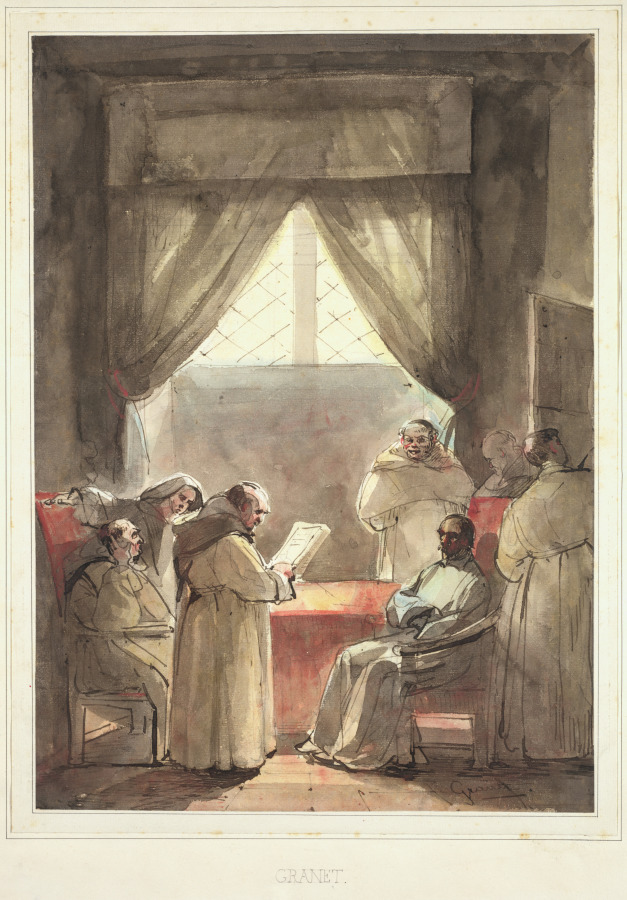
The Monks, c. 1802–30, by François Marius Granet
François Marius Granet · The Cleveland Museum of Art · Bequest of Muriel Butkin
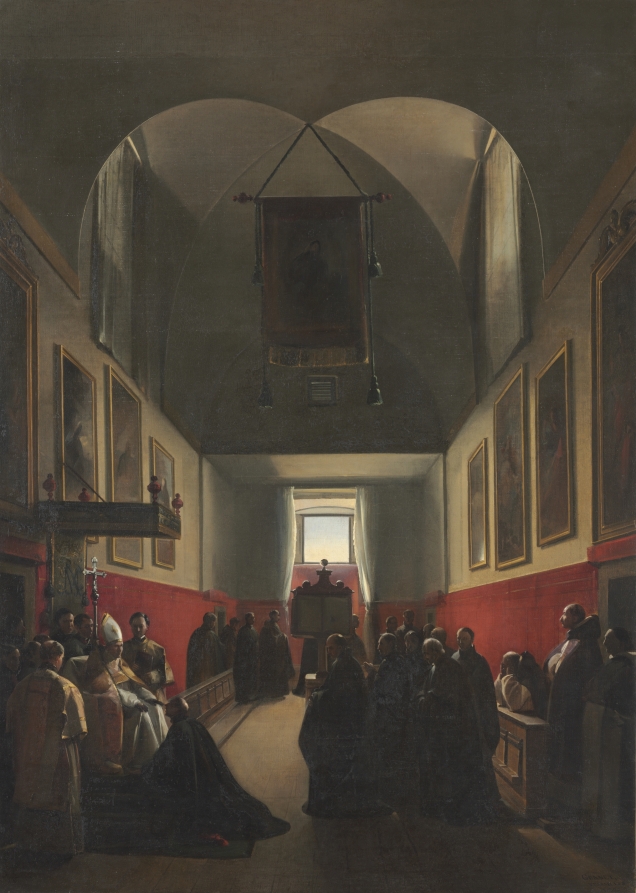
Homage to a Bishop, 1839, by François Marius Granet
François Marius Granet · The Cleveland Museum of Art · Gift of Mr. and Mrs. Noah L. Butkin
Where the work is held
Recognition and collections
François Marius Granet received Officer of the Legion of Honour, Knight of the Order of Saint Michael and Knight of the Legion of Honour.
Notes from the source article
Cited by Wikipedia
Notes from the source article
These works are cited by the source article, in its own numbering. They are recorded as its citations, not as sources VALÉORINE has verified.
- 1.Tinterow, Gary; Conisbee, Philip; Naef, Hans (1999). Portraits by Ingres: Image of an Epoch. New York: Harry N. Abrams, Inc. p. 116. .
- 2.Musée Granet - Aix en Provence
References
Citations
References
Each reference names the institution holding it, so a reader may go to the document itself.
reference work
Wikidata, structured authority record Q964812: François Marius GranetWikimedia Foundation
Partially resolvedreference work
Partially resolved
Further particulars
Held on the record
Further particulars
Open the remaining particulars
He trained under Jean Antoine Constantin and Jacques-Louis David. Each of those relationships is stated by the authority record rather than inferred from style.
The authorities additionally record the headings François-Marius Granet, Francois-Marius Granet, François-Marius Grenet, Francois Marius Granet and Granet. His recorded language was French. Granet worked in painting. His work is associated with Neoclassicism. He belonged to Académie des beaux-arts. Recorded as painter, curator, draftsperson and watercolorist.
Identity and origins
Career and activity
Self-portrait with palette
1820
The Encyclopedia exists whether or not anything is for sale. Corrections are recorded rather than overwritten, and every version of this record is kept. Published 14 August 2026.
Elsewhere in Modern design
3,254 published records in this field, each with its sources named.
- François ArnalDesigner
- François de TroyDesigner
- François DelarozièreDesigner
- François LinkeDesigner
- François PerrierDesigner
- Frank BallardDesigner
- Frank CarpayDesigner
- Frank CoppuckDesigner
Best supported in this field
For owners
Own a work by François Marius Granet?
A specialist will read what you send and tell you what the house can establish, what it cannot, and whether the object is suited to sale. There is no charge and no obligation. The object stays with you throughout; nothing is shipped to us unless it is arranged in writing beforehand.