
Francisco de Zurbarán
Francisco de Zurbarán (ZOOR-bə-RAHN, Spanish: [fɾanˈθisko ðe θuɾβaˈɾan]; baptized 7 November 1598 – 27 August 1664) was a Spanish Baroque painter. He is known primarily for his religious paintings depicting monks, nuns, and martyrs, and for his still-lifes. Zurbarán gained the nickname "Spanish Caravaggio", owing to the forceful use of chiaroscuro, in which he excelled.
Also recorded as Fransisko Surbaran · Francisco De Zurbaran · Francisco Zurbarán · Francisco de Zurbarán Salazar
Francisco de Zurbarán
![detail: Possibly Self-portrait [1] [2] [3]](https://upload.wikimedia.org/wikipedia/commons/thumb/f/f7/Francisco_de_Zurbar%C3%A1n_autoportrait.jpg/953px-Francisco_de_Zurbar%C3%A1n_autoportrait.jpg)
Francisco de Zurbarán · The Yorck Project (2002) 10.000 Meisterwerke der Malerei (DVD-ROM), distributed by DIRECTMEDIA Publishing GmbH. ISBN: 3936122202. · Public domain
- Born
- 1598.
- Nationality
- Spain.
- Occupation
- painter.
- Fields
- still life, religious painting, portrait, history painting, genre painting and mythological painting.
- Movements
- Baroque.
- Known for
- Saint Hugh in the Carthusian Refectory, Crucifixion of Christ and Immaculate Conception.
VALÉORINE Encyclopedia
VALÉORINE documentary reading
Documentary summary
Francisco de Zurbarán (ZOOR-bə-RAHN, Spanish: [fɾanˈθisko ðe θuɾβaˈɾan]; baptized 7 November 1598 – 27 August 1664) was a Spanish Baroque painter. He is known primarily for his religious paintings depicting monks, nuns, and martyrs, and for his still-lifes. Zurbarán gained the nickname "Spanish Caravaggio", owing to the forceful use of chiaroscuro, in which he excelled.
Admitted source layer · organised and presented by VALÉORINE
Note VALÉORINE
Francisco de Zurbarán (1598–1664) was a painter, of Spanish nationality. The painter was born in Fuente de Cantos and died in Madrid.
Francisco de Zurbarán worked in Madrid and Seville. Activity centred on painting. Francisco de Zurbarán was associated with Baroque.
Among the works are Crucifixion of Christ, Immaculate Conception and Saint Hugh in the Carthusian Refectory. The work spans genre painting, history painting and mythological painting, among others. Languages used include Spanish.
Composed from admitted, traceable facts · 30 September 2026
VALÉORINE
Reference Check
Propose documentary evidence for Francisco de Zurbarán. A contribution is never written directly as fact: identity, source, rights and evidence gates still decide.
Sign in to contribute
Documentary evidence
Documentary basis
Authority files
wikidata · Q209615 · wikipedia · Francisco de Zurbarán
In this article
Biography
Biography
He was the father of the painter Juan de Zurbarán.
Zurbarán was born in 1598 in Fuente de Cantos, Extremadura; he was baptized on 7 November of that year. His parents were Luis de Zurbarán, a haberdasher, and his wife, Isabel Márquez. In childhood he set about imitating objects with charcoal. In 1614 his father sent him to Seville to apprentice for three years with Pedro Díaz de Villanueva, an artist of whom very little is known. Zurbarán's first marriage, in 1617, was to María Paet who was nine years older. María died in 1624 after the birth of their third child. In 1625 he married again to wealthy widow Beatriz de Morales. On 17 January 1626, Zurbarán signed a contract with the prior of the Dominican monastery San Pablo el Real in Seville, agreeing to produce 21 paintings within eight months. Fourteen of the paintings depicted the life of Saint Dominic; the others represented Saint Bonaventura, Saint Thomas Aquinas, and the four Doctors of the Church. This commission established Zurbarán as a painter. On 29 August 1628, Zurbarán was commissioned by the Mercedarians of Seville to produce 22 paintings for the cloister in their monastery. In 1629, the Elders of Seville invited Zurbarán to relocate permanently to the city, as his paintings had gained such high reputation that he would increase the reputation of Seville. He accepted the invitation and moved to Seville with his wife Beatriz de Morales, the three children from his first marriage, a relative called Isabel de Zurbarán and eight servants. In May 1639 his second wife, Beatriz de Morales, died. Towards 1630 he was appointed painter to Philip IV, and there is a story that on one occasion the sovereign laid his hand on the artist's shoulder, saying "Painter to the king, king of painters". After 1640 his austere, harsh, hard-edged style was unfavorably compared to the sentimental religiosity of Murillo and Zurbarán's reputation declined. Beginning by the late 1630s, Zurbarán's workshop produced many paintings for export to South America. Jacob and his twelve sons, a series depicting the patriarch Jacob and his 12 sons, seems to have been aimed at the South America market, but the originals were acquired for Auckland Castle in Bishop Auckland, Co. Durham, England. On 7 February 1644, Zurbarán married a third time with another wealthy widow, Leonor de Torder. It was only in 1658, late in Zurbarán's life, that he moved to Madrid in search of work and renewed his contact with Velázquez. Popular myth has Zurbarán dying in poverty, but at his death the value of his estate was about 20,000 reales.
Style
Style
It is unknown whether Zurbarán had the opportunity to see the paintings of Caravaggio, only that his work features a similar use of chiaroscuro and tenebrism (dramatic lighting). The painter thought by some art historians to have had the greatest influence on his characteristically severe compositions was Juan Sánchez Cotán. Polychrome sculpture—which by the time of Zurbarán's apprenticeship had reached a level of sophistication in Seville that surpassed that of the local painters—provided another important stylistic model for the young artist; the work of Juan Martínez Montañés is especially close to Zurbarán's in spirit. He painted his figures directly from nature, and he made great use of the lay-figure in the study of draperies, in which he was particularly proficient. He had a special gift for white draperies; as a consequence, the houses of the white-robed Carthusians are abundant in his paintings. To these rigid methods, Zurbarán is said to have adhered throughout his career, which was prosperous, wholly confined to Spain, and varied by few incidents beyond those of his daily labour. His subjects were mostly severe and ascetic religious vigils, the spirit chastising the flesh into subjection, the compositions often reduced to a single figure. Zurbaran's "incapacity or possibly scorn for narrative" makes the actions depicted in his compositions difficult to interpret without foreknowledge of the subject. The style is more reserved and chastened than Caravaggio's, the tone of color often quite bluish. Exceptional effects are attained by the precisely finished foregrounds, massed out largely in light and shade. Backgrounds are often featureless and dark. Zurbaran had difficulty painting deep space; when interior or exterior settings are represented, the effect is suggestive of theater backdrops on a shallow stage. The art historian Julián Gállego suggests that Zurbarán's early training "may have left him with a taste for Mannerist composition... with the furniture and accessories placed on the slant" in an ambiguous space devoid of unitary perspective. The resulting contradictions have been compared to Cubism for the way each object is represented in isolation. According to José Camón Aznar, "Zurbarán succeeded in making a grace of his clumsiness". Zurbarán's late works, such as the Saint Francis (c. 1658–1664; Alte Pinakothek) show the influence of Murillo and Titian in their looser brushwork and softer contrasts.
Gallery
Gallery
Select works in chronological order.
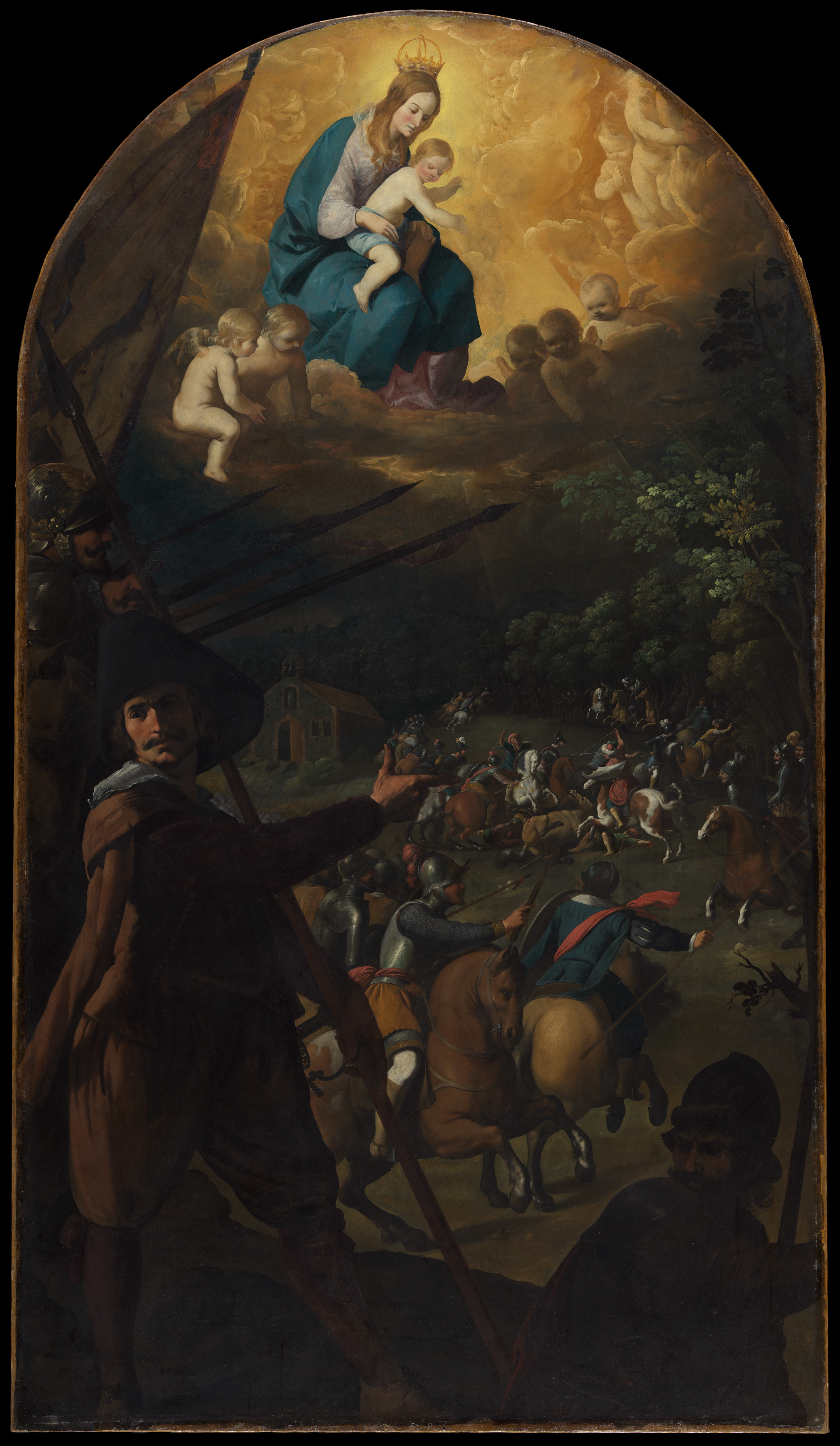
Battle between Christians and Muslims at El Sotillo, ca. 1637–39, by Francisco de Zurbarán
Francisco de Zurbarán · The Metropolitan Museum of Art, New York · Kretschmar Fund, 1920
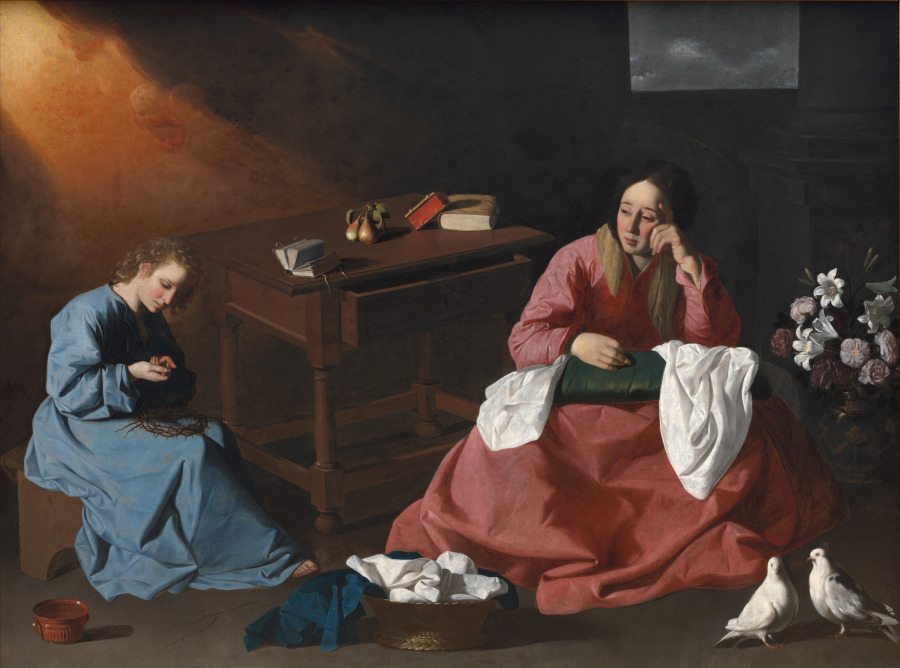
Christ and the Virgin in the House at Nazareth, c. 1640, by Francisco de Zurbarán
Francisco de Zurbarán · The Cleveland Museum of Art · Leonard C. Hanna Jr. Fund
Life and career
Dated record
Life and career
The full dated record · 2 entries
1598
Francisco de Zurbarán born at Fuente de Cantos.
1664
Francisco de Zurbarán died at Madrid.
Artistic legacy
In 1631, he painted the great altarpiece of The Apotheosis of Saint Thomas Aquinas, now in the Museum of Fine Arts of Seville; it was executed for the church of the college of that saint. This is Zurbarán's largest composition, containing figures of Christ, the Madonna, various saints, Charles V with knights, and Archbishop Deza (founder of the college) with monks and servitors, all the principal personages being more than life-size. It had been preceded by numerous pictures for the retable of St. Peter in the cathedral of Seville. Between 1628 and 1634, he painted four scenes from the life of St. Peter Nolasco for the Principal Monastery of the Calced Mercedarians in Seville. In Santa Maria de Guadalupe he painted multiple large pictures, eight of which relate to the history of St. Jerome; and in the church of Saint Paul, Seville, a figure of the Crucified Saviour, in grisaille, creating an illusion of marble. In 1639, he completed the paintings of the high altar of the Carthusians in Jerez. Also in the 1630s he was commissioned to provide canvases representing the Labours of Hercules, the only group of mythological subjects from the hand of Zurbarán, which were installed in the Hall of Realms in Madrid. A fine example of his work is in the National Gallery, London: a whole-length, life-sized figure of a kneeling Saint Francis holding a skull. In 1835, paintings by Zurbarán were confiscated from monasteries and displayed in the new Museum of Cádiz. His principal pupils were Bernabé de Ayala, Juan Caro de Tavira, and the Polanco brothers; others included Ignacio de Ries. Zurbarán was the subject of a major exhibition in 1987 at the Metropolitan Museum of Art in New York, which traveled in 1988 to Galeries nationales du Grand Palais in Paris. In 2015, the Thyssen-Bornemisza Museum in Madrid presented Zurbarán. A New Perspective. In 2026, the National Gallery in London was expected to exhibit Zurbarán, the first major exhibit of his work in the United Kingdom.
Primary material
Documents and archives
reference work
- Wikidata, structured authority record Q209615: Francisco de Zurbarán
Reputable secondary · Wikimedia Foundation
- “Francisco de Zurbarán”, English Wikipedia, consulted as further reading
Reputable secondary · Wikipedia
scholarly publication
- Zurbarán, Francisco De (1598–1664), Historical Dictionary of Renaissance Art, 2016
Scholarly · Crossref registry · 2016
Notes from the source article
Cited by Wikipedia
Notes from the source article
These works are cited by the source article, in its own numbering. They are recorded as its citations, not as sources VALÉORINE has verified.
- 1.Two new paintings now on display. National Gallery. 2018.
- 2.MacKenzie. Write on Art:"Saint Francis". Art UK. 2018.
- 3.Zurbaran Exhibitions National Gallery, London. www.nationalgallery.org.uk.
- 4.Zurbarán paintings : Art and exhibitions at Auckland Castle. The Auckland Project.
- 5.Exposición – Zurbarán. A New Perspective. Museo Nacional Thyssen-Bornemisza.
- 6.Hercules as a Symbol of the Spanish Monarchy. Splendor, Myth, and Vision: Nudes from the Prado.
- 7.Santo Domingo in Soriano. artehistoria.com. 2017.
Bibliography printed in the source article · 11
- Baticle, Jeannine. Zurbaran. Metropolitan Museum of Art. 1987.
- Bussagli, Marco. Baroque & Rococo. Sterling. 2009. 978-1-4027-5925-3.
- Gállego, Julián. Zurbarán, 1598–1664. Secker & Warburg. 1977. 9780436172205.
- Gállego, Julián. Zurbarán. Alpine Fine Arts Collection, Ltd. 1987. 0-88168-115-6.
- Gilbert, Creighton. Zurbarán, for the most part. The New Criterion. December 1987.
- Goodwin, Robert. Spain: The Centre of the World 1519–1682. Bloomsbury. 2015. 978-1-4088-4357-4.
- Harris, Ann Sutherland. Seventeenth-century Art and Architecture. Laurence King. 2005. 978-1-85669-415-5.
- Mallory, Nina A. El Greco to Murillo: Spanish Painting in the Golden Age, 1556–1700. Harper & Row. 1990. 978-0-06-435531-5.
- Pérez, Javier Portús. The Spanish Portrait: From El Greco to Picasso. Museo Nacional del Prado. 2004. 978-1-85759-374-7.
- Ressort, Claudie. Grove Art Online. 2003. 9781884446054.
- Robbins, Jeremy (2026). Francisco de Zurbarán and the Fabric of the World. Reaktion Books. .
References
Citations
References
Each reference names the institution holding it, so a reader may go to the document itself.
scholarly publication
Institutional witnessreference work
Wikidata, structured authority record Q209615: Francisco de ZurbaránWikimedia Foundation
Secondary witnessreference work
Secondary witness
The Encyclopedia exists whether or not anything is for sale. Corrections are recorded rather than overwritten, and every version of this record is kept. Published 14 August 2026.
Elsewhere in Paintings
18,705 published records in this field, each with its sources named.
- Francisco CorzasArtist
- Francisco de PalaciosArtist
- Francisco de Paula Van HalenArtist
- Francisco de SolísArtist
- Francisco Domingo MarquésArtist
- Francisco FernándezArtist
- Francisco Gimeno ArasaArtist
- Francisco HenriquesArtist
Best supported in this field
For owners
Own a work by Francisco de Zurbarán?
A specialist will read what you send and tell you what the house can establish, what it cannot, and whether the object is suited to sale. There is no charge and no obligation. The object stays with you throughout; nothing is shipped to us unless it is arranged in writing beforehand.