
Frances Flora Bond Palmer
Frances Flora Bond Palmer (July 24, 1812 – August 20, 1876), often referred to as Fanny Palmer, was an English artist who became successful in the United States as a lithographer for Currier and Ives.
Also recorded as Fanny Palmer · F. F. Palmer · Fanny née Bond · Frances Flora Bond
Frances Flora Bond Palmer

Public domain
- Birth Name
- Frances Flora Bond
- Birthplace
- Leicester, England
- Occupation
- Artist, lithographer
- Spouse
- Edmund Seymour Palmer (m. 1832)
- Known for
- Lithographs for Currier and Ives
- Born
- 1812. · Leicester.
- Died
- 1876. · Brooklyn.
- Nationality
- United Kingdom of Great Britain and Ireland.
- Fields
- landscape and still life.
- Languages
- English.
VALÉORINE Encyclopedia
VALÉORINE documentary reading
Documentary summary
Frances Flora Bond Palmer (July 24, 1812 – August 20, 1876), often referred to as Fanny Palmer, was an English artist who became successful in the United States as a lithographer for Currier and Ives.
Admitted source layer · organised and presented by VALÉORINE
Note VALÉORINE
Frances Flora Bond Palmer (1812–1876) was an artist, lithographer and painter, of British nationality. The artist was born in Leicester and died in Brooklyn.
Frances Flora Bond Palmer worked for Currier and Ives and worked in Brooklyn. The artist lived in New York City. Activity centred on Lithography.
The work spans landscape, landscape painting and still life. Languages used include English. Works are held at Art Institute of Chicago, Crocker Art Museum and Metropolitan Museum of Art, among others.
Composed from admitted, traceable facts · 01 October 2026
VALÉORINE
Reference Check
Propose documentary evidence for Frances Flora Bond Palmer. A contribution is never written directly as fact: identity, source, rights and evidence gates still decide.
Sign in to contribute
World of VALÉORINE
Documentary connections
Only confirmed graph relationships appear here. Images are shown only when their identity and reuse rights both pass the documentary gate.
Documentary evidence
Documentary basis
Authority files
wikidata · Q22019204
In this article
Biography
Biography
The recorded working language is English. The field of work recorded is lithography. Subjects and genres recorded for the work are landscape and still life. Places of work recorded in the authority are Brooklyn. Residence is recorded at New York City. Employment is recorded with Currier and Ives. Work by Frances Flora Bond Palmer is recorded in the collections of Minneapolis Institute of Art, Art Institute of Chicago, The Nelson-Atkins Museum of Art, Metropolitan Museum of Art and Smithsonian American Art Museum.
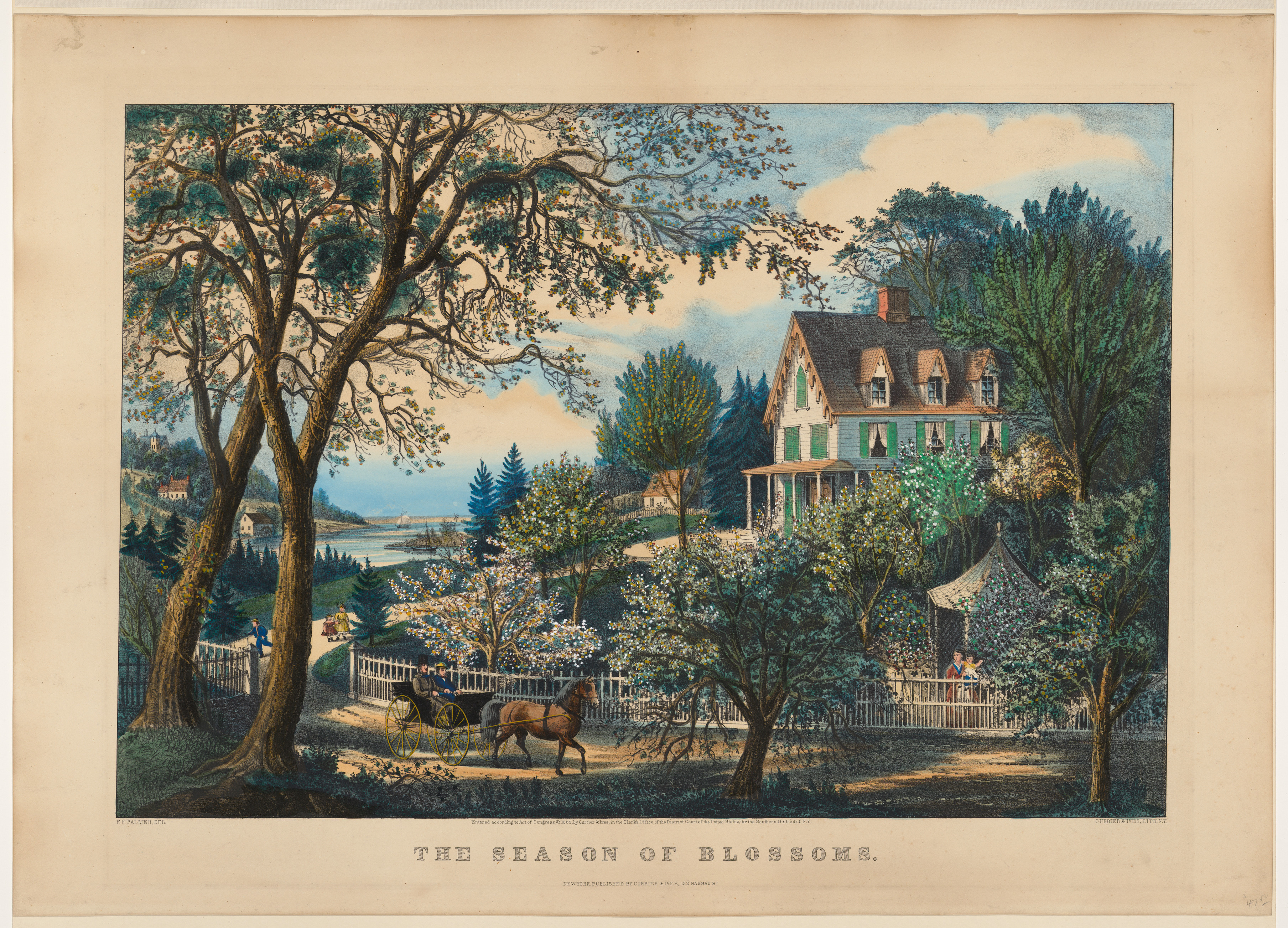
The Season of Blossoms, 1865, by Frances Flora Bond Palmer
Frances Flora Bond Palmer · The Metropolitan Museum of Art, New York · Gift of A. S. Colgate, 1952

Landscape – Fruit and Flowers, 1862, by Frances Flora Bond Palmer
Frances Flora Bond Palmer · The Metropolitan Museum of Art, New York · Bequest of Adele S. Colgate, 1962
Key facts
Key facts
• Birth Name — Frances Flora Bond • Birthplace — Leicester, England • Occupation — Artist, lithographer • Spouse — Edmund Seymour Palmer (m. 1832) • Children — 2 • Known for — Lithographs for Currier and Ives
Early life
Early life
Frances Flora Bond, nicknamed "Fanny", was born in Leicester, England, on July 24, 1812. Her father, Robert Bond, had been a prosperous lawyer and left an ample legacy to his children, who grew up very well off. In her youth, Palmer, with her sister Maria, attended Miss Linwood's School for young ladies, a select private school in London run by needlework artist Mary Linwood. There she was instructed in music, literature, and the fine arts. On July 13, 1832, Fanny married Edmund Seymour Palmer. They had a daughter, Frances E. Palmer, in 1833, and a son Edmund Jr., in 1835. Soon after her marriage, Palmer's family began experiencing financial difficulties. In 1942, Peters wrote that the reverse in their fortune caused the family to turn to their artistic talents as a means of earning a living. Described as charming, cultivated, talented and brave, Palmer was "not too proud to earn her own living." But the idea of an inexperienced romantic forced to earn her keep has been corrected by recent research showing she was a lithographer in England even before coming to America, and ran the F. Palmer and Co. firm in NYC, an "enterprising professional, one of the most versatile and prolific lithographers of her day."
Early career
Early career
By 1841, the Palmers operated a lithography business together with Frances as the artist and Edmund as the printer. The first notice of their work appeared in the Leicester Journal on May 13, 1842. As an artist-printer team, the Palmers began a series of topographical prints under the title of Sketches of Leicestershire. These prints were very well received and often advertised in the Leicester Journal and the Leicester Chronicle amongst enthusiastic reviews. • Illustration — Samuel Fleet Homestead, Brooklyn, c.1850 Brooklyn Museum Despite the high praise, the Palmers' business was unable to support them. Sometime between June, 1843, and January, 1844, the Palmers and Frances' siblings, Robert and Maria, decided to leave England to emigrate to New York in the United States. By moving to a new country, Frances and her family hoped to effect a change in their financial circumstances and to find a better outlet for their artistic talents. Then living in Brooklyn, Palmer taught singing, painting, drawing and wax flower making and worked as a governess and chaperone. Also, she and her husband set themselves up in a printing business again. The couple sought work where they could find it, sometimes creating work for other publishers or making advertisements for businesses and reproducing architectural drawings. Palmer made prints of flowers and sheet music covers in addition to her own work. At this time, like other lithographers, Palmer took advantage of the news-hungry public and created several lithographs depicting imagined scenes of the Mexican War, proving she was capable of a wide variety of work. When the Palmers were once again unable to secure enough work for themselves, their business failed for a second time. Nathaniel Currier then took over their stock and, recognizing Palmer's talents, hired her to work for his firm.
Currier and Ives
Currier and Ives
During Palmer's association with the printing companies of N. Currier and Currier and Ives, between 1849–1868, she is credited with producing around two hundred lithographs. She participated in every stage of the lithographic printing process in some way and was widely renowned for her technical skills. She is also credited with assisting Nathaniel Currier in the improvement of existing lithographic technology, including Currier's own lithographic crayon. • Illustration — Winter Pastime, 1855. Brooklyn Museum Palmer specialized in landscape and genre prints. Among her subjects were rural farm scenes, famous American ships and architecture, hunters, and Western landscapes. A notable example of these prints during her time with Currier and Ives is her highly regarded series of six bird hunting scenes. Palmer sketched these scenes from life using her husband Edmund Palmer, his friends, and their hunting dogs as models. Each medium-folio print is labeled "Drawing from nature and on stone by FF Palmer", and was priced at two dollars at the time of its publication in 1852. • Illustration — Landscape, Fruit, and Flowers, Frances Flora Bond Palmer, 1862 Palmer created most of her work by beginning with rough sketches from life. Often, Currier and Ives would send her by carriage to Long Island to do on-site landscape work. Though her work was mainly directed by the type of prints that Currier and Ives wanted to sell or determined by preexisting prints, her few original pieces received praise for their compositional fluidity and technical skill. Her most notable original work is titled Landscape, Fruit, and Flowers, published in 1862. In Still Life Painting in America, Wolfgang Born describes the composition of this work as "flawless." He also describes the piece as an example of early chromolithography anticipating the impressionist movement. Between 1859 and 1860, immediately following the change of the name of the company from N. Currier to Currier and Ives, no prints are signed by Palmer herself. This is most likely because of her grief following the death of her husband, which occurred around the same time. There are several possible reasons why Palmer may have decided to leave Currier and Ives although she was successful with them. Mary Bartlett Cowdrey suggests that by the end of her career with Currier and Ives, "the heavy hand of James Merritt Ives had settled upon (her) stones," meaning that she no longer had the level of freedom she once did. There was also around the same time a shift in the taste of Currier and Ives' audience. Depictions of landscapes were no longer as popular as prints involving people, and according to Louis Maurer, one of Palmer's colleagues, her inability to draw the human figure was her only flaw.
Later life
Later life
Little is known about Palmer's career after her time with Currier and Ives. After leaving their firm in 1868, she continued to be listed in directories as lithographer or artist, although she produced very little work. It is possible that she continued to take on private students at her home. Palmer's sister, Maria Bond, continued to live with her until Palmer's death from tuberculosis in 1876. Palmer's daughter, Fanny E. Palmer, is also remembered as an artist and studied with her mother. There is speculation that she also produced some lithographs for Currier and Ives which are signed "F.E. Palmer," although this may simply be a mistake made by the letterpress.
Places
Named by the record
Places
Only places the record itself states, plotted where the house gazetteer settles their coordinates. Nothing is inferred from a name or a nationality.
New York City.
Residences
Leicester.
Birth place
Brooklyn.
Death place
Notes from the source article
Cited by Wikipedia
Notes from the source article
These works are cited by the source article, in its own numbering. They are recorded as its citations, not as sources VALÉORINE has verified.
- 1.Cowdrey, Mary Bartlett. "Fanny Palmer, An American Lithographer", in Thirteen Illustrated Essays on the Art of the Print by Carl Zigrosser. New York: Holt, Rinehart, and Winston, 1962.
- 2.Peters, Harry T. Currier & Ives: Printmakers to the American People. New York, 1942
- 3.Streifer, Rubinstein, Charlotte. Fanny Palmer: the life and works of a Currier & Ives artist. xiv. 2018-08-09. 9780815610953.
- 4.Rubinstein, Charlotte Streifer. "The Early Career of Frances Flora Bond Palmer." American Art Journal; Vol 17 (1985): 71-88
- 5.Frances Flora Bond Palmer - Landscape – Fruit and Flowers - The Metropolitan Museum of Art. www.metmuseum.org.
- 6.Gerdts, William H and Burke, Russell. American Still life Painting. New York: Praeger, 1971.
References
Citations
References
Each reference names the institution holding it, so a reader may go to the document itself.
reference work
Secondary witness
The Encyclopedia exists whether or not anything is for sale. Corrections are recorded rather than overwritten, and every version of this record is kept. Published 18 August 2026.
Elsewhere in Paintings
18,792 published records in this field, each with its sources named.
- Frances BunsenArtist
- Frances C. FairmanArtist
- Frances CurreyArtist
- Frances Emilia CroftonArtist
- Frances FowlerArtist
- Frances GearhartArtist
- Frances Irwin HuntArtist
- Frances KornbluthArtist
Best supported in this field
For owners
Own a work by Frances Flora Bond Palmer?
A specialist will read what you send and tell you what the house can establish, what it cannot, and whether the object is suited to sale. There is no charge and no obligation. The object stays with you throughout; nothing is shipped to us unless it is arranged in writing beforehand.