
Fiat-Revelli Model 1914
The Mitragliatrice FIAT Modello 1914, often referred to as FIAT-Revelli mod. 1914 was an Italian water-cooled heavy machine gun produced from 1914 to 1919. It was the standard machine-gun of the Italian Army in World War I, and was used in limited numbers into World War II.
Also recorded as Fiat-Revelli Modello 1914 · M1914 · Mod. 1914
Fiat-Revelli Model 1914

Fotoluce – ediz. d’arte v.e. Boeri – v. f. Corridoni, 7 Roma · Collezione cartoline Albertomos · Public domain
- Name
- Mitragliatrice FIAT Modello 1914
- Field
- medium machine gun
- Region
- Spain · Kingdom of Italy
VALÉORINE Encyclopedia
VALÉORINE documentary reading
Documentary summary
The Mitragliatrice FIAT Modello 1914, often referred to as FIAT-Revelli mod. 1914 was an Italian water-cooled heavy machine gun produced from 1914 to 1919. It was the standard machine-gun of the Italian Army in World War I, and was used in limited numbers into World War II.
Admitted source layer · organised and presented by VALÉORINE
Note VALÉORINE
No house-authored Note is published until its assertions and sources pass the VALÉORINE evidence contract. The documentary article remains available in full while that enrichment is being consolidated.
Documentary enrichment in progress · no unsupported statement published
Reference Check
Propose documentary evidence for Fiat-Revelli Model 1914. A contribution is never written directly as fact: identity, source, rights and evidence gates still decide.
Sign in to contribute
World of VALÉORINE
Documentary connections
Only confirmed graph relationships appear here. Images are shown only when their identity and reuse rights both pass the documentary gate.

Documentary evidence
Evidence Panel
not yet certified
- Identity
- resolved
- Independent source families
- 0
- Admitted assertions
- 0
- Open conflicts
- 0
Authority files
wikidata · Q585095 · wikipedia · Fiat–Revelli Modello 1914
In this article
Key facts
Key facts
• Name — Mitragliatrice FIAT Modello 1914 • Origin — Italy • Type — Heavy machine gun • Is Ranged — yes • Service — 1914–1945 • Used By — See Fiat–Revelli Modello 1914 • Designer — Abiel Bethel Revelli • Manufacturer — FIAT * Metallurgica Bresciana già Tempini • Production Date — 1914–1919 • Number — ~37,500 • Cartridge — 6.5×52mm Carcano • Action — Short recoil • Rate — * Cyclic: 200–500 rounds/min • Practical: 250 rounds/min • Velocity — 660-680 m/s • Range — 1000 m • Max Range — 3000 m
History
History
In 1908, Italian Regio Esercito Colonel Abiel Bethel Revelli patented and presented a brand new machine gun, inspired by his own contemporary-designed Pistola Automatica Mod. 910 overall concept. The first iteration of this Mitragliatrice Automatica "Revelli" was almost identical to the final Mod. 1914, with just small external differences: it featured a large oval milled aperture on top to expel the spent cases and quickly inspect the chamber and address any magazine issues; it used 100 round box magazines, and instead of a water jacket, it had a fluted heavy barrel to lighten the overall weight to an astounding 12 kg. With a 14 kg very flexible tripod, it was a light machine-gun, especially compared to its contemporaries, weighing (with tripod) around 33-40kg. Cyclist units in particular showed interest for this light gun, as it suited the corps' needs. The gun was immediately put under trials by the Royal Italian Army, always looking for better machine-guns, since firearm technology at the dawn of the 20th century was evolving at a very fast pace. They had already adopted the Gardner Mod.1886, the Maxim Mod. 1887, Maxim Mod.1906, the Perino Mod. 1908 and would soon experiment with the and the Vickers-Maxim Mod.1911. This first iteration was rejected in 1911, in favour of the Vickers-Maxim Mod. 1911. Revelli, looking for a manufacturer for his machine-gun concept, sold his patents to FIAT in Turin, starting a decade long collaboration that will generate several other successful gun related products. FIAT, mostly in the Automotive business at the time, immediately set up a production line dedicated to gun production for the trials, in its Villar Perosa facilities. After some updates, the Machine-gun took part at another army trial in Nettuno in June 1913, and despite showing good performances and being cheaper than the Vickers-Maxim, it was again rejected for using a different manual of arms compared to the other machine-gun already in use. After the Sarajevo assassination and foreseeing the inevitability of war, the Italian Army, with the supply of Vickers-Maxim Machine-guns from the UK interrupted, finally adopted the new machine-gun in November 1914, giving it the official nomenclature of Mitragliatrice FIAT Mod. 1914. The definitive version had several lightening cuts in the receiver, a foldable cover on top of it to protect the case expulsion area, a fixed, ribbed water jacket with an external pump, standard 50 round box magazine, and an improved tripod. The Italian Army entered the First World War with just 37 FIAT Mod. 14 machine-guns delivered to corps, but the production numbers quickly increased, granting to arm with the new model most machine-guns sections. To help in the rearmament and to ease FIAT's automotive production for the war effort, Metallurgica Bresciana già Tempini intervened since July 1915, taking upon itself part of the Mod. 14 production, with a grand total of about 17,500 machine-guns produced during the war. FIAT instead managed to produce about 20,000 M1914 during the entirety of the conflict. The Mitragliatrice FIAT Mod. 1914 remained the standard medium/heavy machine-gun of the Italian Army until the adoption of the Breda Mod. 37. Most of these machine-guns got updated in late 1930s to the Mod. 1935 configuration.
Operation
Operation
Despite its similarity to the Maxim design in overall appearance (the typical water-cooling jacket and tripod), its internal mechanism was entirely different. As with the M1910 pistol, the gun works on short recoil and unlocking the bolt via locking wedge. The force needed to unlock the wedge is regulated by a leverageable pin positioned in the wedge' pivotal point, and can be set to three positions: Meno (Less), Più (More) and midway between these two. Positioning the lever on Più, the wedge gets slightly higher, offering more resistance to the bolt and absorbing more recoil. On the Meno position, the wedge is slightly lower, offering less resistance and absorbing less recoil. This helped in offering more or less recoil force from the fired bullet, in order to cycle the gun reliably with different batches of ammo, different magazines and different environmental issues. There were several out of battery safety preventive measures in the mechanism, in order to avoid feeding and faulty ammunition issues as much as possible. The water jacket, whose exterior changed from ribbed to smooth during the war, is notable for having two bottom drain plugs in addition to the top filling plug. One of the bottom drain relieves steam pressure into a condenser (a standard feature), and the other allows users to manually pump condensed water back into the jacket for reuse. The gun was chambered for the 6.5×52mm Carcano, which eased logistics (as it was the same cartridge of the Carcano rifle) but made it somewhat underpowered compared to most of its contemporaries. The gun itself weighed 17 kg, while the tripod weighed 22.4 kg. Another feature was the presence of a select-fire switch, which allowed for the choice between Lento (slow fire, about 200 rounds per minute), Sicura (safety position) and Rapido (fast fire, 500 rounds per minute). In December 1916 a conical flash hider was devised and patented by Belardo Italo; it got quickly implemented in production, offered complimentary by MBT.
Magazine
Magazine
• Illustration — FIAT-Revelli M1914 magazine The FIAT Modello 1914 utilized a distinctive multi-column strip-feed box magazine (sometimes called a "mouse cage" magazine). Available in 50- or 100-round capacities, this magazine was divided into 10 or 20 separate columns, respectively. Each column held five rounds, kept under pressure by a springed follower. The gun could be loaded one round at a time, or quickly using several special tools that inserted cartridges into five columns simultaneously. The magazine is inserted in the gun from the left, and begins firing from its first column on the right. After the column is exhausted and the follower reach the top, the mag is mechanically pulled inward to index and present the next column of ammunition. This column-by-column feeding sequence continues until the final column is fired, at which point the spent magazine drops out of the right side of the weapon, ready for replacement. Despite being a fairly compact magazine, it suffered from its flimsy construction, prone to dents and hence to failures, and for its lack of compatibility with other weapons. In June 1917 there were experimentations with a circular 250 circular magazine, but trials revealed reliability issues since it couldn't be supported from the bottom. The gun mechanisms didn't have enough force to keep up the weight of such a bulky and unsupported magazine and to cycle it reliably at the same time. The 100 round magazine had the same issues, that was solved on Aircraft mounted machine-guns by adding a base plate to support the weight of the magazine and facilitate its cycling. The magazine system was changed in the 1935 update to a belt system and it wasn't used by any other Italian ordnance.
Variants
Variants
- Mitragliatrice Automatica "Revelli", Mitragliatrice Automatica "Revelli-FIAT" Mod. 1910 Early version, without water jacket, with a floating, fluted heavy barrel. Production of prototypes for trial was soon overtaken by FIAT. - Mitragliatrice FIAT Mod. 1914 con refrigerante Standard Infantry version with water jacket. The most produced, widespread and the most known in popular culture. - Mitragliatrice FIAT Mod. 1914 con canna ad alette e supporto Aviatori Aviation variant, with perforated heat shield and heavy fluted barrel. It was designed to swivel and be used to defend the airplane from the front or from the rear, depending on the plane model.
Further development
Further development
While some sources suggest the gun featured a cartridge-oiling system, the official weapon manual makes no mention of it, nor any standard production gun shows it. It appears that only a brief 1930 iteration of the weapon may have included such a system. The machine-gun saw some use within armored vehicles, such as the Ansaldo Light Tank Prototype 1931, a precursor to the L3/33 tankette. It was developed into the FIAT–Revelli Modello 1935.
Users
Users
• Austria-Hungary • Nazi Germany • Kingdom of Italy • Principality of Albania • Kingdom of Yugoslavia
Identity
Identity
Fiat-Revelli Model 1914 is associated with Spain and Kingdom of Italy. Classified as a medium machine gun.
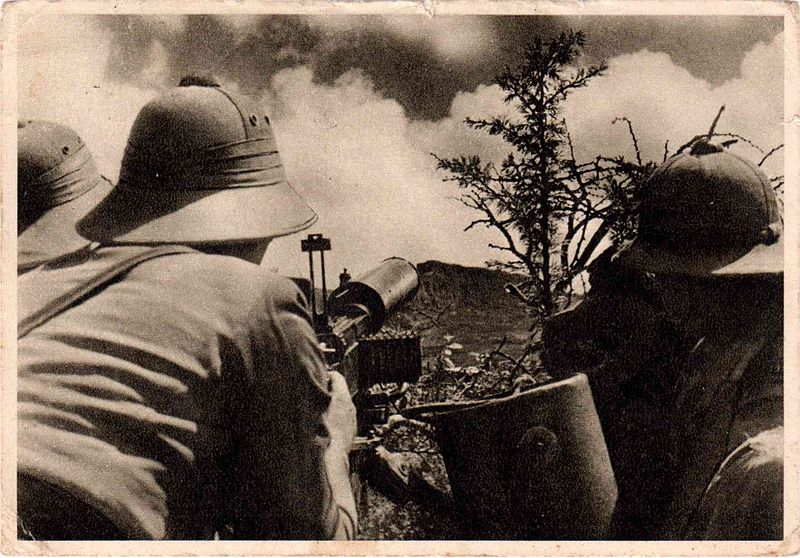
Serie:Visioni della conquista dell’Impero – mitraglieri Fiat-F nel Tembien
Foto luce – ediz. d’arte v.e. Boeri – v. f. Corridoni, 7 Roma · Collezione cartoline Albertomos

Muzeum Śląska Cieszyńskiego
myself (User:Piotrus) · Self-photographed
Chronology
Dated record
Chronology
The full dated record · 2 entries
1914
Fiat-Revelli Model 1914 is associated with Spain and Kingdom of Italy.
1914
Fiat-Revelli Model 1914 is classified as a medium machine gun.
Places
Named by the record
Places
Only places the record itself states, plotted where the house gazetteer settles their coordinates. Nothing is inferred from a name or a nationality.
Spain and Kingdom of Italy
Country
Fiat-Revelli Model 1914 is associated with Spain and Kingdom of Italy.
Country
Literature
Scholarly footprint
A count of publications is evidence of attention, not of standing, and is given here only as a measure.
Notes from the source article
Cited by Wikipedia
Notes from the source article
These works are cited by the source article, in its own numbering. They are recorded as its citations, not as sources VALÉORINE has verified.
- 1.Esdaile, 2018
- 2.Popenker, 2010
- 3.Menarini, Giuseppe. La mitragliatrice automatica "Revelli". La nuova rivista di Fanteria. 270. 15 April 1909.
- 4.Pocobelli, Gustavo. Mitragliatrici e ciclisti. La nuova rivista di Fanteria. 550. 15 July 1909.
- 5.Sacchi, Ettore. Gli esperimenti di una nuova mitragliatrice. Rassegna dei lavori pubblici e delle strade ferrate. 189. 7 March 1911.
- 6.Ministero Della Guerra, Comando del Corpo di Stato Maggiore - Ufficio Storico. L'esercito Italiano nella grande guerra (1915-1918), Volume I, Le Forze Belligeranti. Provveditorato dello Stato. 115-116. 1927.
- 7.Foglio D'annunzi della Rivista Marittima. Rivista Marittima. 1. 1 December 1913.
- 8.Montù, 1948, pp=55-56, p=758, 771
- 9.Revelli, 1914, p=16
- 10.Big set N°20 Armi della fanteria (infantry weapons) by John Weeks
- 11.Stabilimento Costruzioni Areonautiche. Relazione sui lavori compiuti dal suddetto Reparto nel mese di dicembre 1916. Reparto Artiglieria Aerea.
- 12.Popenker, 2010
- 13.Revelli, 1914, pp=37
- 14.Sacchi, Ettore. Gli esperimenti di una nuova mitragliatrice. Rassegna dei lavori pubblici e delle strade ferrate. 189. 7 March 1911.
- 15.Pocobelli, Gustavo. Mitragliatrici e ciclisti. La nuova rivista di Fanteria. 550. 15 July 1909.
- 16.Enciclopedia Militare. 495. 1933.
- 17.Revelli, 1914, p=56
- 18.Segal, 2023
Bibliography printed in the source article · 12
- Jowett, Philip. The Italian Army 1940-45 (1): Europe 1940-43. Bloomsbury Publishing. April 25, 2000. 9781855328648.
- Gucci, Luigi. Armi Portatili: Parte I - Generalità sulle Armi Portatili e sugli Esplosivi. 1918.
- Manganoni, Carlo. Caratteristiche di alcune Armi da Fuoco portatili - Testo. R. Accademia di Artiglieria e Genio. 1930.
- Comando 7a Armata. Istruzione sulle mitragliatrici in distribuzione. 1918.
- Grandi, Felice. Le Armi e le Artiglierie in Servizio. 1938.
- Popenker, Maxim. Modern Firearms: FIAT-Revelli M1914 and M1914/35 machine gun (Italy). modernfirearms.net. World Guns. October 27, 2010.
- Esdaile, Charles J. The Spanish Civil War: A Military History. Routledge. October 10, 2018. 9780429859298.
- Hills, Andrew. Ansaldo Light Tank Prototype 1931 - Tanks Encyclopedia. Tank Encyclopedia. February 20, 2020.
- Poggiaroni, Giulio. Fiat–Revelli Modello 1935 History and Specifications. comandosupremo.com. May 29, 2020.
- Segal, Robert G. FIAT Revelli Modello 1914. Small Arms Defense Journal. 3. 2. August 15, 2023.
- Montù, Carlo. Storia dell'Artiglieria - Vol. XI. USSME. 1948.
- Revelli, Abiel Bethel. Mitragliatrice Automatica "FIAT". Metallurgica Bresciana già Tempini. 1914.
References
Citations
References
Each reference names the institution holding it, so a reader may go to the document itself.
reference work
Partially resolvedreference work
Partially resolved
The Encyclopedia exists whether or not anything is for sale. Corrections are recorded rather than overwritten, and every version of this record is kept. Published 14 August 2026.
Elsewhere in Militaria
6,095 published records in this field, each with its sources named.
- FGM-172 SRAWTerminology
- FGR-17 ViperTerminology
- FH-88Terminology
- FH-901Terminology
- Fiat-Revelli Modello 1935Terminology
- field artilleryTerminology
- field gunTerminology
- Fieseler Fi 103R ReichenbergTerminology
Best supported in this field
For owners
Own an object connected with Fiat-Revelli Model 1914?
A specialist will read what you send and tell you what the house can establish, what it cannot, and whether the object is suited to sale. There is no charge and no obligation. The object stays with you throughout; nothing is shipped to us unless it is arranged in writing beforehand.