
Federico Zuccari
Federico Zuccaro, also known as Federico Zuccari and Federigo Zucchero (c. 1540/1541 – July/August 1609), was an Italian painter, draughtsman, architect and writer. He worked in various cities in Italy, as well as in other countries such as Spain, France, the Spanish Netherlands and England.
Also recorded as Federico Sucarus · Federico Zuccheri · Federigo Zuccaro · Federico Zucchero
Federico Zuccari
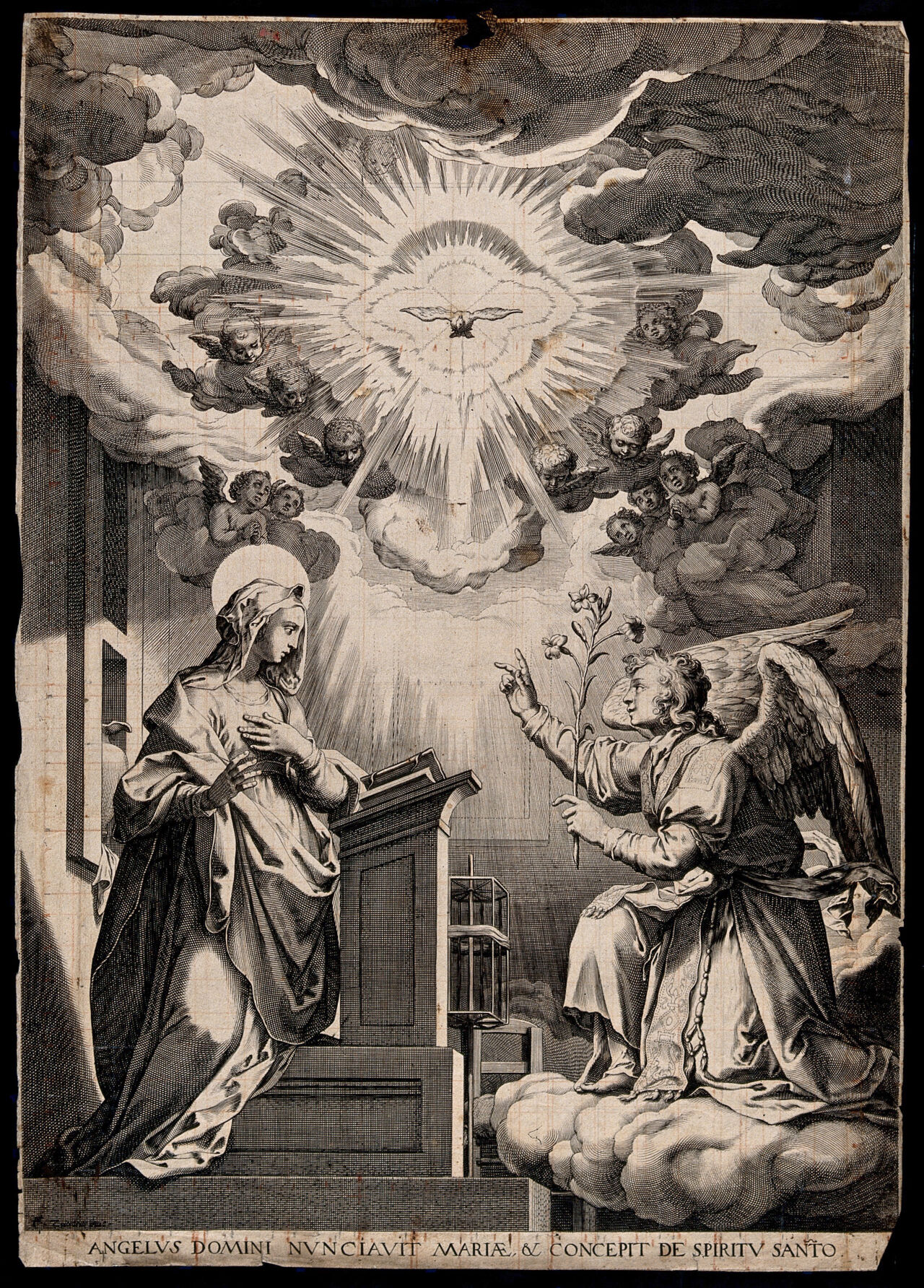
Federico Zuccari · Wellcome Collection, London · Wellcome Collection · Public Domain Mark
- Born
- sources differ (1539 and 1540).
- Nationality
- Italy.
- Occupation
- painter, architect, draftsperson, art theorist, designer, visual artist and artist.
- Fields
- portrait.
- Movements
- Renaissance and Mannerism.
VALÉORINE Encyclopedia
VALÉORINE documentary reading
Documentary summary
Federico Zuccaro, also known as Federico Zuccari and Federigo Zucchero (c. 1540/1541 – July/August 1609), was an Italian painter, draughtsman, architect and writer. He worked in various cities in Italy, as well as in other countries such as Spain, France, the Spanish Netherlands and England.
Admitted source layer · organised and presented by VALÉORINE
Note VALÉORINE
No house-authored Note is published until its assertions and sources pass the VALÉORINE evidence contract. The documentary article remains available in full while that enrichment is being consolidated.
Documentary enrichment in progress · no unsupported statement published
Reference Check
Propose documentary evidence for Federico Zuccari. A contribution is never written directly as fact: identity, source, rights and evidence gates still decide.
Sign in to contribute
Documentary evidence
Evidence Panel
not yet certified
- Identity
- resolved
- Independent source families
- 0
- Admitted assertions
- 0
- Open conflicts
- 0
Authority files
wikidata · Q345605 · wikipedia · Federico Zuccari
In this article
Life and work
Life and work
He was an important representative of late Mannerism in Italian art.
Zuccaro was born in Sant'Angelo in Vado, near Urbino (Marche), then in the Duchy of Urbino. His parents were the painter Ottaviano de Zucharellis, who changed his surname to Zuccaro in 1569, and Antonia Neri. He was the third child of eight. His siblings were called Taddeo, Bartolomea, Federico, Iacopo, Lucio, Maurizio, Aloysio and Marco Antonio. In 1550, when he was just 11 years old, his parents brought him to Rome to study law but Federico preferred a career in art. He trained and worked in the workshop of his elder brother Taddeo who had become a successful painter in Rome. He became quickly integrated into the team of his brother and assisted with the workshop's commissions. Around 1560 he was able to join a group of artists who worked for pope Pius IV at the Vatican where he made decorations for the Casino in the garden and the cycle with the History of Moses at the Belvedere which were commenced in 1560. He helped his brother on the fresco decorations at the Villa Farnese at Caprarola. He left his work on this commission to travel to Venice to work for a private Venetian patron, Giovanni Grimani, the patriarch of Aquileia. He made decorations for the Palazzo Grimani di Santa Maria Formosa in Venice and painted frescoes and the altarpiece of the patriarch's chapel in San Francesco della Vigna. During this period in Venice, he met the prominent architect Palladio and the Florentine writer Anton Francesco Doni. They were active in various literary and artistic academies to which they introduced him. He collaborated with Palladio on the design of sets for the theater company Compagnia della Calza degli Accesi and in March 1565 they visited together Cividale del Friuli. He tried unsuccessfully to obtain the commissions for the decoration of the Scuola di San Rocco and the wall with the Paradise fresco in the Doge's Palace. He used his period in Venice to copy works of other masters of the 15th and 16th centuries, including some pages of the precious Grimani Breviary, a manuscript illumination produced by Flemish artists between 1515 and 1520. In 1565, Zuccaro left Venice and traveled to Florence where he had been introduced to some important people by his Florentine friends in Venice. He arrived not long before the elaborate wedding of the Grand Duke of Tuscany Francesco I de' Medici with Joanna of Austria in December 1565. Giorgio Vasari, who was in charge of the organisation of the artistic and decorative preparations for the festive occasion, entrusted him with the painting of some stories in grisaille. These served as decorations of the fake arch and the great drop scene that closed off one of the sides of the Sala dei Cinquecento in the Palazzo Vecchio, where the wedding was to take place. A preparatory sketch in colour depicting hunting scenes near Florence is the only item that survives in relation to his contribution. After returning to Rome in 1566, he found artistic success with his Annunciation (lost) in the church of the Jesuits in Piazza del Collegio Romano and frescoes in the Villa d'Este at Tivoli. His brother Taddeo died suddenly, aged 37, on 2 September 1566. He took over all the ongoing commissions of his brother. This kept him busy for many years. He worked extensively on the fresco decorations at the Villa Farnese at Caprarola. In summer 1569, a conflict over payments arose between Zuccaro and Cardinal Farnese. As a result, Federico was sent away from Caprarola where he was replaced by Jacopo Bertoia of Parma. Upset by this event, Federico painted and then made copies of a satirical composition which was inspired by the lost painting of the ancient Greek painter Apelles called the Calumny of Apelles as described by the ancient author Lucian. In the painting Apelles had expressed his unhappiness with his ignorant patron King Midas. In his painting, Zuccaro depicts King Midas with donkey ears while the painter hero is led away under the protection of the Roman god Mercury. In this painting Zuccaro for the first time expressed his feeling of being misunderstood by an ignorant patron that would accompany him in the remainder of his career. In 1569, with Taddeo's team of assistants dispersed, Federico began to work mostly for the free market. On 22 June 1573, he set out for Paris after accepting to work in the service of Charles, Cardinal of Lorraine, a member of the powerful House of Guise. He arrived in Paris on 24 August 1573. He may have seen Leonardo da Vinci's Mona Lisa when he visited the Palace of Fontainebleau near Paris. From Paris he traveled on 14 August 1574 to Antwerp where he arrived six days later. He visited Brussels, where he prepared a series of cartoons for the tapestry-weavers. On 16 March 1575 he left Antwerp for England, where he stayed until 8 August 1575. In England he received a commission from Robert Dudley, 1st Earl of Leicester to portray himself and Queen Elizabeth I. Only the preparatory drawings for the two portraits are preserved. The drawings are inscribed with the date “1575” and “in london magio 1575.” He also painted Mary, Queen of Scots, Sir Nicholas Bacon, Sir Francis Walsingham, Lord High Admiral Howard. Upon learning that the Grand Duke Francesco I de' Medici wished to commission him with the completion of the Last Judgement in the dome of Santa Maria del Fiore in Florence, left unfinished by Giorgio Vasari upon his death in 1574, he immediately decided to return to Italy. On his return trip, he stopped over in Antwerp from 18 to 30 August. In the execution of the Last Judgement in Florence he only relied in Vasari's general proportional scheme while creating his own original design by changing the manner of representation, technique and style. He painted a portrait of a Man with Two Dogs in the Pitti Palace (Florence), and the Dead Christ and Angels in the Galleria Borghese (Rome). In 1585, he accepted an offer by Philip II of Spain to decorate the new Escorial at a yearly salary of 2,000 crowns. He worked at the palace from January 1586 to end of 1588, when he returned to Rome. His paintings (like those of El Greco before him) were not in line with the austere artistic preferences of the king and many were painted over or heavily retouched after he left. However the parting was amicable: "We must not blame him, but those who sent him to us", said Philip. He was succeeded by Pellegrino Tibaldi. In Rome, he obtained a charter confirmed by Pope Sixtus V approving the establishment in 1595 of the Accademia di San Luca, of which he was the first president. Bartolomeo Carducci is said to have studied with him. In 1603, he spent time in his birthplace Sant'Angelo in Vado, where he completed the Zuccari altarpiece at the monastery of Santa Caterina. He was in Venice, where he perfected the work in the Great Council room at the Doge Palace (signed, dated “1582 / PERFECIT AN. 1603” and bearing his emblem, a lily sugar loaf). He was given a gold necklace and the title of cavaliere knight as his reward for completing this work. From Venice he travelled to Pavia where, together with Cesare Nebbia, he frescoed the hall of the Collegio Borromeo, a work commissioned by Cardinal Federico Borromeo. Zuccari travelled from one court to another. The last stages of his journey took him to Emilia and Romagna. Following a brief illness, he died in July or August 1609, in Ancona, in the home of a gentleman with whom he was staying and who arranged for his burial.
Draughtsman
Draughtsman
He was a prolific draughtsman and left a large number of preliminary studies for his paintings. He is the author of one of the most complete illustrations of the Divina Commedia of Dante which he created between 1586 and 1588 during his stay in Spain. The set of 88 sheets was kept by the artist throughout his life and were part of his estate at the time of his death. The sheets are now in the collection of the Uffizi in Florence. He created around in 1595 a series of 20 drawings, which illustrate the early life of his older brother Taddeo, starting with the hardships and disappointments during the period of his training in Rome until his first artistic successes at the age of 18. In addition to 16 scenes depicting Taddeo's life, the series includes four drawings of allegorical Virtues flanking the Zuccaro emblem. The set is kept at the Getty Center.
Selected fresco projects
Selected fresco projects
The fresco projects he worked on include: Sala Regia in the Apostolic Palace, Rome Decoration of the Casina Pio IV, Rome Chapel of St. Hyacinth in the Basilica of Saint Sabina, Rome Grimani Chapel, San Francesco della Vigna, Venice Monumental staircase, Palazzo Grimani, Venice Pucci Chapel in the church of Trinità dei Monti, Rome San Marcello al Corso, Rome Cathedral of Orvieto (1570) Oratorio del Gonfalone, Rome (1573) The Last Judgement on the ceiling of the dome of the Florence Cathedral. Started by Giorgio Vasari and unfinished at the time of his death, it was completed by Zuccari between 1576 and 1579 with the assistance of Bartolomeo Carducci, Domenico Passignano and Stefano Pieri.
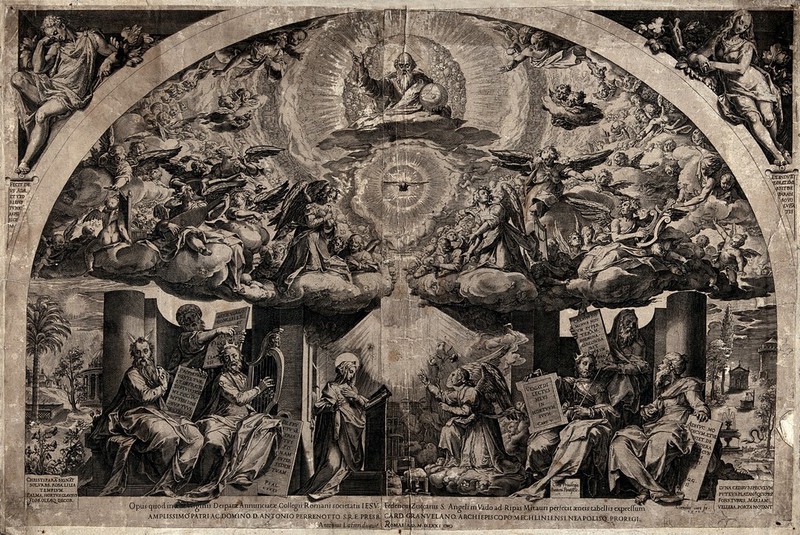
The annunciation with figures from the Old Testament. Etching by C. Cort after F. Zuccari, 1571., 1571, by Federico Zuccari
Federico Zuccari · Wellcome Collection, London · Wellcome Collection
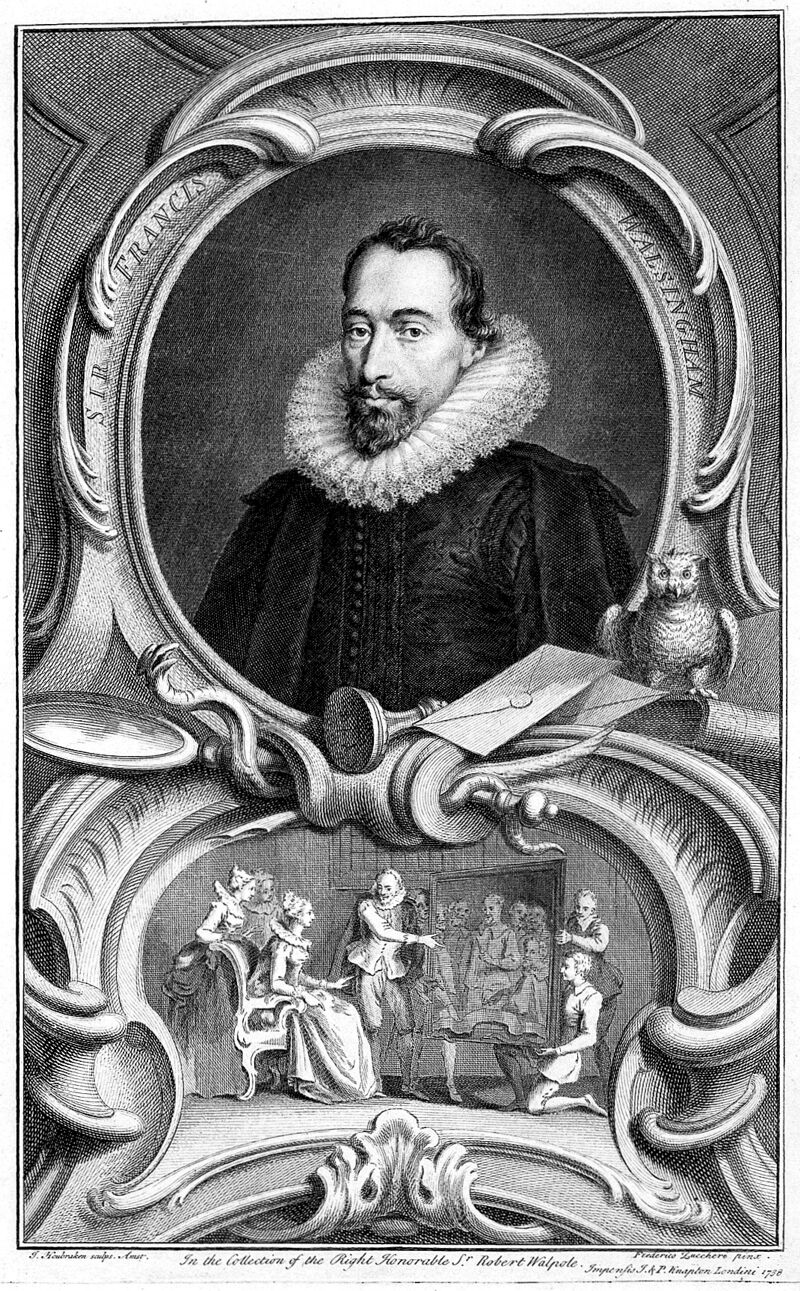
Sir Francis Walsingham (1530?-1590). Engraving by Jacobus Houbraken after a painting ascribed to Federico Zucchero., 1738, by Federico Zuccari
Federico Zuccari · Wellcome Collection, London · Wellcome Collection
Life and career
Dated record
Life and career
Explore 1539–1609
The full dated record · 3 entries
1539
Federico Zuccari born at Sant'Angelo in Vado.
1566
Annontiation (Federico Zuccari).
1609
Federico Zuccari died at Ancona.
Art writer
Zuccaro also published books on art theory and art history. In his book L'idea de' Pittori, Scultori, ed Architetti (1607) he sets out a complex theoretical exposition on the idea of design.
Primary material
Documents and archives
Institutional database
- Wikidata, structured authority record Q345605: Federico Zuccari
Scholarly · Wikimedia Foundation
reference work
- “Federico Zuccari”, English Wikipedia, consulted as further reading
Reputable secondary · Wikipedia
Notes from the source article
Cited by Wikipedia
Notes from the source article
These works are cited by the source article, in its own numbering. They are recorded as its citations, not as sources VALÉORINE has verified.
- 1.harnvb Spagnolo 2020 .
- 2.harnvb Donati Barcellona 1970 .
- 3.Cristina Acidini Luchinat, The life of the Zuccari brothers at la Repubblica of the Arts
- 4.Federico Zuccaro (c. 1542-1609), Calumny at the Royal Collection
- 5.Goldring, Elizabeth: "The Earl of Leicester's Inventory of Kenilworth Castle, c.1578", English Heritage Historical Review, Vol. 2, 2007, p. 38
- 6.EB1911 1 Zuccaro 28 1047 Middleton John Henry John Henry Middleton
- 7.Trevor-Roper, Hugh; Princes and Artists, Patronage and Ideology at Four Habsburg Courts 1517-1633, Thames & Hudson, London, 1976, p 69
- 8.Collegio Borromeo. Visit the College. Almo Collegio Borromeo Pavia.
- 9.Regione Lombardia. Collegio Borromeo - complesso Pavia (PV). Lombardia Beni Culturali.
- 10.Eike D. Schmidt, Dante Illustrated. at the Uffizi Galleries
- 11.Federico Zuccaro, Twenty Drawings Depicting the Early Life of Taddeo Zuccaro at the Getty Center
- 12.Shulman, Ken. ART: On the Scaffolds, a Delicate Labor in the Duomo. New York Times. 3 December 1989.
- 13.Berti, Federico. Domenico Cresti, il Passignano,"fra la natione fiorentina e veneziana": Viatico per il periodo giovanile con una inedita Sacra Famiglia. De Stijl Art Publishing. 18. 2013. 978-88-904451-3-2.
Bibliography printed in the source article · 2
- Freedberg, Sydney J. Painting in Italy, 1500-1600. Penguin Books Ltd. 1993.
- Thompson, Wendy. Federico Zuccaro's Love Affair with Florence: Two Allegorical Designs. Metropolitan Museum Journal. The University of Chicago Press. 43. 75–97. 2008.
References
Citations
References
Each reference names the institution holding it, so a reader may go to the document itself.
Institutional database
Wikidata, structured authority record Q345605: Federico ZuccariWikimedia Foundation
Verifiedreference work
Partially resolved
The Encyclopedia exists whether or not anything is for sale. Corrections are recorded rather than overwritten, and every version of this record is kept. Published 14 August 2026.
Elsewhere in Modern design
3,254 published records in this field, each with its sources named.
- Fanny Harlfinger-ZakuckaDesigner
- Fawn RogersDesigner
- Faye ResnickDesigner
- Federico de VincioloDesigner
- Felice Mario BoanoDesigner
- Felix KellyDesigner
- Felix LandauDesigner
- Ferdinand Alexander PorscheDesigner
Best supported in this field
For owners
Own a work by Federico Zuccari?
A specialist will read what you send and tell you what the house can establish, what it cannot, and whether the object is suited to sale. There is no charge and no obligation. The object stays with you throughout; nothing is shipped to us unless it is arranged in writing beforehand.