
Federico Barocci
Federico Barocci (also written Barozzi) (c. 1535 – 30 September 1612) was an Italian Renaissance painter and printmaker. His original name was Federico Fiori, and he was nicknamed Il Baroccio.
Also recorded as Federico Barochio · Federigo Baroccio · Federico Barrochio · Fiori da Urbino
Federico Barocci

Adri08 · Own work- origine · CC BY-SA 4.0
- Name
- Federico Barocci
- Born
- c. 1535
- Birthplace
- Urbino, Duchy of Urbino
- Died
- 30 September 1612
- Known for
- Painting
- Movement
- * Renaissance
- Nationality
- Italy and Duchy of Urbino.
- Occupation
- painter, engraver, draftsperson, visual artist and artist.
- Movements
- Renaissance.
VALÉORINE Encyclopedia
VALÉORINE documentary reading
Documentary summary
Federico Barocci (also written Barozzi) (c. 1535 – 30 September 1612) was an Italian Renaissance painter and printmaker. His original name was Federico Fiori, and he was nicknamed Il Baroccio.
Admitted source layer · organised and presented by VALÉORINE
Note VALÉORINE
Federico Barocci (1535–1612) was an artist, draftsperson and engraver, among other activities, a national of the Duchy of Urbino and Italy. The artist was born and died in Urbino.
Activity centred on painting and visual arts. The artist was associated with Renaissance.
Among the works are Circumcision, Communion of the Apostles, Descent from the Cross and Head of a Shepherd, study for The Circumcision, among others. Languages used include Italian.
Composed from admitted, traceable facts · 30 September 2026
VALÉORINE
Reference Check
Propose documentary evidence for Federico Barocci. A contribution is never written directly as fact: identity, source, rights and evidence gates still decide.
Sign in to contribute
Documentary evidence
Documentary basis
Authority files
gnd · 16039273-1 · wikidata · Q316731 · wikipedia · Federico Barocci
In this article
Biography
Biography
His work was highly esteemed and influential, and foreshadows the Baroque works of Rubens. He is generally considered the greatest and most individual painter of his time in central Italy.
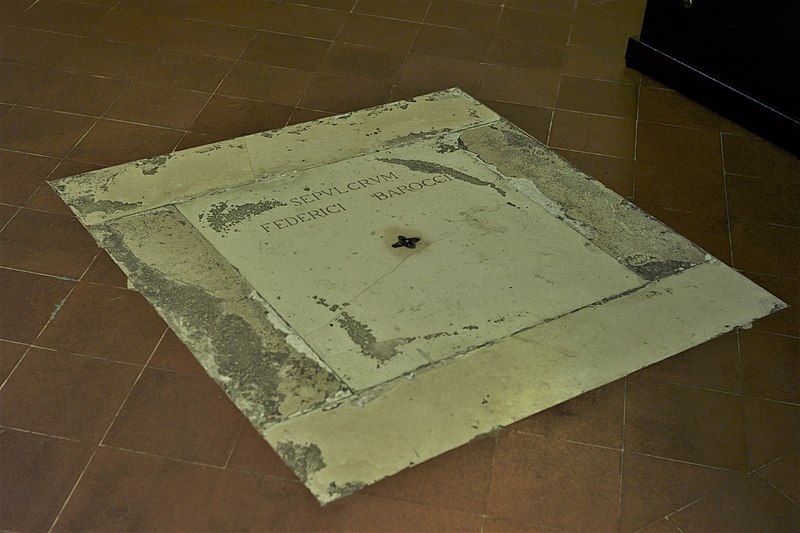
The grave of Federico Barocci in the church of Saint Francis in Urbino.
Limoncellista

Inmaculada Concepción patrona de Alhendín
Antgam
Key facts
Key facts
• Name — Federico Barocci • Born — c. 1535 • Birthplace — Urbino, Duchy of Urbino • Died — 30 September 1612 • Place of death — Urbino, Duchy of Urbino • Known for — Painting • Movement — * Renaissance • Mannerism • Notable Works — The Communion of the Apostles
Early life and training
Early life and training
• Illustration — Annunciation (1592–96) Oil on canvas, Santa Maria degli Angeli, Perugia. He was born at Urbino, Duchy of Urbino, and received his earliest apprenticeship with his father, Ambrogio Barocci, a sculptor of some local eminence. He was then apprenticed with the painter Battista Franco Veneziano in Urbino. He accompanied his uncle, Bartolommeo Genga, to Pesaro, then in 1548 to Rome, where he worked in the pre-eminent studio of the day, that of the Mannerist painters, Taddeo and Federico Zuccari.
Mature work in Rome and Urbino
Mature work in Rome and Urbino
After passing four years at Rome, he returned to his native city, where his first work of art was a St. Margaret executed for the Confraternity of the Holy Sacrament. He was invited back to Rome by Pope Pius IV to assist in the decoration of the Vatican Belvedere Palace at Rome, where he painted the Virgin Mary and infant, with several Saints and a ceiling in fresco, representing the Annunciation. During this second sojourn, while completing the decorations for the Vatican, Barocci fell ill with intestinal complaints. He suspected that a salad which he had eaten had been poisoned by jealous rivals. Fearing his illness was terminal, he left Rome in 1563; four years later he was said to experience a partial remission after prayers to the Virgin. Barocci henceforth often complained of frail health, though he remained productive for nearly four decades more. While he is described by contemporaries as personally somewhat morose and hypochondriacal, his paintings are lively and brilliant. Although he continued to have major altarpiece commissions from afar, he never returned to Rome, and was mainly patronised in his native city by Francesco Maria II della Rovere, duke of Urbino. The Ducal Palace can be seen in the background of his paintings, rendered in a forced perspective that seems a holdover from Mannerism. • Illustration — Nativity, 1597, oil on canvas, Museo del Prado, Madrid While Barocci was removed from Rome, the fulcrum of artistic fame and influence, he continued to innovate in his style. At some point, he may have seen coloured chalk/pastel drawings by Correggio, but Barocci's remarkable pastel studies are the earliest examples of the technique to survive. In pastels and in oil sketches (another technique he pioneered), Barocci's soft, opalescent renderings evoke the ethereal. Such studies were part of a complex process Barocci used to complete his altarpieces. An organised series of steps leading up to the final product ensured its speed and success in execution. Barocci did innumerable sketches: gestural, compositional, figural studies (using models), lighting studies (using clay models), perspective studies, colour studies, nature studies, etc. Today, over 2,000 drawings by him are extant. Every detail of his subsequent cartoons for canvases was worked out in this way. A good example is his famed Madonna del Popolo (Uffizi). It is a vortex of colour and vitality, made possible by the great variety of people, poses, perspectives, natural details, colors, lighting and atmospheric effects. There are many surviving drawings for the Madonna del Popolo, from initial sketches to colour studies of heads, to the final full-size cartoon. Despite this painstaking process, Barocci's genius kept the brushstrokes passionate and liberated, and a spiritual light seems to flicker as a jewel across faces, hands, drapery, and sky. • Illustration — Federico Barocci, Madonna del Popolo, 1579 Barocci's embrace of the Counter Reformation would shape his long and fruitful career. By 1566, he joined a lay order of Capuchins, an offshoot of Franciscans. He may have been influenced by Saint Philip Neri, whose Oratorians sought to reconnect the spiritual realm with the lives of everyday people. Neri, who was somewhat ambivalent about the accumulating richness of his Santa Maria in Vallicella, commissioned two completed works from Barocci, the pre-eminent artist of these large pious altarpieces: The Visitation (1583–6) and Presentation of the Virgin (1593–94). Neri is said to have been moved to ecstasy by Barocci's accomplishment in the former painting, which shows the Virgin and Elizabeth greeting each other. In Urbino, where he painted a Descent from the Cross for the cathedral of San Lorenzo at Perugia. He again visited Rome during the papacy of Gregory XIII when he painted two admirable pictures for the Chiesa Nuova, representing the Visitation of the Virgin Mary to Elisabeth and the Presentation in the Temple, and for the Chiesa della Minerva, a Last Supper.
Partial list of works
Partial list of works
• Painting — Date — Site — Image link • Martyrdom of St Sebastian — 1557 — Urbino Cathedral • Madonna di San Simone — 1567 — Galleria Nazionale delle Marche, Urbino • Deposition — 1567–69 — Perugia Cathedral • Rest on the Flight into Egypt — c. 1573 — Pinacoteca Vaticana, Vatican — • Nativity — 1597 — Museo del Prado, Madrid — • The Vision of St Francis — San Francesco, Urbino • Madonna del Popolo — 1575–79 — Uffizi, Florence — • Entombment — 1580-2 — Chiesa della Croce, Senigallia • Martyrdom of San Vitale — 1583 — Pinacoteca di Brera, Milan • Portrait of a Young Man — c. 1580–85 — Musée des Beaux-Arts de Strasbourg — • Circumcision — Paris — • Annunciation — 1592–96 — Basilica of Santa Maria degli Angeli, Assisi, Perugia • Aeneas' Flight from Troy — 1598 — Galleria Borghese, Rome — • St Jerome — 1598 — Galleria Borghese, Rome • Portrait of Francisco II della Rovere — 1572 — Uffizi, Florence • Christ and Mary Magdalen (Noli me tangere) — 1590 — Gemaldegalerie, Munich • Entombment (etching) — 1579–1582 — Getty Museum, Los Angeles • Quintilia Fischeri — c. 1600 — National Gallery of Art, Washington, D.C. — • Annunciation (etching) • St Francis receives the stigmata (drawing) — Accademia Carrara, Bergamo • Madonna with Sts Simon and Jude — Galleria Nazionale delle Marche, Urbino • Vocation of Saints Peter and Andrew — 1586 — Royal Museums of Fine Arts of Belgium • Madonna and Child with the Infant John the Baptist and St Joseph (Madonna with the Cat) — c. 1575 — National Gallery, London • Communion of the Apostles — c. 1603~1608 — Santa Maria sopra Minerva, Rome —
Identity and origins
Identity and origins
The authorities additionally record the headings Federico Barochio, Federigo Baroccio, Federico Barrochio, Fiori da Urbino and Federico Barozio. His recorded language was Italian.
Career and activity
Career and activity
Federico Barocci worked in painting and visual arts. His work is associated with Renaissance. He belonged to Order of Friars Minor Capuchin.
Work and production
Work and production
Works recorded as notable number 7: Communion of the Apostles, Circumcision, Head of a Shepherd, study for The Circumcision, Madonna of the people, Descent from the Cross, Presentation of Virgin Mary at the Temple and Visitation.
Life and career
Dated record
Life and career
The full dated record · 2 entries
1535
Federico Barocci was born in 1535.
1612
Federico Barocci died at Urbino.
Critical assessment and legacy
The artist biographer Giovanni Pietro Bellori, the Baroque equivalent of Giorgio Vasari, considered Barocci to be among the finest painters of his time. Barocci's emotive brushwork was not lost on Peter Paul Rubens when he was in Italy. Rubens is known to have made a sketch of his dramatic Martyrdom of St Vitale, in which the martyr's undulating flesh is the eye of another whirlwind of figures, gestures, and drama. Also, Rubens' The Martyrdom of St Livinus seems to owe much to Barocci, from the putto with the pointing palm frond to the presence of dogs in the lower right corner. Among the painters and artists who worked under Barocci are Antonio Cimatori (Visacci), Ventura Mazza, Antonio Viviani (il Sordo di Urbino), Giovanni Andrea Urbani, Alessandro Vitali, and finally Felice and Vincenzo Pellegrini. Barocci also had many who followed or were strongly influenced by his style, including Nicolo Martinelli (il Trometta), Giovanni Battista Lombardelli, Domenico Malpiedi, Cesare & Basilio Maggeri, Filippo Bellini, Giovanni Laurentini (Arrigoni), Giorgio Picchi, Giovanni Giacomo Pandolfi, Pietro Paolo Tamburini, Terenzio d’Urbino (il Rondolino), Giulio Cesare Begni, Benedetto Marini, Girolamo Cialdieri, Giovanni Battista Urbinelli, Alfonso Patanazzi, Gian Ortensio Bertuzzi, Cesare Franchi (il Pollino), Silla Piccinini, Benedetto Bandiera, Matteuccio Salvucci, Simeone Ciburri, Pietro Rancanelli, Onofrio Marini, Alessandro Brunelli, and Francesco Baldelli. Barocci's swirling composition and the focus on the emotional and spiritual are elements that foreshadow the Baroque of Rubens. But even in Federico's Proto-Baroque Beata Michelina can see the makings of Bernini's High Baroque masterpiece Ecstasy of St Theresa.
Primary material
Documents and archives
reference work
- Wikidata, structured authority record Q316731: Federico Barocci
Reputable secondary · Wikimedia Foundation
- “Federico Barocci”, English Wikipedia, consulted as further reading
Reputable secondary · Wikipedia
scholarly publication
- Barocci, Federico, Benezit Dictionary of Artists, 2011
Scholarly · Crossref registry · 2011
authority file
- Gemeinsame Normdatei 16039273-1, Mostra di Federico Barocci (1975 : Bologna).
General reference · Deutsche Nationalbibliothek
Literature
Literature
Literature
Lustro della patria: riscoperta e conservazione dei dipinti urbinati di Federico Barocci nel terzo centenario della morte / The lustre of the Country: rediscovery and conservation of paintings by Federico Barocci in Urbino on the occasion of the third centenary of his death, Il Capitale Culturale: Studies on the Value of Cultural Heritage, 2015.
Barocci, Federico, Benezit Dictionary of Artists, 2011
Barocci, Federico, Oxford Art Online, 2003
Algunos apuntes sobre la Natividad de Federico Barocci en el Museo del Prado, Archivo Español de Arte, 2011
Scholarly footprint
Literature
Scholarly footprint
A count of publications is evidence of attention, not of standing, and is given here only as a measure.
Notes from the source article
Cited by Wikipedia
Notes from the source article
These works are cited by the source article, in its own numbering. They are recorded as its citations, not as sources VALÉORINE has verified.
- 1.Federico Barocci Artcyclopedia
- 2.Excerpt from Passion, Penance and Mystical Vision: Early Modern C. Google Docs.
- 3.Walter Friedlander, Burlington Magazine (1964), pp. 16–17, reviewing Harold Olsen's book.
- 4.Chiesanuova. www.romecity.it.
- 5.CHIESA NUOVA O SANTA MARIA IN VALLICELLA. www.romecity.it.
- 6.Bryan, Michael. Dictionary of Painters and Engravers, Biographical and Critical. George Bell and Sons. I: A–K. 83. 1886.
- 7.Catalogo dei quadri che si conservano nella Pinacoteca Vannucci in Perugia, by Galleria Nazionale dell'Umbria, (1903) page 60.
- 8.Feedback. 15 December 2005.
- 9.Rest on the Flight to Egypt by BAROCCI, Federico Fiori. www.wga.hu.
- 10.Martyrdom of St. Vitalis – Federico Barocci (Federico Fiori). pinacotecabrera.org.
- 11.Annunciation by BAROCCI, Federico Fiori. www.wga.hu.
- 12.St Jerome by Barocci, Federico Fiori. www.wga.hu.
- 13.Barocci ibiblio.org
- 14.pinakothek.de – Federico Barocci. 8 February 2013.
- 15.The Entombment (Getty Museum). 3 April 2005.
- 16.The Italians : Three Centuries of Italian Art – Madonna and child with St Simon and St Jude -. 3 November 2005.
- 17.The Madonna and Child with Saint Joseph and the Infant Baptist ('La Madonna del Gatto'). 26 May 2006.
Bibliography printed in the source article · 2
- Scannelli, Francesco. Il microscomo della pittura. Peril Neri. 1657.
- Norwich, John Julius. Oxford illustrated encyclopedia. Oxford University Press. 35. 1985–1993. 0-19-869129-7.
References
Citations
References
Each reference names the institution holding it, so a reader may go to the document itself.
scholarly publication
Barocci, Federico, Benezit Dictionary of Artists, 2011Crossref registry
Institutional witnessauthority file
Gemeinsame Normdatei 16039273-1, Mostra di Federico Barocci (1975 : Bologna).Deutsche Nationalbibliothek
Secondary witnessreference work
Wikidata, structured authority record Q316731: Federico BarocciWikimedia Foundation
Secondary witnessreference work
Secondary witness
The Encyclopedia exists whether or not anything is for sale. Corrections are recorded rather than overwritten, and every version of this record is kept. Published 14 August 2026.
Elsewhere in Prints
4,138 published records in this field, each with its sources named.
- Favianna RodriguezEngraver
- Fayga OstrowerEngraver
- Federica GalliEngraver
- Federico AgnelliEngraver
- Federico Cantú GarzaEngraver
- Federigo PastorisEngraver
- Fedor FlinzerEngraver
- Felice CaronniEngraver
Best supported in this field
For owners
Own a work by Federico Barocci?
A specialist will read what you send and tell you what the house can establish, what it cannot, and whether the object is suited to sale. There is no charge and no obligation. The object stays with you throughout; nothing is shipped to us unless it is arranged in writing beforehand.