
Eugen Ciuca
Eugen Ciucă (lang; 27 February 1913 – 26 September 2005) was a Romanian-American artist known for his monumental sculptures, vivid paintings and drawings of delicate feminine figures. He spent the most successful years of his career in Italy, where he created many works inspired by the Divine Comedy and its author Dante Alighieri. Ciucă's art has been displayed in nearly 100 exhibitions across Europe and the United States.
Eugen Ciuca

Sport 7, aprilie 1966 · Public domain
- Name
- Eugen Ciucă
- Born
- 27 February 1913
- Birthplace
- Miluani, Sălaj County, Romania
- Died
- 26 September 2005
- Place of death
- New York City, United States
- Known for
- Sculpture, Painting, Drawing
- Training
- University of Cluj Bucharest Academy of Fine Arts University of Bucharest
- Movement
- Modernism
- Nationality
- Romania
- Occupation
- painter · sculptor
- Fields
- art of sculpture
- Education
- Babeș-Bolyai University
VALÉORINE Encyclopedia
VALÉORINE documentary reading
Documentary summary
Eugen Ciucă (lang; 27 February 1913 – 26 September 2005) was a Romanian-American artist known for his monumental sculptures, vivid paintings and drawings of delicate feminine figures. He spent the most successful years of his career in Italy, where he created many works inspired by the Divine Comedy and its author Dante Alighieri. Ciucă's art has been displayed in nearly 100 exhibitions across Europe and the United States.
Admitted source layer · organised and presented by VALÉORINE
Note VALÉORINE
Eugen Ciuca (1913–2005) was a painter and sculptor, of Romanian nationality. The painter was born in Hida and died in New York.
Eugen Ciuca was educated at Babeș-Bolyai University. Activity centred on art of sculpture. Eugen Ciuca was associated with modernism. Languages used include Romanian.
Composed from admitted, traceable facts · 01 October 2026
VALÉORINE
Reference Check
Propose documentary evidence for Eugen Ciuca. A contribution is never written directly as fact: identity, source, rights and evidence gates still decide.
Sign in to contribute
World of VALÉORINE
Documentary connections
Only confirmed graph relationships appear here. Images are shown only when their identity and reuse rights both pass the documentary gate.

Documentary evidence
Documentary basis
Authority files
wikidata · Q15138366
In this article
Key facts
Key facts
• Name — Eugen Ciucă • Born — 27 February 1913 • Birthplace — Miluani, Sălaj County, Romania • Died — 26 September 2005 • Place of death — New York City, United States • Known for — Sculpture, Painting, Drawing • Training — University of Cluj Bucharest Academy of Fine Arts University of Bucharest • Movement — Modernism
Education and career
Education and career
Born in Miluani village, Sălaj County, he studied Economics at the University of Cluj (1934–1938) and later went to the Bucharest Academy of Fine Arts (1942–1946) and the Pedagogical Institute of the University of Bucharest (1945–1947). During World War II he served as a military officer and went on to create a monument to the heroes of the Romanian army at Piešťany, Slovakia (To The Heroes – 1946). • Illustration — The Festive Column, Herăstrău Park, Bucharest After the war, Ciucă set up a studio in Bucharest, where he worked until leaving Romania in 1968. He also taught Anatomy Drawing at the University of Bucharest and was Director of the Monumental Sculpture Art Studio of Fondul Plastic, UAP, Bucharest (1958–1960). He held the first Romanian open-air exhibition on Calea Victoriei (1957) and designed The Festive Column (1964), a high concrete and stone monument that stands in Herăstrău Park, Bucharest. His major Romanian exhibition at Sala Dalles (1965), which coincided with the 700-year anniversary of Dante's birth, brought Ciucă notoriety and international recognition. In 1967 he was invited to Padua to build Monument to Dante in Pontelongo. Shortly after that he had two one-man exhibitions in Padua and Rome and was a major exhibitor at the Palazzo Al Valentino in Turin. The following year he represented Romania at the International Symposium of Sculpture Forma Viva in Yugoslavia (now Slovenia) with the wooden sculpture inspired from Romanian folk art, The Archaic Column (1968). Prompted by growing international success and the hardship and lack of opportunities in communist Romania, Ciucă left his homeland in 1968. He first moved to Venice, where he set up a studio and continued to participate in many individual and joint exhibits. His work was widely sought after by many private collectors. Ciucă became a United States citizen in 1975, two years after establishing a residence and studio in Long Island, NY. A year later, during the festivities dedicated to the Bicentennial of the American Revolution, his sculpture, Universal Harmony, was put on display at the White House in Washington, D.C. and still remains in the collection of the Gerald R. Ford Museum. In 1976 a series of 220 of Ciucă's paintings and sculptures dedicated entirely to Dante Alighieri were on exhibit for four months at the tomb of the poet at Chiostro Di Dante in Ravenna. He kept working and traveling between Italy and the US for many years. In 1984, he moved his New York residence to Jackson Heights, in Queens and his Italian residence to Capriccio, in Padua. He retired permanently to Jackson Heights in 1989, where he continued to work in spite of his old age.
Artistic style
Artistic style
Ciucă was a prolific artist whose work, described as both folkloric and modern, encompasses many media. A master at sculpting in polychrome marble, granite, wood, onyx, ceramics, bronze, copper and mosaic, he also completed numerous paintings – many on glass – as well as watercolors, etchings and drawings. Throughout his career, which spanned more than a half-century, Ciucă explored several themes and concepts. Through his work, he blended elements of Romanian folk art with the more contemporary concept of art's fourth dimension, in which the artist provides a visual expression for feelings such as optimism, curiosity, remorse or fear. A vast amount of Ciucă's art was dedicated to Dante Alighieri, poet and author of The Divine Comedy. Inspired by the beauty of Dante's muse, Beatrice, he created countless sculptures, paintings and drawings depicting the delicate feminine figure that would become his trademark. In addition to several monumental sculptures representing the poet, Ciucă created a series of paintings named The Divine Comedy in 600 Images.
Monuments
Monuments
• Boundary – 1943 – Carol Davila University of Medicine and Pharmacy, Bucharest, Romania – Height: • To The Heroes – 1946 – Piešťany, Czechoslovakia – Height: • Sport Statues For The Stadium – 1950 – Bucharest, Romania • The Festive Column – 1964 – Herăstrău Park, Bucharest, Romania – Height: • Musician Enesco – 1966 – Slobozia, Romania • Dante Alighieri – 1967 – Pontelongo, Padua, Italy – Height: • The Archaic Column – 1968 – Kostanjevica na Krki, Slovenia – Height: (wood) • The Monument to The Partisans – 1968 – Kostanjevica na Krki, Slovenia – Height: (wood and stone) • The Monument of The Heroes – 1972 – Mira, Oriago, Italy • Dante (monumental bust) – 1974 – Town Hall of Cappricio, Padua, Italy • Universal Harmony – 1976 – White House, Washington, D.C., USA (currently in the collection of the Gerald R. Ford Museum) • Dante – 1976 – Centro Dantesco Museum, Ravenna, Italy – (hammered copper)
Places
Named by the record
Places
Only places the record itself states, plotted where the house gazetteer settles their coordinates. Nothing is inferred from a name or a nationality.
Hida.
Birth place
New York.
Death place
Museum collections
• National Museum of Contemporary Art - Bucharest, Romania – (5 polychrome marble heads) • National Military Museum, Romania – Bucharest, Romania – Trajan (monumental bust) • Hungarian National Gallery – Budapest, Hungary – Figure With Flower • Museum of Modern Art, Ljubljana – Ljubljana, Slovenia – The Flight • Venetian Arsenal – Venice, Italy – Dante Alighieri (monumental head) • Beethoven House – Bonn, Germany – Symphony to Beethoven
Awards and accomplishments
• First Prize - Monumental Sports Sculptures Contest – 1952 – Bucharest, Romania • Honorary Citizen of Pontelongo – 1968 – Padua, Italy • Gold Medal – International Joint Contest at the International Culture Centre of Jesolo-Lido – 1971 - Venice, Italy • Honorary Citizen of Mira – 1971 – Mira-Venice, Italy • Associate Academician of The Tiberian Academy – 1973 – Rome, Italy • Parchment of Gratitude – offered by the City of Ravenna for The Divine Comedy in images – 1976 - Ravenna, Italy • Gold Medal “Tetradrama D’Oro” – offered by The Tiberian Academy – 1977 – Rome, Italy • The Golden Frame Award art-culture-information– “Cronaca ’77” for contribution to the social elevation of the mankind – 1977 – Rome, Italy • Honorary member of the Mark Twain Society – 1977 and 1978 – Kirkwood, Missouri, USA • Nominated “Distinguished Mid-Atlantic Artist” from University of Delaware – 1980 - Newark, USA • Nominated “Member of The International Association of Art” – UNESCO-Paris, 1981 – Paris, France

Monument in the Herastrau Park, Bucharest, Romania
Diego Delso
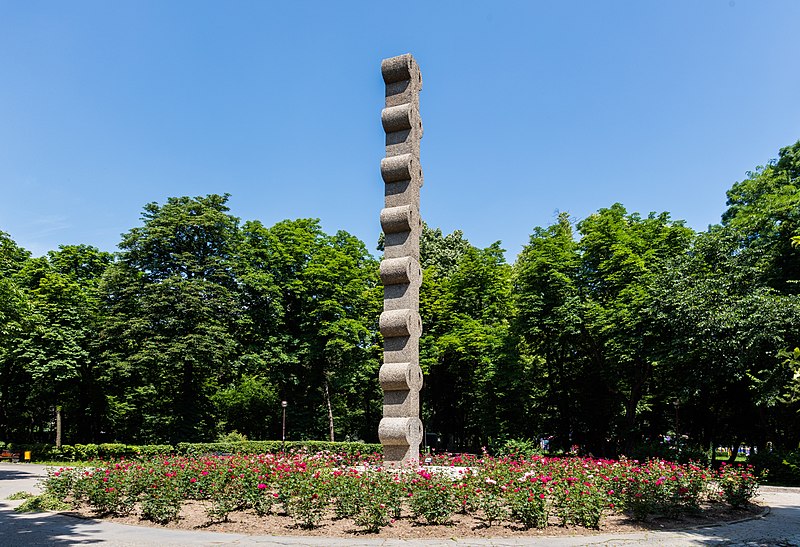
Monument in the Herastrau Park, Bucharest, Romania
Diego Delso
Notes from the source article
Cited by Wikipedia
Notes from the source article
These works are cited by the source article, in its own numbering. They are recorded as its citations, not as sources VALÉORINE has verified.
- 1.Ioana Vlasiu (ed.), "Ciucă Eugen" in Dicționarul sculptorilor din România secolele XIX-XX, vol. I, A-G, p.138-39. Editura Academiei Române, Bucharest, 2011
- 2.Centro Dantesco. Biennale Internazionale Dantesca - Mostre sulla fortuna e sull’interpretazione artistica di Dante e della sua opera.
- 3.Ravenna, il Settembre Dantesco fra trekking e letture. Ravenna 24 Ore. March 2026.
- 4.Lo stand espone la mostra 21 Artisti per Dante. Instituto per i beni artistici culturali e naturali.
- 5.Beethoven Memorial House. Ludwig van Beethoven – Painting on Glass Dead link. March 2026.
- 6.Beethoven Memorial House. Symphony to Beethoven - Model for a Beethoven monument – Plastic Dead link. March 2026.
- 7.Coloana - Herastrau Park, Bucharest, RO. The Festive Column.
- 8.Forma Viva Permanent Collection. List of Participants - Year 1968.
Bibliography printed in the source article · 2
- Segato, Giorgio (1988). Eugen Ciuca. Corbo & Fiore, Venice.
- Ciuca, Eugen (1988). Art’s Fourth Dimension. Corbo & Fiore, Venice.
References
Citations
References
Each reference names the institution holding it, so a reader may go to the document itself.
reference work
Secondary witness
People, houses and institutions
Knowledge graph
People, houses and institutions
Teachers, collaborators, publishers and institutions recorded against this person, each on a stated basis.
Studied at
1- Babeș-Bolyai UniversityOrganisation
Established from a fact already recorded on a verified source.
The Encyclopedia exists whether or not anything is for sale. Corrections are recorded rather than overwritten, and every version of this record is kept. Published 17 August 2026.
Elsewhere in Sculpture
6,174 published records in this field, each with its sources named.
- Ettore CadorinArtist
- Ettore FerrariArtist
- Ettore SpallettiArtist
- Eugen BoermelArtist
- Eugen HoffmannArtist
- Eugène André OudinéArtist
- Eugène BourgouinArtist
- Eugène Cyrille BrunetArtist
Best supported in this field
For owners
Own a work by Eugen Ciuca?
A specialist will read what you send and tell you what the house can establish, what it cannot, and whether the object is suited to sale. There is no charge and no obligation. The object stays with you throughout; nothing is shipped to us unless it is arranged in writing beforehand.