
Eudora Welty
Eudora Alice Welty (April 13, 1909 – July 23, 2001) was an American short-story writer, novelist, and photographer who wrote about the American South. Her novel The Optimist's Daughter won the Pulitzer Prize in 1973. Welty received numerous awards, including the Presidential Medal of Freedom and the Order of the South.
Also recorded as Eudora Alice Welty
Eudora Welty

Joe C. Furr · CC BY-SA 3.0
- Born
- 1909. · Jackson.
- Died
- 2001. · Jackson.
- Nationality
- United States.
- Occupation
- photographer, novelist, writer, literary critic, autobiographer and artist.
- Education
- Peterhouse, University of Wisconsin–Madison, Columbia Business School and Mississippi University for Women.
- Known for
- A Worn Path, A Curtain of Green, Music from Spain, The Collected Stories of Eudora Welty, The Robber Bridegroom, The Ponder Heart, The Optimist's Daughter and One Writer's Beginnings.
- Honours
- Guggenheim Fellowship, O. Henry Award, Fellow of the American Academy of Arts and Sciences, Pulitzer Prize for Fiction, honorary doctor of Brandeis University and Presidential Medal of Freedom.
- Languages
- English.
VALÉORINE Encyclopedia
VALÉORINE documentary reading
Documentary summary
Eudora Alice Welty (April 13, 1909 – July 23, 2001) was an American short-story writer, novelist, and photographer who wrote about the American South. Her novel The Optimist's Daughter won the Pulitzer Prize in 1973. Welty received numerous awards, including the Presidential Medal of Freedom and the Order of the South.
Admitted source layer · organised and presented by VALÉORINE
Note VALÉORINE
Eudora Welty (1909–2001) was an American artist, autobiographer and literary critic, among other activities. The artist was born and died in Jackson.
Eudora Welty studied at Central High School, Columbia Business School and Columbia University, among others. The artist was a member of American Academy of Arts and Letters, American Academy of Arts and Sciences and Fellowship of Southern Writers and lived in Eudora Welty House, Jackson and Mississippi.
Works include A Curtain of Green, A Worn Path, Music from Spain and One Writer's Beginnings, among others. Languages used include English. Eudora Welty received America Award in Literature, Charles Frankel Prize and Common Wealth Award of Distinguished Service, among others.
Composed from admitted, traceable facts · 26 September 2026
VALÉORINE
Reference Check
Propose documentary evidence for Eudora Welty. A contribution is never written directly as fact: identity, source, rights and evidence gates still decide.
Sign in to contribute
Documentary evidence
Evidence Panel
original value insufficient · checked 25 September 2026
- Identity
- resolved
- Independent source families
- 0
- Admitted assertions
- 0
- Open conflicts
- 0
Authority files
wikidata · Q259364 · wikipedia · Eudora Welty
In this article
Biography
Biography
She was the first living author to have her works published by the Library of America. Her house in Jackson, Mississippi, has been designated as a National Historic Landmark and is open to the public as a house museum.
Eudora Welty studied at Peterhouse, University of Wisconsin–Madison and Columbia Business School. The recorded working language is English. Residence is recorded at Mississippi and Jackson. Works named in the authority record are A Worn Path, A Curtain of Green, Music from Spain, The Collected Stories of Eudora Welty, The Robber Bridegroom and The Ponder Heart. Work by Eudora Welty is recorded in the collections of J. Paul Getty Museum. Distinctions recorded are Guggenheim Fellowship, O. Henry Award, Fellow of the American Academy of Arts and Sciences and Pulitzer Prize for Fiction.
Eudora Welty was born in Jackson, Mississippi, on April 13, 1909, the daughter of Christian Webb Welty (1879–1931) and Mary Chestina (Andrews) Welty (1883–1966). She grew up with three younger brothers: Edward Nickher Jefferson, Walter Allen Andrews and Logan Allen Howze. Her mother was a schoolteacher. Her family were members of the Methodist church. Her childhood home is still standing and was listed on the National Register of Historic Places in 1980 prior to being delisted in 1986 because a dormer and deck were added to the roof. Welty soon developed a love of reading, reinforced by her mother, who believed that "any room in our house, at any time in the day, was there to read in, or to be read to." Her father, who worked as an insurance executive, was intrigued by gadgets and machines and inspired in Welty a love of mechanical things. She later used technology for symbolism in her stories and also became an avid photographer, like her father. She attended Central High School in Jackson. Near the time of her high-school graduation, Welty moved with her family to a house built for them at 1119 Pinehurst Street, which remained her permanent address until her death. Wyatt C. Hedrick designed the Weltys' Tudor Revival-style home, which is now known as the Eudora Welty House and Garden. Welty studied at the Mississippi State College for Women from 1925 to 1927, then transferred to the University of Wisconsin to complete her studies in English literature. At the suggestion of her father, she studied advertising at Columbia University. Having graduated during the Great Depression, she struggled to find work in New York. Soon after Welty returned to Jackson in 1931, her father died of leukemia. She took a job at a local radio station and wrote as a correspondent about Jackson society for the Memphis newspaper The Commercial Appeal. In 1933, she began work for the Works Progress Administration. As a publicity agent, she collected stories, conducted interviews, and took photographs of daily life in Mississippi. She gained a wider view of Southern life and relationships; she would later draw from these experiences for her short stories. During this time she also held meetings with fellow writers and friends in her house, forming a group she called the Night-Blooming Cereus Club. Three years later, she left her job to become a full-time writer. In 1936, she published "The Death of a Traveling Salesman" in the literary magazine Manuscript, and soon published stories in other notable publications including The Sewanee Review and The New Yorker. She strengthened her place as an influential Southern writer with the publication of her first book of short stories, A Curtain of Green. Her newfound success won her a seat on the staff of The New York Times Book Review as well as the Guggenheim Fellowship, which enabled her to travel to France, England, Ireland, and Germany. While abroad, she spent some time as a resident lecturer at the University of Oxford and the University of Cambridge She was the first woman to be permitted into the hall of Peterhouse College. In 1960, she returned to Jackson to care for her elderly mother and two brothers. After the field secretary of the NAACP in Mississippi Medgar Evers was assassinated, she published a story in The New Yorker, "Where Is the Voice Coming From?", from the first-person perspective as the assassin. In 1971, she published a collection of her photographs depicting the Great Depression, titled One Time, One Place. Two years later, she received the Pulitzer Prize for Fiction for her novel The Optimist's Daughter. She lectured at Harvard University and eventually adapted her talks as a three-part memoir titled One Writer's Beginnings. Throughout the 1970s, Welty carried on a lengthy correspondence with novelist Ross Macdonald, creator of the Lew Archer series of detective novels. She continued to live in her family house in Jackson until her death from natural causes on July 23, 2001. She is buried in Greenwood Cemetery in Jackson. Her headstone has a quote from The Optimist's Daughter: "For her life, any life, she had to believe, was nothing but the continuity of its love."
Writing career and major works
Writing career and major works
Welty's first short story, "Death of a Traveling Salesman", was published in 1936. In May 1940 the literary agent Diarmuid Russell wrote to her, "John Woodburn of Doubleday's has suggested that I write to you to see if you might need the service of an agent. I suppose you know the parasitic way an agent works taking 10% of the author's takings. He is rather a benevolent parasite because authors as a rule make more when they have an agent than they do without one." Welty accepted Russell's offer; he represented her and was her friend for many years. Her work attracted the attention of author Katherine Anne Porter, who became a mentor to her and wrote the foreword to Welty's first collection of short stories, A Curtain of Green, in 1941. The book established Welty as one of American literature's leading lights and featured the stories "Why I Live at the P.O.", "Petrified Man", and the frequently anthologized "A Worn Path". Excited by the printing of Welty's works in publications such as The Atlantic Monthly, the Junior League of Jackson of which Welty was a member requested permission from the publishers to reprint some of her works. She eventually published over forty short stories, five novels, three works of non-fiction, and one children's book. The short story "Why I Live at the P.O." was published in 1941 along with two others in The Atlantic Monthly. It was republished later that year in Welty's first collection of short stories, A Curtain of Green. "A Worn Path" was also published in The Atlantic Monthly and A Curtain of Green. It is seen as one of Welty's finest short stories, winning the second-place O. Henry Award in 1941. Welty's debut novel, The Robber Bridegroom (1942), deviated from her previous psychologically inclined works, presenting static, fairy-tale characters. Some critics suggest that she worried about "encroaching on the turf of the male literary giant to the north of her in Oxford, Mississippi—William Faulkner", and therefore wrote in a fairy-tale style instead of a historical one. Most critics and readers saw it as a modern Southern fairy-tale and noted that it employs themes and characters reminiscent of the Grimm Brothers' works. Immediately after the murder of Medgar Evers in 1963, Welty wrote Where Is the Voice Coming From?. As she later said, she wondered: "Whoever the murderer is, I know him: not his identity, but his coming about, in this time and place. That is, I ought to have learned by now, from here, what such a man, intent on such a deed, had going on in his mind. I wrote his story—my fiction—in the first person: about that character's point of view". Welty's story was published in The New Yorker soon after Byron De La Beckwith's arrest. Winner of the Pulitzer Prize for Fiction, The Optimist's Daughter (1972) is believed by some to be Welty's best novel. It was written at a much later date than the bulk of her work. As poet Howard Moss wrote in The New York Times, the book is "a miracle of compression, the kind of book, small in scope but profound in its implications, that rewards a lifetime of work". The plot focuses on family struggles when the daughter and the second wife of a judge confront each other in the limited confines of a hospital room while the judge undergoes eye surgery. Welty gave a series of addresses at Harvard University, revised and published as One Writer's Beginnings (Harvard, 1983). It was the first book published by Harvard University Press to be a New York Times Best Seller (at least 32 weeks on the list), and runner-up for the 1984 National Book Award for Nonfiction. In 1992, she was awarded the Rea Award for the Short Story for her lifetime contributions to the American short story. Welty was a charter member of the Fellowship of Southern Writers, founded in 1987. She also taught creative writing at colleges and in workshops. She lived near Jackson's Belhaven College and was a common sight among the people of her home town. Welty personally influenced several young Mississippi writers in their careers including Richard Ford, Ellen Gilchrist, and Elizabeth Spencer.
Commemoration
Commemoration
In 1990, Steve Dorner named his e-mail program "Eudora", inspired by Welty's story "Why I Live at the P.O." Welty was reportedly "pleased and amused" by the tribute. In 1973, the state of Mississippi established May 2 as "Eudora Welty Day". Each October, Mississippi University for Women hosts the "Eudora Welty Writers' Symposium" to promote and celebrate the work of contemporary Southern writers. Mississippi State University sculpture professor Critz Campbell has designed furniture inspired by Welty, that has been featured in Smithsonian magazine, The New York Times, the Los Angeles Times, The Washington Post and Elle magazine, and on the Discovery Channel. A portrait of Eudora Welty hangs in the National Portrait Gallery of the Smithsonian; it was painted by her friend Mildred Nungester Wolfe. On September 10, 2018, Eudora Welty became the first author honored with a historical marker through the Mississippi Writers Trail. The historical marker was installed at the Eudora Welty House and Garden in Jackson, Mississippi. A tribute to Eudora Welty is included in Mississippi's float for the 137th Rose Parade.
Novels
Novels
The Robber Bridegroom (novella), 1942 Musical based on the novella Delta Wedding, 1946 The Ponder Heart, 1954 The Shoe Bird (juvenile), 1964 Losing Battles, 1970 The Optimist's Daughter, 1972 (revised version)
Essays
Essays
The Eye of the Story, 1979 One Writer's Beginnings, 1984 On Writing, 2002
Resources
Resources
Eudora Welty Foundation Eudora Welty Society Homepage. Includes resources on Welty and Southern literature. Eudora Welty webpage at The Mississippi Writers Page Archived October 1, 2015, at the Wayback Machine. Presented by the Department of English at the University of Mississippi. Eudora Welty Small Manuscripts Collection (MUM00471). Collection owned and maintained by the University of Mississippi Department of Archives and Special Collections.
Life and career
Dated record
Life and career
The full dated record · 2 entries
1909
Eudora Welty was born in 1909 at Jackson.
2001
Eudora Welty died in 2001 at Jackson.
Places
Named by the record
Places
Only places the record itself states, plotted where the house gazetteer settles their coordinates. Nothing is inferred from a name or a nationality.
Mississippi, Jackson and Eudora Welty House.
Residences
Jackson.
Birth place
Writings on
"Why I Live at the P.O." Fiction Writers Review on Eudora Welty's "Why I Live at the P.O." 1987 Whiting Writers' Award Keynote Speech
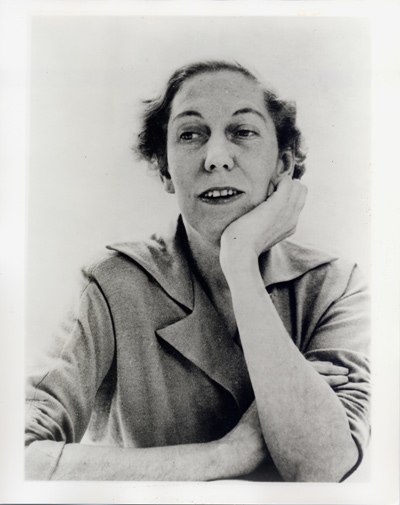
Photograph of the American writer Eudora Welty (1909–2001). First published on 21 April 1962.
Anonymous Unknown author
Photography
While Welty worked as a publicity agent for the Works Progress Administration, she took photographs of people from all economic and social classes in her spare time. Her photographs from the 1930s focused on Mississippi's rural poor and the effects of the Great Depression. Collections of her photographs were published as One Time, One Place (1971) and Photographs (1989). Her photographs inspired several of her short stories, including "Why I Live at the P.O.", which was centered on a woman she photographed ironing in the back of a small post office. Although focused on her writing, Welty continued to take photographs until the 1950s. Welty's photographs were the subject of the National Museum of Women in the Arts exhibition Passionate Observer: Photographs by Eudora Welty which was on display October 27, 2003 to February 29, 2004.
Short-story collections
Short-story collections
A Curtain of Green, 1941 The Wide Net and Other Stories, 1943 The Golden Apples, 1949 The Bride of the Innisfallen and Other Stories, 1955 Thirteen Stories, 1965 The Collected Stories of Eudora Welty, 1980 Moon Lake and Other Stories, 1980 Morgana: Two Stories from The Golden Apples, 1988
Documents and archives
Primary material
Documents and archives
reference work
- “Eudora Welty”, English Wikipedia, consulted as further reading
Reputable secondary · Wikipedia
authority record
- Wikidata, structured authority record Q259364: Eudora Welty
Unverified · Wikidata
Honors
1941: O. Henry Award, second place, "A Worn Path" 1942: O. Henry Award, first place, "The Wide Net" 1943: O. Henry Award, first place, "Livvie is Back" 1954: William Dean Howells medal for fiction, The Ponder Heart 1968: O. Henry Award, first place, "The Demonstrators" 1969: Fellow of the American Academy of Arts and Sciences 1970: The Edward MacDowell Medal 1973: Pulitzer Prize for Fiction, The Optimist's Daughter 1979: Honorary Doctorate of Letters from University of Illinois at Urbana–Champaign in Urbana, Illinois 1980: Presidential Medal of Freedom 1981: Honorary Doctorate of Humane Letters from Randolph-Macon Woman's College in Lynchburg, Virginia 1983: National Book Award for the first paperback edition of The Collected Works of Eudora Welty 1983: Invited by Harvard University to give the first annual Massey Lectures in the History of American Civilization, revised and published as One Writer's Beginnings 1983: St. Louis Literary Award from the Saint Louis University Library Associates 1985: Honorary Doctorate of Letters from The College of William and Mary in Virginia 1985: Achievement Award, American Association of University Women 1986: National Medal of Arts. 1990: A recipient of the Governor's Award for Excellence in the Arts, Lifetime Achievement, which was the state of Mississippi's recognition of her extraordinary contribution to American Letters. 1991: National Book Foundation Medal for Distinguished Contribution to American Letters 1991: Peggy V. Helmerich Distinguished Author Award. The Helmerich Award is presented annually by the Tulsa Library Trust. 1992: Rea Award for the Short Story 1992: PEN/Malamud Award for the Short Story 1992: National Humanities Medal 1993: Charles Frankel Prize, National Endowment for the Humanities 1993: Distinguished Alumni Award, American Association of State Colleges and Universities 1996: Made a Chevalier de la Légion d'honneur by the French government 1998: First living author to have her works published in the prestigious Library of America series 2000: America Award for a lifetime contribution to international writing 2000: Induction into the National Women's Hall of Fame
Notes from the source article
Cited by Wikipedia
Notes from the source article
These works are cited by the source article, in its own numbering. They are recorded as its citations, not as sources VALÉORINE has verified.
- 1."Eudora Welty Biography ". PBS.org. Retrieved November 28, 2011.
- 2.Opinion How I 'bribed' a justice to take a no-expenses-paid trip to Mississippi. The Washington Post.
- 3.Property.
- 4.Welty, p. 841
- 5.Johnston, Carol Ann. "Mississippi Writer's Page: Eudora Welty ". MWP: University of Mississippi. Retrieved November 28, 2011.
- 6.Fowler, Sarah. Central High School Class of '65 celebrates reunion. The Clarion-Ledger. 2015-05-01.
- 7."House ". Eudora Welty Foundation. Retrieved November 28, 2011.
- 8.Makowsky, pp. 341–342
- 9.See for example, Jackson Society Revels in Splendor Attached to Natchez Garden Ball. The Commercial Appeal 03 Sep 1933, Sun · Page 8.
- 10.Marrs, p. 52
- 11.Marrs, p. 50
- 12."House ". Eudora Welty Foundation. Retrieved November 28, 2011.
- 13.Messud, Claire. Obituary: Eudora Welty. The Guardian. 2001-07-25. 0261-3077.
- 14.Makowsky, p. 342
- 15.Louis Bayard (2015) Review: Eudora Welty and Ross Macdonald, Conjoined by a Torrent of Words, The New York Times JULY 13, 2015, accessed 14 April 2016
- 16.Welty, Eudora. Meanwhile There Are Letters: The Correspondence of Eudora Welty and Ross Macdonald. Arcade. 2015. 978-1-62872-527-8.
- 17.Makowsky, p. 341
- 18.Resting Places
- 19.T.A. Frail, "Eudora Welty as Photographer", Smithsonian magazine, April 2009. Retrieved 20 May 2013.
- 20.Rosenberg, Karen (January 14, 2009). "Eudora Welty's work as a young writer: Taking pictures". The New York Times. Retrieved May 26, 2009.
- 21.Weeks, Linton. Eudora Welty: Writing Wasn't Her Only Focus. Washington Post. October 26, 2003.
- 22.Passionate Observer – International Arts & Artists. International Arts & Artists – Promoting cross-cultural understanding and exposure to the arts internationally. 2018-07-20.
- 23.Author and Agent - Eudora Welty and Diarmuid Russell by Michael Kreyling, Farrar, Straus & Giroux, 1992
- 24.Marrs, p. 70
- 25.Makowsky, p. 345
- 26.Makowsky, p. 347
- 27.Hauser, Marianne. (November 1, 1942.) "Miss Welty's Fairy Tale". The New York Times. Retrieved November 28, 2011.
- 28.Welty, p. xi
- 29."Welty Book is First Harvard U. Best Seller", Edwin McDowell, The New York Times, March 13, 1984, page C16.
- 30."Three Writers Win Book Awards", The New York Times, November 16, 1984, page C32.
- 31.Waldron, Ann. Eudora Welty: A Writer's Life. Knopf Doubleday Publishing. 2–5. 1998. 9780307773883.
- 32.Adams, Tim. Interview with Richard Ford. Granta. October 25, 2007.
- 33.Walrdon, Ann. Eudrora Welty: A Writer's Life. Knopf Doubleday Publishing. 277. 1998. 9780307773883.
- 34.Waldron, Ann. Eudora Welty: A Writer's Life. Knopf Doubleday Publishing. 134–145, 255, 216, 277. 1998. 9780307773883.
- 35.Johnston, 1997 p. 16: Epigraph, quoted here in full.
- 36.Welty, p. 862
- 37.Welty, p. 220
- 38.Makowsky, p. 349
- 39.Makowsky, p. 350
- 40.Dawidoff, Nicholas. (August 10, 1995.) "At Home with Eudora Welty: Only the Typewriter Is Silent". The New York Times. Retrieved November 28, 2011.
- 41.American Academy of Arts and Sciences. Book of Members, 1780–2010: Chapter W.
- 42.Macdowell Medalists.
- 43."Fiction". Past winners & finalists by category. The Pulitzer Prizes. Retrieved 2013-11-19.
- 44.Honorary Degrees 1891 - present == Archived copy.
- 45."National Book Awards – 1983". National Book Foundation. Retrieved 2012-01-26. (With essay by Robin Black from the Awards 60-year anniversary blog.)
- 46.Welty's Collected Works won the 1983 award for paperback Fiction. From 1980 to 1983 in National Book Awards history there were dual hardcover and paperback awards in most categories. Most of the paperback award-winners were reprints, including this one.
- 47.Saint Louis Literary Award - Saint Louis University. www.slu.edu.
- 48.Saint Louis University Library Associates. Recipients of the Saint Louis Literary Award.
- 49.Honorary degree recipients. William & Mary Libraries' Special Collections Research Center. September 25, 2020.
- 50.Lifetime Honors: National Medal of Arts. 21 July 2011.
- 51."Distinguished Contribution to American Letters" . National Book Foundation. Retrieved 2012-03-11. (With acceptance speech by Welty.)
- 52.Marrs, p. 547
- 53.Dana Sterling, "Welty reads to audience at Helmerich award dinner", Tulsa World, December 7, 1991.
- 54.Marrs, p. 549
- 55.National Endowment for the Humanities. Charles Frankel Prize. NEH.gov.
- 56.National Women's Hall of Fame, Eudora Welty
- 57."Historical Backgrounder ". Eudora.com. Retrieved November 28, 2011.
- 58.Thomas, Jo. For Inventor of Eudora, Great Fame, No Fortune. The New York Times. 1997-01-21.
- 59."http://mswritersandmusicians.com/writers/eudora-welty.html ". Mississippi Writers and Musicians, Retrieved March 17, 2012
- 60."Eudora Welty Writers' Symposium" Mississippi University for Women. Retrieved November 28, 2011.
- 61.Smithsonian Institution. Eudora Alice Welty. National Portrait Gallery.
- 62.Eudora Welty gets first marker on Mississippi Writers Trail. The Clarion Ledger.
- 63.WXXV-TV. Visit Mississippi unveils float for 137th Rose Parade. wxxv25.com. September 14, 2025.
- 64.Adapted by Alice Parker into a two-act opera which premiered in Jackson, Mississippi in September 1982. The performance was reviewed by Edward Rothstein of The New York Times.
Bibliography printed in the source article · 9
- Ford, Richard, and Michael Kreyling, eds. Welty: Stories, Collections, & Memoir. New York: Penguin Putnam Inc., 1998. Print.
- Johnston, Carol Ann. 1997. Eudora Welty: A Study of the Short Fiction. Twayne Publishers, New York. Gordon Weaver, general editor.
- Makowsky, Veronica. Eudora Welty. American Writers. Ed. Stephen Wagley. New York: Charles Scribner's Sons, 1998. 343–356. Print.
- Marrs, Suzanne. Eudora Welty: A Biography. Orlando: Harcourt, Inc., 2005. Print. 50–52.
- Welty, Eudora. The Collected Stories of Eudora Welty. Houghton Mifflin Harcourt, 1980. .
- UP of Mississippi. Eudora Welty and mystery : hidden in plain sight. 2023.
- Gwin, Minrose. Mourning Medgar: Justice, Aesthetics, and the Local. March 11, 2008. Southern Spaces.
- Kuehl, Linda. Eudora Welty, The Art of Fiction No. 47. The Paris Review. Fall 1972. 55.
- Pollack, Harriet. Eudora Welty's Fiction and Photography: The Body of the Other Woman. The University of Georgia Press. 2016. 978-0-8203-4870-4.
References
Citations
References
Each reference names the institution holding it, so a reader may go to the document itself.
reference work
Partially resolvedauthority record
Unverified
The Encyclopedia exists whether or not anything is for sale. Corrections are recorded rather than overwritten, and every version of this record is kept. Published 14 August 2026.
Elsewhere in Books
38,582 published records in this field, each with its sources named.
- Euclides da CunhaAuthor
- Eudokia IngerinaAuthor
- Eudokia MakrembolitissaAuthor
- Eudora BumsteadAuthor
- Eudore ÉvanturelAuthor
- Eudoxus of CnidusAuthor
- Eugammon of CyreneAuthor
- Eugen BarbuAuthor
Best supported in this field
For owners
Own a work by Eudora Welty?
A specialist will read what you send and tell you what the house can establish, what it cannot, and whether the object is suited to sale. There is no charge and no obligation. The object stays with you throughout; nothing is shipped to us unless it is arranged in writing beforehand.