
Erwin Piscator
Erwin Friedrich Maximilian Piscator (17 December 1893 – 30 March 1966) was a German theatre director and producer. Along with Bertolt Brecht, he was the foremost exponent of epic theatre, a form that emphasizes the socio-political content of drama, rather than its emotional manipulation of the audience or the production's formal beauty.
Also recorded as Erwin Friedrich Maximilian Piscator
Erwin Piscator
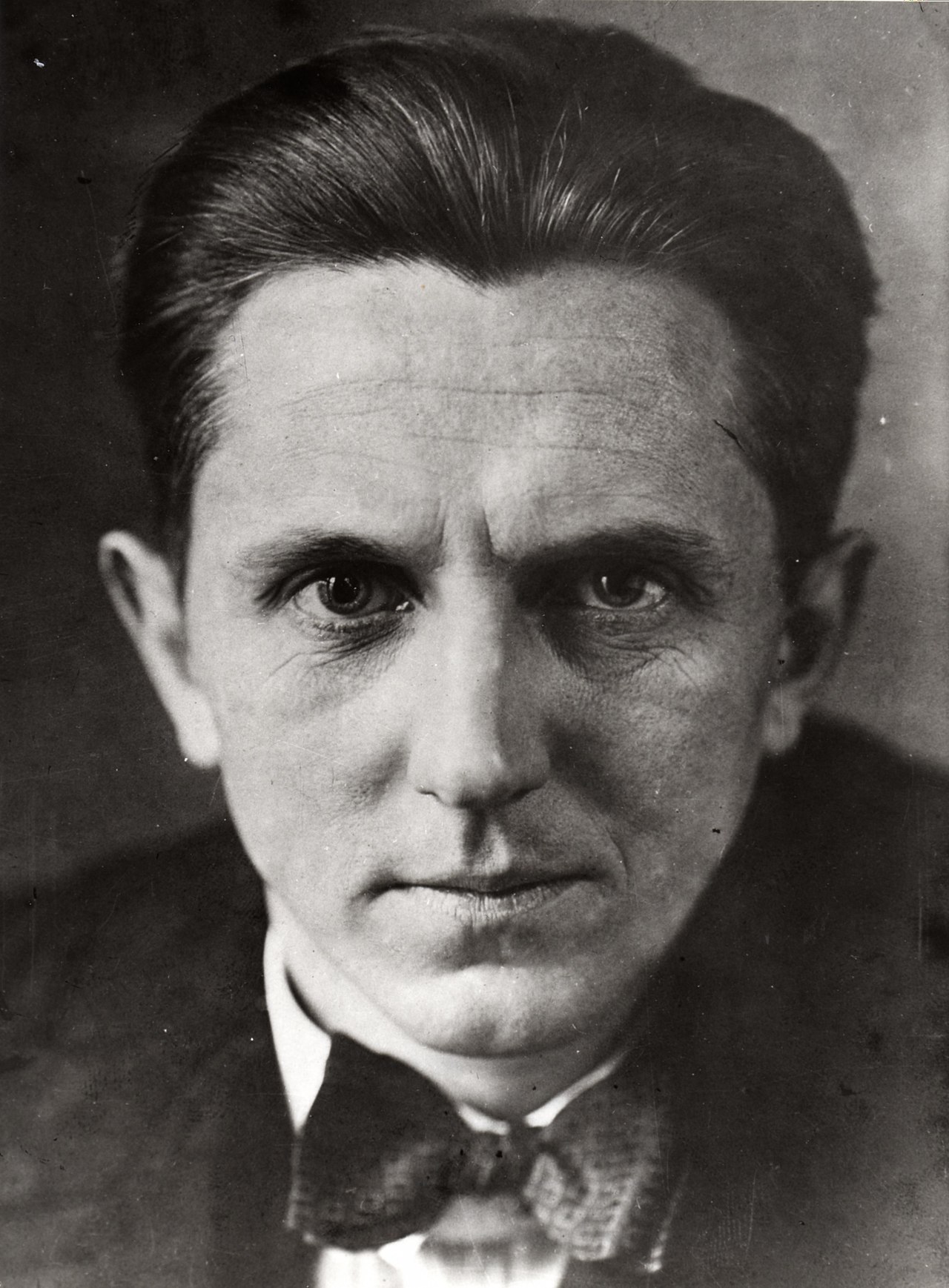
Anonymous (photographer unknown) · A Piscator archive (EPS, Sign.: 38991) · Public domain
- Born
- 1893. · Greifenstein.
- Nationality
- Germany, German Empire and Weimar Republic.
- Occupation
- director, theatrologist, writer, theatre manager, screenwriter and film editor.
- Education
- Gymnasium Philippinum Marburg.
- Teachers
- Arthur Kutscher.
- Honours
- Commander's Cross of the Order of Merit of the Federal Republic of Germany and Goethe-Plakette des Landes Hessen.
- Languages
- German.
VALÉORINE Encyclopedia
VALÉORINE documentary reading
Documentary summary
Erwin Friedrich Maximilian Piscator (17 December 1893 – 30 March 1966) was a German theatre director and producer. Along with Bertolt Brecht, he was the foremost exponent of epic theatre, a form that emphasizes the socio-political content of drama, rather than its emotional manipulation of the audience or the production's formal beauty.
Admitted source layer · organised and presented by VALÉORINE
Note VALÉORINE
Erwin Piscator (1893–1966) was a director, film director and film editor, among other activities, of French and German nationality. The director was born in Greifenstein and died in Starnberg.
Erwin Piscator was educated at Gymnasium Philippinum and Gymnasium Philippinum Marburg. The director worked in New York City and Paris.
Languages used include German. Honours include Goethe-Plakette des Landes Hessen.
Composed from admitted, traceable facts · 26 September 2026
VALÉORINE
Reference Check
Propose documentary evidence for Erwin Piscator. A contribution is never written directly as fact: identity, source, rights and evidence gates still decide.
Sign in to contribute
World of VALÉORINE
Documentary connections
Only confirmed graph relationships appear here. Images are shown only when their identity and reuse rights both pass the documentary gate.
Documentary evidence
Evidence Panel
technical hold · checked 25 September 2026
- Identity
- resolved
- Independent source families
- 0
- Admitted assertions
- 0
- Open conflicts
- 0
Authority files
museum · 286472706 · wikidata · Q60978 · wikipedia · Erwin Piscator
In this article
Youth and wartime experience
Youth and wartime experience
Erwin Piscator studied at Gymnasium Philippinum Marburg. Training under Arthur Kutscher is recorded. Van der Bert Linden, Tennessee Williams and Marlon Brando are recorded as having studied under Erwin Piscator. The recorded working language is German. Places of work recorded in the authority are Paris and New York City. Distinctions recorded are Commander's Cross of the Order of Merit of the Federal Republic of Germany and Goethe-Plakette des Landes Hessen.
Erwin Friedrich Max Piscator was born on 17 December 1893 in the small Prussian village of Greifenstein-Ulm, the son of Carl Piscator, a merchant, and his wife Antonia Laparose. His family was descended from Johannes Piscator, a Protestant theologian who produced an important translation of the Bible in 1600. The family moved to the university town Marburg in 1899 where Piscator attended the Gymnasium Philippinum. In the autumn of 1913, he attended a private Munich drama school and enrolled at the Ludwig-Maximilians-Universität München (LMU) to study German, philosophy and art history. Piscator also took Arthur Kutscher's famous seminar in theatre history, which Bertolt Brecht later also attended. Piscator began his acting career in the autumn of 1914, in small unpaid roles at the Munich Court Theatre, under the directorship of Ernst von Possart. In 1896, Karl Lautenschläger had installed one of the world's first revolving stages in that theatre. During the First World War, Piscator was drafted into the German army, serving in a frontline infantry unit as a Landsturm soldier from the spring of 1915 (and later as a signaller). The experience inspired a hatred of militarism and war that lasted for the rest of his life. He wrote a few bitter poems that were published in 1915 and 1916 in the left-wing Expressionist literary magazine Die Aktion. In summer 1917, having participated in the battles at Ypres Salient and been in hospital once, he was assigned to a newly established army theatre unit. In November 1918, when the armistice was declared, Piscator participated in the November Revolution, giving a speech in Hasselt at the first meeting of a revolutionary Soldiers' Council (Soviet).
Early success in the Weimar Republic
Early success in the Weimar Republic
Piscator returned to Berlin and joined the newly formed Communist Party of Germany (KPD). He left briefly for Königsberg, where he joined the Tribunal Theatre. He participated in several expressionist plays and played the student, Arkenholz, in the Ghost Sonata by August Strindberg. He joined Hermann Schüller in establishing the Proletarian Theatre, Stage of the Revolutionary Workers of Greater Berlin. In collaboration with writer Hans José Rehfisch, Piscator formed a theatre company in Berlin at the Comedy-Theater on Alte Jacobsstrasse, following the Volksbühne ("people's stage") concept. In 1922–1923 they staged works by Maxim Gorky, Romain Rolland, and Leo Tolstoy. As stage director at the Volksbühne (1924–1927), and later as managing director at his own theatre (the Piscator-Bühne on Nollendorfplatz), Piscator produced social and political plays especially suited to his theories. His dramatic aims were utilitarian — to influence voters or clarify left-wing policies. He used mechanized sets, lectures, movies, and mechanical devices that appealed to his audiences. In 1926, his updated production of Friedrich Schiller's The Robbers at the distinguished Preußisches Staatstheater in Berlin provoked widespread controversy. Piscator made extensive cuts to the text and reinterpreted the play as a vehicle for his political beliefs. He presented the protagonist Karl Moor as a substantially self-absorbed insurgent. As Moor's foil, Piscator made the character of Spiegelberg, often presented as a sinister figure, the voice of the working-class revolution. Spiegelberg appeared as a Trotskyist intellectual, slightly reminiscent of Charlie Chaplin with his cane and bowler hat. As he died, the audience heard The Internationale sung. Piscator founded the influential (though short-lived) Piscator-Bühne in Berlin in 1927. In 1928 he produced a notable adaptation of the unfinished, episodic Czech comic novel The Good Soldier Schweik. The dramaturgical collective that produced this adaptation included Bertolt Brecht. Brecht later described it as a "montage from the novel". Leo Lania's play Konjunktur (Oil Boom) premiered in Berlin in 1928, directed by Erwin Piscator, with incidental music by Kurt Weill. Three oil companies fight over the rights to oil production in a primitive Balkan country, and in the process exploit the people and destroy the environment. Weill's songs from this play, such as Die Muschel von Margate, are still part of the modern repertoire of art music. In 1929 Piscator published his The Political Theatre, discussions of the theory of theatre. In the preface to its 1963 edition, Piscator wrote that the book was "assembled in hectic sessions during rehearsals for The Merchant of Berlin" by Walter Mehring, which had opened on 6 September 1929 at the second Piscator-Bühne. It was intended to provide "a definitive explanation and elucidation of the basic facts of epic, i.e. political theatre", which at that time "was still meeting with widespread rejection and misapprehension." Three decades later, Piscator said that: The justification for epic techniques is no longer disputed by anyone, but there is considerable confusion about what should be expressed by these means. The functional character of these epic techniques, in other words their inseparability from a specific content (the specific content, the specific message determines the means and not vice versa!) has by now become largely obscured. So we are still standing at the starting blocks. The race is not yet on...
International work, emigration, and late productions in West Germany
International work, emigration, and late productions in West Germany
In 1931, after the collapse of the third Piscator-Bühne, Piscator went to Moscow in order to make the motion picture Revolt of the Fishermen with actor Aleksei Dikiy, for Mezhrabpom, the Soviet film company associated with the International Workers' Relief Organisation. As John Willett wrote, throughout the pre-Hitler years Piscator's "commitment to the Russian Revolution was a decisive factor in all his work." With Hitler's rise to power in 1933, Piscator's stay in the Soviet Union became exile. In July 1936, Piscator left the Soviet Union for France. In 1937, he married dancer Maria Ley in Paris. Bertolt Brecht was one of the groomsmen. During his years in Berlin, Piscator had collaborated with Lena Goldschmidt on a stage adaptation of Theodore Dreiser's bestselling novel An American Tragedy; under the title The Case of Clyde Griffiths. With American Lee Strasberg as director, it had run for 19 performances on Broadway in 1936. When Piscator and Ley subsequently immigrated to the United States in 1939, Piscator was invited by Alvin Johnson, the founding president of The New School, to establish a theatre workshop. Among Piscator's students at this Dramatic Workshop in New York were Bea Arthur, Harry Belafonte, Marlon Brando, Tony Curtis, Ben Gazzara, Judith Malina, Walter Matthau, Rod Steiger, Elaine Stritch, Eli Wallach, Jack Creley, and Tennessee Williams. Established in New York, Erwin and Maria Ley-Piscator lived at 17 East 76th Street, an Upper East Side townhome, sometimes remembered as the Piscator House. After World War II and the break-up of Germany, Piscator returned to West Germany in 1951 due to McCarthy era political pressure in the United States against former communists in the arts. Despite his decision to settle in West Berlin, Piscator often visited the theaters of the capital of East Germany, maintaining warm relations with its cultural figures. He was elected a corresponding member of the East German Academy of Arts in 1956, one of the few West Germans to have this position. In 1962 Piscator was appointed manager and director of the Freie Volksbühne in West Berlin. To much international critical acclaim, in February 1963 Piscator premièred Rolf Hochhuth's The Deputy, a play "about Pope Pius XII and the allegedly neglected rescue of Italian Jews from Nazi gas chambers." Until his death in 1966, Piscator was a major exponent of contemporary and documentary theatre. Piscator's wife, Maria Ley, died in New York City in 1999.
Effects on theatre
Effects on theatre
Piscator's contribution to theatre has been described by theatre historian Günther Rühle as "the boldest advance made by the German stage" during the 20th century. Piscator's theatre techniques of the 1920s — such as the extensive use of still and cinematic projections from 1925 on, as well as complex scaffold stages — had an extensive influence on European and American production methods. His dramaturgy of contrasts led to sharp political satirical effects and anticipated the commentary techniques of epic theatre. In the Federal Republic of Germany, Piscator's interventionist theatre model enjoyed a late second zenith. From 1962 on, Piscator produced several works that dealt with trying to come to terms with the Germans' Nazi past and other timely issues; he inspired mnemonic and documentary theatre in those years until his death. Piscator's stage adaptation of Leo Tolstoy's novel War and Peace has been produced in some 16 countries since 1955, including three productions in New York City.
Broadway productions
Broadway productions
Gotthold Ephraim Lessing, Nathan the Wise (Belasco Theatre, April 1942) Irving Kaye Davis, The Last Stop (Ethel Barrymore Theatre, September 1944)
Works
Works
Piscator, Erwin. 1929. The Political Theatre. A History 1914–1929. Translated by Hugh Rorrison. New York: Avon, 1978. ISBN 978-0-380401-88-8 (= London: Methuen, 1980. ISBN 978-0-413335-00-5). The ReGroup Theatre Company (ed.): The "Lost" Group Theatre Plays. Volume 3. The House of Connelly, Johnny Johnson, & Case of Clyde Griffiths. By Paul Green and Erwin Piscator. Prefaces by Judith Malina & William Ivey Long. New York, NY: CreateSpace, 2013. ISBN 978-1-484150-13-9. Tolstoy, Leo. War and Peace. Adapted for the Stage by Alfred Neumann, Erwin Piscator, and Guntram Prüfer. English adaptation by Robert David MacDonald. Preface by Bamber Gascoigne. London: Macgibbon & Kee, 1963.
Life and career
Dated record
Life and career
The full dated record · 1 entries
1966
Erwin Piscator died in 1966 at Starnberg.
Places
Named by the record
Places
Only places the record itself states, plotted where the house gazetteer settles their coordinates. Nothing is inferred from a name or a nationality.
Greifenstein.
Birth place
Starnberg.
Death place
Films
Revolt of the Fishermen (Восстание рыбаков). Director: Erwin Piscator, Screenplay: Georgi Grebner, Willy Döll, Producer: Mikhail Doller, USSR 1932–1934.
Legacy and honors
In 1980, a monumental sculpture by Scottish artist Eduardo Paolozzi was dedicated to Piscator in central London. In the fall of 1985, an annual Erwin Piscator Award was inaugurated in New York City, the adopted home of Piscator's widow Maria Ley. Additionally, a Piscator Prize of Honors has been annually awarded to generous patrons of art and culture in commemoration of Maria Ley since 1996. The host of the Erwin Piscator Award is the international non-profit organisation "Elysium − between two continents" that aims to foster artistic and academic dialogue and exchange between the United States and Europe. In 2016, a Piscator monument was erected in his birthplace of Greifenstein-Ulm. Piscator's artistic papers are held by the archive of the Academy of Arts, Berlin (since 1966) and the Southern Illinois University Carbondale (Morris Library, since 1971).
Primary material
Documents and archives
reference work
- Wikidata, structured authority record Q60978: Erwin Piscator
Reputable secondary · Wikimedia Foundation
- “Erwin Piscator”, English Wikipedia, consulted as further reading
Reputable secondary · Wikipedia
Institutional database
- OpenStreetMap gazetteer entry for Erwin Piscator, Wasgensteig, Wonnegauviertel, Nikolassee, Steglitz-Zehlendorf, Berlin, 14129, Deutschland
Scholarly · OpenStreetMap Foundation
Literature
Connelly, Stacey Jones. Forgotten Debts: Erwin Piscator and the Epic Theatre. Bloomington: Indiana University 1991. Innes, Christopher D. Erwin Piscator's Political Theatre: The Development of Modern German Drama. Cambridge: Cambridge University Press 1972. Ley-Piscator, Maria. The Piscator Experiment. The Political Theatre. New York: James H. Heineman 1967. ISBN 0-8093-0458-9. Malina, Judith. The Piscator Notebook. London: Routledge Chapman & Hall 2012. ISBN 0-415-60073-1. McAlpine, Sheila. Visual Aids in the Productions of the First Piscator-Bühne, 1927–28. Frankfurt, Bern, New York etc.: Lang 1990. Probst, Gerhard F. Erwin Piscator and the American Theatre. New York, San Francisco, Bern etc. 1991. Rorrison, Hugh. Erwin Piscator: Politics on the Stage in the Weimar Republic. Cambridge, Alexandria VA 1987. Wannemacher, Klaus. "Moving Theatre Back to the Spotlight: Erwin Piscator’s Later Stage Work". In: The Great European Stage Directors. Vol. 2. Meyerhold, Piscator, Brecht. Ed. by David Barnett. London etc.: Bloomsbury (Methuen Drama) 2018, pp. 91–129. ISBN 1-474-25411-X. Willett, John. The Theatre of Erwin Piscator: Half a Century of Politics in the Theatre. London: Methuen 1978. ISBN 0-413-37810-1.

"Ehrengrab" (grave of honor), Erwin Piscator, Potsdamer Chaussee 75, Berlin-Nikolassee, Germany
OTFW, Berlin · Self-photographed
Notes from the source article
Cited by Wikipedia
Notes from the source article
These works are cited by the source article, in its own numbering. They are recorded as its citations, not as sources VALÉORINE has verified.
- 1.erwin-piscator.de
- 2.Piscator, Erwin. Grolier Encyclopedia of Knowledge, volume 15, copyright 1991. Grolier Inc.,
- 3.Willett, John. 1978. The Theatre of Erwin Piscator: Half a Century of Politics in the Theatre. London: Methuen. pg 13.
- 4.Willett (1978, 42).
- 5.Willett (1978, 43)
- 6.Willett (1978, 43).
- 7.Braun, Edward. The Director & The Stage: From Naturalism to Grotowski. A & C Black. 1986. 978-1-4081-4924-9.
- 8.Willett (1978, 15–16, 46–47).
- 9.Willett (1978, 90–95).
- 10.See Brecht's Journal entry for 24 June 1943. Brecht claimed in his Journal entry to have written the adaptation, but Piscator contested that; the manuscript bears the names "Brecht, Gasbarra, Piscator, G. Grosz" in Brecht's handwriting (John Willett. 1978. Art and Politics in the Weimar Period: The New Sobriety 1917–1933. New York: Da Capo Press, 1996, 110). Brecht wrote another Schweik drama in 1943, Schweik in the Second World War.
- 11.The Kurt Weill Foundation for Music's Documentation on Muschel von Margate
- 12.Piscator (1929).
- 13.Piscator (1929, vi).
- 14.Piscator (1929, vii).
- 15.Gerhard F. Probst: Erwin Piscator and the American Theatre. New York etc.: Peter Lang, 1991, p. 7.
- 16.John Willett: Introduction, in: Erwin Piscator. 1893–1966. An Exhibition by the Archiv der Akademie der Künste Berlin, in cooperation with the Goethe Institute. Ed. by Walter Huder. London 1979, p. 1–4, p.1.
- 17.Hermann Haarmann: "Politisches Theater im Geiste der Polis. Die späte Heimkehr des Erwin Piscator". In: Freie Volksbühne Berlin 1890–1990. Beiträge zur Geschichte der Volksbühnenbewegung in Berlin. Ed. by Dietger Pforte. Berlin: Argon 1990. Pp. 195–210, p. 195.
- 18.Willett (1978, 166).
- 19.Art, Sebastian Izzard Asian. MARCH 2004 and APRIL 2004. Sebastian Izzard Asian Art.
- 20.Alexander Stephan: Im Visier des FBI. Deutsche Exilschriftsteller in den Akten amerikanischer Geheimdienste. Stuttgart, Weimar 1995, p. 373.
- 21.Erwin Piscator - Piscators Biographie. www.erwin-piscator.de.
- 22.Gerhard F. Probst: Erwin Piscator and the American Theatre. New York etc.: Peter Lang, 1991, p. 19.
- 23.From a speech given on 25 March 1929, and reproduced in Schriften 2 p.50; Quoted by Willett (1978, 107).
- 24.Günther Rühle: "Erwin Piscator: Dream and Achievement", in: Erwin Piscator. 1893–1966. An Exhibition by the Archiv der Akademie der Künste Berlin, in cooperation with the Goethe Institute. Ed. by Walter Huder. London 1979, p. 12–19, p. 16.
- 25.Leo Tolstoy. War and Peace. Adapted for the stage by Alfred Neumann, Erwin Piscator and Guntram Prüfer. London: Macgibbon & Kee 1963.
- 26.Piscator – The Making of Eduardo Paolozzi's Euston Square Sculpture. Director: Murray Grigor. Inverkeithing: Everallin 1984 (documentary film).
- 27.Erwin Piscator Monument (in German), Greifenstein-Ulm website
- 28.Archive Performing Art at Academy of Arts, Berlin (in German), website, Erwin Piscator Papers, Southern Illinois University Carbondale, website
References
Citations
References
Each reference names the institution holding it, so a reader may go to the document itself.
Institutional database
OpenStreetMap gazetteer entry for Erwin Piscator, Wasgensteig, Wonnegauviertel, Nikolassee, Steglitz-Zehlendorf, Berlin, 14129, DeutschlandOpenStreetMap Foundation
Verifiedreference work
Wikidata, structured authority record Q60978: Erwin PiscatorWikimedia Foundation
Partially resolvedreference work
Partially resolved
The Encyclopedia exists whether or not anything is for sale. Corrections are recorded rather than overwritten, and every version of this record is kept. Published 14 August 2026.
Elsewhere in Film memorabilia
36,804 published records in this field, each with its sources named.
- Erwin C. DietrichPerson
- Erwin KalserPerson
- Erwin LederPerson
- Erwin LeiserPerson
- Erwin WagenhoferPerson
- Eryk RochaPerson
- Esat TelitiPerson
- Esben StormPerson
Best supported in this field
For owners
Own a work by Erwin Piscator?
A specialist will read what you send and tell you what the house can establish, what it cannot, and whether the object is suited to sale. There is no charge and no obligation. The object stays with you throughout; nothing is shipped to us unless it is arranged in writing beforehand.